Our Universe: one of many or specially designed?

Creationism, Evolution, and other science issues

Moderator: Moderators

Post Reply
User avatar
QED
Prodigy
Posts: 3798
Joined: Sun Jan 30, 2005 5:34 am
Location: UK

Our Universe: one of many or specially designed?

Post #1

Post by QED »

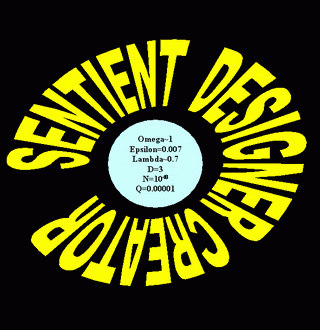
Design amounts to a process of selection. Human designers design things by making intelligent selections. Our Universe has a number of critical parameters that have no apparent reason for their values, but if these values were even slightly different, we wouldn't exist. This suggests to some that the values were carefully selected by a sentient being who had the intelligence to know the exact values required for our existence.

I've illustrated this scenario in the following picture:

Image

Here our Universe, with it's critical values, is all that exists -- besides its sentient, designer-creator.

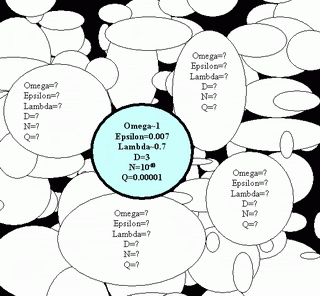
However, other forms of selection are possible. The simple act of observation can create its own selection Effect. In the illustration that follows I have drawn our Universe surrounded by numerous other universes. Within this ensemble the vast majority could be expected to have parameters that would not support life (at least in a form that would be recognizable to us). But a tiny number might. We could, therefore, have selected our own Universe as one from many, simply as a consequence of it having a favorable set of parameters for our existence.

Image

If we are only considering the empirical evidence furnished by scientific observations then both scenarios would seem to be functionally equivalent. How then can we claim that the apparent fine-tuning implies a designer-creator when we can see this potential for ambiguity?

User avatar
NGR
Student
Posts: 73
Joined: Mon Apr 25, 2005 9:35 pm
Location: Australia

Post #41

Post by NGR »

Confused wrote:
If we are only considering the empirical evidence, then neither the theory of the megaverse nor the theory of fine tuning hold water. We lack empirical data to prove either. So I can't see either functional let alone functionally equivalent. However, one might make the argument that they are both theoretically equivalent. The difference being, at some point technology may advance enough to allow us to test theoretical physics, fine tuning will never be testable.

I can't argue with this, it points out our current position with clarity.
Otseng wrote:
If you discount "specially designed" and "one of many", there is one other alternative I can think of. It was just luck. But simply being lucky though is not a satisfying answer.

Satisfying? Surely the truth is what we should seek regardless of how good bad or indifferent it makes us feel.
Otseng wrote:
Suppose I go into a casino and play poker. I get dealt the cards and I lay down a royal flush. The dealer would probably raise his eyebrows. Then on the next hand, I have another royal flush. The dealer would probably notify the manager. On the next hand, I have yet another royal flush. The manager comes and talks to me. I simply say, I just got lucky. But, odds are, he won't be satisfied with that answer.

So, achieving high odds demands an explanation.

The problem with your analogy is that in the case of card playing we are well aware of the odds in getting any particular hand because we understand the factors in play that led to any outcome. We simply do not know any of this with Universe creation.
Otseng wrote:
In a sense, that's true. There'd be no way to directly "test" the "sentient designer creator". But, as of now, there's also no way to test the alternate universes. So, testability cannot be a criteria since it would eliminate both.

I think that was the point, they are both speculation.
Otseng wrote:
But, what you are suggesting is that in the future the alternate universes will be testable. However, we cannot appeal to the future of what might happen. We can only make conclusions based on data that we currently have.

The point is we have no data concerning this matter that leads us in any particular direction and we therefore can not make any conclusions at all, we can only speculate for amusement sake.

User avatar
NGR
Student
Posts: 73
Joined: Mon Apr 25, 2005 9:35 pm
Location: Australia

Post #42

Post by NGR »

Otseng wrote: I have a story of two inspectors arriving at a crime scene.
If only it had some relevance to this thread.

User avatar
Furrowed Brow
Site Supporter
Posts: 3720
Joined: Mon Nov 20, 2006 9:29 am
Location: Here
Been thanked: 1 time
Contact:

Post #43

Post by Furrowed Brow »

Otseng wrote:There is no circularity. There are no slippery concepts. And it's a valid conclusion.
Otseng I think it is not that we have different conclusions here, but to reach those different conclusions we have to be using a whole different kind of logic.
On circularity Furrowed Brow to 4gold wrote:Whilst interpreting the universe in terms of design/intelligence serves no purpose other than to support the idea that life is here on purpose, and idea dependent on there being design/intelligence.
Summarising Nature’s Destiny Furrowed Brow wrote: 1/ General conclusions drawn from observation of this universe give zero logical support for any notion of optimal fitness. There is a huge semantic confusion.

2/ Any insistence that there is no alternative to the conditions that make for life is inconsistent with invoking purpose, destiny or design, without invoking alternative non observed theoretical possibilities like multiverses, or just plain old philosophical counter factuals.

3/ The singling out of life as a characteristic of a universe, singles out life as a special case. This is a value judgment not arguable for by way of statistics or science, or arguments of the form X is fit for life.
Previously I have given argument and counter arguments for all these points, that are plainly valid.

User avatar
Furrowed Brow
Site Supporter
Posts: 3720
Joined: Mon Nov 20, 2006 9:29 am
Location: Here
Been thanked: 1 time
Contact:

Post #44

Post by Furrowed Brow »

otseng wrote:I have a story of two inspectors arriving at a crime scene.

Inspector Tom: What do you make of the victim?
Inspector Bob: He's dead. Of course.
Inspector Tom: I know he's dead. The question is what happened?
Inspector Bob: It just is. There's no need for an explanation.
Inspector Tom: Yeah, but how did he die?
Inspector Bob: If he wasn't dead, then we wouldn't be here. If he was alive, do you think we would be here?
Inspector Tom: I think he got shot. Look at the hole in his head.
Inspector Bob: Yeah, but his twin brother is still alive.
Inspector Tom: How do you know he has a twin?
Inspector Bob: Because we just happened to come across the dead one.
Inspector Tom: Maybe the other is dead too.
Inspector Bob: I actually believe that there are a bunch of brothers, one of them is alive.
Inspector Tom: I think someone intentionally killed him. There's just one shot into the base of the neck.
Inspector Bob: Yeah, but who killed the killer?
Inspector Tom: It doesn't matter who killed the killer. We just know that there is a killer.
Inspector Bob: I'm sorry, but if you don't know who killed the killer, then you are obviously committing the tortoise logical fallacy.
Inspector Tom: Look, it's a small calibre bullet. The killer knew what he was doing.
Inspector Bob: Yeah, but do you see the killer? Look around. I don't see him.
Inspector Tom: I don't need to actually see the killer to know about the killer.
Inspector Bob: Do you know his name? Is it Joe, Bill, Don?
Inspector Tom: No, I don't know the killer's name. Let's just call him Kil for now.
Inspector Bob: How can you test your idea though? You can't kill him again.
Inspector Tom: We don't need to test the idea to determine he was intentionally killed. We just look at the clues left to determine what happened.
Inspector Bob: Thank God his brother is still alive.
But again the metaphor is crook. You could write another story where they found a baby and ask questions about how the baby got there. But questions of the universe designed for life are not those kind of questions. Bob and Tom need to be philosophers who upon finding the body get to question the design and purpose of death in the cosmic scheme, not who killed J doe.

User avatar
Cathar1950
Site Supporter
Posts: 10503
Joined: Sun Feb 13, 2005 12:12 pm
Location: Michigan(616)
Been thanked: 2 times

Post #45

Post by Cathar1950 »

Furrowed Brow wrote:
otseng wrote:I have a story of two inspectors arriving at a crime scene.

Inspector Tom: What do you make of the victim?
Inspector Bob: He's dead. Of course.
Inspector Tom: I know he's dead. The question is what happened?
Inspector Bob: It just is. There's no need for an explanation.
Inspector Tom: Yeah, but how did he die?
Inspector Bob: If he wasn't dead, then we wouldn't be here. If he was alive, do you think we would be here?
Inspector Tom: I think he got shot. Look at the hole in his head.
Inspector Bob: Yeah, but his twin brother is still alive.
Inspector Tom: How do you know he has a twin?
Inspector Bob: Because we just happened to come across the dead one.
Inspector Tom: Maybe the other is dead too.
Inspector Bob: I actually believe that there are a bunch of brothers, one of them is alive.
Inspector Tom: I think someone intentionally killed him. There's just one shot into the base of the neck.
Inspector Bob: Yeah, but who killed the killer?
Inspector Tom: It doesn't matter who killed the killer. We just know that there is a killer.
Inspector Bob: I'm sorry, but if you don't know who killed the killer, then you are obviously committing the tortoise logical fallacy.
Inspector Tom: Look, it's a small calibre bullet. The killer knew what he was doing.
Inspector Bob: Yeah, but do you see the killer? Look around. I don't see him.
Inspector Tom: I don't need to actually see the killer to know about the killer.
Inspector Bob: Do you know his name? Is it Joe, Bill, Don?
Inspector Tom: No, I don't know the killer's name. Let's just call him Kil for now.
Inspector Bob: How can you test your idea though? You can't kill him again.
Inspector Tom: We don't need to test the idea to determine he was intentionally killed. We just look at the clues left to determine what happened.
Inspector Bob: Thank God his brother is still alive.
But again the metaphor is crook. You could write another story where they found a baby and ask questions about how the baby got there. But questions of the universe designed for life are not those kind of questions. Bob and Tom need to be philosophers who upon finding the body get to question the design and purpose of death in the cosmic scheme, not who killed J doe.
It seems to me that it is more of a case where we see the live brother and asume there is a bunch of dead ones we have not seen.
Another problem is that none of them are twins? :confused2:

acamp1
Scholar
Posts: 285
Joined: Sun Apr 08, 2007 12:50 am
Location: Massachusetts

Post #46

Post by acamp1 »

I just don't get why people want to keep throwing out the "one of many" scenario. Blow a bunch of bubbles. Some are stable enough to last a while, while most are not.

A zillion seeds spread out, some of which gain purchase and grow into plants.
A zillion planets... some of which grow life.
A zillion universes... some of which remain stable enough to exist for more than an instant.

If the earthbound seed scenario works as evidence of an "Intelligent Designer", why shouldn't a multi-universe Big Bang?

acamp1
Scholar
Posts: 285
Joined: Sun Apr 08, 2007 12:50 am
Location: Massachusetts

Post #47

Post by acamp1 »

Bob and Tom, as inspectors, would draw their conclusions from common sense and experience. Human common sense and experience do not necessarily apply on a cosmic scale. As Einstein could have told you. And as so many Christians would be happy to tell you.

We do not understand the universe. The best we can do is seek parallels here on earth. By suggesting a Creator, the religious seeks parallels in man. Science works (should work) from an assumption that we are not the center of the universe.

User avatar
QED
Prodigy
Posts: 3798
Joined: Sun Jan 30, 2005 5:34 am
Location: UK

Post #48

Post by QED »

NGR wrote:The point is we have no data concerning this matter that leads us in any particular direction and we therefore can not make any conclusions at all, we can only speculate for amusement sake.
That's how I see it too.

To eliminate unnecessary confusion, for the purposes of this debate, I would like us to consider the "multiverse" as a blanket term for multiple environments governed by different natures. Our environment is the visible universe and our nature is the particular set of physical constants that seem to hold sway within it. The multiverse might therefore be a repeated expansion/contraction of space-like dimensions (a serial mulitiverse) or it might be an approximate repeat of the ongoing process in our own universe, but outside the dimensions apparent to us (parallel universes -- sometimes poorly termed worlds). It might be a combination of the two, but the key concept is the potential for there to be more than one instance of nature.

Now there might be a case to be made for one instance of nature (ours) that was inevitable, with nature being constrained by necessity. A Theory of Everything could supply an understanding of these constraints but I would expect philosophers to continue arguing for deeper meaning -- and I can't personally see the ratios between the tiny and huge numbers that are so critical for a stable and long-lived universe dropping out of any ToE.

So, back to NGR's observation that any conclusion drawn from our restricted viewpoint can only be speculation: 4gold suggests that Occam's razor can be applied to yield a definitive conclusion.
Max Tegmark wrote:So should you believe in parallel universes? The principal arguments against them are that they are wasteful and that they are weird. The first argument is that multiverse theories are vulnerable to Occam's razor because they postulate the existence of other worlds that we can never observe. Why should nature be so wasteful and indulge in such opulence as an infinity of different worlds? Yet this argument can be turned around to argue for a multiverse. What precisely would nature be wasting? Certainly not space, mass or atoms--the uncontroversial Level I multiverse already contains an infinite amount of all three, so who cares if nature wastes some more? The real issue here is the apparent reduction in simplicity. A skeptic worries about all the information necessary to specify all those unseen worlds.

But an entire ensemble is often much simpler than one of its members. This principle can be stated more formally using the notion of algorithmic information content. The algorithmic information content in a number is, roughly speaking, the length of the shortest computer program that will produce that number as output. For example, consider the set of all integers. Which is simpler, the whole set or just one number? Naively, you might think that a single number is simpler, but the entire set can be generated by quite a trivial computer program, whereas a single number can be hugely long. Therefore, the whole set is actually simpler. [...]

A common feature of all four multiverse levels is that the simplest and arguably most elegant theory involves parallel universes by default. To deny the existence of those universes, one needs to complicate the theory by adding experimentally unsupported processes and ad hoc postulates: finite space, wave function collapse and ontological asymmetry. Our judgment therefore comes down to which we find more wasteful and inelegant: many worlds or many words. Perhaps we will gradually get used to the weird ways of our cosmos and find its strangeness to be part of its charm.
Any explanation that narrows down the infinite array of possibilities to those that pertain will, by necessity, be at least (if not vastly more) intensely complicated. This reflects the greatness of the supposed designer creator. Such an entity may well be expressed simply in language, but any functional description would be infinitely more demanding. To be fair, I think the two hypotheses ought to carry an equal handicap which dismisses Occam from the argument.

Island has joined in to show his distain for the Weak Anthropic Principle. To Island I would only ask for more of your help in breaking the apparent symmetry between the potential causes of appearances that we have here. :D

4gold
Sage
Posts: 527
Joined: Wed Jun 15, 2005 3:33 pm
Location: Michigan

Post #49

Post by 4gold »

QED wrote:4gold suggests that Occam's razor can be applied to yield a definitive conclusion.
I just wanted to clarify this remark. Occam's razor is never used to yield a definitive conclusion. I hope that I said we could use Occam's razor to yield a preferred answer.

User avatar
Ncik666
Student
Posts: 69
Joined: Mon Jan 08, 2007 2:08 pm

Post #50

Post by Ncik666 »

otseng wrote:
Ncik666 wrote:If Earth say had no water, and life evolved anyway, I dunno say nitrogen based, we would look on the world differently but still have many of the same questions.
The problem is, life cannot come about in any other way. Please refer to the Nature's Destiny thread.
Its the same as the Universe.
This would not be true either. If any of the fundamental constants were any different, this universe would be a dead universe, or near dead.

Some examples:
1. If the initial explosion of the big bang had differed in strength by as little as 1 part in 10^60, the universe would have either quickly collapsed back on itself, or expanded too rapidly for stars to form. In either case, life would be impossible. [See Davies, 1982, pp. 90-91. (As John Jefferson Davis points out (p. 140), an accuracy of one part in 10^60 can be compared to firing a bullet at a one-inch target on the other side of the observable universe, twenty billion light years away, and hitting the target.)

2. Calculations indicate that if the strong nuclear force, the force that binds protons and neutrons together in an atom, had been stronger or weaker by as little as 5%, life would be impossible. (Leslie, 1989, pp. 4, 35; Barrow and Tipler, p. 322.)

3. Calculations by Brandon Carter show that if gravity had been stronger or weaker by 1 part in 10^40, then life-sustaining stars like the sun could not exist. This would most likely make life impossible. (Davies, 1984, p. 242.)

4. If the neutron were not about 1.001 times the mass of the proton, all protons would have decayed into neutrons or all neutrons would have decayed into protons, and thus life would not be possible. (Leslie, 1989, pp. 39-40 )

5. If the electromagnetic force were slightly stronger or weaker, life would be impossible, for a variety of different reasons. (Leslie, 1988, p. 299.)
The Fine-Tuning Design Argument
Also I personally believe in multiple Universes but since we seem to be stuck on that I ignored it.
So, you believe something even though there is absolutely no empirical evidence for it to exist?
alright here we go, I don't know to much about physics OK? But I do like to think very differently than most people. The fact that these all say that life couldn't have existed depends on the definition of life. The various aspects of life are a bit weird but life does not neccessarily have to be what we define it as. For instance I once read a science fiction short story about an entire planet on the edge of the galaxy that was made of a superconductor. The planet ended up functioning like a brain or vastly intelligent computer. Don't talk about wether this is possible or not, what I'm trying to say is that short of the Universe collapsing in on itself right after formation that life could have evolved in some extremely strange ways. I have no doubts that the Universe could have been very different for instance there could have been no stars, that doesn't mean life couldn't have existed. That just means life in any way similar to us could have existed.
And yes with no proof I believe in a multiverse. That doesn't mean I can't stay open minded about it. Please don't sound so condescending when talking about it.

Post Reply