Our Universe: one of many or specially designed?

Creationism, Evolution, and other science issues

Moderator: Moderators

Post Reply
User avatar
QED
Prodigy
Posts: 3798
Joined: Sun Jan 30, 2005 5:34 am
Location: UK

Our Universe: one of many or specially designed?

Post #1

Post by QED »

Design amounts to a process of selection. Human designers design things by making intelligent selections. Our Universe has a number of critical parameters that have no apparent reason for their values, but if these values were even slightly different, we wouldn't exist. This suggests to some that the values were carefully selected by a sentient being who had the intelligence to know the exact values required for our existence.

I've illustrated this scenario in the following picture:

Image

Here our Universe, with it's critical values, is all that exists -- besides its sentient, designer-creator.

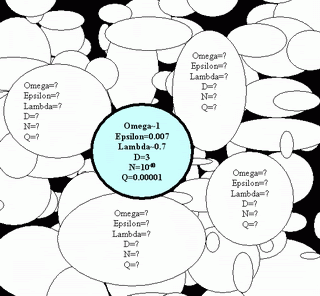
However, other forms of selection are possible. The simple act of observation can create its own selection Effect. In the illustration that follows I have drawn our Universe surrounded by numerous other universes. Within this ensemble the vast majority could be expected to have parameters that would not support life (at least in a form that would be recognizable to us). But a tiny number might. We could, therefore, have selected our own Universe as one from many, simply as a consequence of it having a favorable set of parameters for our existence.

Image

If we are only considering the empirical evidence furnished by scientific observations then both scenarios would seem to be functionally equivalent. How then can we claim that the apparent fine-tuning implies a designer-creator when we can see this potential for ambiguity?

User avatar
Furrowed Brow
Site Supporter
Posts: 3720
Joined: Mon Nov 20, 2006 9:29 am
Location: Here
Been thanked: 1 time
Contact:

Post #61

Post by Furrowed Brow »

4gold wrote:Allow me to flip your argument. You are arguing that the reason we seem to theorize an omnipotent, omniscient God is to explain "the subtle inference of intent".

But I would argue that the reason we even theorize about multiple universes is to justify the philosophical argument that the universe we observe could have occurred by chance.
Id say that is about right. Except that multiverses were introduced for reasons to do with quantum physics and not an argument against God. Though Dawkins I think is guilty of hijacking multiverse as a defence against design. A move that is unnecessary and something I wish he had not done.

However as soon as the design argument cites fine tuning then that concept implies the parameters we see have been selected for out of a set of other possible parameters. You cant have a set of one and say that the answer given within that set has been selected for because there is then no selecting going on. Fine tuning makes no sense without other alternative possibilities. Now purveyors of fine tuning do not have to commit to multiverses but they do have to admit alternative possibilities. And then we come back to the previous point as which other possibilities might contain some version of life. We dont know. And we dont need to know. There just has to be an undefined field of open possibilities for the notion of fine tuning to be misapplied. But that implication does not suit the design argument, so an attempt is made to try to edit such possibilities out of the picture on the basis they are not empirical and not testable; as if the possibilities they want to admit are observable and testable - which they are not.

User avatar
Confused
Site Supporter
Posts: 7308
Joined: Mon Aug 14, 2006 5:55 am
Location: Alaska

Post #62

Post by Confused »

island wrote:Confused:
Blame it on Weinberg. He made the first fatal flaw to introduce the "anthropic" concept into the cosmos.

If I were debating this, I'd stop you in your tracks right here and call this proof positive that you have no business whatsoever pretending that you know the first thing about it.

You think that Weinberg "introduced the anthropic principle into the cosmos"... huh?

L.O.L

And then I'd look to see if anybody else called you on it, or did they just keep rambling on as if you were right on track with the science...


goat said:
The way I look at it...

THAT'S THE WHOLE PROBLEM!... ;)
In 1987 Steven Weinberg suggested the unthinkable: He suggested that perhaps the cosmological constant is so small for reasons having nothing to do with the special properties of String Theory or any other mathematical theory. Maybe the reason is that if it were any larger, our own existence would be in jeopardy. This kind of logic went by the name of the Anthropic Principle: some property of the universe of the Laws of Physics must be true because if it wasn't', we couldn't exist.

His writings and lectures clearly imply he sees the evidence, if not definitive, the as strongly suggesting that some version of the Anthropic Principle may play a role in determining the Laws of Physics. In his 1992 book "Dreams of A Final Theory" He wrote that
"if such a cosmological constant (the first 119 decimal places cancel, but then in the 120th, a nonzero value results) is confirmed it will be reasonable to infer that our own existence plays an important role in explaining why the universe is the way it is. For what it is worth, I hope this is not the case. As a theoretical physicist, I would like to see us able to make precise predictions, not vague statements that certain life constants have to be in a range that is more or less favorable to life"
'Guess what, The first 119 decimal places of the cosmological constant cancel, but then, in the 12th, incredibly, a nonzero value results. To make matters worse, its value is just about what Weinberg predicted it would be based on the Anthropic Principle"
(The cosmic landscape, Leonard Susskind, Page 154)

I am in no way saying that Weinbergs statement in 1987 didn't leave a bad taste in his mouth and he expresses his regrets in his book listed above.

However, all that aside, perhaps you should review your own information before making ignorant statements about anothers.
What we do for ourselves dies with us,
What we do for others and the world remains
and is immortal.

-Albert Pine
Never be bullied into silence.
Never allow yourself to be made a victim.
Accept no one persons definition of your life; define yourself.

-Harvey Fierstein

User avatar
Furrowed Brow
Site Supporter
Posts: 3720
Joined: Mon Nov 20, 2006 9:29 am
Location: Here
Been thanked: 1 time
Contact:

Re: Our Universe: one of many or specially designed?

Post #63

Post by Furrowed Brow »

island wrote:
QED wrote:Our Universe has a number of critical parameters that have no apparent reason for their values, but if these values were even slightly different, we wouldn't exist. This suggests to some that the values were carefully selected by a sentient being who had the intelligence to know the exact values required for our existence.
No it doesn't. The hardest proof that we are not here by accident can only be evidence that there is "method to nature's madness", unless you have **direct proof** that an intelligent agent is involved.

Your assertion requires an unfounded leap of faith that is not evidenced by non-random occurrence alone.
Sorry Island. I think you dashed this one off in a hurry. Read this about five times and your point is still not clear. Question: what is the assertion you are referring to? And what is the nature of the leap of faith?

User avatar
QED
Prodigy
Posts: 3798
Joined: Sun Jan 30, 2005 5:34 am
Location: UK

Post #64

Post by QED »

I'm trying to avoid pulling on my moderator hat in my own thread here. I'm not sure if Island wants to reserve his technical judgment from this thread or not. What we really need is for him to reserve his argumentum ad hominem so we can move on peacefully.

User avatar
Confused
Site Supporter
Posts: 7308
Joined: Mon Aug 14, 2006 5:55 am
Location: Alaska

Post #65

Post by Confused »

My apologies in my choice of wording in regards to Weinberg. Furrowed pointed out my flaw. The many worlds interpretation was the inspiration for the Anthropic Principle when Brandon Carter first coined it in 1974. He was applying it towards Evertts theory that at every junction in history the world splits into parallel universes with alternate histories. Carters early pioneering ideas for synthesizing the anthropic principle with the many worlds interpretation was this: suppose the wave function includes branches not only for such ordinary things as the location of an electron, the decay or nondecay of the neutron, or the life and death of a cat, but also for different Laws of Physics. If one assumes all branches are equal, then there are worlds out there with many alternative environments. Carter referred more to different branches of reality rather than different regions of a megaverse.

However, I was incorrect when I said Weinberg first introduced the anthropic principle into cosmology. However, his 1984 public suggestion listed in the post previous this seems to be the one that got most people more interested in proving it wrong (IMHO). Though this hasn't been done yet, Weinberg still considers that one public admission to be a black stain on his otherwise brilliant contributions to science.
What we do for ourselves dies with us,
What we do for others and the world remains
and is immortal.

-Albert Pine
Never be bullied into silence.
Never allow yourself to be made a victim.
Accept no one persons definition of your life; define yourself.

-Harvey Fierstein

User avatar
Confused
Site Supporter
Posts: 7308
Joined: Mon Aug 14, 2006 5:55 am
Location: Alaska

Post #66

Post by Confused »

QED wrote:I'm trying to avoid pulling on my moderator hat in my own thread here. I'm not sure if Island wants to reserve his technical judgment from this thread or not. What we really need is for him to reserve his argumentum ad hominem so we can move on peacefully.
I vote to move along:
QED wrote:If we are only considering the empirical evidence furnished by scientific observations then both scenarios would seem to be functionally equivalent. How then can we claim that the apparent fine-tuning implies a designer-creator when we can see this potential for ambiguity?
Tell me, is it possible to have one constant be one value without having another one be the same? I mean if we look at all the constants. Can we say that one started a cascading effect. In other words, any constant developed after the initial one would have a value that was consistent with the previous constant and so forth. Sort of like the human bodies clotting cascade factors. If we change one constant would it effect all constants? Is it possible to determine if the constants it would effect would have been constants formed later on in the creation of the universe, but earlier constants would remain the same? I am trying to see if it is possible that constants came to be what they are by simply adapting to work with the previous constant. This would require no fine tuning, but instead, be a sort of evolution in and of itself.

I don't know if this is possible or not. So I am not postulating this could have happened. I am questioning if anyone know if it could or couldn't have occurred.
What we do for ourselves dies with us,
What we do for others and the world remains
and is immortal.

-Albert Pine
Never be bullied into silence.
Never allow yourself to be made a victim.
Accept no one persons definition of your life; define yourself.

-Harvey Fierstein

User avatar
Furrowed Brow
Site Supporter
Posts: 3720
Joined: Mon Nov 20, 2006 9:29 am
Location: Here
Been thanked: 1 time
Contact:

Post #67

Post by Furrowed Brow »

Confused wrote:
QED wrote:I'm trying to avoid pulling on my moderator hat in my own thread here. I'm not sure if Island wants to reserve his technical judgment from this thread or not. What we really need is for him to reserve his argumentum ad hominem so we can move on peacefully.
I vote to move along:
QED wrote:If we are only considering the empirical evidence furnished by scientific observations then both scenarios would seem to be functionally equivalent. How then can we claim that the apparent fine-tuning implies a designer-creator when we can see this potential for ambiguity?
Tell me, is it possible to have one constant be one value without having another one be the same? I mean if we look at all the constants. Can we say that one started a cascading effect. In other words, any constant developed after the initial one would have a value that was consistent with the previous constant and so forth. Sort of like the human bodies clotting cascade factors. If we change one constant would it effect all constants? Is it possible to determine if the constants it would effect would have been constants formed later on in the creation of the universe, but earlier constants would remain the same? I am trying to see if it is possible that constants came to be what they are by simply adapting to work with the previous constant. This would require no fine tuning, but instead, be a sort of evolution in and of itself.

I don't know if this is possible or not. So I am not postulating this could have happened. I am questioning if anyone know if it could or couldn't have occurred.
I think if we knew the answer to that we would be close to having a TOE.

island
Student
Posts: 56
Joined: Sun May 30, 2004 12:11 pm

Post #68

Post by island »

Confused asked:
Sorry Island. I think you dashed this one off in a hurry. Read this about five times and your point is still not clear. Question: what is the assertion you are referring to? And what is the nature of the leap of faith?

The implication is that "careful selection" requires intelligence, but it doesn't, so it requires an unfounded leap of faith to say that it does, unless you can prove it.
QED wrote:I'm trying to avoid pulling on my moderator hat in my own thread here. I'm not sure if Island wants to reserve his technical judgment from this thread or not. What we really need is for him to reserve his argumentum ad hominem so we can move on peacefully.
heheh... What?!?, where, how, when, who... OHHHHH, you think that stating a fact is insulting... lol Okay, okay... I'll try to levy my criticisms more gently.

Confused asked:
Tell me, is it possible to have one constant be one value without having another one be the same? I mean if we look at all the constants. Can we say that one started a cascading effect. In other words, any constant developed after the initial one would have a value that was consistent with the previous constant and so forth. Sort of like the human bodies clotting cascade factors. If we change one constant would it effect all constants? Is it possible to determine if the constants it would effect would have been constants formed later on in the creation of the universe, but earlier constants would remain the same? I am trying to see if it is possible that constants came to be what they are by simply adapting to work with the previous constant. This would require no fine tuning, but instead, be a sort of evolution in and of itself.

I don't know if this is possible or not. So I am not postulating this could have happened. I am questioning if anyone know if it could or couldn't have occurred.


I think that it's important to remember that we shouldn't expect the constants or the rest of the anthropic coincidences to evolve contrary to the the least action principle, and in this context it is expected that they fall into place in accordance with the process that was started when the matter field was determined by the big bang.

But besides that, I think that you'd have a lot more trouble explaining how they randomly evolved into those balance points, than you would to find some good physical reason for why they are the way that they are.

You should read this paper by Sean Carroll. I call it, the only thing that this pseudo-fantasyLand string theorist has ever done for me... ;)

But it's actually called:

Is Our Universe Natural?
http://arxiv.org/abs/hep-th/0512148

Furrowed Brow:
I think if we knew the answer to that we would be close to having a TOE.

I think that we'd have the ToE long ago if scientists would quit ignoring the strong implication. It is utterly amazing how obvious many things become once you break down and honestly admit that there is a real possibility that there actually is something to this anthropic thing.

You would not believe the stuff that is right in front of your nose, once you start sudying the physics from this perspective, but there is a serious form of non-scientific predispositioning that causes anyone that isn't a creationist to willfully ignore the most apparent implications of the evidence.

It doesn't help that creationists insist on using it as evidence for god... in fact, that's what causes the reactionary auto-denial of many important and valid points that creationists make for all the wrong reasons, and quite possibly is the biggest hindrence to finding the truth, because nobody, and I mean nobody, besides me-n-Paul Davies, even bothers to look at the evidence from this perspective, for this reason.

The stupid stuff that comes out of people's mouths as a result is typically as absurd as it is wrong when you look at it in this light for about two seconds.

I've found that I can win every battle, yet still lose the war, and I find that pathetic.

User avatar
Furrowed Brow
Site Supporter
Posts: 3720
Joined: Mon Nov 20, 2006 9:29 am
Location: Here
Been thanked: 1 time
Contact:

Post #69

Post by Furrowed Brow »

island wrote:Confused asked:
Sorry Island. I think you dashed this one off in a hurry. Read this about five times and your point is still not clear. Question: what is the assertion you are referring to? And what is the nature of the leap of faith?

The implication is that "careful selection" requires intelligence, but it doesn't, so it requires an unfounded leap of faith to say that it does, unless you can prove it.
Tink that was me actually. Anyhow, I think if your read QED carefully youll see he was being - as always - very judicious with choice of language.
island wrote:Your assertion

I think QED made no assertion himself other than to say
QED wrote:This suggests to some
Anyhow, you say
island wrote:The implication is that "careful selection" requires intelligence, but it doesn't
Well it depends what you mean by "careful" I guess. Here are some definitions of "careful" from Readers Digest Word power dictionary

1/ taking care to avoid harm or mistakes
2/ prudent in use of
3/ done with showing thought and attention

1 and 3 certainly require some form of intelligence, and 2 implies purpose, and perhaps implies intelligence. But that seems like a semantic quibble. What does a universe with a purpose but without intelligence design mean? Not very much I think.
island wrote:You would not believe the stuff that is right in front of your nose, once you start studying the physics from this perspective, but there is a serious form of non-scientific predispositioning that causes anyone that isn't a creationist to wilfully ignore the most apparent implications of the evidence.
Ok were talking about the strong anthropic principle. If youll allow Ill cut and paste from your blog for a definition of the strong anthropic principle
island wrote:carbon-based life is somehow "specially" relevant to the structure mechanism of the universe, and weak, multiverse interpretations do not supersede this fact,
So what implications are wilfully being ignored? That carbon based life is "specially" relevant to the universe. But by what objective criteria do you define "specially" relevant?

The accusation that there is wilful ignoring of the implications of the evidence would carry weight if the special relevance of carbon based life to the universe is an objective assessment, and not a subjective value judgment. Can you show how you are not making a subjective value judgment? A good answer to that question will not rely on the word "special".

island
Student
Posts: 56
Joined: Sun May 30, 2004 12:11 pm

Post #70

Post by island »

Furrowed Brow wrote:
1 and 3 certainly require some form of intelligence, and 2 implies purpose, and perhaps implies intelligence. But that seems like a semantic quibble. What does a universe with a purpose but without intelligence design mean? Not very much I think.
You're right, it's semantics that attempts to remove our actions, words, thoughts, etc... from a determinsitic physical process for which these are just manifestations of the process.


island wrote:You would not believe the stuff that is right in front of your nose, once you start studying the physics from this perspective, but there is a serious form of non-scientific predispositioning that causes anyone that isn't a creationist to wilfully ignore the most apparent implications of the evidence.
Furrowed Brow wrote: Ok were talking about the strong anthropic principle. If youll allow Ill cut and paste from your blog for a definition of the strong anthropic principle
island wrote:carbon-based life is somehow "specially" relevant to the structure mechanism of the universe, and weak, multiverse interpretations do not supersede this fact,
Furrowed Brow wrote: So what implications are wilfully being ignored? That carbon based life is "specially" relevant to the universe. But by what objective criteria do you define "specially" relevant?
C'mon, that's not a definition, rather, you selectively cut that out of context with information that answers your own question.


Furrowed Brow wrote: The accusation that there is wilful ignoring of the implications of the evidence would carry weight if the special relevance of carbon based life to the universe is an objective assessment, and not a subjective value judgment. Can you show how you are not making a subjective value judgment? A good answer to that question will not rely on the word "special".
The accusation that the point hasn't been made is more than just a little bit telling when context is manipulated to ones' desired appearance, rather than what is actually said.

BUT... the point that was well established within the context is that the subjectivity that is required is comparable to ignoring a guy stading over a body with a smoking gun, in order to say that he "probably" didn't do it, so we shouldn't investigate this possibility with at the very least, EQUAL earnest, to every other less-directly-implicated possibility.

The kind of subjectivity that makes Paul Davies say that,

"the universe looks like a fix".

The kind of subjectivity that makes Richard Dawkins say that,

"The blind forces of nature are VERY SPECIALLY deployed."

The kind of subjectivity that makes Leonard Susskind say,

"As things stand now, we will be hard pressed to answer the idists if the landscape fails".

Yeah, like a dead body and a guy with a smoking gun, "subjective".

The kind of "subjectivity" that requires willful ignorance and a clear predispositioning toward denial to hide from.

Post Reply