A Deluge of Evidence for the Flood?

Creationism, Evolution, and other science issues

Moderator: Moderators

Post Reply
User avatar
LittlePig
Sage
Posts: 916
Joined: Mon Feb 04, 2008 1:51 pm
Location: Dallas, TX

A Deluge of Evidence for the Flood?

Post #1

Post by LittlePig »

otseng wrote:
goat wrote:
otseng wrote:
LittlePig wrote: And I can't think of any reason you would make the comment you made if you weren't suggesting that the find favored your view of a worldwide flood.
Umm, because simply it's a better explanation? And the fact that it's more consistent with the Flood Model doesn't hurt either. ;)
Except, of course, it isn't consistent with a 'Flood Model', since it isn't mixed in with any animals that we know are modern.
Before the rabbits multiply beyond control, I'll just leave my proposal as a rapid burial. Nothing more than that. For this thread, it can just be a giant mud slide.
Since it's still spring time, let's let the rabbits multiply.

Questions for Debate:

1) Does a Global Flood Model provide the best explanation for our current fossil record, geologic formations, and biodiversity?

2) What real science is used in Global Flood Models?

3) What predictions does a Global Flood Model make?

4) Have Global Flood Models ever been subjected to a formal peer review process?

"Well thanks a lot, Plato." - James ''Sawyer'' Ford
"Don''t flip ya lid." - Ricky Rankin

User avatar
otseng
Savant
Posts: 20984
Joined: Thu Jan 15, 2004 1:16 pm
Location: Atlanta, GA
Has thanked: 218 times
Been thanked: 393 times
Contact:

Where's all the boulders?

Post #861

Post by otseng »

The Grand Canyon was formed by all of the stratas forming first. And according to SG, the Colorado river then eroded the stratas to form the Grand Canyon. The topmost layer, Kaibab Limestone, is around 250 million years old. And then around 17 million years ago, the Colorado River formed.

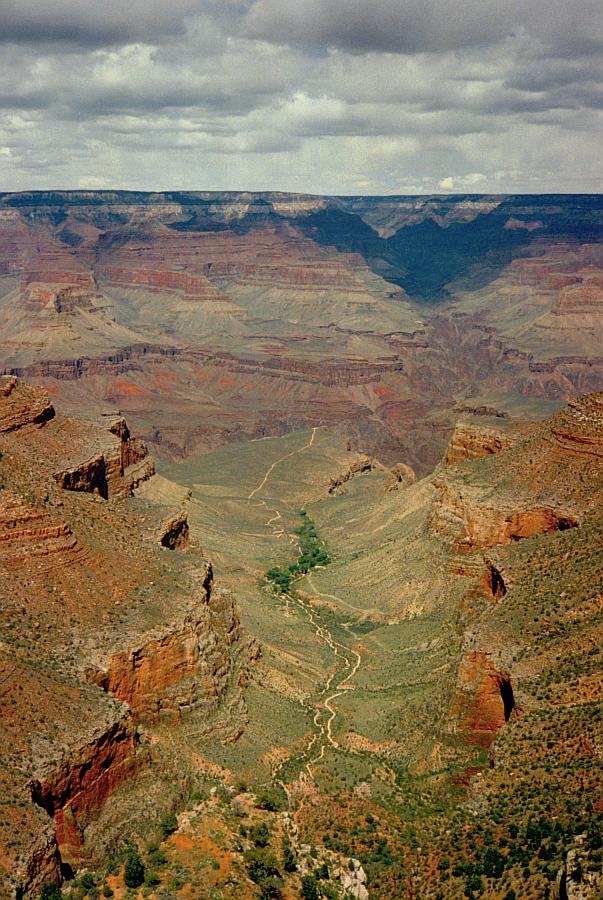
Prior to the Colorado river, the entire area was flat solid rock. The Colorado river would've had to had erode through the lithified rocks. There are many problems with this. But I want to concentrate on one problem. Wouldn't have all this erosion of solid rock have produced boulders?

Here is an aerial view:
Image
http://en.wikipedia.org/wiki/File:Grand ... tantin.jpg

The eroded area is much larger than the Colorado River. Erosion doesn't follow the Colorado River either. But there are many "inlets" that the river does not flow into. The width of the Canyon is also much wider than the river. The walls of the Canyon must've formed by rocks falling off the sides as the river eroded downward into the lower stratas. Yet, these rocks/boulders are remarkable absent. Only a small amount exists. For the amount of rock that was eroded, shouldn't there be more evidence of eroded rocks by boulders scattered everywhere?

Some more images of scarcity of boulders:

Image
http://www.newworldencyclopedia.org/ent ... _cloud.jpg

Image
http://wikitravel.org/en/Image:Grand_Ca ... o_Peak.JPG

User avatar
McCulloch
Site Supporter
Posts: 24063
Joined: Mon May 02, 2005 9:10 pm
Location: Toronto, ON, CA
Been thanked: 3 times

Post #862

Post by McCulloch »

otseng wrote:They teach the flood in schools?
Only private religious ones. Yet the religious lobby is strong enough in the USA to stifle attempts to debunk creationism in the education system.

Image
The State Board of Education [in Texas] on Friday [March, 2009] passed science curriculum standards that members described as a compromise between those who are critical of teaching evolutionary theories without scrutiny and those who feared attacks on evolution would lead to the teaching of creationism in Texas schoolsThe new standards remove current requirements that students be taught the "strengths and weaknesses" of scientific theories. Instead, teachers will be required to have students scrutinize "all sides" of the theories.

The Discovery Institute, which encourages teaching that the universe is the product of an intelligent designer, called the vote "a huge victory for those who favor teaching the scientific evidence for and against evolution."
Examine everything carefully; hold fast to that which is good.
First Epistle to the Church of the Thessalonians
The truth will make you free.
Gospel of John

User avatar
Scotracer
Guru
Posts: 1772
Joined: Tue Apr 28, 2009 5:25 pm
Location: Scotland

Re: Where's all the boulders?

Post #863

Post by Scotracer »

otseng wrote:The Grand Canyon was formed by all of the stratas forming first. And according to SG, the Colorado river then eroded the stratas to form the Grand Canyon. The topmost layer, Kaibab Limestone, is around 250 million years old. And then around 17 million years ago, the Colorado River formed.

Prior to the Colorado river, the entire area was flat solid rock. The Colorado river would've had to had erode through the lithified rocks. There are many problems with this. But I want to concentrate on one problem. Wouldn't have all this erosion of solid rock have produced boulders?

Here is an aerial view:
Image
http://en.wikipedia.org/wiki/File:Grand ... tantin.jpg

The eroded area is much larger than the Colorado River. Erosion doesn't follow the Colorado River either. But there are many "inlets" that the river does not flow into. The width of the Canyon is also much wider than the river. The walls of the Canyon must've formed by rocks falling off the sides as the river eroded downward into the lower stratas. Yet, these rocks/boulders are remarkable absent. Only a small amount exists. For the amount of rock that was eroded, shouldn't there be more evidence of eroded rocks by boulders scattered everywhere?

Some more images of scarcity of boulders:

Image
http://www.newworldencyclopedia.org/ent ... _cloud.jpg

Image
http://wikitravel.org/en/Image:Grand_Ca ... o_Peak.JPG
The 3 major river forming mechanisms are Erosion, Transportation and Deposition. It shouldn't be beyond reason to assume they were transported somewhere else.
Why Evolution is True
Universe from nothing

Claims made without evidence can be dismissed without evidence
- Christopher Hitchens

User avatar
otseng
Savant
Posts: 20984
Joined: Thu Jan 15, 2004 1:16 pm
Location: Atlanta, GA
Has thanked: 218 times
Been thanked: 393 times
Contact:

Re: Where's all the boulders?

Post #864

Post by otseng »

Scotracer wrote: The 3 major river forming mechanisms are Erosion, Transportation and Deposition. It shouldn't be beyond reason to assume they were transported somewhere else.
Where were they all transported to?
Do we find a significant amount of boulders there?
Also, there are many areas that the Colorado river did not even reach. How did all those boulders get transported?

User avatar
McCulloch
Site Supporter
Posts: 24063
Joined: Mon May 02, 2005 9:10 pm
Location: Toronto, ON, CA
Been thanked: 3 times

Re: Where's all the boulders?

Post #865

Post by McCulloch »

otseng wrote:Wouldn't have all this erosion of solid rock have produced boulders?
[i]Geology of U.S. Parklands[/i], By Eugene P. Kiver, David V. Harris, Page 379 wrote:Individual plateaus reduce in size as blocks of rock fall from the cliffs, either pried loose by frost-wedging or by the removal of the underlying shale support by erosion. It would seem that there should be an abundance of fallen blocks-taluses perhaps-along the base of the cliffs. Talus deposits, however, are essentially nonexistent and even scattered boulders are rare. The scarcity of boulders prompted the assumption that active scarp retreat had ceased, perhaps when there was a change in climate. This assumption appears to be invalid. Schum and Chorley (1964) found that (1) many sandstone boulders essentially disintegrate by impact and (2) others weather rapidly once they are partially buried in material that tends to hold moisture. Therefore, scarp retreat continues today although the boulders disappear about as rapidly as they are replaced by others falling from the cliff above.
EUGENE P. KIVER, PhD, is a professor of geology at Eastern Washington University in Cheney, Washington. Dr. Kiver received his doctorate in geology from the University of Wyoming. He is coauthor of the Fourth Edition of this book, and prepared the revisions of this Fifth Edition.

DAVID V. HARRIS, PhD (deceased), was a professor of geology at Colorado State University from 1946 until 1976. He was the author of the first three editions of this book, and coauthor of the Fourth Edition, then titled Geologic Story of National Parks and Monuments.

Perhaps if you looked to geologists for your answers rather than an open internet forum, you would be less confused.
Examine everything carefully; hold fast to that which is good.
First Epistle to the Church of the Thessalonians
The truth will make you free.
Gospel of John

User avatar
Goat
Site Supporter
Posts: 24999
Joined: Fri Jul 21, 2006 6:09 pm
Has thanked: 25 times
Been thanked: 207 times

Re: Where's all the boulders?

Post #866

Post by Goat »

otseng wrote:
Scotracer wrote: The 3 major river forming mechanisms are Erosion, Transportation and Deposition. It shouldn't be beyond reason to assume they were transported somewhere else.
Where were they all transported to?
Do we find a significant amount of boulders there?
Also, there are many areas that the Colorado river did not even reach. How did all those boulders get transported?
The pacific ocean.. and since there has been slipage of where the river exits over time, we see a pattern of where the soil was deposited over time.
“What do you think science is? There is nothing magical about science. It is simply a systematic way for carefully and thoroughly observing nature and using consistent logic to evaluate results. So which part of that exactly do you disagree with? Do you disagree with being thorough? Using careful observation? Being systematic? Or using consistent logic?�

Steven Novella

User avatar
nygreenguy
Guru
Posts: 2349
Joined: Mon Jul 07, 2008 8:23 am
Location: Syracuse

Re: Where's all the boulders?

Post #867

Post by nygreenguy »

McCulloch wrote:
otseng wrote:Wouldn't have all this erosion of solid rock have produced boulders?
[i]Geology of U.S. Parklands[/i], By Eugene P. Kiver, David V. Harris, Page 379 wrote:Individual plateaus reduce in size as blocks of rock fall from the cliffs, either pried loose by frost-wedging or by the removal of the underlying shale support by erosion. It would seem that there should be an abundance of fallen blocks-taluses perhaps-along the base of the cliffs. Talus deposits, however, are essentially nonexistent and even scattered boulders are rare. The scarcity of boulders prompted the assumption that active scarp retreat had ceased, perhaps when there was a change in climate. This assumption appears to be invalid. Schum and Chorley (1964) found that (1) many sandstone boulders essentially disintegrate by impact and (2) others weather rapidly once they are partially buried in material that tends to hold moisture. Therefore, scarp retreat continues today although the boulders disappear about as rapidly as they are replaced by others falling from the cliff above.
EUGENE P. KIVER, PhD, is a professor of geology at Eastern Washington University in Cheney, Washington. Dr. Kiver received his doctorate in geology from the University of Wyoming. He is coauthor of the Fourth Edition of this book, and prepared the revisions of this Fifth Edition.

DAVID V. HARRIS, PhD (deceased), was a professor of geology at Colorado State University from 1946 until 1976. He was the author of the first three editions of this book, and coauthor of the Fourth Edition, then titled Geologic Story of National Parks and Monuments.

Perhaps if you looked to geologists for your answers rather than an open internet forum, you would be less confused.

This is why I dont comment on geology.

This is also why Id like to switch to my expertise, which is ecology/biology.

Lets talk about that and I can give some proper responses.

User avatar
micatala
Site Supporter
Posts: 8338
Joined: Sun Feb 27, 2005 2:04 pm
Has thanked: 1 time

Re: Where's all the boulders?

Post #868

Post by micatala »

McCulloch wrote:
otseng wrote:Wouldn't have all this erosion of solid rock have produced boulders?
[i]Geology of U.S. Parklands[/i], By Eugene P. Kiver, David V. Harris, Page 379 wrote:Individual plateaus reduce in size as blocks of rock fall from the cliffs, either pried loose by frost-wedging or by the removal of the underlying shale support by erosion. It would seem that there should be an abundance of fallen blocks-taluses perhaps-along the base of the cliffs. Talus deposits, however, are essentially nonexistent and even scattered boulders are rare. The scarcity of boulders prompted the assumption that active scarp retreat had ceased, perhaps when there was a change in climate. This assumption appears to be invalid. Schum and Chorley (1964) found that (1) many sandstone boulders essentially disintegrate by impact and (2) others weather rapidly once they are partially buried in material that tends to hold moisture. Therefore, scarp retreat continues today although the boulders disappear about as rapidly as they are replaced by others falling from the cliff above.


EUGENE P. KIVER, PhD, is a professor of geology at Eastern Washington University in Cheney, Washington. Dr. Kiver received his doctorate in geology from the University of Wyoming. He is coauthor of the Fourth Edition of this book, and prepared the revisions of this Fifth Edition.

DAVID V. HARRIS, PhD (deceased), was a professor of geology at Colorado State University from 1946 until 1976. He was the author of the first three editions of this book, and coauthor of the Fourth Edition, then titled Geologic Story of National Parks and Monuments.

Perhaps if you looked to geologists for your answers rather than an open internet forum, you would be less confused.

If you want to see boulders, one good place is northern Minnesota and across the border into Canada. There, we find igneous rocks, granite etc., close to the surface (the Canadian shield) and these types of rocks make good boulders (that don't disintegrate as easily when they fall off cliffs). The Boundaray Waters Canoe Area has at least one, and I think two, lakes that are called Boulder Lake.
" . . . the line separating good and evil passes, not through states, nor between classes, nor between political parties either, but right through every human heart . . . ." Alexander Solzhenitsyn

User avatar
otseng
Savant
Posts: 20984
Joined: Thu Jan 15, 2004 1:16 pm
Location: Atlanta, GA
Has thanked: 218 times
Been thanked: 393 times
Contact:

Re: Where's all the boulders?

Post #869

Post by otseng »

(1) many sandstone boulders essentially disintegrate by impact and (2) others weather rapidly once they are partially buried in material that tends to hold moisture.
Regarding (1), I grant that sandstone boulders break apart more easily than other types of rocks. However, even if a falling sandstone boulder could "disintegrate on impact", this would only explain sandstone.

Some points about (2). If a boulder fell off a cliff, where would all that material come from to bury it? And how would it hold moisture? How does moisture alone erode rocks? Also, to have formed the Grand Canyon, a lot of boulders would've fallen off. So it should have left a lot of buried/eroded rock.
you would be less confused.
Umm, stating "you would be less confused" would be considered a personal comment.

User avatar
micatala
Site Supporter
Posts: 8338
Joined: Sun Feb 27, 2005 2:04 pm
Has thanked: 1 time

Re: Where's all the boulders?

Post #870

Post by micatala »

otseng wrote:
(1) many sandstone boulders essentially disintegrate by impact and (2) others weather rapidly once they are partially buried in material that tends to hold moisture.
Regarding (1), I grant that sandstone boulders break apart more easily than other types of rocks. However, even if a falling sandstone boulder could "disintegrate on impact", this would only explain sandstone.

Some points about (2). If a boulder fell off a cliff, where would all that material come from to bury it? And how would it hold moisture? How does moisture alone erode rocks? Also, to have formed the Grand Canyon, a lot of boulders would've fallen off. So it should have left a lot of buried/eroded rock.
you would be less confused.
Umm, stating "you would be less confused" would be considered a personal comment.
There is very little igneous rock in the grand canyon. A lot of it IS sandstone. There is also shale and limestone. We could look at what happens to those types of rocks as well if they fall off cliffs.
" . . . the line separating good and evil passes, not through states, nor between classes, nor between political parties either, but right through every human heart . . . ." Alexander Solzhenitsyn

Post Reply