[
Replying to 1213]
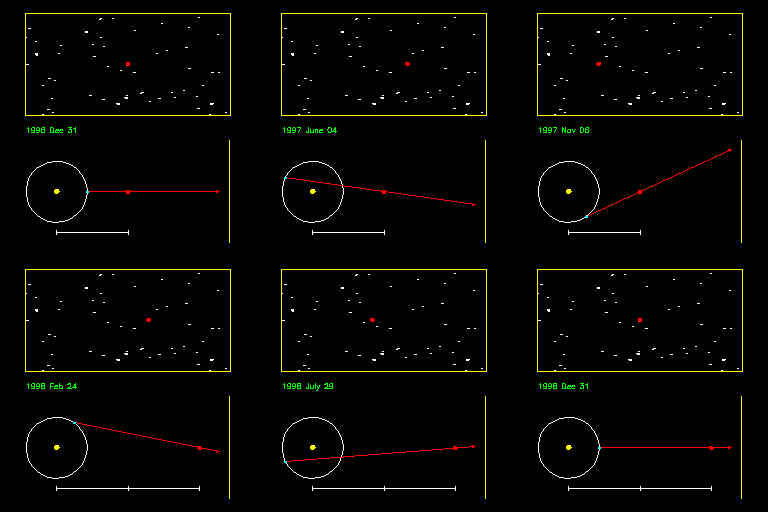
One could explain it also by saying that the orbit of the sun changes so that it looks like earth is tilting.
Nice picture. However, that also can be explained otherwise. For example, that earth is fixed, but the star moves for some reason so that it looks like in your description."
Q: Do you believe the Sun orbits the Earth?
Q: Do you not believe the Sun is much bigger then the Earth?( that Its diameter is about 109 times that of Earth, and its mass is about 330,000 times that of Earth)
Q: Do you not believe the Sun is 149.6 million km away from Earth?
Q: Do you not believe in gravity?
In Bible, earth means dry land. And by the Biblical description dry land was in the beginning on top of huge water storage. So, earth was like shell on top of water. Shell is form that can be called flat, or at least relatively flat, if its thickness is much smaller than its width and length. Similarly, as plate is flat, even if is curved. But flat is not very good word to describe thickness of something, because it can be understood as plane. However, Bible doesnt say earth is flat and especially it doesnt say planet earth is flat, so this is not any issue for me here.
Q: What land was on huge water storage nonsense are you babbling about?!!!
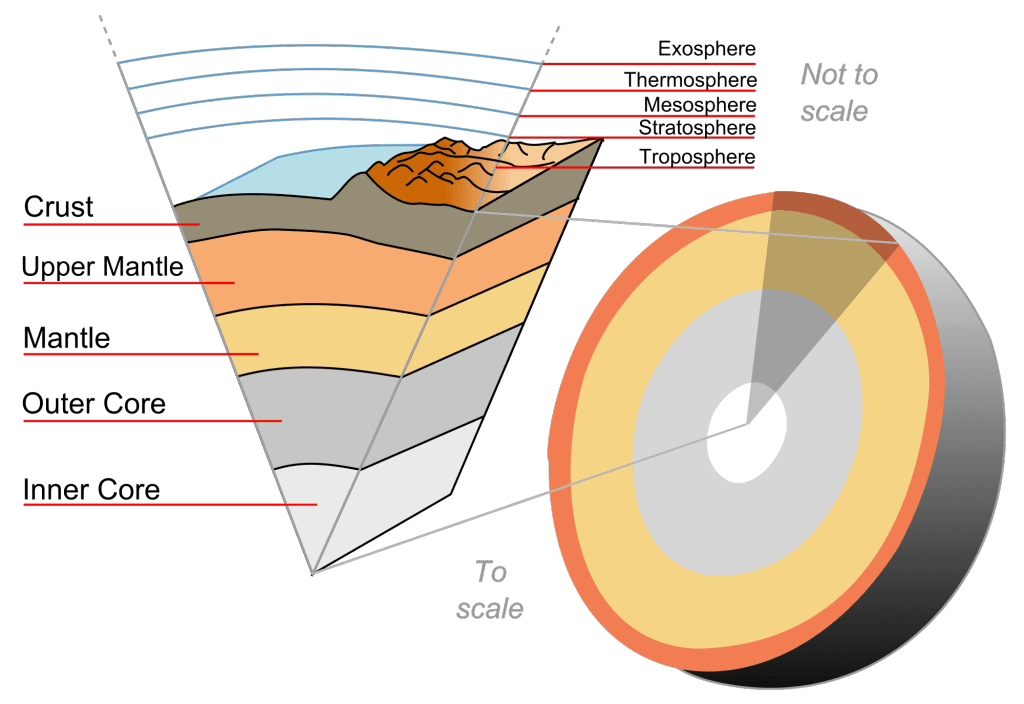
Earth's interior, like that of the other terrestrial planets, is divided into layers by their chemical or physical (rheological) properties. The outer layer is a chemically distinct silicate solid crust, which is underlain by a highly viscous solid mantle. The crust is separated from the mantle by the Mohorovii discontinuity. The thickness of the crust varies from about 6 km (kilometers) under the oceans to 30"50 km for the continents. The crust and the cold, rigid, top of the upper mantle are collectively known as the lithosphere, and it is of the lithosphere that the tectonic plates are composed. Beneath the lithosphere is the asthenosphere, a relatively low-viscosity layer on which the lithosphere rides. Important changes in crystal structure within the mantle occur at 410 and 660 km below the surface, spanning a transition zone that separates the upper and lower mantle. Beneath the mantle, an extremely low viscosity liquid outer core lies above a solid inner core.[106] The Earth's inner core might rotate at a slightly higher angular velocity than the remainder of the planet, advancing by 0.1"0.5 per year.[107] The radius of the inner core is about one fifth of that of Earth.
Geologic layers of Earth:
Depth(km) Component layer Density(g/cm3)
0"60 Lithosphere "
0"35 Crust 2.2"2.9
35"60 Upper mantle 3.4"4.4
35"2890 Mantle 3.4"5.6
100"700 Asthenosphere "
2890"5100 Outer core 9.9"12.2
5100"6378 Inner core 12.8"13.1
 https://en.wikipedia.org/wiki/Earth
Q: Do you not believe the shape of Earth is an Oblate Spheroid?