In Genesis 2:16 and 17 the Bible (New International Version) says:
And the Lord God commanded the man, "You are free to eat from any tree in the garden; but you must not eat from the tree of the knowledge of good and evil, for when you eat from it you will certainly die."
If after eating the forbidden fruits, Adam and Eve died just as God had said, then that would have been just and consistent with God's Words. However, after Adam and Eve ate the forbidden fruits, instead of just Adam and Eve just dying:
1. God evicted them from Eden.
2. God punished Eve and all her daughters (an estimated 54 billion and counting) with painful childbirths.
3. God evicted all the other species from Eden, too, and makes herbivores, parasites, carnivores and omnivores instead of making all the species non-consumers.
4. God punished humans with having to toil to survive.
5. God commanded humans to reproduce which leads to more suffering and death. Ruling over other creatures causes suffering and death to those creatures, too. "God blessed them and said to them, "Be fruitful and increase in number; fill the earth and subdue it. Rule over the fish in the sea and the birds in the sky and over every living creature that moves on the ground."" - Genesis 1:28, The Bible (NIV)
These acts are cruel and unjust and totally inconsistent with what God had said to Adam and Eve which was they would just die if they ate the forbidden fruits. God didn't keep his words to Adam and Eve.
I didn't ask to come into existence. No living thing does. I would have preferred it if I never existed. If God is real and actually did the things the Bible claims, then these cruel, unjust and inconsistent actions make the Biblical God evil.
God didn't keep his words
Moderator: Moderators
-
Compassionist
- Guru
- Posts: 1524
- Joined: Tue Feb 19, 2008 5:56 pm
- Has thanked: 1070 times
- Been thanked: 251 times
God didn't keep his words
Post #1
Last edited by Compassionist on Fri May 02, 2025 9:12 am, edited 1 time in total.
-
Compassionist
- Guru
- Posts: 1524
- Joined: Tue Feb 19, 2008 5:56 pm
- Has thanked: 1070 times
- Been thanked: 251 times
Re: God didn't keep his words
Post #71[Replying to The Tanager in post #70]
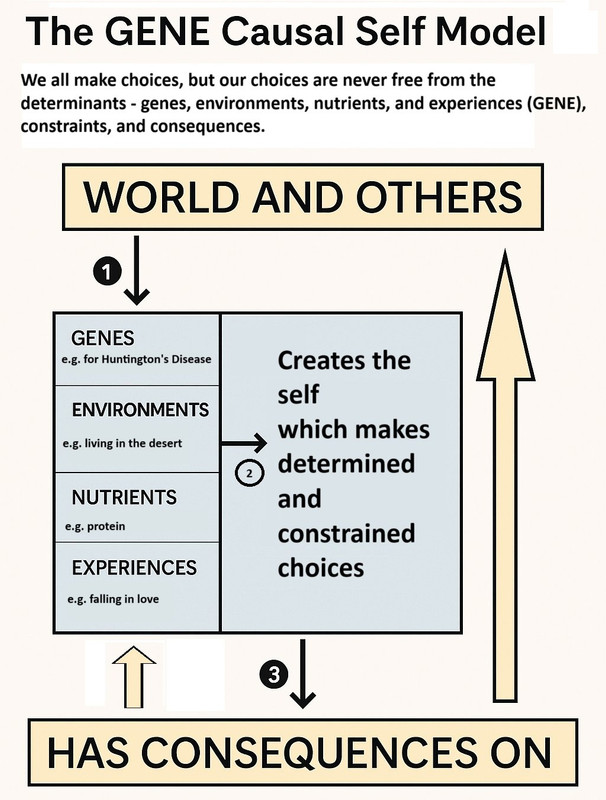
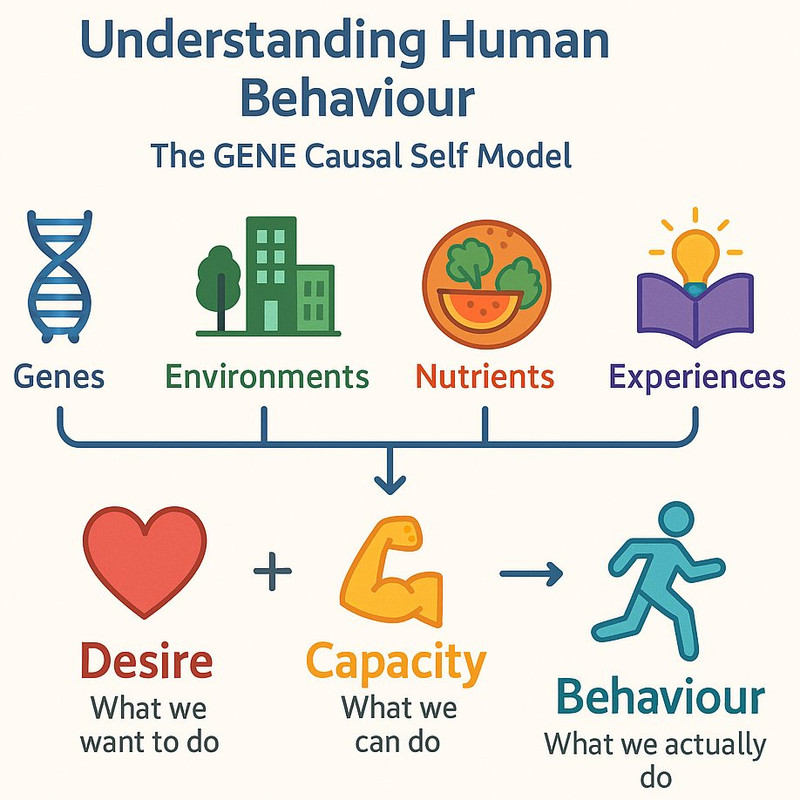
I used an image-sharing website to share the images. That's probably why Chrome didn't let you see them.
I will try another method:
https://i.postimg.cc/MTVH97C0/The-GENE- ... ograph.jpg
https://i.postimg.cc/rsBD0LMT/Understan ... aviour.jpg
Thank you very much for your thoughtful and respectful reply. I really appreciate that you took the time to engage point by point. Let me respond in kind.
On the “if-then†about falsifying determinism
You are right that my phrasing can be refined. What I meant was:
If anyone can demonstrate that a conscious intention changes matter without any corresponding physical mechanism, then physical determinism would be falsified.
If every mental act correlates with and depends on physical brain activity, then “mental causation without mechanism†hasn’t been shown. A supernatural creator (e.g., God) would not count as an empirical counter-example, because the hypothesis itself lies outside physics and cannot be independently tested. Appealing to divine creation assumes the very thing in question - a disembodied mind affecting matter - without showing how such interaction is possible or measurable.
So, as an epistemological point: physical determinism could only be falsified by empirical evidence of mind-over-matter without physical mediation, not by metaphysical assertions.
1. Causal regularity
You say wills are “one of the kinds of causes in existence.†I agree that volition is a cause - but it’s a physically instantiated cause. When I will to lift my arm, motor neurons fire, muscles contract, and the arm moves. That causal chain remains continuous within the physical domain.
If an immaterial “will†interrupts that chain, then we would see spontaneous, uncaused neural activity - a measurable violation of causal regularity. So far, neuroscience finds no such discontinuities. Hence, causal regularity supports determinism because every event we can measure has physical precursors sufficient to explain it.
2. Neuroscience and mind-brain dependence
You say “affecting the brain can affect consciousness,†but that doesn’t mean the brain determines it. True - correlation isn’t identical to causation. However, we have systematic, lawful, and bidirectional dependencies:
* Specific brain lesions eliminate particular cognitive capacities.
* Electrical stimulation elicits definite experiences or intentions.
* Psychoactive chemicals alter mood and volition predictably.
* Neural activity precedes reported decisions (e.g., Libet, Soon, Haynes).
No comparable evidence exists for the reverse - a purely mental cause altering the brain without intermediate neural activity. Until such evidence appears, the most parsimonious model is that mind is what the brain does.
3. Parsimony
Adding an unverifiable “non-physical will†doesn’t explain the illusion of freedom; it merely duplicates the explanation already accounted for by neurocognitive complexity.
You’re right that not all verification is empirical, but if a hypothesis concerns physical outcomes (choices, speech, motion), it must entail some measurable difference. Otherwise, it’s indistinguishable from “no cause at all.†Parsimony, therefore, favours physical determinism: it explains the same data with fewer assumptions.
4. Apparent freedom
Both frameworks can describe the phenomenology of choice, but only determinism explains why our choices are statistically predictable from prior states (genetic, environmental, neural). Complex systems exhibit chaos and unpredictability at a human scale, but that’s epistemic, not ontological, indeterminism.
We feel free because our cognitive model cannot track every micro-determinant of our actions, not because our will floats free of them.
5. Conservation and mental causation
If a non-physical mind can move matter, then energy or momentum must change in the physical domain without a physical cause. That would violate conservation laws unless the “mental†somehow is physical.
If, alternatively, the mind merely coincides with neural events (no energy transfer), then it is causally inert - an epiphenomenon. Either way, libertarian free will fails to preserve both physics and genuine agency.
Free will of the “could have done otherwise, all else identical†type requires a break in the physical causal chain. Determinism observes no such breaks. Quantum indeterminacy doesn’t help because random events don’t constitute control or moral authorship. Also, quantum indeterminacy does not apply to macroscopic objects such as humans due to quantum decoherence.
Every observed event has sufficient physical causes.
No verified case of mind-over-matter without a mechanism exists.
Positing non-physical causes either violates physics or adds no explanatory power.
That’s why determinism remains the simpler and stronger model.
I used an image-sharing website to share the images. That's probably why Chrome didn't let you see them.
I will try another method:
https://i.postimg.cc/MTVH97C0/The-GENE- ... ograph.jpg
https://i.postimg.cc/rsBD0LMT/Understan ... aviour.jpg
Thank you very much for your thoughtful and respectful reply. I really appreciate that you took the time to engage point by point. Let me respond in kind.
On the “if-then†about falsifying determinism
You are right that my phrasing can be refined. What I meant was:
If anyone can demonstrate that a conscious intention changes matter without any corresponding physical mechanism, then physical determinism would be falsified.
If every mental act correlates with and depends on physical brain activity, then “mental causation without mechanism†hasn’t been shown. A supernatural creator (e.g., God) would not count as an empirical counter-example, because the hypothesis itself lies outside physics and cannot be independently tested. Appealing to divine creation assumes the very thing in question - a disembodied mind affecting matter - without showing how such interaction is possible or measurable.
So, as an epistemological point: physical determinism could only be falsified by empirical evidence of mind-over-matter without physical mediation, not by metaphysical assertions.
1. Causal regularity
You say wills are “one of the kinds of causes in existence.†I agree that volition is a cause - but it’s a physically instantiated cause. When I will to lift my arm, motor neurons fire, muscles contract, and the arm moves. That causal chain remains continuous within the physical domain.
If an immaterial “will†interrupts that chain, then we would see spontaneous, uncaused neural activity - a measurable violation of causal regularity. So far, neuroscience finds no such discontinuities. Hence, causal regularity supports determinism because every event we can measure has physical precursors sufficient to explain it.
2. Neuroscience and mind-brain dependence
You say “affecting the brain can affect consciousness,†but that doesn’t mean the brain determines it. True - correlation isn’t identical to causation. However, we have systematic, lawful, and bidirectional dependencies:
* Specific brain lesions eliminate particular cognitive capacities.
* Electrical stimulation elicits definite experiences or intentions.
* Psychoactive chemicals alter mood and volition predictably.
* Neural activity precedes reported decisions (e.g., Libet, Soon, Haynes).
No comparable evidence exists for the reverse - a purely mental cause altering the brain without intermediate neural activity. Until such evidence appears, the most parsimonious model is that mind is what the brain does.
3. Parsimony
Adding an unverifiable “non-physical will†doesn’t explain the illusion of freedom; it merely duplicates the explanation already accounted for by neurocognitive complexity.
You’re right that not all verification is empirical, but if a hypothesis concerns physical outcomes (choices, speech, motion), it must entail some measurable difference. Otherwise, it’s indistinguishable from “no cause at all.†Parsimony, therefore, favours physical determinism: it explains the same data with fewer assumptions.
4. Apparent freedom
Both frameworks can describe the phenomenology of choice, but only determinism explains why our choices are statistically predictable from prior states (genetic, environmental, neural). Complex systems exhibit chaos and unpredictability at a human scale, but that’s epistemic, not ontological, indeterminism.
We feel free because our cognitive model cannot track every micro-determinant of our actions, not because our will floats free of them.
5. Conservation and mental causation
If a non-physical mind can move matter, then energy or momentum must change in the physical domain without a physical cause. That would violate conservation laws unless the “mental†somehow is physical.
If, alternatively, the mind merely coincides with neural events (no energy transfer), then it is causally inert - an epiphenomenon. Either way, libertarian free will fails to preserve both physics and genuine agency.
Free will of the “could have done otherwise, all else identical†type requires a break in the physical causal chain. Determinism observes no such breaks. Quantum indeterminacy doesn’t help because random events don’t constitute control or moral authorship. Also, quantum indeterminacy does not apply to macroscopic objects such as humans due to quantum decoherence.
Every observed event has sufficient physical causes.
No verified case of mind-over-matter without a mechanism exists.
Positing non-physical causes either violates physics or adds no explanatory power.
That’s why determinism remains the simpler and stronger model.
-
The Tanager

- Savant
- Posts: 6220
- Joined: Wed May 06, 2015 11:08 am
- Has thanked: 89 times
- Been thanked: 272 times
Re: God didn't keep his words
Post #72[Replying to Compassionist in post #71]
I don't think your scenario above puts simplicity on the determinist's side either. The outcomes you speak of would all be explainable within all 4 views: the determinist' view, the free will view, the random view, and the uncaused view. No measurable difference; all narratives account for all of the outcomes (while all except the free will view include notions of illusion of one thing or another).
You have definitely responded thoughtfully and respectfully. As to the method for the images, Chrome is still saying the security of that website (it uses HSTS) is compromised and won't let me open the page.Compassionist wrote: ↑Fri Oct 10, 2025 1:46 pmI used an image-sharing website to share the images. That's probably why Chrome didn't let you see them.
I will try another method:
https://i.postimg.cc/MTVH97C0/The-GENE- ... ograph.jpg
https://i.postimg.cc/rsBD0LMT/Understan ... aviour.jpg
Thank you very much for your thoughtful and respectful reply. I really appreciate that you took the time to engage point by point. Let me respond in kind.
Thank you for clarifying your meaning; I agree with your if-then above. But how could there be empirical evidence of an immaterial mind at all, whether that is a divine mind or a human one?Compassionist wrote: ↑Fri Oct 10, 2025 1:46 pmOn the “if-then†about falsifying determinism
You are right that my phrasing can be refined. What I meant was:
If anyone can demonstrate that a conscious intention changes matter without any corresponding physical mechanism, then physical determinism would be falsified.
If every mental act correlates with and depends on physical brain activity, then “mental causation without mechanism†hasn’t been shown. A supernatural creator (e.g., God) would not count as an empirical counter-example, because the hypothesis itself lies outside physics and cannot be independently tested. Appealing to divine creation assumes the very thing in question - a disembodied mind affecting matter - without showing how such interaction is possible or measurable.
So, as an epistemological point: physical determinism could only be falsified by empirical evidence of mind-over-matter without physical mediation, not by metaphysical assertions.
The will would be the start of that chain, not an interruption.Compassionist wrote: ↑Fri Oct 10, 2025 1:46 pm1. Causal regularity
You say wills are “one of the kinds of causes in existence.†I agree that volition is a cause - but it’s a physically instantiated cause. When I will to lift my arm, motor neurons fire, muscles contract, and the arm moves. That causal chain remains continuous within the physical domain.
If an immaterial “will†interrupts that chain, then we would see spontaneous, uncaused neural activity - a measurable violation of causal regularity. So far, neuroscience finds no such discontinuities. Hence, causal regularity supports determinism because every event we can measure has physical precursors sufficient to explain it.
I agree with those examples, but I don't understand what comparable evidence you are expecting.Compassionist wrote: ↑Fri Oct 10, 2025 1:46 pm2. Neuroscience and mind-brain dependence
You say “affecting the brain can affect consciousness,†but that doesn’t mean the brain determines it. True - correlation isn’t identical to causation. However, we have systematic, lawful, and bidirectional dependencies:
* Specific brain lesions eliminate particular cognitive capacities.
* Electrical stimulation elicits definite experiences or intentions.
* Psychoactive chemicals alter mood and volition predictably.
* Neural activity precedes reported decisions (e.g., Libet, Soon, Haynes).
No comparable evidence exists for the reverse - a purely mental cause altering the brain without intermediate neural activity. Until such evidence appears, the most parsimonious model is that mind is what the brain does.
Sorry for my confusing phrasing. You seemed to say that determinism was simpler because the free will view has to explain one extra part of reality (the 'will'). I was saying that determinism still has to explain an extra part of reality (the illusion of freedom). The free will view doesn't believe there is an illusion of freedom and doesn't need to explain it, it's extra entity is the will itself. So, neither has an extra layer.Compassionist wrote: ↑Fri Oct 10, 2025 1:46 pm3. Parsimony
Adding an unverifiable “non-physical will†doesn’t explain the illusion of freedom; it merely duplicates the explanation already accounted for by neurocognitive complexity.
You’re right that not all verification is empirical, but if a hypothesis concerns physical outcomes (choices, speech, motion), it must entail some measurable difference. Otherwise, it’s indistinguishable from “no cause at all.†Parsimony, therefore, favours physical determinism: it explains the same data with fewer assumptions.
I don't think your scenario above puts simplicity on the determinist's side either. The outcomes you speak of would all be explainable within all 4 views: the determinist' view, the free will view, the random view, and the uncaused view. No measurable difference; all narratives account for all of the outcomes (while all except the free will view include notions of illusion of one thing or another).
Why is statistical predictability important here? Yes, if the free will view is true, reality isn't as ontologically predictable as determinism by definition. Why is that a test for truth?Compassionist wrote: ↑Fri Oct 10, 2025 1:46 pm4. Apparent freedom
Both frameworks can describe the phenomenology of choice, but only determinism explains why our choices are statistically predictable from prior states (genetic, environmental, neural). Complex systems exhibit chaos and unpredictability at a human scale, but that’s epistemic, not ontological, indeterminism.
We feel free because our cognitive model cannot track every micro-determinant of our actions, not because our will floats free of them.
I'm missing something here. Why would the mind have to create energy that didn't exist in order to accomplish moving matter? Wouldn't it just cause the physical parts to transform the energy they have into what it gets transformed into? And then we would measure that change to where it looks the same whether there is a will behind it or not?Compassionist wrote: ↑Fri Oct 10, 2025 1:46 pm5. Conservation and mental causation
If a non-physical mind can move matter, then energy or momentum must change in the physical domain without a physical cause. That would violate conservation laws unless the “mental†somehow is physical.
If, alternatively, the mind merely coincides with neural events (no energy transfer), then it is causally inert - an epiphenomenon. Either way, libertarian free will fails to preserve both physics and genuine agency.
What's bad about having a break in the physical causal chain to where everything doesn't go back to movement of elements or quantum events at the beginning of time?Compassionist wrote: ↑Fri Oct 10, 2025 1:46 pmFree will of the “could have done otherwise, all else identical†type requires a break in the physical causal chain. Determinism observes no such breaks. Quantum indeterminacy doesn’t help because random events don’t constitute control or moral authorship. Also, quantum indeterminacy does not apply to macroscopic objects such as humans due to quantum decoherence.
How does determinism explain the first event in reality? I'm not sure this question is important, but thought I'd ask it to explore more.Compassionist wrote: ↑Fri Oct 10, 2025 1:46 pmEvery observed event has sufficient physical causes.
No verified case of mind-over-matter without a mechanism exists.
Positing non-physical causes either violates physics or adds no explanatory power.
That’s why determinism remains the simpler and stronger model.
-
Compassionist
- Guru
- Posts: 1524
- Joined: Tue Feb 19, 2008 5:56 pm
- Has thanked: 1070 times
- Been thanked: 251 times
Re: God didn't keep his words
Post #73[Replying to The Tanager in post #72]
Thank you again for your courteous and careful engagement. You’ve raised several thoughtful questions, and I’ll respond to each in turn.
1. On empirical evidence for an immaterial mind
You asked, “How could there be empirical evidence of an immaterial mind at all?â€
That’s precisely the problem. If something is genuinely immaterial and causally interacts with matter, then by definition it must leave measurable physical traces - for instance, neural activity that cannot be explained by prior physical states. If no such discontinuities are ever found, then the “immaterial†component makes no testable difference, and therefore lies outside the scope of evidence.
In other words, the moment an immaterial mind does anything, its effects become physical and measurable. If it does nothing measurable, then it’s indistinguishable from non-existence.
2. On the will as “the start†of the chain
You said, “The will would be the start of that chain, not an interruption.â€
But a “start†without any prior cause is an interruption from a physical perspective. Every observable event has antecedent causes. To posit a will that begins causal sequences ex nihilo is to insert a gap into causal regularity - precisely the kind of gap we never observe in brain dynamics.
When you will to raise your arm, neural firing begins milliseconds before your conscious awareness of willing (Libet, Soon, Haynes, etc.). This shows the chain already in motion before the feeling of volition arises.
3. On “comparable evidenceâ€
You asked what kind of “comparable evidence†would show mental causation independent of the brain.
It would be something like this: reproducible data showing that mere conscious intention can alter a physical process without neural mediation - e.g., changing a random number generator, a decaying isotope rate, or neural activity in another person’s brain at a distance. So far, such studies (e.g., PEAR lab, Ganzfeld, etc.) have failed replication or yielded results within statistical noise.
By contrast, the physical-to-mental direction is demonstrably robust and repeatable - drugs, lesions, stimulation, and imaging all confirm it.
4. On parsimony and “explaining the illusionâ€
You wrote that determinism must still explain the illusion of freedom, while the free-will view need not.
But the illusion itself is an empirical phenomenon - we feel as though we could have done otherwise. Determinism explains that illusion by showing how complex feedback loops in predictive processing and introspection generate a sense of openness that doesn’t exist at the micro-causal level.
The free-will hypothesis, in contrast, simply asserts that this feeling corresponds to a metaphysical power. Since that power adds no new predictive capacity, Occam’s razor still favours determinism: it explains both the data and the illusion with fewer entities.
5. On statistical predictability as evidence
You asked why predictability matters.
Because predictability is a symptom of underlying lawfulness. If our choices are statistically correlated with prior neural, genetic, and environmental states, that means those antecedents contain information about what we’ll do.
A world with uncaused, metaphysical freedom would not yield those correlations - decisions would be truly opaque to prior conditions. The fact that predictive algorithms can anticipate choices seconds in advance implies that the determinants are physical, not metaphysical.
6. On conservation and “energy creationâ€
You wondered why mental causation would need to “create†energy.
If a non-physical mind exerts a net force on matter, then by definition that force must register as a change in momentum or energy within the physical system. Since all known energy transfers in the brain are traceable to physical sources (glucose metabolism, electrochemical gradients, etc.), any additional influence must either:
1. inject new energy (violating conservation), or
2. redirect existing energy without a physical mechanism (which is the same problem restated).
To preserve the conservation laws, the mind must be part of the physical system, not external to it.
7. On “breaks†in the causal chain
You asked, “What’s bad about a break in the physical causal chain?â€
It’s not that it’s morally “bad†- it’s that it undermines explanation. Once causality is broken, outcomes become arbitrary. A universe with causal gaps is one where science can no longer generalise or predict. Even if such gaps existed, they would make agency incoherent: if an act isn’t caused, it’s random, not freely willed.
Hence, the very notion of responsibility or authorship presupposes dependable causal continuity - not its absence.
8. On determinism and the “first eventâ€
You asked, “How does determinism explain the first event in reality?â€
Determinism, as a model, applies within the universe once it exists. Cosmology does not yet know whether there was a true “first event†or an eternal quantum state, cyclic bounce, or multiverse. Whatever the case, invoking “free will†at the origin explains nothing — since there were no minds yet to will anything.
So the honest answer is: we don’t yet know what caused the first event, but that ignorance is not evidence for libertarian freedom. “We don’t know†is epistemically humbler - and therefore stronger - than “a disembodied mind did it.â€
Empirical adequacy: every mental event we can observe has a physical causation.
Parsimony: determinism explains the same data without postulating undetectable agents such as souls.
Causal coherence: uncaused will implies randomness, not control.
Predictive power: deterministic models yield testable forecasts; free-will metaphysics does not.
For these reasons, physical determinism remains the most coherent, parsimonious, and evidence-based account of human volition - even if it offends our intuitions about freedom.
Just because you can't disprove the existence of an undetectable dragon in your room, it does not mean it is actually in your room. The same goes for gods, souls, angels, demons, devil, fairies, etc.
Thank you again for your courteous and careful engagement. You’ve raised several thoughtful questions, and I’ll respond to each in turn.
1. On empirical evidence for an immaterial mind
You asked, “How could there be empirical evidence of an immaterial mind at all?â€
That’s precisely the problem. If something is genuinely immaterial and causally interacts with matter, then by definition it must leave measurable physical traces - for instance, neural activity that cannot be explained by prior physical states. If no such discontinuities are ever found, then the “immaterial†component makes no testable difference, and therefore lies outside the scope of evidence.
In other words, the moment an immaterial mind does anything, its effects become physical and measurable. If it does nothing measurable, then it’s indistinguishable from non-existence.
2. On the will as “the start†of the chain
You said, “The will would be the start of that chain, not an interruption.â€
But a “start†without any prior cause is an interruption from a physical perspective. Every observable event has antecedent causes. To posit a will that begins causal sequences ex nihilo is to insert a gap into causal regularity - precisely the kind of gap we never observe in brain dynamics.
When you will to raise your arm, neural firing begins milliseconds before your conscious awareness of willing (Libet, Soon, Haynes, etc.). This shows the chain already in motion before the feeling of volition arises.
3. On “comparable evidenceâ€
You asked what kind of “comparable evidence†would show mental causation independent of the brain.
It would be something like this: reproducible data showing that mere conscious intention can alter a physical process without neural mediation - e.g., changing a random number generator, a decaying isotope rate, or neural activity in another person’s brain at a distance. So far, such studies (e.g., PEAR lab, Ganzfeld, etc.) have failed replication or yielded results within statistical noise.
By contrast, the physical-to-mental direction is demonstrably robust and repeatable - drugs, lesions, stimulation, and imaging all confirm it.
4. On parsimony and “explaining the illusionâ€
You wrote that determinism must still explain the illusion of freedom, while the free-will view need not.
But the illusion itself is an empirical phenomenon - we feel as though we could have done otherwise. Determinism explains that illusion by showing how complex feedback loops in predictive processing and introspection generate a sense of openness that doesn’t exist at the micro-causal level.
The free-will hypothesis, in contrast, simply asserts that this feeling corresponds to a metaphysical power. Since that power adds no new predictive capacity, Occam’s razor still favours determinism: it explains both the data and the illusion with fewer entities.
5. On statistical predictability as evidence
You asked why predictability matters.
Because predictability is a symptom of underlying lawfulness. If our choices are statistically correlated with prior neural, genetic, and environmental states, that means those antecedents contain information about what we’ll do.
A world with uncaused, metaphysical freedom would not yield those correlations - decisions would be truly opaque to prior conditions. The fact that predictive algorithms can anticipate choices seconds in advance implies that the determinants are physical, not metaphysical.
6. On conservation and “energy creationâ€
You wondered why mental causation would need to “create†energy.
If a non-physical mind exerts a net force on matter, then by definition that force must register as a change in momentum or energy within the physical system. Since all known energy transfers in the brain are traceable to physical sources (glucose metabolism, electrochemical gradients, etc.), any additional influence must either:
1. inject new energy (violating conservation), or
2. redirect existing energy without a physical mechanism (which is the same problem restated).
To preserve the conservation laws, the mind must be part of the physical system, not external to it.
7. On “breaks†in the causal chain
You asked, “What’s bad about a break in the physical causal chain?â€
It’s not that it’s morally “bad†- it’s that it undermines explanation. Once causality is broken, outcomes become arbitrary. A universe with causal gaps is one where science can no longer generalise or predict. Even if such gaps existed, they would make agency incoherent: if an act isn’t caused, it’s random, not freely willed.
Hence, the very notion of responsibility or authorship presupposes dependable causal continuity - not its absence.
8. On determinism and the “first eventâ€
You asked, “How does determinism explain the first event in reality?â€
Determinism, as a model, applies within the universe once it exists. Cosmology does not yet know whether there was a true “first event†or an eternal quantum state, cyclic bounce, or multiverse. Whatever the case, invoking “free will†at the origin explains nothing — since there were no minds yet to will anything.
So the honest answer is: we don’t yet know what caused the first event, but that ignorance is not evidence for libertarian freedom. “We don’t know†is epistemically humbler - and therefore stronger - than “a disembodied mind did it.â€
Empirical adequacy: every mental event we can observe has a physical causation.
Parsimony: determinism explains the same data without postulating undetectable agents such as souls.
Causal coherence: uncaused will implies randomness, not control.
Predictive power: deterministic models yield testable forecasts; free-will metaphysics does not.
For these reasons, physical determinism remains the most coherent, parsimonious, and evidence-based account of human volition - even if it offends our intuitions about freedom.
Just because you can't disprove the existence of an undetectable dragon in your room, it does not mean it is actually in your room. The same goes for gods, souls, angels, demons, devil, fairies, etc.
-
The Tanager
- Savant
- Posts: 6220
- Joined: Wed May 06, 2015 11:08 am
- Has thanked: 89 times
- Been thanked: 272 times
Re: God didn't keep his words
Post #74Thank you for continuing this stimulating conversation in your friendly manner. I'm really enjoying it!
Yes, this would mean we have no scientifically testable difference, but that's only a problem if science is the only valid evidence when coming to our beliefs. Do you believe it is the only valid kind of evidence?
Those experiments do not show that the neural firing is determining the choice, though. It may be that it's starting down a particular path that the will can interrupt and change (as Libet himself postulated). The data also seems to fit with the neural firing getting ready for whatever decision is made that then propels the next bits of neural firing to get the end result.
As to the bit about the free will view inserting a gap into causal regularity, could you define what you mean by 'causal regularity'?
Now, the free will view posits that human minds work through brains. You seem to be saying the free will view can only be proven in humans if it goes against it's own claim and works without the medium of a brain. This sounds like the only way it can prove itself is to be self-refuting. That is illogical. Please help me see how you mean something else.
I do think there is evidence of an unembodied mind that created all of physical reality, which would also show that there is mental causation independent of a brain. We can go there, if you want, but even if I'm right there, that doesn't mean physical reality itself isn't deterministic, which I think has been your main point.
Science still is able to generalize and predict in the field it, by definition, is involved in: physical, non-agent causation. Agency isn't made incoherent in this. The act is caused and, therefore, not random; it's just ultimately caused by a will rather than physical factors.
And what do you mean by 'responsibility'? I don't think you can mean personal or moral responsibility, because on determinism that is completely out the door. It's only with agent causation that we can have personal or moral responsibility.
Yes, it would leave a physical footprint, but there is no reason to think that other theories (such as determinism) would have to be unable to explain it within their own framework. There are multiple theories in quantum mechanics that are empirically equivalent and that doesn't mean they are all false.Compassionist wrote: ↑Tue Oct 14, 2025 1:45 pm1. On empirical evidence for an immaterial mind
You asked, “How could there be empirical evidence of an immaterial mind at all?â€
That’s precisely the problem. If something is genuinely immaterial and causally interacts with matter, then by definition it must leave measurable physical traces - for instance, neural activity that cannot be explained by prior physical states. If no such discontinuities are ever found, then the “immaterial†component makes no testable difference, and therefore lies outside the scope of evidence.
In other words, the moment an immaterial mind does anything, its effects become physical and measurable. If it does nothing measurable, then it’s indistinguishable from non-existence.
Yes, this would mean we have no scientifically testable difference, but that's only a problem if science is the only valid evidence when coming to our beliefs. Do you believe it is the only valid kind of evidence?
A start is an interruption from a deterministic physical perspective, yes. But to fault it for that is begging the question in favor of determinism.Compassionist wrote: ↑Tue Oct 14, 2025 1:45 pm2. On the will as “the start†of the chain
You said, “The will would be the start of that chain, not an interruption.â€
But a “start†without any prior cause is an interruption from a physical perspective. Every observable event has antecedent causes. To posit a will that begins causal sequences ex nihilo is to insert a gap into causal regularity - precisely the kind of gap we never observe in brain dynamics.
When you will to raise your arm, neural firing begins milliseconds before your conscious awareness of willing (Libet, Soon, Haynes, etc.). This shows the chain already in motion before the feeling of volition arises.
Those experiments do not show that the neural firing is determining the choice, though. It may be that it's starting down a particular path that the will can interrupt and change (as Libet himself postulated). The data also seems to fit with the neural firing getting ready for whatever decision is made that then propels the next bits of neural firing to get the end result.
As to the bit about the free will view inserting a gap into causal regularity, could you define what you mean by 'causal regularity'?
I'm not questioning the physical to mental direction. We are asking whether it goes in both directions in our world.Compassionist wrote: ↑Tue Oct 14, 2025 1:45 pm3. On “comparable evidenceâ€
You asked what kind of “comparable evidence†would show mental causation independent of the brain.
It would be something like this: reproducible data showing that mere conscious intention can alter a physical process without neural mediation - e.g., changing a random number generator, a decaying isotope rate, or neural activity in another person’s brain at a distance. So far, such studies (e.g., PEAR lab, Ganzfeld, etc.) have failed replication or yielded results within statistical noise.
By contrast, the physical-to-mental direction is demonstrably robust and repeatable - drugs, lesions, stimulation, and imaging all confirm it.
Now, the free will view posits that human minds work through brains. You seem to be saying the free will view can only be proven in humans if it goes against it's own claim and works without the medium of a brain. This sounds like the only way it can prove itself is to be self-refuting. That is illogical. Please help me see how you mean something else.
I do think there is evidence of an unembodied mind that created all of physical reality, which would also show that there is mental causation independent of a brain. We can go there, if you want, but even if I'm right there, that doesn't mean physical reality itself isn't deterministic, which I think has been your main point.
I think you are miscategorizing things here. We are talking about explaining the (1) physical data and (2) the subjective experience we have along with the physical data. Our views both explain (1) in the same way, while we explain (2) differently: you with illusion and me with a will. Determinism doesn't have fewer pieces in it's explanation.Compassionist wrote: ↑Tue Oct 14, 2025 1:45 pm4. On parsimony and “explaining the illusionâ€
You wrote that determinism must still explain the illusion of freedom, while the free-will view need not.
But the illusion itself is an empirical phenomenon - we feel as though we could have done otherwise. Determinism explains that illusion by showing how complex feedback loops in predictive processing and introspection generate a sense of openness that doesn’t exist at the micro-causal level.
The free-will hypothesis, in contrast, simply asserts that this feeling corresponds to a metaphysical power. Since that power adds no new predictive capacity, Occam’s razor still favours determinism: it explains both the data and the illusion with fewer entities.
I agree that if one can highly accurately predict choices, that would be good evidence for determinism, but where is that data? Experiments like Libet's don't show that as far as I have seen.Compassionist wrote: ↑Tue Oct 14, 2025 1:45 pm5. On statistical predictability as evidence
You asked why predictability matters.
Because predictability is a symptom of underlying lawfulness. If our choices are statistically correlated with prior neural, genetic, and environmental states, that means those antecedents contain information about what we’ll do.
A world with uncaused, metaphysical freedom would not yield those correlations - decisions would be truly opaque to prior conditions. The fact that predictive algorithms can anticipate choices seconds in advance implies that the determinants are physical, not metaphysical.
I disagree with 2, as I said earlier in this post. I don't see why the physical footprint has to be absent.Compassionist wrote: ↑Tue Oct 14, 2025 1:45 pm6. On conservation and “energy creationâ€
You wondered why mental causation would need to “create†energy.
If a non-physical mind exerts a net force on matter, then by definition that force must register as a change in momentum or energy within the physical system. Since all known energy transfers in the brain are traceable to physical sources (glucose metabolism, electrochemical gradients, etc.), any additional influence must either:
1. inject new energy (violating conservation), or
2. redirect existing energy without a physical mechanism (which is the same problem restated).
To preserve the conservation laws, the mind must be part of the physical system, not external to it.
I meant something more like intellectually bad than morally bad. I also don't see how it undermines explanation, breaks causality, or makes outcomes arbitrary. Agent causation is an explanation. Agent causation upholds causality. Agent causation decides specific outcomes rather than making them arbitary.Compassionist wrote: ↑Tue Oct 14, 2025 1:45 pm7. On “breaks†in the causal chain
You asked, “What’s bad about a break in the physical causal chain?â€
It’s not that it’s morally “bad†- it’s that it undermines explanation. Once causality is broken, outcomes become arbitrary. A universe with causal gaps is one where science can no longer generalise or predict. Even if such gaps existed, they would make agency incoherent: if an act isn’t caused, it’s random, not freely willed.
Hence, the very notion of responsibility or authorship presupposes dependable causal continuity - not its absence.
Science still is able to generalize and predict in the field it, by definition, is involved in: physical, non-agent causation. Agency isn't made incoherent in this. The act is caused and, therefore, not random; it's just ultimately caused by a will rather than physical factors.
And what do you mean by 'responsibility'? I don't think you can mean personal or moral responsibility, because on determinism that is completely out the door. It's only with agent causation that we can have personal or moral responsibility.
Epistemic humility is good until the data suggests otherwise. I think the philosophical case for the necessity of a first event and an eternal agent causation (free will) to explain that first temporal effect/event has overcome that epistemic humility. I do hold that belief tentatively and am always open to changing my mind.Compassionist wrote: ↑Tue Oct 14, 2025 1:45 pm8. On determinism and the “first eventâ€
You asked, “How does determinism explain the first event in reality?â€
Determinism, as a model, applies within the universe once it exists. Cosmology does not yet know whether there was a true “first event†or an eternal quantum state, cyclic bounce, or multiverse. Whatever the case, invoking “free will†at the origin explains nothing — since there were no minds yet to will anything.
So the honest answer is: we don’t yet know what caused the first event, but that ignorance is not evidence for libertarian freedom. “We don’t know†is epistemically humbler - and therefore stronger - than “a disembodied mind did it.â€
No, it has corresponding physical data; that's all we can say.Compassionist wrote: ↑Tue Oct 14, 2025 1:45 pmEmpirical adequacy: every mental event we can observe has a physical causation.
More exactly, "without postulating empirically undetectable agents..." by postulating empirically undetectable illusions in their place. That's not more parsimonious.Compassionist wrote: ↑Tue Oct 14, 2025 1:45 pmParsimony: determinism explains the same data without postulating undetectable agents such as souls.
No, it implies agency control not randomness.Compassionist wrote: ↑Tue Oct 14, 2025 1:45 pmCausal coherence: uncaused will implies randomness, not control.
This is a category mistake. Both free will and determinism are in the realm of metaphysics which are free to agree on the best model for physical laws.Compassionist wrote: ↑Tue Oct 14, 2025 1:45 pmPredictive power: deterministic models yield testable forecasts; free-will metaphysics does not.
For the reasons I've shared here, I completely disagree with your conclusion. Those reasons I've shared have nothing to do with determinism offending our intuitions and I've never said anything like God or souls or free will exists because you can't disprove it.Compassionist wrote: ↑Tue Oct 14, 2025 1:45 pmFor these reasons, physical determinism remains the most coherent, parsimonious, and evidence-based account of human volition - even if it offends our intuitions about freedom.
Just because you can't disprove the existence of an undetectable dragon in your room, it does not mean it is actually in your room. The same goes for gods, souls, angels, demons, devil, fairies, etc.
-
Compassionist
- Guru
- Posts: 1524
- Joined: Tue Feb 19, 2008 5:56 pm
- Has thanked: 1070 times
- Been thanked: 251 times
Re: God didn't keep his words
Post #75[Replying to The Tanager in post #74]
Thank you for a thoughtful and detailed response. You’ve raised several interesting philosophical points. I’ll reply to each in turn.
1. “Science isn’t the only kind of valid evidence.â€
Agreed, but valid evidence must still have some way to discriminate truth from error.
Philosophical reasoning, logical coherence, and testimony all count as evidence only when they can, in principle, be checked or falsified.
If a claim can’t, even in theory, produce contrary evidence, then it’s not a matter of knowledge but belief.
So, while science isn’t the only way of knowing, it’s the only method with built-in error correction - replication, peer review, predictive power.
That’s why it’s the most reliable tool for claims about the external world.
2. On “causal regularity.â€
By causal regularity I mean the empirical observation that similar causes under similar conditions yield similar effects.
This regularity is what allows prediction, technology, and science itself.
If an “agent cause†can, at any moment, override physical causation without observable mechanism, that regularity disappears - and with it, all predictive coherence.
So when I say a “gap†in causal regularity undermines explanation, I mean it breaks the continuity that makes explanation possible in the first place.
3. On the Libet and Soon experiments.
You’re right that Libet himself speculated about a “veto†function - that consciousness could stop an action already initiated.
But follow-up studies (Soon et al., 2008; Fried et al., 2011; Schurger et al., 2012) found neural precursors not only before the action but also before subjects decide to veto.
It shows that brain activity precedes and predicts both “do†and “don’t do†decisions.
If “will†can override neural processes, it does so invisibly and without measurable effect - which again makes it indistinguishable from nonexistence.
4. On “the will works through the brain.â€
If the will is entirely dependent on the brain to act, then all causal power is still mediated physically.
A non-physical will that only ever acts through physical channels adds no new explanatory variable.
It becomes an interpretive overlay on top of brain processes, not a separate cause.
That’s why parsimony still favors determinism: it explains behavior with fewer untestable layers.
5. On “agent causation.â€
An “agent cause†sounds coherent until you ask what determines the agent’s choice.
Either (a) it has a sufficient cause - which re-enters determinism - or (b) it lacks a sufficient cause - which is randomness.
Labeling the gap “agency†doesn’t supply the missing mechanism; it only renames it.
Without a causal pathway linking intent to outcome, “agent causation†is a metaphysical black box.
6. On moral responsibility.
Determinism doesn’t destroy moral responsibility; it redefines it.
Responsibility is about responding to reasons and shaping future behavior through accountability, not about metaphysical self-creation.
We hold people responsible because consequences and rehabilitation affect future outcomes - both theirs and others’.
That framework still functions perfectly within causal determinism.
Ultimate culpability = 0%,
Pragmatic accountability = necessary,
Moral response = compassion and prevention.
If choices were uncaused, then no one could be responsible, because actions would spring from nothing, not desires and capacities. Different people make different choices because they have different desires and capacities. Even the same person makes different choices at different times, e.g. the four-year-old me made very different choices from the adult me. The reason people have different desires and capacities is because they have different genes, environments, nutrients and experiences. I desire to go back in time and prevent all suffering, injustice, and death, and make all living things have 100% well-being forever and ever. I lack the capacity to do this, or else I would have done it years ago.
7. On “the first cause†and “eternal agent.â€
I appreciate your epistemic humility.
But the leap from “the universe began†to “therefore an eternal mind freely caused it†adds speculation beyond necessity.
Quantum cosmology already contains models where the universe emerges from a timeless quantum vacuum or cyclic process.
None require a will; all are consistent with the data we do have.
Until “eternal agency†yields distinct, testable predictions that no physical model can match, it remains an elegant conjecture, not knowledge.
8. On “illusions vs. undetectable agents.â€
An illusion is a detectable misperception - it’s still part of the observable world.
We can measure its neural correlates, manipulate it experimentally, and explain why it feels real.
Souls, by contrast, are postulated entities with no empirical signature.
One can explain the experience of freedom (illusion) within neuroscience; one cannot measure a soul.
That’s why the illusion hypothesis is more parsimonious.
9. On “uncaused will implies agency control, not randomness.â€
Agency control requires a mechanism linking intent to effect.
If the will is uncaused, then its selection among possibilities is by definition not determined by prior states - which means there’s no reason why one outcome rather than another occurs.
That is randomness under another name.
A self that wills “for no reason†doesn’t control - it just happens.
10. On determinism as a metaphysical model.
Yes, both free will and determinism are philosophical frameworks.
But determinism uniquely interfaces with empirical science: every successful scientific model assumes regular causation.
Free-will metaphysics has no comparable predictive domain.
Hence, even as metaphysics, determinism has greater explanatory and empirical integration.
Evidence must be falsifiable to be meaningful.
“Agent causation†introduces mystery without mechanism.
Neuroscience supports continuity between brain activity and choice.
Determinism preserves responsibility through causal influence, not supernatural exemption.
Parsimony and predictive coherence favor physical determinism until evidence demands otherwise.
Determinism remains the simplest model consistent with all observed data, whereas libertarian free will remains a position unsupported by evidence.
Thank you for a thoughtful and detailed response. You’ve raised several interesting philosophical points. I’ll reply to each in turn.
1. “Science isn’t the only kind of valid evidence.â€
Agreed, but valid evidence must still have some way to discriminate truth from error.
Philosophical reasoning, logical coherence, and testimony all count as evidence only when they can, in principle, be checked or falsified.
If a claim can’t, even in theory, produce contrary evidence, then it’s not a matter of knowledge but belief.
So, while science isn’t the only way of knowing, it’s the only method with built-in error correction - replication, peer review, predictive power.
That’s why it’s the most reliable tool for claims about the external world.
2. On “causal regularity.â€
By causal regularity I mean the empirical observation that similar causes under similar conditions yield similar effects.
This regularity is what allows prediction, technology, and science itself.
If an “agent cause†can, at any moment, override physical causation without observable mechanism, that regularity disappears - and with it, all predictive coherence.
So when I say a “gap†in causal regularity undermines explanation, I mean it breaks the continuity that makes explanation possible in the first place.
3. On the Libet and Soon experiments.
You’re right that Libet himself speculated about a “veto†function - that consciousness could stop an action already initiated.
But follow-up studies (Soon et al., 2008; Fried et al., 2011; Schurger et al., 2012) found neural precursors not only before the action but also before subjects decide to veto.
It shows that brain activity precedes and predicts both “do†and “don’t do†decisions.
If “will†can override neural processes, it does so invisibly and without measurable effect - which again makes it indistinguishable from nonexistence.
4. On “the will works through the brain.â€
If the will is entirely dependent on the brain to act, then all causal power is still mediated physically.
A non-physical will that only ever acts through physical channels adds no new explanatory variable.
It becomes an interpretive overlay on top of brain processes, not a separate cause.
That’s why parsimony still favors determinism: it explains behavior with fewer untestable layers.
5. On “agent causation.â€
An “agent cause†sounds coherent until you ask what determines the agent’s choice.
Either (a) it has a sufficient cause - which re-enters determinism - or (b) it lacks a sufficient cause - which is randomness.
Labeling the gap “agency†doesn’t supply the missing mechanism; it only renames it.
Without a causal pathway linking intent to outcome, “agent causation†is a metaphysical black box.
6. On moral responsibility.
Determinism doesn’t destroy moral responsibility; it redefines it.
Responsibility is about responding to reasons and shaping future behavior through accountability, not about metaphysical self-creation.
We hold people responsible because consequences and rehabilitation affect future outcomes - both theirs and others’.
That framework still functions perfectly within causal determinism.
Ultimate culpability = 0%,
Pragmatic accountability = necessary,
Moral response = compassion and prevention.
If choices were uncaused, then no one could be responsible, because actions would spring from nothing, not desires and capacities. Different people make different choices because they have different desires and capacities. Even the same person makes different choices at different times, e.g. the four-year-old me made very different choices from the adult me. The reason people have different desires and capacities is because they have different genes, environments, nutrients and experiences. I desire to go back in time and prevent all suffering, injustice, and death, and make all living things have 100% well-being forever and ever. I lack the capacity to do this, or else I would have done it years ago.
7. On “the first cause†and “eternal agent.â€
I appreciate your epistemic humility.
But the leap from “the universe began†to “therefore an eternal mind freely caused it†adds speculation beyond necessity.
Quantum cosmology already contains models where the universe emerges from a timeless quantum vacuum or cyclic process.
None require a will; all are consistent with the data we do have.
Until “eternal agency†yields distinct, testable predictions that no physical model can match, it remains an elegant conjecture, not knowledge.
8. On “illusions vs. undetectable agents.â€
An illusion is a detectable misperception - it’s still part of the observable world.
We can measure its neural correlates, manipulate it experimentally, and explain why it feels real.
Souls, by contrast, are postulated entities with no empirical signature.
One can explain the experience of freedom (illusion) within neuroscience; one cannot measure a soul.
That’s why the illusion hypothesis is more parsimonious.
9. On “uncaused will implies agency control, not randomness.â€
Agency control requires a mechanism linking intent to effect.
If the will is uncaused, then its selection among possibilities is by definition not determined by prior states - which means there’s no reason why one outcome rather than another occurs.
That is randomness under another name.
A self that wills “for no reason†doesn’t control - it just happens.
10. On determinism as a metaphysical model.
Yes, both free will and determinism are philosophical frameworks.
But determinism uniquely interfaces with empirical science: every successful scientific model assumes regular causation.
Free-will metaphysics has no comparable predictive domain.
Hence, even as metaphysics, determinism has greater explanatory and empirical integration.
Evidence must be falsifiable to be meaningful.
“Agent causation†introduces mystery without mechanism.
Neuroscience supports continuity between brain activity and choice.
Determinism preserves responsibility through causal influence, not supernatural exemption.
Parsimony and predictive coherence favor physical determinism until evidence demands otherwise.
Determinism remains the simplest model consistent with all observed data, whereas libertarian free will remains a position unsupported by evidence.
-
The Tanager
- Savant
- Posts: 6220
- Joined: Wed May 06, 2015 11:08 am
- Has thanked: 89 times
- Been thanked: 272 times
Re: God didn't keep his words
Post #76I completely agree that science is a very powerful tool for very important areas of knowledge. Is it, though, if determinism is true?Compassionist wrote: ↑Tue Oct 14, 2025 5:32 pm1. “Science isn’t the only kind of valid evidence.â€
Agreed, but valid evidence must still have some way to discriminate truth from error.
Philosophical reasoning, logical coherence, and testimony all count as evidence only when they can, in principle, be checked or falsified.
If a claim can’t, even in theory, produce contrary evidence, then it’s not a matter of knowledge but belief.
So, while science isn’t the only way of knowing, it’s the only method with built-in error correction - replication, peer review, predictive power.
That’s why it’s the most reliable tool for claims about the external world.
Say two scientists disagree on something. Let's assume one is correct. Both of them have chemical reactions and neurons producing their thoughts, right? Why is one person's neurons right and the other one's not? If it's about non-physical reasons, how do neurons access those non-physical, abstract concepts and claims?
But on to falsifiability. In post 71, you wrote: "So as an epistemological point: physical determinism could only be falsified by empirical evidence of mind-over-matter without physical mediation, not by metaphysical assertions."
It is logically impossible to get empirical evidence of a mind without any corresponding physicality by the very nature of the meaning of empirical. If the only way something can be falsified is through a logical impossibility, then it can't be falsified. If evidence is only valid if it can be falsified, then you should reject the claims for determinism you have made because, by your own words, they can't be falsified.
Science is the most reliable tool for claims about the physical world, but not when questions go beyond that. The free will vs. determinism question takes account of the science, but goes beyond that.
I agree that we need regularity for science, technology, and various kinds of helpful predictions. Agent causation can work perfectly well with that. Yes, we would never, even in theory, be able to predict with certainty what agents would do in certain situations if determinism is false, but there are other situations where predictions can be reliably made. We could still study physical regularities, test them, rely on them, make technological advancements with them, etc.Compassionist wrote: ↑Tue Oct 14, 2025 5:32 pm2. On “causal regularity.â€
By causal regularity I mean the empirical observation that similar causes under similar conditions yield similar effects.
This regularity is what allows prediction, technology, and science itself.
If an “agent cause†can, at any moment, override physical causation without observable mechanism, that regularity disappears - and with it, all predictive coherence.
So when I say a “gap†in causal regularity undermines explanation, I mean it breaks the continuity that makes explanation possible in the first place.
Libet's study relied on subjective self-reporting of a time of conscious intention which can be biased by distractions, attention to the time, and memory. It was also about very basic motor skills, not the kinds of decisions we are really talking about here. But even in those basic decisions, all it shows is a kind of readiness potential, not a signal of decisions being determined.Compassionist wrote: ↑Tue Oct 14, 2025 5:32 pm3. On the Libet and Soon experiments.
You’re right that Libet himself speculated about a “veto†function - that consciousness could stop an action already initiated.
But follow-up studies (Soon et al., 2008; Fried et al., 2011; Schurger et al., 2012) found neural precursors not only before the action but also before subjects decide to veto.
It shows that brain activity precedes and predicts both “do†and “don’t do†decisions.
If “will†can override neural processes, it does so invisibly and without measurable effect - which again makes it indistinguishable from nonexistence.
Soon's study produced, what, 55-60% accuracy, which is barely above chance. If this were truly evidence of determinism, shouldn't we expect 100% accuracy? The failure of 100% accuracy means there are other things going on that we can't currently see. That could be other physical determinants, so I'm not saying we put the mind in that gap of knowledge (my arguments for a mind are philosophical, not gap arguments), but we also can't just fill the gap with hope of future empirical evidence. Determinism needs that empirical evidence or philosophical argument before it can go through.
Fried's study seems to have refined Libet's timing data, but still didn't give evidence of anything more than pre-conscious motor preparation concerning very simple motor tasks.
And Shurger's group, as I understand it, was arguing that when someone is told to act whenever they feel like it, they are waiting for a random neural fluctuation to pass a certain threshold before acting. At best, that sounds like determining when the person will make a choice.
But I'm open to being shown I have misunderstood those studies.
I don't think parsimony still favors determinism here because it still has a unique untestable layer (free will is an illusion). That is a philosophical move after looking at the data, not a direct statistical, testable result. Determinists don't just show the data, they connect the data to their conclusion by offering other reasons.Compassionist wrote: ↑Tue Oct 14, 2025 5:32 pm4. On “the will works through the brain.â€
If the will is entirely dependent on the brain to act, then all causal power is still mediated physically.
A non-physical will that only ever acts through physical channels adds no new explanatory variable.
It becomes an interpretive overlay on top of brain processes, not a separate cause.
That’s why parsimony still favors determinism: it explains behavior with fewer untestable layers.
Of course 'agent causation' sounds incoherent once you ask a question that assumes it is flat out wrong. The whole point of agent causation is that the agent determines the choice, not something else. There are influences and limitations, but not determinants. In agent causation, there is (a) the event has a sufficient cause...the agent. The agent's will is the ultimate mechanism.Compassionist wrote: ↑Tue Oct 14, 2025 5:32 pm5. On “agent causation.â€
An “agent cause†sounds coherent until you ask what determines the agent’s choice.
Either (a) it has a sufficient cause - which re-enters determinism - or (b) it lacks a sufficient cause - which is randomness.
Labeling the gap “agency†doesn’t supply the missing mechanism; it only renames it.
Without a causal pathway linking intent to outcome, “agent causation†is a metaphysical black box.
"Redefines" seems like semantics (I'm not using that perjoratively towards you). A new definition means the old one is no longer there; it has been destroyed. And, on determinism, we don't respond to abstract reasons, "we" respond to chemical reactions and the like that produce these illusions. Future behavior is shaped by our neurons, not other people keeping us accountable. Accountability seems like an illusion. Things are going to happen how they do without any further input from us, because it's just physical things following physical laws.Compassionist wrote: ↑Tue Oct 14, 2025 5:32 pm6. On moral responsibility.
Determinism doesn’t destroy moral responsibility; it redefines it.
Responsibility is about responding to reasons and shaping future behavior through accountability, not about metaphysical self-creation.
We hold people responsible because consequences and rehabilitation affect future outcomes - both theirs and others’.
That framework still functions perfectly within causal determinism.
Ultimate culpability = 0%,
Pragmatic accountability = necessary,
Moral response = compassion and prevention.
Free will/agent causation doesn't say choices are uncaused. You are also slipping back here into an image of free will that hardly no one ever in history has held. You can say that it's not truly "free" will, then. That's fine, but that doesn't mean you don't have to deal with the concept that other people have termed "free will" or "libertarian free will".Compassionist wrote: ↑Tue Oct 14, 2025 5:32 pmIf choices were uncaused, then no one could be responsible, because actions would spring from nothing, not desires and capacities. Different people make different choices because they have different desires and capacities. Even the same person makes different choices at different times, e.g. the four-year-old me made very different choices from the adult me. The reason people have different desires and capacities is because they have different genes, environments, nutrients and experiences. I desire to go back in time and prevent all suffering, injustice, and death, and make all living things have 100% well-being forever and ever. I lack the capacity to do this, or else I would have done it years ago.
Answers to why there is a physical reality at all is not a scientific question. It should use the scientific data, but must go beyond it. Therefore, we cannot logically expect (empirically) testable predictions as the test for truth here. The naturalistic answers to that question must go beyond the empirical into philosophy, just as the theistic answers must do, to be worthy of being more than conjecture.Compassionist wrote: ↑Tue Oct 14, 2025 5:32 pm7. On “the first cause†and “eternal agent.â€
I appreciate your epistemic humility.
But the leap from “the universe began†to “therefore an eternal mind freely caused it†adds speculation beyond necessity.
Quantum cosmology already contains models where the universe emerges from a timeless quantum vacuum or cyclic process.
None require a will; all are consistent with the data we do have.
Until “eternal agency†yields distinct, testable predictions that no physical model can match, it remains an elegant conjecture, not knowledge.
A timeless quantum vacuum as the answer would mean that the vacuum was not physically caused, right? That would be an undetermined physical thing. Earlier you said that every observed event has a sufficient physical cause and that this is evidence of determinism. Now, we wouldn't be able to observe that moment of emergence, but it is still observable in theory, which would go against that earlier claim and invalidate it from being used to prove determinism.
The cyclic process would either run into the same problem or call for an infinite series of previous cycles, which is logically impossible.
My point here is just that there still seems that there has to be some element of reality that is undetermined.
The illusion is a misperception of the observable world, not a part within it. You can measure neural activity, cause experiences of misperception of reality, and explain why you think it feels real but isn't, but that's not measuring the illusion. Neither souls nor illusions themselves have empirical signatures...the reality they are misperceptions of (if they are actually misperceptions) have empirical signatures. That's why the illusion hypothesis isn't more parsiminious.Compassionist wrote: ↑Tue Oct 14, 2025 5:32 pm8. On “illusions vs. undetectable agents.â€
An illusion is a detectable misperception - it’s still part of the observable world.
We can measure its neural correlates, manipulate it experimentally, and explain why it feels real.
Souls, by contrast, are postulated entities with no empirical signature.
One can explain the experience of freedom (illusion) within neuroscience; one cannot measure a soul.
That’s why the illusion hypothesis is more parsimonious.
Yes, an uncaused will is not determined by prior states, but that doesn't mean there's no explanation/reason why one outcome rather than another occurs. The explanation/reason is that the will choose that outcome.Compassionist wrote: ↑Tue Oct 14, 2025 5:32 pm9. On “uncaused will implies agency control, not randomness.â€
Agency control requires a mechanism linking intent to effect.
If the will is uncaused, then its selection among possibilities is by definition not determined by prior states - which means there’s no reason why one outcome rather than another occurs.
That is randomness under another name.
A self that wills “for no reason†doesn’t control - it just happens.
"Regular causation" is not a synonym (or unique factor) of determinism, but you are using it like it is. Free will metaphysics also asserts regular causation. Determinism does not interface with empirical science, it is a philosophical view that interprets empirical science in certain ways just like free will metaphysics does. You are conflating determinism with causal regularity.Compassionist wrote: ↑Tue Oct 14, 2025 5:32 pm10. On determinism as a metaphysical model.
Yes, both free will and determinism are philosophical frameworks.
But determinism uniquely interfaces with empirical science: every successful scientific model assumes regular causation.
Free-will metaphysics has no comparable predictive domain.
Hence, even as metaphysics, determinism has greater explanatory and empirical integration.
-
Compassionist
- Guru
- Posts: 1524
- Joined: Tue Feb 19, 2008 5:56 pm
- Has thanked: 1070 times
- Been thanked: 251 times
Re: God didn't keep his words
Post #77[Replying to The Tanager in post #76]
Thank you for your thoughtful engagement. I’ll respond point by point so we keep definitions and reasoning clear.
1. Determinism and science
Determinism is not a “scientific discoveryâ€; it is a philosophical generalisation from empirical success. Every verified physical law so far describes regular, law-governed relations: identical conditions cause identical results. Whether reality is ultimately deterministic is open, but methodological determinism - the working assumption that events have causes - is what makes science possible. If agent causation adds an extra layer that never alters predictions, it’s metaphysical surplus.
2. “If determinism is true, why can one scientist be right?â€
Because correct and incorrect beliefs are functions of how accurately each model matches external data. Brains are deterministic systems that form internal representations. Those whose neural patterns track the world’s causal structure better will generate more accurate predictions. Error-correction, not metaphysical freedom, is why some theories survive peer review and others fail.
3. On falsifiability and the mind
You’re right that “non-physical mind without physical mediation†can’t be empirically tested by definition. That’s precisely why it lies outside the domain of evidence. A claim that cannot, even in principle, produce contrary observations is not necessarily false - it’s non-empirical. Science therefore withholds judgment, not because it’s anti-mind, but because there is no testable differential outcome between “mind causes†and “brain causes plus subjective experience.â€
4. On causal regularity and agent causes
Agent causation doesn’t preserve regularity; it introduces exceptions without mechanism. A single untraceable intervention would break conservation laws. If agents can override physics, we should observe statistical anomalies in energy or momentum transfer when decisions occur. We never do. That’s why causal continuity remains the simpler, empirically supported model.
5. Libet-type studies
I agree the early experiments were coarse. Their significance is not precision timing but the direction of causation: neural preparation precedes conscious awareness of deciding. Later work refined this with intracranial recordings and machine-learning prediction - never perfect, but consistently above chance long before reported choice. That partial predictability is exactly what we’d expect if conscious intent is a late-arriving narrative on top of neural computation.
6. Parsimony and the “illusion†hypothesis
Determinism’s claim that “free will feels real but isn’t ontologically independent†is not an extra layer; it’s a subtraction of unnecessary ones. Illusions are empirically traceable misperceptions - we can map their neural correlates and manipulate them. A soul adds an untestable layer that explains nothing new. By Occam’s principle, the model with fewer unverifiable entities wins.
7. Moral responsibility and pragmatism
Redefining responsibility is not wordplay; it’s reframing it in causal terms. Accountability works because feedback changes future behaviour - whether through neural plasticity, social conditioning, or deterrence. That mechanism remains even if choices are fully caused. Ultimate metaphysical freedom adds nothing to the practical functioning of justice or rehabilitation. There is no evidence for ultimate metaphysical freedom.
8. First cause and undetermined origins
You’re right that cosmological origins reach beyond current empiricism. But appealing to an “eternal agent†doesn’t solve the regress; it just replaces an unexplained physical reality with an unexplained personal one. A timeless quantum vacuum or cyclic cosmology at least keeps the explanatory currency - regularity and mathematics - the same throughout. Adding an untestable mind increases mystery without increasing predictive power.
9. “Regular causation does not equal to determinismâ€
Agreed in wording, but in practice they co-extend: every confirmed scientific law so far is deterministic or probabilistic under fixed constraints. Free-will metaphysics makes no distinct, testable prediction; causal regularity does. That’s why determinism - understood as universal causal closure - remains the most parsimonious framework consistent with all data.
Determinism is not dogma but the minimal assumption consistent with every successful explanation.
Agent causation posits exceptions without evidence or mechanism.
Moral and scientific life continue to function perfectly under causal regularity.
The burden of proof lies on anyone asserting a non-causal domain that never manifests empirically.
That is why I remain a compassionate determinist: our understanding, empathy, and accountability still matter - but they unfold within the lawful continuity of reality.
Thank you for your thoughtful engagement. I’ll respond point by point so we keep definitions and reasoning clear.
1. Determinism and science
Determinism is not a “scientific discoveryâ€; it is a philosophical generalisation from empirical success. Every verified physical law so far describes regular, law-governed relations: identical conditions cause identical results. Whether reality is ultimately deterministic is open, but methodological determinism - the working assumption that events have causes - is what makes science possible. If agent causation adds an extra layer that never alters predictions, it’s metaphysical surplus.
2. “If determinism is true, why can one scientist be right?â€
Because correct and incorrect beliefs are functions of how accurately each model matches external data. Brains are deterministic systems that form internal representations. Those whose neural patterns track the world’s causal structure better will generate more accurate predictions. Error-correction, not metaphysical freedom, is why some theories survive peer review and others fail.
3. On falsifiability and the mind
You’re right that “non-physical mind without physical mediation†can’t be empirically tested by definition. That’s precisely why it lies outside the domain of evidence. A claim that cannot, even in principle, produce contrary observations is not necessarily false - it’s non-empirical. Science therefore withholds judgment, not because it’s anti-mind, but because there is no testable differential outcome between “mind causes†and “brain causes plus subjective experience.â€
4. On causal regularity and agent causes
Agent causation doesn’t preserve regularity; it introduces exceptions without mechanism. A single untraceable intervention would break conservation laws. If agents can override physics, we should observe statistical anomalies in energy or momentum transfer when decisions occur. We never do. That’s why causal continuity remains the simpler, empirically supported model.
5. Libet-type studies
I agree the early experiments were coarse. Their significance is not precision timing but the direction of causation: neural preparation precedes conscious awareness of deciding. Later work refined this with intracranial recordings and machine-learning prediction - never perfect, but consistently above chance long before reported choice. That partial predictability is exactly what we’d expect if conscious intent is a late-arriving narrative on top of neural computation.
6. Parsimony and the “illusion†hypothesis
Determinism’s claim that “free will feels real but isn’t ontologically independent†is not an extra layer; it’s a subtraction of unnecessary ones. Illusions are empirically traceable misperceptions - we can map their neural correlates and manipulate them. A soul adds an untestable layer that explains nothing new. By Occam’s principle, the model with fewer unverifiable entities wins.
7. Moral responsibility and pragmatism
Redefining responsibility is not wordplay; it’s reframing it in causal terms. Accountability works because feedback changes future behaviour - whether through neural plasticity, social conditioning, or deterrence. That mechanism remains even if choices are fully caused. Ultimate metaphysical freedom adds nothing to the practical functioning of justice or rehabilitation. There is no evidence for ultimate metaphysical freedom.
8. First cause and undetermined origins
You’re right that cosmological origins reach beyond current empiricism. But appealing to an “eternal agent†doesn’t solve the regress; it just replaces an unexplained physical reality with an unexplained personal one. A timeless quantum vacuum or cyclic cosmology at least keeps the explanatory currency - regularity and mathematics - the same throughout. Adding an untestable mind increases mystery without increasing predictive power.
9. “Regular causation does not equal to determinismâ€
Agreed in wording, but in practice they co-extend: every confirmed scientific law so far is deterministic or probabilistic under fixed constraints. Free-will metaphysics makes no distinct, testable prediction; causal regularity does. That’s why determinism - understood as universal causal closure - remains the most parsimonious framework consistent with all data.
Determinism is not dogma but the minimal assumption consistent with every successful explanation.
Agent causation posits exceptions without evidence or mechanism.
Moral and scientific life continue to function perfectly under causal regularity.
The burden of proof lies on anyone asserting a non-causal domain that never manifests empirically.
That is why I remain a compassionate determinist: our understanding, empathy, and accountability still matter - but they unfold within the lawful continuity of reality.
-
The Tanager
- Savant
- Posts: 6220
- Joined: Wed May 06, 2015 11:08 am
- Has thanked: 89 times
- Been thanked: 272 times
Re: God didn't keep his words
Post #78[Replying to Compassionist in post #77]
Thanks for your continued thoughtful engagement, as well, Compassionist.
So does the next one:
In post 71 you wrote: “So as an epistemological point: physical determinism could only be falsified by empirical evidence of mind-over-matter without physical mediation, not by metaphysical assertions.â€
Since we logically can’t have empirical evidence of “mind-over-matter without physical mediationâ€, if what you wrote in post 71 is true, then physical determinism is unfalsifiable. And you think unfalsifiable things are invalid.
To solve the regress there must be something eternal. But not just eternal, it seems to need to be timelessly eternal and a quantum vacuum isn’t timeless; it’s a physical, temporal entity.
Thanks for your continued thoughtful engagement, as well, Compassionist.
Compassionist wrote: ↑Sat Oct 18, 2025 7:58 am1. Determinism and science
Determinism is not a “scientific discoveryâ€; it is a philosophical generalisation from empirical success. Every verified physical law so far describes regular, law-governed relations: identical conditions cause identical results. Whether reality is ultimately deterministic is open, but methodological determinism - the working assumption that events have causes - is what makes science possible. If agent causation adds an extra layer that never alters predictions, it’s metaphysical surplus.
The free will vs. determinism debate is not about this “methodological determinismâ€. Agent causation is not an alternative to laws concerning how the physical world works. Determinism says that those laws are all that are at work in reality and the free will view says there are other things at work that aren’t determined by those physical laws. Neither side gets that claim from the physical laws themselves, so whichever way you go you are relying on metaphysical surplus.Compassionist wrote: ↑Sat Oct 18, 2025 7:58 am9. “Regular causation does not equal to determinismâ€
Agreed in wording, but in practice they co-extend: every confirmed scientific law so far is deterministic or probabilistic under fixed constraints. Free-will metaphysics makes no distinct, testable prediction; causal regularity does. That’s why determinism - understood as universal causal closure - remains the most parsimonious framework consistent with all data.
This seems to go with the above, so I’ll respond to it here. Agent causation does provide the mechanism: the will. Since the will is not physical, but is acting through a physical medium we should not expect statistical anomalies. It is empirically untraceable, but determinism has also moved beyond the empirical into the metaphysical for its claims, so that’s not a problem.Compassionist wrote: ↑Sat Oct 18, 2025 7:58 am4. On causal regularity and agent causes
Agent causation doesn’t preserve regularity; it introduces exceptions without mechanism. A single untraceable intervention would break conservation laws. If agents can override physics, we should observe statistical anomalies in energy or momentum transfer when decisions occur. We never do. That’s why causal continuity remains the simpler, empirically supported model.
So does the next one:
No, determinism interprets those neural correlates and manipulations as illusionary. That means there is the physical data itself and the added layer of illusions accompanying that physical data.Compassionist wrote: ↑Sat Oct 18, 2025 7:58 am6. Parsimony and the “illusion†hypothesis
Determinism’s claim that “free will feels real but isn’t ontologically independent†is not an extra layer; it’s a subtraction of unnecessary ones. Illusions are empirically traceable misperceptions - we can map their neural correlates and manipulate them. A soul adds an untestable layer that explains nothing new. By Occam’s principle, the model with fewer unverifiable entities wins.
I’ll try to clarify my critique better. Yes, if determinism is true, brains are systems that form internal representations of reality because of neurons, chemicals, etc. Those internal representations differ and one seems more right to us than others through experiments, etc., but those are also internal representations because of what our neurons are doing. Some people’s neurons also fire and make them think they are right about things. Some people’s neurons fire in ways that make them see hallucinations. If it is all about neurons firing, there is no guarantee that those neurons are picking out what is actually true about reality. Yes, we think we are tracking the world’s structure better, but our neurons could just be tricking us.Compassionist wrote: ↑Sat Oct 18, 2025 7:58 am2. “If determinism is true, why can one scientist be right?â€
Because correct and incorrect beliefs are functions of how accurately each model matches external data. Brains are deterministic systems that form internal representations. Those whose neural patterns track the world’s causal structure better will generate more accurate predictions. Error-correction, not metaphysical freedom, is why some theories survive peer review and others fail.
No, it lies outside the domain of empirical evidence, but that’s not the only valid evidence to use when forming one’s beliefs. Science withholds judgment here (as it should) because it is outside of its domain.Compassionist wrote: ↑Sat Oct 18, 2025 7:58 am3. On falsifiability and the mind
You’re right that “non-physical mind without physical mediation†can’t be empirically tested by definition. That’s precisely why it lies outside the domain of evidence. A claim that cannot, even in principle, produce contrary observations is not necessarily false - it’s non-empirical. Science therefore withholds judgment, not because it’s anti-mind, but because there is no testable differential outcome between “mind causes†and “brain causes plus subjective experience.â€
In post 71 you wrote: “So as an epistemological point: physical determinism could only be falsified by empirical evidence of mind-over-matter without physical mediation, not by metaphysical assertions.â€
Since we logically can’t have empirical evidence of “mind-over-matter without physical mediationâ€, if what you wrote in post 71 is true, then physical determinism is unfalsifiable. And you think unfalsifiable things are invalid.
Yes, but what is being neurally prepared? The decision itself or what will be needed to accomplish the decision? No study shows the former, as I laid out in detail. They show, at best, deciding a feeling that “it is time†to make a choice, perform only slightly better than chance although it is supposedly a certain deterministic process and, even if true, concern basic motor actions, not the kinds of decisions free will vs. determinism is really talking about. That is just not good enough.Compassionist wrote: ↑Sat Oct 18, 2025 7:58 am5. Libet-type studies
I agree the early experiments were coarse. Their significance is not precision timing but the direction of causation: neural preparation precedes conscious awareness of deciding. Later work refined this with intracranial recordings and machine-learning prediction - never perfect, but consistently above chance long before reported choice. That partial predictability is exactly what we’d expect if conscious intent is a late-arriving narrative on top of neural computation.
Calling it redefining or reframing instead of changing or destroying does seem like semantics. On determinism our neurons and previous physical causes are responsible for our behavior, not “usâ€. Only with free will can we be held responsible for our actions within the factors that influence us. That’s not evidence for one or the other, just what logically follows if they are true.Compassionist wrote: ↑Sat Oct 18, 2025 7:58 am7. Moral responsibility and pragmatism
Redefining responsibility is not wordplay; it’s reframing it in causal terms. Accountability works because feedback changes future behaviour - whether through neural plasticity, social conditioning, or deterrence. That mechanism remains even if choices are fully caused. Ultimate metaphysical freedom adds nothing to the practical functioning of justice or rehabilitation. There is no evidence for ultimate metaphysical freedom.
They don’t just reach beyond current empiricism, they will always reach beyond empiricism into metaphysics. And that’s okay, but we must realize this to address things correctly.Compassionist wrote: ↑Sat Oct 18, 2025 7:58 am8. First cause and undetermined origins
You’re right that cosmological origins reach beyond current empiricism. But appealing to an “eternal agent†doesn’t solve the regress; it just replaces an unexplained physical reality with an unexplained personal one. A timeless quantum vacuum or cyclic cosmology at least keeps the explanatory currency - regularity and mathematics - the same throughout. Adding an untestable mind increases mystery without increasing predictive power.
To solve the regress there must be something eternal. But not just eternal, it seems to need to be timelessly eternal and a quantum vacuum isn’t timeless; it’s a physical, temporal entity.
The burden of proof is on anyone making a positive argument. You brought determinism into this thread to support the other claim(s) you were making concerning God being evil or non-existent. It is not the opponent’s burden to prove your premises wrong.Compassionist wrote: ↑Sat Oct 18, 2025 7:58 amThe burden of proof lies on anyone asserting a non-causal domain that never manifests empirically.
-
Compassionist
- Guru
- Posts: 1524
- Joined: Tue Feb 19, 2008 5:56 pm
- Has thanked: 1070 times
- Been thanked: 251 times
Re: God didn't keep his words
Post #79[Replying to The Tanager in post #78]
Thank you again for such a careful and respectful discussion. I’ll take your points in sequence.
1. Determinism as philosophical inference
I agree that both determinism and libertarian free will are metaphysical frameworks. The reason determinism remains more plausible is consilience: it extends the causal regularity already verified at every observable scale, without invoking a new category of undetectable causes. Agent causation, by contrast, posits a non-physical variable that never alters measurable outcomes. That makes it explanatory surplus rather than parity.
2. “The will as mechanismâ€
If the will acts through the brain but leaves no physical trace, it becomes empirically indistinguishable from the brain acting alone. A cause that produces no differential evidence cannot be confirmed or even identified. In science and philosophy, indistinguishability from non-existence counts against a hypothesis, not for it.
3. “Determinism adds the illusion layerâ€
The “illusion†is not an extra layer; it’s a reduction. We already observe the feeling of choice, the timing of awareness, and the neural precursors. Calling the experience an illusion simply means “the feeling misrepresents its own origin.â€
That explanation adds no new entity; it removes one - the untestable soul.
4. Reliability under determinism
You ask why deterministic brains can be “right†about reality. Because brains are physical models that evolve and learn within feedback loops that reward accuracy. The success of physics, chemistry, and engineering - all emerging from those same neurons - shows that deterministic processes can track truth through selection and correction. If neural causation guaranteed deception, no technology would work.
5. Falsifiability and scope
You are correct: strict physical determinism is not directly falsifiable by empirical data, because it is a metaphysical extrapolation from empirical regularities. Its justification is coherence, simplicity, and scope, not lab testing. The same standard applies to libertarian free will. The difference is that determinism aligns with all known evidence, while free-will dualism posits a realm entirely disconnected from observation.
6. Libet-type studies and significance
You’re right that these experiments address simple motor actions, not moral dilemmas. Their value is not in proving total determinism but in showing a consistent direction: neural events precede reported intention. Every refinement since 1983 has preserved that asymmetry. It’s evidence that the feeling of initiating action occurs after the neural preparation, not before.
7. Moral agency and personhood
Determinism doesn’t erase persons; it locates them within causal networks. “We†are the organized systems that respond to reasons, anticipate outcomes, and influence one another’s future behaviour. That’s why rehabilitation, deterrence, and compassion all still matter: they change the very conditions that cause future choices. Culpability isn’t metaphysical self-creation; it’s causal participation.
8. First cause and timelessness
I agree that ultimate origins are beyond empirical reach. However, postulating an eternal agent doesn’t resolve the regress; it just relocates it to an untestable mind. A timeless quantum field may be equally metaphysical, but at least it keeps the explanatory vocabulary - regularity and mathematics - continuous. That continuity is what makes a theory scientific rather than devotional.
9. Burden of proof
You’re right that whoever asserts bears the burden. I’ve introduced determinism not as dogma but as the default extrapolation from universal causal regularity. If someone proposes an extra realm of uncaused agency, the burden shifts to them to show how that realm connects with evidence without collapsing back into mystery.
Determinism is a philosophical extension of causal regularity, not an empirical law.
Agent causation introduces an invisible mechanism that changes no predictions.
Reliability of knowledge follows from feedback and error correction, not metaphysical freedom.
Moral life remains meaningful inside causal continuity because consequences still shape futures.
We may never settle the metaphysics, but determinism remains the leaner, more coherent, and evidence-aligned framework - one that still leaves full room for compassion, creativity, and moral growth.
Thank you again for such a careful and respectful discussion. I’ll take your points in sequence.
1. Determinism as philosophical inference
I agree that both determinism and libertarian free will are metaphysical frameworks. The reason determinism remains more plausible is consilience: it extends the causal regularity already verified at every observable scale, without invoking a new category of undetectable causes. Agent causation, by contrast, posits a non-physical variable that never alters measurable outcomes. That makes it explanatory surplus rather than parity.
2. “The will as mechanismâ€
If the will acts through the brain but leaves no physical trace, it becomes empirically indistinguishable from the brain acting alone. A cause that produces no differential evidence cannot be confirmed or even identified. In science and philosophy, indistinguishability from non-existence counts against a hypothesis, not for it.
3. “Determinism adds the illusion layerâ€
The “illusion†is not an extra layer; it’s a reduction. We already observe the feeling of choice, the timing of awareness, and the neural precursors. Calling the experience an illusion simply means “the feeling misrepresents its own origin.â€
That explanation adds no new entity; it removes one - the untestable soul.
4. Reliability under determinism
You ask why deterministic brains can be “right†about reality. Because brains are physical models that evolve and learn within feedback loops that reward accuracy. The success of physics, chemistry, and engineering - all emerging from those same neurons - shows that deterministic processes can track truth through selection and correction. If neural causation guaranteed deception, no technology would work.
5. Falsifiability and scope
You are correct: strict physical determinism is not directly falsifiable by empirical data, because it is a metaphysical extrapolation from empirical regularities. Its justification is coherence, simplicity, and scope, not lab testing. The same standard applies to libertarian free will. The difference is that determinism aligns with all known evidence, while free-will dualism posits a realm entirely disconnected from observation.
6. Libet-type studies and significance
You’re right that these experiments address simple motor actions, not moral dilemmas. Their value is not in proving total determinism but in showing a consistent direction: neural events precede reported intention. Every refinement since 1983 has preserved that asymmetry. It’s evidence that the feeling of initiating action occurs after the neural preparation, not before.
7. Moral agency and personhood
Determinism doesn’t erase persons; it locates them within causal networks. “We†are the organized systems that respond to reasons, anticipate outcomes, and influence one another’s future behaviour. That’s why rehabilitation, deterrence, and compassion all still matter: they change the very conditions that cause future choices. Culpability isn’t metaphysical self-creation; it’s causal participation.
8. First cause and timelessness
I agree that ultimate origins are beyond empirical reach. However, postulating an eternal agent doesn’t resolve the regress; it just relocates it to an untestable mind. A timeless quantum field may be equally metaphysical, but at least it keeps the explanatory vocabulary - regularity and mathematics - continuous. That continuity is what makes a theory scientific rather than devotional.
9. Burden of proof
You’re right that whoever asserts bears the burden. I’ve introduced determinism not as dogma but as the default extrapolation from universal causal regularity. If someone proposes an extra realm of uncaused agency, the burden shifts to them to show how that realm connects with evidence without collapsing back into mystery.
Determinism is a philosophical extension of causal regularity, not an empirical law.
Agent causation introduces an invisible mechanism that changes no predictions.
Reliability of knowledge follows from feedback and error correction, not metaphysical freedom.
Moral life remains meaningful inside causal continuity because consequences still shape futures.
We may never settle the metaphysics, but determinism remains the leaner, more coherent, and evidence-aligned framework - one that still leaves full room for compassion, creativity, and moral growth.
-
The Tanager
- Savant
- Posts: 6220
- Joined: Wed May 06, 2015 11:08 am
- Has thanked: 89 times
- Been thanked: 272 times
Re: God didn't keep his words
Post #80[Replying to Compassionist in post #79]
Thanks for your response! I hope you are having a great day! I've rearranged in my own way because I find it helpful to group them in this way; hopefully that's not causing me to misunderstand or mischaracterize your actual points and how you think the categories work. I'll use letters instead of numbers to contrast our two categorizations.
A. Valid types of evidence
B. Consideration 1: The default position
C. Consideration 2: Parsimony
D. Consideration 3: Scientific studies
E. Consideration 4: Accounting for rationality
You say, the tests distinguish them, but what we think about those tests, their reliability, if we accept or reject them is all decided by neurons, etc., not the data the tests produce. Our abstract thoughts don't cause anything, on determinism. That you believe determinism for reasons A, B, and C is an illusion, because you actually believe because of previous physical causes. If both our right and wrong beliefs are equally the result of neurons and previous physical causes, I see no reason to trust that your neurons pick out truth better than mine on any given topic. We'd have no reason to think physics, chemistry, and engineering is actually being successful.
The chain of physical causation survives whether the brain produces true thoughts or false ones. Yes, a particular brain may cease to exist, but that's just a physical cause for something else to happen in the world. This isn't accuracy being rewarded; accuracy and inaccuracy are being 'rewarded' differently, but not one rewarded better than the other.
F. Consideration 5: Accounting for moral agency and personhood
G. Consideration 6: Accounting for why there is something physical at all
A temporally eternal quantum field doesn't resolve the regress. A timelessly eternal quantum field seems a contradiction in terms to me, as quantum fields are physical objects within space and time by their very nature. So, while a "timelessly eternal quantum field" may be consistent with scientific vocabulary, it doesn't seem consistent with logic. Illogical things cannot be true.
Thanks for your response! I hope you are having a great day! I've rearranged in my own way because I find it helpful to group them in this way; hopefully that's not causing me to misunderstand or mischaracterize your actual points and how you think the categories work. I'll use letters instead of numbers to contrast our two categorizations.
A. Valid types of evidence
Compassionist wrote: ↑Sat Oct 18, 2025 1:00 pm2. “The will as mechanismâ€
If the will acts through the brain but leaves no physical trace, it becomes empirically indistinguishable from the brain acting alone. A cause that produces no differential evidence cannot be confirmed or even identified. In science and philosophy, indistinguishability from non-existence counts against a hypothesis, not for it.
Compassionist wrote: ↑Sat Oct 18, 2025 1:00 pm5. Falsifiability and scope
You are correct: strict physical determinism is not directly falsifiable by empirical data, because it is a metaphysical extrapolation from empirical regularities. Its justification is coherence, simplicity, and scope, not lab testing. The same standard applies to libertarian free will. The difference is that determinism aligns with all known evidence, while free-will dualism posits a realm entirely disconnected from observation.
A will does produce differential evidence, it's just not empirical evidence. If you agree that empirical evidence is not the only one that can give us truth (I thought you did earlier, but maybe I was wrong in that), then libertarian free will is distinguishable from non-existence in a way that can give us truth about reality in exactly the same way that determinism can. We definitely need to be consistent with the empirical data, but we must go beyond it. The question then becomes what best aligns with all of the evidence and we can consider various parts.Compassionist wrote: ↑Sat Oct 18, 2025 1:00 pm8. First cause and timelessness
I agree that ultimate origins are beyond empirical reach. However, postulating an eternal agent doesn’t resolve the regress; it just relocates it to an untestable mind. A timeless quantum field may be equally metaphysical, but at least it keeps the explanatory vocabulary - regularity and mathematics - continuous. That continuity is what makes a theory scientific rather than devotional.
B. Consideration 1: The default position
Agnosticism is the default position, not determinism. Causal regularity is not a necessary extrapolation from the causal regularity we study in scientific endeavors.Compassionist wrote: ↑Sat Oct 18, 2025 1:00 pm9. Burden of proof
You’re right that whoever asserts bears the burden. I’ve introduced determinism not as dogma but as the default extrapolation from universal causal regularity. If someone proposes an extra realm of uncaused agency, the burden shifts to them to show how that realm connects with evidence without collapsing back into mystery.
C. Consideration 2: Parsimony
Libertarian free will invokes additional physically undetectable causes, yes. But determinism invokes additional physically undetectable elements as well, since the illusions are an extra layer to the physical data, not the physical data itself.Compassionist wrote: ↑Sat Oct 18, 2025 1:00 pm1. Determinism as philosophical inference
I agree that both determinism and libertarian free will are metaphysical frameworks. The reason determinism remains more plausible is consilience: it extends the causal regularity already verified at every observable scale, without invoking a new category of undetectable causes. Agent causation, by contrast, posits a non-physical variable that never alters measurable outcomes. That makes it explanatory surplus rather than parity.
I think your focus of and meaning for 'entity' is confusing things here. Parsimony is about simpler explanations of the data, not just explaining fewer things. If you don't want to call an illusion an entity, that's fine, but it's still a conceptual piece to the deterministic explanation that libertarian free will doesn't have.Compassionist wrote: ↑Sat Oct 18, 2025 1:00 pm3. “Determinism adds the illusion layerâ€
The “illusion†is not an extra layer; it’s a reduction. We already observe the feeling of choice, the timing of awareness, and the neural precursors. Calling the experience an illusion simply means “the feeling misrepresents its own origin.â€
That explanation adds no new entity; it removes one - the untestable soul.
D. Consideration 3: Scientific studies
All they show is that there is at least neural preparation going on before one feels they are making a choice. Libertarian free will does not assert thatCompassionist wrote: ↑Sat Oct 18, 2025 1:00 pm6. Libet-type studies and significance
You’re right that these experiments address simple motor actions, not moral dilemmas. Their value is not in proving total determinism but in showing a consistent direction: neural events precede reported intention. Every refinement since 1983 has preserved that asymmetry. It’s evidence that the feeling of initiating action occurs after the neural preparation, not before.
E. Consideration 4: Accounting for rationality
That's the exact point I'm exploring here. If technology works, then neural causation doesn't guarantee deception, but in determinism everything is 'guaranteed' through the same process, including deception. It's not about reasons, but neurons and previous physical reactions and the like. Both truth and falsehood come the exact same way. There is no way to distinguish them.Compassionist wrote: ↑Sat Oct 18, 2025 1:00 pm4. Reliability under determinism
You ask why deterministic brains can be “right†about reality. Because brains are physical models that evolve and learn within feedback loops that reward accuracy. The success of physics, chemistry, and engineering - all emerging from those same neurons - shows that deterministic processes can track truth through selection and correction. If neural causation guaranteed deception, no technology would work.
You say, the tests distinguish them, but what we think about those tests, their reliability, if we accept or reject them is all decided by neurons, etc., not the data the tests produce. Our abstract thoughts don't cause anything, on determinism. That you believe determinism for reasons A, B, and C is an illusion, because you actually believe because of previous physical causes. If both our right and wrong beliefs are equally the result of neurons and previous physical causes, I see no reason to trust that your neurons pick out truth better than mine on any given topic. We'd have no reason to think physics, chemistry, and engineering is actually being successful.
The chain of physical causation survives whether the brain produces true thoughts or false ones. Yes, a particular brain may cease to exist, but that's just a physical cause for something else to happen in the world. This isn't accuracy being rewarded; accuracy and inaccuracy are being 'rewarded' differently, but not one rewarded better than the other.
F. Consideration 5: Accounting for moral agency and personhood
"We" sound like robots, not persons. Why does rehabilitation, deterrence, and compassion still matter? We don't choose those things, "we" are forced to do them or reject them. The physical chain goes on whether it is "we" or a different organized system.Compassionist wrote: ↑Sat Oct 18, 2025 1:00 pm7. Moral agency and personhood
Determinism doesn’t erase persons; it locates them within causal networks. “We†are the organized systems that respond to reasons, anticipate outcomes, and influence one another’s future behaviour. That’s why rehabilitation, deterrence, and compassion all still matter: they change the very conditions that cause future choices. Culpability isn’t metaphysical self-creation; it’s causal participation.
G. Consideration 6: Accounting for why there is something physical at all
A timelessly eternal agent does resolve the regress; it would be the starting point of causation. The mind is testable, just not scientifically, but you agree we need to go beyond the empirical into the metaphysical for this question. And it is perfectly consistent ('continuous') with scientific regularity and mathematics.Compassionist wrote: ↑Sat Oct 18, 2025 1:00 pm8. First cause and timelessness
I agree that ultimate origins are beyond empirical reach. However, postulating an eternal agent doesn’t resolve the regress; it just relocates it to an untestable mind. A timeless quantum field may be equally metaphysical, but at least it keeps the explanatory vocabulary - regularity and mathematics - continuous. That continuity is what makes a theory scientific rather than devotional.
A temporally eternal quantum field doesn't resolve the regress. A timelessly eternal quantum field seems a contradiction in terms to me, as quantum fields are physical objects within space and time by their very nature. So, while a "timelessly eternal quantum field" may be consistent with scientific vocabulary, it doesn't seem consistent with logic. Illogical things cannot be true.