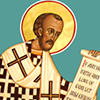
The Nicene Creed

Exploring the details of Christianity

Moderator: Moderators

Post Reply
User avatar
historia
Prodigy
Posts: 3085
Joined: Wed May 04, 2011 6:41 pm
Has thanked: 306 times
Been thanked: 473 times

The Nicene Creed

Post #1

Post by historia »

Here is the Creed that was affirmed at the Council of Nicaea, broken down into separate lines:
  1. We believe in one God,
  2. the Father almighty,
  3. maker of all things visible and invisible;
  4. And in one Lord, Jesus Christ,
  5. the Son of God,
  6. begotten from the Father uniquely --
  7. that is, from the essence of the Father,
  8. God from God,
  9. Light from Light,
  10. true God from true God,
  11. begotten, not made,
  12. of the same essence as the Father --
  13. through whom all things came to be,
  14. both the things in heaven and the things on earth,
  15. who for us human beings and for our salvation
  16. came down,
  17. and was made flesh,
  18. and became human,
  19. and suffered,
  20. and rose on the third day,
  21. and ascended into the heavens,
  22. and is coming to judge the living and the dead;
  23. And in the Holy Spirit.
Question for debate:

Which lines, if any -- you can just refer to them by number -- do you disagree with? And why?

User avatar
historia
Prodigy
Posts: 3085
Joined: Wed May 04, 2011 6:41 pm
Has thanked: 306 times
Been thanked: 473 times

Re: The Nicene Creed

Post #111

Post by historia »

tam wrote: ↑Sun Jul 19, 2026 3:50 pm
I did not wish to 'argue' or offend, and I was no sure how (or if) to respond.
You can't offend me even if you tried. And the whole point of this site is to debate, to argue, so no need to hold back.
tam wrote: ↑Sun Jul 19, 2026 3:50 pm
I was pretty sure the line meant more than what it said, which is why I delved into it more deeply.
So, it sounds like you don't disagree with the words of the Creed itself, you just disagree with how it has been generally understood. Is that a fair assessment of your position?
tam wrote: ↑Sun Jul 19, 2026 3:50 pm
"Early Church Fathers." Even the term itself is wrong (Matthew 23:9). I don't know if that term came from those men (in which case, why are they ignoring Matt 23:9?) or from others (same question.)
Was the apostle Paul wrong to use the term "father," then?
tam wrote: ↑Sun Jul 19, 2026 3:50 pm
Why go to people who are dead for answers instead of to the One who is alive?
I'm citing the ante-Nicene Fathers here just to show that this idea that the Son is co-eternal was not a novel idea introduced at the Council of Nicaea.

But, to answer your question: There are a bunch of people on this forum who all claim they are going directly to the One. Yet they wildly disagree with each other as to what the One is saying to them. It's easy for people to dillude themselves. So, this is not a reliable way to get answers.
tam wrote: ↑Sun Jul 19, 2026 3:50 pm
historia wrote: ↑Thu Jun 25, 2026 11:06 am
Irenaeus writing in the 2nd Century, for example, already can say in Against Heresies:
Irenaeus wrote:
But there is only one God, the Creator . . . He is the Father of our Lord Jesus Christ . . . But the Son, eternally co-existing with the Father, from of old, yeah, from the beginning, always reveals the Father to angels, archangels, powers, virtues, and all to whom he wills that God should be revealed.
It is interesting to me that he writes that the One God - the Creator - is the Father of Christ.
That's what the Creed says too, right? See lines 1-3.
tam wrote: ↑Sun Jul 19, 2026 3:50 pm
it does, however, contradict the term 'mother of God' on your Mary thread. Because she is not the mother of the Creator, the Father of Christ.
Mary's title, theotokos, is not claiming that she is the mother of God the Father.
tam wrote: ↑Sun Jul 19, 2026 3:50 pm
However, if the term 'eternally co-existing' contradicts what is true of my Lord (who is Wisdom) in Proverbs 8, then that term 'eternally co-existing' cannot be true.
I don't know what authority the Bible has for you, especially when anything it might say can be rejected in favor of your own sense that Christ speaks to you directly.

Is the Gospel of John authoritative for you? He has some things to say on this question.
tam wrote: ↑Sun Jul 19, 2026 3:50 pm
historia wrote: ↑Thu Jun 25, 2026 11:06 am
Or, consider Origen, writing in the early 3rd Century, in De Principiis:
Origin wrote:
[W]hat belongs to the nature of deity is common to the Father and the Son.
As the Father is eternal, so is the Son.
Are you sure that is what he meant?
Yes. Consider, for example, what Origin says in his Commentary on John:
Origen wrote:
And again, neither did He come to be in the beginning after He had not been in it, nor did He come to be with God after not having been with Him. For before all time and the remotest age the Word was in the beginning, and the Word was with God.
For Origen, there was no time when the Son was not.
tam wrote: ↑Sun Jul 19, 2026 3:50 pm
The word 'eternal' does not necessarily mean "no beginning."
Say more about this, as I'm interested in this idea.
tam wrote: ↑Sun Jul 19, 2026 3:50 pm
historia wrote: ↑Thu Jun 25, 2026 11:06 am
Think about the analogy of the Sun I mentioned above. The rays emit from the orb, so are 'begotten' from it. If the Sun was eternal -- if it always existed -- then both the orb and its rays would be eternal as well, the latter being eternally 'begotten' from the orb.
The Sun is not eternal, so it does not really compare, although I understand what you are trying to say. But then the word 'begotten' doesn't really fit, since that word carries a meaning of having been brought forth, being born.
In this analogy of the Sun, what 'begotten' is describing is that the orb is actively 'generating' the rays. If the orb stopped doing that, then the rays would disappear, right? So, it's describing the relationship between the orb and it's rays.

We can still talk about that relationship even if the Sun is 'eternal'. If you went back to the first moment of time (t = 0) and discovered that both the orb and the rays of the Sun were already there, we would have to say both the orb and the rays had no beginning -- there was never a time when they did not exist -- yet the orb is still 'generating', or 'begetting', the rays, right?

In that way, the rays would be eternally begotten.
tam wrote: ↑Sun Jul 19, 2026 3:50 pm
Even 'monogenes' (translated only begotten son, referring to Christ) carries the meaning of being born, brought forth.

Monogenes (look also at the root words):
I think this is a bit of red herring. As Bruce and I were discussing earlier in the thread (see post #87), monogenes derives from the root words monos ('one') and genos ('kind'). It often just means "unique," so BDAG.

User avatar
tam
Savant
Posts: 6985
Joined: Fri Jun 19, 2015 4:59 pm
Has thanked: 397 times
Been thanked: 369 times
Contact:

Re: The Nicene Creed

Post #112

Post by tam »

Peace to you,
historia wrote: ↑Sun Jul 19, 2026 9:05 pm
tam wrote: ↑Sun Jul 19, 2026 3:50 pm
I was pretty sure the line meant more than what it said, which is why I delved into it more deeply.
So, it sounds like you don't disagree with the words of the Creed itself, you just disagree with how it has been generally understood. Is that a fair assessment of your position?
Not just how it is understood, but how it is meant.

I would not say lines 8-10.
tam wrote: ↑Sun Jul 19, 2026 3:50 pm
"Early Church Fathers." Even the term itself is wrong (Matthew 23:9). I don't know if that term came from those men (in which case, why are they ignoring Matt 23:9?) or from others (same question.)
Was the apostle Paul wrong to use the term "father," then?
He may have been.
tam wrote: ↑Sun Jul 19, 2026 3:50 pm
Why go to people who are dead for answers instead of to the One who is alive?
I'm citing the ante-Nicene Fathers here just to show that this idea that the Son is co-eternal was not a novel idea introduced at the Council of Nicaea.

But, to answer your question: There are a bunch of people on this forum who all claim they are going directly to the One. Yet they wildly disagree with each other as to what the One is saying to them. It's easy for people to dillude themselves. So, this is not a reliable way to get answers.
People make a lot of claims.

But like you said, it is easy for people to delude themselves. So if we are following people instead of following Christ, how do we know we are not following people who have deluded themselves? Or people who have simply misunderstood.

Christ said that He is the Son of God. He said He came from the Father. He did not state that he is true god from true god (capitalized or not.) Or that He is 'light from light.' Or even 'god from god' (again, capitalized or not.)
tam wrote: ↑Sun Jul 19, 2026 3:50 pm
historia wrote: ↑Thu Jun 25, 2026 11:06 am
Irenaeus writing in the 2nd Century, for example, already can say in Against Heresies:
Irenaeus wrote:
But there is only one God, the Creator . . . He is the Father of our Lord Jesus Christ . . . But the Son, eternally co-existing with the Father, from of old, yeah, from the beginning, always reveals the Father to angels, archangels, powers, virtues, and all to whom he wills that God should be revealed.
It is interesting to me that he writes that the One God - the Creator - is the Father of Christ.
That's what the Creed says too, right? See lines 1-3.
But it says more than that in lines 8 and 10.
tam wrote: ↑Sun Jul 19, 2026 3:50 pm
it does, however, contradict the term 'mother of God' on your Mary thread. Because she is not the mother of the Creator, the Father of Christ.
Mary's title, theotokos, is not claiming that she is the mother of God the Father.
Of course not. But in quote you shared from Irenaeus:

But there is only one God, the Creator . . . He is the Father of our Lord Jesus Christ
tam wrote: ↑Sun Jul 19, 2026 3:50 pm
However, if the term 'eternally co-existing' contradicts what is true of my Lord (who is Wisdom) in Proverbs 8, then that term 'eternally co-existing' cannot be true.
I don't know what authority the Bible has for you, especially when anything it might say can be rejected in favor of your own sense that Christ speaks to you directly.

Is the Gospel of John authoritative for you? He has some things to say on this question.


Christ is authoritative for me.

But as I stated, if the term 'eternally co-existing' (and I say if, because Irenaeus is not here for me to ask what he meant), contradicts what is true of my Lord (who is Wisdom) in Proverbs 8, then that term 'eternally co-existing' cannot be true.

tam wrote: ↑Sun Jul 19, 2026 3:50 pm
historia wrote: ↑Thu Jun 25, 2026 11:06 am
Or, consider Origen, writing in the early 3rd Century, in De Principiis:
Origin wrote:
[W]hat belongs to the nature of deity is common to the Father and the Son.
As the Father is eternal, so is the Son.
Are you sure that is what he meant?
Yes. Consider, for example, what Origin says in his Commentary on John:
Origen wrote:
And again, neither did He come to be in the beginning after He had not been in it, nor did He come to be with God after not having been with Him. For before all time and the remotest age the Word was in the beginning, and the Word was with God.
For Origen, there was no time when the Son was not.
Then I would refer back to Proverbs 8.
tam wrote: ↑Sun Jul 19, 2026 3:50 pm
The word 'eternal' does not necessarily mean "no beginning."
Say more about this, as I'm interested in this idea.

If we are given the gift of eternal life - it does not mean that we have always existed. We had beginnings, even if we receive eternal life.

tam wrote: ↑Sun Jul 19, 2026 3:50 pm
historia wrote: ↑Thu Jun 25, 2026 11:06 am
Think about the analogy of the Sun I mentioned above. The rays emit from the orb, so are 'begotten' from it. If the Sun was eternal -- if it always existed -- then both the orb and its rays would be eternal as well, the latter being eternally 'begotten' from the orb.
The Sun is not eternal, so it does not really compare, although I understand what you are trying to say. But then the word 'begotten' doesn't really fit, since that word carries a meaning of having been brought forth, being born.
In this analogy of the Sun, what 'begotten' is describing is that the orb is actively 'generating' the rays. If the orb stopped doing that, then the rays would disappear, right? So, it's describing the relationship between the orb and it's rays.

We can still talk about that relationship even if the Sun is 'eternal'. If you went back to the first moment of time (t = 0) and discovered that both the orb and the rays of the Sun were already there, we would have to say both the orb and the rays had no beginning -- there was never a time when they did not exist -- yet the orb is still 'generating', or 'begetting', the rays, right?

In that way, the rays are eternally begotten.
But you have to first assume that both the orb and the rays existed eternally. We know that is not true. In order for one thing to generate another thing - the generator had to exist first (or always.)
tam wrote: ↑Sun Jul 19, 2026 3:50 pm
Even 'monogenes' (translated only begotten son, referring to Christ) carries the meaning of being born, brought forth.

Monogenes (look also at the root words):
I think this is a bit of red herring. As Bruce and I were discussing earlier in the thread (see post #87), monogenes derives from the root words monos ('one') and genos ('kind'). It often just means "unique," so BDAG.
I don't know how it could be a red herring, but I also don't know what else to say other than to post the link again:

Monogenes (see the link below for meaning and all the passages in the bible that use this word):
https://www.blueletterbible.org/lexicon ... jv/tr/0-1/

The two root words listed on that same linked page:

Monos
https://www.blueletterbible.org/lexicon ... jv/tr/0-1/

Ginomai (which does not appear to mean 'kind'):
https://www.blueletterbible.org/lexicon ... jv/tr/0-1/


Peace again.
- Non-religious Christian spirituality

- For Christ (who is the Spirit)

BruceLeiter
Sage
Posts: 594
Joined: Thu Nov 06, 2025 3:39 pm
Been thanked: 16 times

Re: The Nicene Creed

Post #113

Post by BruceLeiter »

[Replying to tam in post #110]

@tam, the wisdom in Proverbs does not refer to the Person of God who becomes Jesus by taking on a human nature. Look at the previous verses, especially verse 1, and you will see that, in the context, "Wisdom" or understanding is a poetic personification compared with a woman in the Hebrew of the divine quality of God: Pro 8:1 Does not wisdom call? Does not understanding raise her voice? Thus, the rest of the verses that you quote are her "words." 

Therefore, the "birth" is not of the Word in the past, who is part of the godhead; it is God's quality that he reveals at creation in making everything.

User avatar
historia
Prodigy
Posts: 3085
Joined: Wed May 04, 2011 6:41 pm
Has thanked: 306 times
Been thanked: 473 times

Re: The Nicene Creed

Post #114

Post by historia »

tam wrote: ↑Sun Jul 19, 2026 10:10 pm
I would not say lines 8-10.
Why?
tam wrote: ↑Sun Jul 19, 2026 10:10 pm
historia wrote: ↑Sun Jul 19, 2026 9:05 pm
There are a bunch of people on this forum who all claim they are going directly to the One. Yet they wildly disagree with each other as to what the One is saying to them. It's easy for people to dillude themselves. So, this is not a reliable way to get answers.
People make a lot of claims.

But like you said, it is easy for people to delude themselves. So if we are following people instead of following Christ, how do we know we are not following people who have deluded themselves? Or people who have simply misunderstood.
Indeed, there is a fundamental question of authority underlying all of the conversations on this forum.

What I am noting in my reply above is that the approach you have advocated -- that everyone "go directly to the One" -- has produced wildly different beliefs. In that way, it has proven to be an unreliable way of approaching things.

By the same token, the folks on here saying that the Bible alone is sufficient for determining faith and practice also arrive at completely different beliefs. This, too, has proven to be an unreliable way of approaching things.

In practice, both approaches make the individual the final arbiter of Christian faith and practice, which is why they are unreliable.
tam wrote: ↑Sun Jul 19, 2026 10:10 pm
Christ said that He is the Son of God. He said He came from the Father.
Where did you get this information from?
tam wrote: ↑Sun Jul 19, 2026 10:10 pm
He did not state that he is true god from true god (capitalized or not.) Or that He is 'light from light.' Or even 'god from god' (again, capitalized or not.)
Maybe he just hasn't told you yet.
tam wrote: ↑Sun Jul 19, 2026 10:10 pm
historia wrote: ↑Sun Jul 19, 2026 9:05 pm
Is the Gospel of John authoritative for you?
Christ is authoritative for me.
So, just to be clear, you do not believe the Gospel of John is authoritative. Correct me if that is not the case.
tam wrote: ↑Sun Jul 19, 2026 10:10 pm
historia wrote: ↑Sun Jul 19, 2026 9:05 pm
tam wrote: ↑Sun Jul 19, 2026 3:50 pm
it does, however, contradict the term 'mother of God' on your Mary thread. Because she is not the mother of the Creator, the Father of Christ.
Mary's title, theotokos, is not claiming that she is the mother of God the Father.
Of course not.
If you can respond of course here, why did you say it contradicts the title in the first place?
tam wrote: ↑Sun Jul 19, 2026 10:10 pm
historia wrote: ↑Sun Jul 19, 2026 9:05 pm
tam wrote: ↑Sun Jul 19, 2026 3:50 pm
historia wrote: ↑Thu Jun 25, 2026 11:06 am
Think about the analogy of the Sun I mentioned above. The rays emit from the orb, so are 'begotten' from it. If the Sun was eternal -- if it always existed -- then both the orb and its rays would be eternal as well, the latter being eternally 'begotten' from the orb.
The Sun is not eternal, so it does not really compare, although I understand what you are trying to say. But then the word 'begotten' doesn't really fit, since that word carries a meaning of having been brought forth, being born.
In this analogy of the Sun, what 'begotten' is describing is that the orb is actively 'generating' the rays. If the orb stopped doing that, then the rays would disappear, right? So, it's describing the relationship between the orb and it's rays.

We can still talk about that relationship even if the Sun is 'eternal'. If you went back to the first moment of time (t = 0) and discovered that both the orb and the rays of the Sun were already there, we would have to say both the orb and the rays had no beginning -- there was never a time when they did not exist -- yet the orb is still 'generating', or 'begetting', the rays, right?

In that way, the rays are eternally begotten.
But you have to first assume that both the orb and the rays existed eternally. We know that is not true.
Well, yeah, I'm not trying to argue the Sun is actually eternal. I'm posing a hypothetical scenario here to illustrate a logical point. If it helps to think it's a different star than our Sun, just substitute that instead.

Suppose we go back to the first moment of time (t = 0) and we see the orb and rays of the Sun already there. Both would have no beginning -- there would have been no time when they did not exist, right? But the rays are being generated from the orb -- if the orb stopped generating the rays, then the rays would disappear, right?
tam wrote: ↑Sun Jul 19, 2026 10:10 pm
In order for one thing to generate another thing - the generator had to exist first (or always.)
That is typically the case, because the things that we are familiar with exist within time, long after the universe was created. What I'm asking you to consider in the hypothetical situation above is an edge case. Does your maxim hold true in that edge case?
tam wrote: ↑Sun Jul 19, 2026 10:10 pm
historia wrote: ↑Sun Jul 19, 2026 9:05 pm
tam wrote: ↑Sun Jul 19, 2026 3:50 pm
Even 'monogenes' (translated only begotten son, referring to Christ) carries the meaning of being born, brought forth.

Monogenes (look also at the root words):
I think this is a bit of red herring. As Bruce and I were discussing earlier in the thread (see post #87), monogenes derives from the root words monos ('one') and genos ('kind'). It often just means "unique," so BDAG.
I don't know how it could be a red herring
It's a bit of a red herring because the Creed already speaks of the Son as begotten (gennethenta) of the Father. So it doesn't really matter one way or the other what the word monogenes means, at least for the purposes of evaluating the Creed.
tam wrote: ↑Sun Jul 19, 2026 10:10 pm
I also don't know what else to say other than to post the link again:

Monogenes (see the link below for meaning and all the passages in the bible that use this word):
https://www.blueletterbible.org/lexicon ... jv/tr/0-1/

The two root words listed on that same linked page:

Monos
https://www.blueletterbible.org/lexicon ... jv/tr/0-1/

Ginomai (which does not appear to mean 'kind'):
https://www.blueletterbible.org/lexicon ... jv/tr/0-1/
One of the problems with relying on free Greek language resources you find on the Web is that they can be outdated. This site, in particular, is relying on 19th Century biblical scholarship, since those works have fallen out of copyright, and so can be reproduced without royalties.

Scholarship on the etymology of monogenes has evolved over time. That is why I cited the standard lexicon for koine Greek, BDAG, which shows the consensus of modern scholarship, namely that the etymology of monogenes is monos ('one') and genos ('kind').

Hope that helps.

User avatar
tam
Savant
Posts: 6985
Joined: Fri Jun 19, 2015 4:59 pm
Has thanked: 397 times
Been thanked: 369 times
Contact:

Re: The Nicene Creed

Post #115

Post by tam »

Peace to you,
historia wrote: ↑Wed Jul 22, 2026 6:27 pm
tam wrote: ↑Sun Jul 19, 2026 10:10 pm
I would not say lines 8-10.
Why?
Because Christ did not describe Himself thus.
tam wrote: ↑Sun Jul 19, 2026 10:10 pm
historia wrote: ↑Sun Jul 19, 2026 9:05 pm
There are a bunch of people on this forum who all claim they are going directly to the One. Yet they wildly disagree with each other as to what the One is saying to them. It's easy for people to dillude themselves. So, this is not a reliable way to get answers.
People make a lot of claims.

But like you said, it is easy for people to delude themselves. So if we are following people instead of following Christ, how do we know we are not following people who have deluded themselves? Or people who have simply misunderstood.
Indeed, there is a fundamental question of authority underlying all of the conversations on this forum.

What I am noting in my reply above is that the approach you have advocated -- that everyone "go directly to the One" -- has produced wildly different beliefs. In that way, it has proven to be an unreliable way of approaching things.

By the same token, the folks on here saying that the Bible alone is sufficient for determining faith and practice also arrive at completely different beliefs. This, too, has proven to be an unreliable way of approaching things.

In practice, both approaches make the individual the final arbiter of Christian faith and practice, which is why they are unreliable.
You will need to add religion (the various sects and denominations) into that mix.

I know that Christ is reliable. He is the Truth and the One to whom God said to listen. So I'm going to do that and keep doing it. Christ has not led me wrong.

People on the other hand are unreliable and can/do make mistakes, even if they are the Bishop of Rome.


Everything should be held up against the Light (who is Christ) - whether it is something written in the bible, or something that a religion/religious leader says, or something a person claims to have heard.

If a person does not yet hear His voice, they can certainly ask (God and His Son) for ears to hear. They can test against love - at the very least act out of love - for 'love covers over a multitude of sins' and 'against love, there is no law.' They can also at least look at what HE (Christ) is written to have said.

tam wrote: ↑Sun Jul 19, 2026 10:10 pm
Christ said that He is the Son of God. He said He came from the Father.
Where did you get this information from?
These are things that Christ said in what is written.
tam wrote: ↑Sun Jul 19, 2026 10:10 pm
He did not state that he is true god from true god (capitalized or not.) Or that He is 'light from light.' Or even 'god from god' (again, capitalized or not.)
Maybe he just hasn't told you yet.
Until such a time (if ever), I am not comfortable saying them.

Especially when His words in what is written states that His Father is the one true God.

He is the Son of God. That is what He has said of Himself. That is also what the Father said of Him.


historia wrote: ↑Sun Jul 19, 2026 9:05 pm
Is the Gospel of John authoritative for you?
The one who wrote it was a direct witness to Christ. I think the testimony is accurate (possibly some scribal/translation errors.)

Christ is authoritative for me.
So, just to be clear, you do not believe the Gospel of John is authoritative. Correct me if that is not the case.
See above.

For the difference - Christ is the Word of God, everything He says is true, He is the Truth. He says it, I know it is true.

tam wrote: ↑Sun Jul 19, 2026 10:10 pm
historia wrote: ↑Sun Jul 19, 2026 9:05 pm
tam wrote: ↑Sun Jul 19, 2026 3:50 pm
it does, however, contradict the term 'mother of God' on your Mary thread. Because she is not the mother of the Creator, the Father of Christ.
Mary's title, theotokos, is not claiming that she is the mother of God the Father.
Of course not.
If you can respond of course here, why did you say it contradicts the title in the first place?
Because what you posted of Irenaeus' definition of God contradicts the term 'mother of God' (if "God" is referring to Christ.) Irenaeus' definition stated,

But there is only one God, the Creator . . . He is the Father of our Lord Jesus Christ . . .


Only one God: The Creator, the Father of Christ
tam wrote: ↑Sun Jul 19, 2026 10:10 pm
historia wrote: ↑Sun Jul 19, 2026 9:05 pm
tam wrote: ↑Sun Jul 19, 2026 3:50 pm

The Sun is not eternal, so it does not really compare, although I understand what you are trying to say. But then the word 'begotten' doesn't really fit, since that word carries a meaning of having been brought forth, being born.
In this analogy of the Sun, what 'begotten' is describing is that the orb is actively 'generating' the rays. If the orb stopped doing that, then the rays would disappear, right? So, it's describing the relationship between the orb and it's rays.

We can still talk about that relationship even if the Sun is 'eternal'. If you went back to the first moment of time (t = 0) and discovered that both the orb and the rays of the Sun were already there, we would have to say both the orb and the rays had no beginning -- there was never a time when they did not exist -- yet the orb is still 'generating', or 'begetting', the rays, right?

In that way, the rays are eternally begotten.
But you have to first assume that both the orb and the rays existed eternally. We know that is not true.
Well, yeah, I'm not trying to argue the Sun is actually eternal. I'm posing a hypothetical scenario here to illustrate a logical point. If it helps to think it's a different star than our Sun, just substitute that instead.

Suppose we go back to the first moment of time (t = 0) and we see the orb and rays of the Sun already there. Both would have no beginning -- there would have been no time when they did not exist, right? But the rays are being generated from the orb -- if the orb stopped generating the rays, then the rays would disappear, right?
Correct.
tam wrote: ↑Sun Jul 19, 2026 10:10 pm
In order for one thing to generate another thing - the generator had to exist first (or always.)
That is typically the case, because the things that we are familiar with exist within time, long after the universe was created. What I'm asking you to consider in the hypothetical situation above is an edge case. Does your maxim hold true in that edge case?
My point was that you have to assume a hypothetical even for this 'edge case.' The claim 'the Son is eternal' (if that means that He was not given birth, that He was not brought forth), is a hypothesis, an assumption.

It contradicts what is written about my Lord (Wisdom) in Proverbs 8 - but even if it did not, the claim is still a hypothesis, an assumption. Is it not?
tam wrote: ↑Sun Jul 19, 2026 10:10 pm
historia wrote: ↑Sun Jul 19, 2026 9:05 pm
tam wrote: ↑Sun Jul 19, 2026 3:50 pm
Even 'monogenes' (translated only begotten son, referring to Christ) carries the meaning of being born, brought forth.

Monogenes (look also at the root words):
I think this is a bit of red herring. As Bruce and I were discussing earlier in the thread (see post #87), monogenes derives from the root words monos ('one') and genos ('kind'). It often just means "unique," so BDAG.
I don't know how it could be a red herring
It's a bit of a red herring because the Creed already speaks of the Son as begotten (gennethenta) of the Father. So it doesn't really matter one way or the other what the word monogenes means, at least for the purposes of evaluating the Creed.
Okay.
tam wrote: ↑Sun Jul 19, 2026 10:10 pm
I also don't know what else to say other than to post the link again:

Monogenes (see the link below for meaning and all the passages in the bible that use this word):
https://www.blueletterbible.org/lexicon ... jv/tr/0-1/

The two root words listed on that same linked page:

Monos
https://www.blueletterbible.org/lexicon ... jv/tr/0-1/

Ginomai (which does not appear to mean 'kind'):
https://www.blueletterbible.org/lexicon ... jv/tr/0-1/
One of the problems with relying on free Greek language resources you find on the Web is that they can be outdated. This site, in particular, is relying on 19th Century biblical scholarship, since those works have fallen out of copyright, and so can be reproduced without royalties.

Scholarship on the etymology of monogenes has evolved over time. That is why I cited the standard lexicon for koine Greek, BDAG, which shows the consensus of modern scholarship, namely that the etymology of monogenes is monos ('one') and genos ('kind').

Hope that helps.
[/quote]


Thank you. It is interesting. I believe it is being disputed. Regardless, we can remove the word monogenes from our discussion.

I will point out the the people who wrote the nicene creed appear to be drawing a very clear distinction here: "begotten, not made." If begotten meant only 'one of a kind', then how would that direct comparison make sense?


Peace to you!

- Non-religious Christian spirituality

- For Christ (who is the Spirit)

User avatar
NeutralZone
Apprentice
Posts: 111
Joined: Fri Jun 20, 2025 6:46 pm
Been thanked: 7 times

Re: The Nicene Creed

Post #116

Post by NeutralZone »

BruceLeiter wrote: ↑Tue Jul 14, 2026 11:56 am [Replying to NeutralZone in post #104]

So, @NeutralZone, why do you require a single verse. I think that I have already given you several verses that add up to the clear biblical teaching that God is three Persons in one God. Aren't those enough for you? That's okay if you reject that truth; that's your right.

As far as lexicons go, it's BIBLICAL lexicons that I am talking about, which define words according to their usages IN the Bible without depending on liberal scholars who do not take the Bible's inspiration seriously. Those lexicons do a good job of defining words within the Bible.

You won't find a single verse of scripture in Jehovah's inspired word in support of Christendom's Trinity. That's the point I'm making.


NeutralZone


________________
". . . be swift about hearing, slow about speaking, slow about wrath. . . . " (James 1:19-20)

User avatar
NeutralZone
Apprentice
Posts: 111
Joined: Fri Jun 20, 2025 6:46 pm
Been thanked: 7 times

Re: The Nicene Creed

Post #117

Post by NeutralZone »

BruceLeiter wrote: ↑Tue Jul 14, 2026 11:56 am [Replying to NeutralZone in post #104]

So, @NeutralZone, why do you require a single verse. I think that I have already given you several verses that add up to the clear biblical teaching that God is three Persons in one God. Aren't those enough for you? That's okay if you reject that truth; that's your right.

As far as lexicons go, it's BIBLICAL lexicons that I am talking about, which define words according to their usages IN the Bible without depending on liberal scholars who do not take the Bible's inspiration seriously. Those lexicons do a good job of defining words within the Bible.
The routine of Trinitarians is to cherry-pick a verse of scripture and ignore its context (surrounding words, verses, and chapters). Without context, anyone can put whatever meaning they want to the isolated verse or isolated words within a verse. That's exactly what you have done, BruceLeiter.


NeutralZone


________________
". . . be swift about hearing, slow about speaking, slow about wrath. . . . " (James 1:19-20)

User avatar
NeutralZone
Apprentice
Posts: 111
Joined: Fri Jun 20, 2025 6:46 pm
Been thanked: 7 times

Re: The Nicene Creed

Post #118

Post by NeutralZone »

BruceLeiter wrote: ↑Tue Jul 14, 2026 11:56 am [Replying to NeutralZone in post #104]

So, @NeutralZone, why do you require a single verse. I think that I have already given you several verses that add up to the clear biblical teaching that God is three Persons in one God. Aren't those enough for you? That's okay if you reject that truth; that's your right.

As far as lexicons go, it's BIBLICAL lexicons that I am talking about, which define words according to their usages IN the Bible without depending on liberal scholars who do not take the Bible's inspiration seriously. Those lexicons do a good job of defining words within the Bible.
It doesn't matter what type of lexicon you're talking about. Capbook came up with that same nonsense, insisting that "Biblical" lexicons are different from other types of lexicons. They are not. Lexicons of all kinds are composed of a list of words that do not provide word meaning. The person who authored the lexicon proceeds to string the words together to suit his or her personal philosophy. Below is the definition of lexicon again.


"A lexicon is a list of words that belong to a particular language.

Sometimes, lexicon is used as another word for thesaurus (see below)

A dictionary is a list of words and phrases that are (or were) in common usage, together with their definitions - so a dictionary is different from a lexicon because a lexicon is a simple list and doesn't define the words."
https://english.stackexchange.com/questions/34968/difference-between-lexicon-and-dictionary


NeutralZone


________________
". . . be swift about hearing, slow about speaking, slow about wrath. . . . " (James 1:19-20)

placebofactor
Guru
Posts: 2156
Joined: Wed Nov 20, 2024 3:37 pm
Location: Tuscaloosa Alabama
Been thanked: 122 times
Contact:

Re: The Nicene Creed

Post #119

Post by placebofactor »

NeutralZone wrote: ↑Fri Jul 24, 2026 12:32 pm
BruceLeiter wrote: ↑Tue Jul 14, 2026 11:56 am [Replying to NeutralZone in post #104]

So, @NeutralZone, why do you require a single verse. I think that I have already given you several verses that add up to the clear biblical teaching that God is three Persons in one God. Aren't those enough for you? That's okay if you reject that truth; that's your right.

As far as lexicons go, it's BIBLICAL lexicons that I am talking about, which define words according to their usages IN the Bible without depending on liberal scholars who do not take the Bible's inspiration seriously. Those lexicons do a good job of defining words within the Bible.
The routine of Trinitarians is to cherry-pick a verse of scripture and ignore its context (surrounding words, verses, and chapters). Without context, anyone can put whatever meaning they want to the isolated verse or isolated words within a verse. That's exactly what you have done, BruceLeiter.


NeutralZone


________________
". . . be swift about hearing, slow about speaking, slow about wrath. . . . " (James 1:19-20)
NeutralZone, sounds to me like you don't know what you're talking about. "Cherry-pick", I love cherries, and when younger, loved to pick them. Now I'm too old to climb trees, but I can tell others how to climb and pick.

Biblical lexicons are specialized reference works designed to help readers and scholars interpret the original languages of the Bible with precision and depth, primarily Hebrew, Aramaic, and Greek. While all lexicons catalog words and their meanings, biblical lexicons have several key distinctions from general or modern lexicons.

Their focus is on Ancient Languages. Most are keyed to the original biblical languages, not modern vernaculars. They provide detailed entries for terms as they appeared in the Hebrew Bible, Aramaic portions of the Old Testament, and the Greek New Testament. This is essential because ancient languages have complex grammar, syntax, and semantic ranges that differ significantly from contemporary usage.

Unlike standard dictionaries, which often give brief definitions, biblical lexicons offer comprehensive lexical entries including root analysis, grammatical patterns, inflectional forms, semantic ranges, contextual nuances,
Historical usage and cross-references to related languages, scriptural citations showing how the term appears in the Bible.

Biblical lexicons help avoid misinterpretations by showing how a single term can have multiple meanings depending on context. For example, the Greek logos can mean “word,” “statement,” “reason,” or “message” in different passages. This level of detail is critical for accurate biblical interpretation.

Biblical lexicons often draw on manuscript evidence, such as in the Dead Sea Scrolls, the Septuagint, Targumim, and rabbinic literature, to trace how terms evolved and were used. This historical grounding is absent in most modern lexicons, which focus on current language use.

Many biblical lexicons are bilingual and may be keyed to concordances or theological dictionaries for easy cross-referencing Bible Study Tools. They are often used alongside concordances and commentaries in scholarly and pastoral study. A biblical lexicon is not just a dictionary; it’s a tool tailored to the study of ancient biblical languages. It goes beyond simple translation to explain how words functioned in their original contexts, making it indispensable for accurate biblical interpretation.

User avatar
Richard Aberdeen
Scholar
Posts: 284
Joined: Thu Jun 04, 2026 3:39 pm
Location: California
Been thanked: 11 times
Contact:

Re: The Nicene Creed

Post #120

Post by Richard Aberdeen »

[Replying to historia in post #1]

This creed is religious nonsense. No follower of Jesus is required to adhere to this creed. The New Testament clearly says, "whoever calls on the name of the Lord will be saved." No Christianity or foolish creed required, necessary or desired.
In Search of the Real Jesus
https://FreedomTracks.com/revolution.html

Post Reply