Our Universe: one of many or specially designed?

Creationism, Evolution, and other science issues

Moderator: Moderators

Post Reply
User avatar
QED
Prodigy
Posts: 3798
Joined: Sun Jan 30, 2005 5:34 am
Location: UK

Our Universe: one of many or specially designed?

Post #1

Post by QED »

Design amounts to a process of selection. Human designers design things by making intelligent selections. Our Universe has a number of critical parameters that have no apparent reason for their values, but if these values were even slightly different, we wouldn't exist. This suggests to some that the values were carefully selected by a sentient being who had the intelligence to know the exact values required for our existence.

I've illustrated this scenario in the following picture:

Image

Here our Universe, with it's critical values, is all that exists -- besides its sentient, designer-creator.

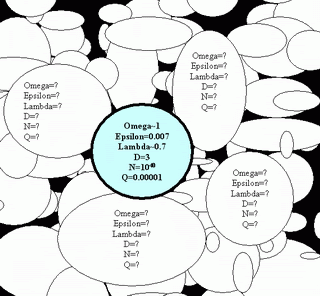
However, other forms of selection are possible. The simple act of observation can create its own selection Effect. In the illustration that follows I have drawn our Universe surrounded by numerous other universes. Within this ensemble the vast majority could be expected to have parameters that would not support life (at least in a form that would be recognizable to us). But a tiny number might. We could, therefore, have selected our own Universe as one from many, simply as a consequence of it having a favorable set of parameters for our existence.

Image

If we are only considering the empirical evidence furnished by scientific observations then both scenarios would seem to be functionally equivalent. How then can we claim that the apparent fine-tuning implies a designer-creator when we can see this potential for ambiguity?

User avatar
QED
Prodigy
Posts: 3798
Joined: Sun Jan 30, 2005 5:34 am
Location: UK

Post #51

Post by QED »

4gold wrote:
QED wrote:4gold suggests that Occam's razor can be applied to yield a definitive conclusion.
I just wanted to clarify this remark. Occam's razor is never used to yield a definitive conclusion. I hope that I said we could use Occam's razor to yield a preferred answer.
Sure, but I think it's only reasonable to ask for a reason for a preference. There may be other reasons but as Tegmark points out, Occam isn't one of them.

I just want to digress a moment into the reasons one might have for discarding the multiverse hypotheses. I don't think it can be written-off by saying it's too far-fetched or unrealistic to have something outside our universe as a cause for it -- not if, in the next sentence, we declare our belief in a God with the exact same properties. This belief contains an unquestioning acceptance that the intricacies of nature have been cleverly and deliberately devised by a sentience who knew how to engineer such things form scratch. I personally find that much harder to swallow than to admit something that allows self-selection to take place instead.

This swaps the unexplained, concentrated, intelligence of God for an unexplained, diffuse and unstructured gas of physics. It seems to me that we tend to massively underestimate the extent of things when we start looking into them. There seems to me to be great parallels between the omnipotence, omniscience etc. of a "really big God" and a meta-universe that makes ours look like a single atom within our own universe. The only distinguishing feature is the subtle inference of intent which, I would say for purely human social reasons, is something we hope to see.

acamp1
Scholar
Posts: 285
Joined: Sun Apr 08, 2007 12:50 am
Location: Massachusetts

Post #52

Post by acamp1 »

The only distinguishing feature is the subtle inference of intent which, I would say for purely human social reasons, is something we hope to see.
Well said, QED. Clearly, we are alive, we are conscious, and life wants to stay alive. There's *some* force there.

Whether that force is analogous to an intelligent human mind - even on an impossibly grand scale - is open to debate.

I do not consciously control my heart, yet it continues to beat. It is not my conscious intent that keeps it going, but something else, an involuntary "force." In this same way the universe may perpetuate life; there can be "intelligence" without conscious intent.

User avatar
QED
Prodigy
Posts: 3798
Joined: Sun Jan 30, 2005 5:34 am
Location: UK

Post #53

Post by QED »

Ncik666 wrote: The various aspects of life are a bit weird but life does not neccessarily have to be what we define it as. For instance I once read a science fiction short story about an entire planet on the edge of the galaxy that was made of a superconductor. The planet ended up functioning like a brain or vastly intelligent computer. Don't talk about wether this is possible or not, what I'm trying to say is that short of the Universe collapsing in on itself right after formation that life could have evolved in some extremely strange ways. I have no doubts that the Universe could have been very different for instance there could have been no stars, that doesn't mean life couldn't have existed. That just means life in any way similar to us could have existed.
This leads to the role of speculation in the arguments for a multiverse. otseng would prefer we based our conclusions on what we can see rather than what we suppose we might see if our view wasn't so restricted. But knowing that we have a restricted view should make for caution. It becomes an assumption that we have the full context for our existence and we should list our assumptions when laying claim to knowledge. I've never seen any assumptions listed before theological claims.

4gold
Sage
Posts: 527
Joined: Wed Jun 15, 2005 3:33 pm
Location: Michigan

Post #54

Post by 4gold »

QED wrote:Sure, but I think it's only reasonable to ask for a reason for a preference. There may be other reasons but as Tegmark points out, Occam isn't one of them.
I think the question is perfectly suited for Occam's razor. We satisfy all the requirements -- (1) two reasonable hypotheses that answer the same question, and (2) an underdetermined thesis.

Tegmark incorrectly tries to deflect the Occam's argument by claiming that mutliple universe theory shouldn't even qualify for Occam's, since the theory is reasonable on its own. But reasonableness of the hypothesis does not exclude the hypothesis from Occam. It is a requirement for Occam!

As Jarrold Katz writes,
If a hypothesis, H, explains the same evidence as a hypothesis G, but does so by postulating more entities than G, then, other things being equal, the evidence has to bear greater weight in the case of H than in the case of G, and hence the amount of support it gives H is proportionately less than it gives G.
QED wrote:I just want to digress a moment into the reasons one might have for discarding the multiverse hypotheses. I don't think it can be written-off by saying it's too far-fetched or unrealistic to have something outside our universe as a cause for it -- not if, in the next sentence, we declare our belief in a God with the exact same properties. This belief contains an unquestioning acceptance that the intricacies of nature have been cleverly and deliberately devised by a sentience who knew how to engineer such things form scratch. I personally find that much harder to swallow than to admit something that allows self-selection to take place instead.
Your original post framed the debate as an argument between Intelligent Design and Multiple Universe theories. Using a debate framed in these terms, we find that neither can supported with physical evidence, and therefore they are "equal" (I think that's the word you originally used). However, if the debate is framed as a comparison between multiple universe theory and single universe theory, I feel that single universe theory clearly takes precedence, due to Occam's razor.

Also, I never claimed multiple universe theory is far-fetched, but it doesn't appear you were accusing me of such things. I think it is a reasonable theory to explain why we observe our universe the way we do.
QED wrote:This swaps the unexplained, concentrated, intelligence of God for an unexplained, diffuse and unstructured gas of physics. It seems to me that we tend to massively underestimate the extent of things when we start looking into them. There seems to me to be great parallels between the omnipotence, omniscience etc. of a "really big God" and a meta-universe that makes ours look like a single atom within our own universe. The only distinguishing feature is the subtle inference of intent which, I would say for purely human social reasons, is something we hope to see.
Allow me to flip your argument. You are arguing that the reason we seem to theorize an omnipotent, omniscient God is to explain "the subtle inference of intent".

But I would argue that the reason we even theorize about multiple universes is to justify the philosophical argument that the universe we observe could have occurred by chance.

acamp1
Scholar
Posts: 285
Joined: Sun Apr 08, 2007 12:50 am
Location: Massachusetts

Post #55

Post by acamp1 »

Chance should not be a bad word.

It's a part of the way the world works, indeed the universe. It's part of the "design".

Chance and intent need not be mutually exclusive.

We may exist in a world that owes its existence to statistical probability. Statistic probability may be the means by which the creative intelligence - if it exists - created.

4gold
Sage
Posts: 527
Joined: Wed Jun 15, 2005 3:33 pm
Location: Michigan

Post #56

Post by 4gold »

acamp1 wrote:Chance should not be a bad word.

It's a part of the way the world works, indeed the universe. It's part of the "design".

Chance and intent need not be mutually exclusive.

We may exist in a world that owes its existence to statistical probability. Statistic probability may be the means by which the creative intelligence - if it exists - created.
Intent can include chance, but chance cannot include intent.

acamp1
Scholar
Posts: 285
Joined: Sun Apr 08, 2007 12:50 am
Location: Massachusetts

Post #57

Post by acamp1 »

Intent can include chance, but chance cannot include intent.
So.... we've narrowed it down. There might have been conscious intent. There might have been unconscious intent. There might have been no intent.

Feels good!

User avatar
QED
Prodigy
Posts: 3798
Joined: Sun Jan 30, 2005 5:34 am
Location: UK

Post #58

Post by QED »

4gold wrote:
QED wrote:Sure, but I think it's only reasonable to ask for a reason for a preference. There may be other reasons but as Tegmark points out, Occam isn't one of them.
I think the question is perfectly suited for Occam's razor. We satisfy all the requirements -- (1) two reasonable hypotheses that answer the same question, and (2) an underdetermined thesis.

Tegmark incorrectly tries to deflect the Occam's argument by claiming that mutliple universe theory shouldn't even qualify for Occam's, since the theory is reasonable on its own. But reasonableness of the hypothesis does not exclude the hypothesis from Occam. It is a requirement for Occam!
I didn't get this from my reading. Admittedly he does start by saying:
Tegmark wrote:The first argument is that multiverse theories are vulnerable to Occam's razor because they postulate the existence of other worlds that we can never observe..
But he then goes on to point out the inherent simplicity possessed by the set over the specific subset. The subset requires an extraction routine -- either careful and deliberate selection, or self-selection using our conscious emergence to select from all possible observational standpoints. He invites us to feed that into Occam's razor and see what comes out.
4gold wrote: Your original post framed the debate as an argument between Intelligent Design and Multiple Universe theories. Using a debate framed in these terms, we find that neither can supported with physical evidence, and therefore they are "equal" (I think that's the word you originally used). However, if the debate is framed as a comparison between multiple universe theory and single universe theory, I feel that single universe theory clearly takes precedence, due to Occam's razor.
Obviously that's the case. But we're not supposing that this single universe is all there is (i.e. has it's own cause within itself). Supporters of ID are suggesting a meta-state for this universe (i.e. a creation phase that marks the transition between the universe not existing and existing). My aim is to present two distinctly different meta-states and ask how we can determine which pertains.
4gold wrote:Also, I never claimed multiple universe theory is far-fetched, but it doesn't appear you were accusing me of such things. I think it is a reasonable theory to explain why we observe our universe the way we do.
Quite so. I understand you as having given the matter a good deal of thought. But there's a wider audience for this topic and not everyone seems to appreciate the "worth" of the various concepts on the table.
4gold wrote:
QED wrote:This swaps the unexplained, concentrated, intelligence of God for an unexplained, diffuse and unstructured gas of physics. It seems to me that we tend to massively underestimate the extent of things when we start looking into them. There seems to me to be great parallels between the omnipotence, omniscience etc. of a "really big God" and a meta-universe that makes ours look like a single atom within our own universe. The only distinguishing feature is the subtle inference of intent which, I would say for purely human social reasons, is something we hope to see.
Allow me to flip your argument. You are arguing that the reason we seem to theorize an omnipotent, omniscient God is to explain "the subtle inference of intent".

But I would argue that the reason we even theorize about multiple universes is to justify the philosophical argument that the universe we observe could have occurred by chance.

Naturally there's a symmetryhere too. That's why even the greatest of human minds have been unable to resolve this issue one way or the other in a convincing manner. What I wanted to draw attention to was a possible psychological motivator that might explain how, in the face of such a perfect conceptual symmetry, so many people go so strongly with one particular interpretation. We know from the discussion so far that it cannot be on the basis of the empirical evidence at our disposal.

User avatar
QED
Prodigy
Posts: 3798
Joined: Sun Jan 30, 2005 5:34 am
Location: UK

Post #59

Post by QED »

acamp1 wrote:Chance should not be a bad word.

It's a part of the way the world works, indeed the universe. It's part of the "design".
What design? :lol: It's certainly a part of the process. People jump on the traps set by language whenever they can. The principle of evolution by natural selection can be seen as a design generating principle. The fact that the designs have to "stand up" implies a degree of intelligence, yet the principle can be seen to contain no intelligence of the sort we employ in our decision making. We select our materials and the way we configure them in a different way to the way evolution does it but the end-results can be similar.

Likewise selection of physics that can sustain life can be performed by those very same life-forms in a sufficiently large landscape of varied physics. Same result as careful selection by a sentient mind but a totally different process.

acamp1
Scholar
Posts: 285
Joined: Sun Apr 08, 2007 12:50 am
Location: Massachusetts

Post #60

Post by acamp1 »

What design?
Right... keep in mind I put the word "design" in quotes!

Post Reply