QED wrote:Sure, but I think it's only reasonable to ask for a reason for a preference. There may be other reasons but as Tegmark points out, Occam isn't one of them.
I think the question is perfectly suited for Occam's razor. We satisfy all the requirements -- (1) two reasonable hypotheses that answer the same question, and (2) an underdetermined thesis.
Tegmark incorrectly tries to deflect the Occam's argument by claiming that mutliple universe theory shouldn't even qualify for Occam's, since the theory is reasonable on its own. But reasonableness of the hypothesis does not exclude the hypothesis from Occam. It is a requirement for Occam!
As Jarrold Katz writes,
If a hypothesis, H, explains the same evidence as a hypothesis G, but does so by postulating more entities than G, then, other things being equal, the evidence has to bear greater weight in the case of H than in the case of G, and hence the amount of support it gives H is proportionately less than it gives G.
QED wrote:I just want to digress a moment into the reasons one might have for discarding the multiverse hypotheses. I don't think it can be written-off by saying it's too far-fetched or unrealistic to have something outside our universe as a cause for it -- not if, in the next sentence, we declare our belief in a God with the exact same properties. This belief contains an unquestioning acceptance that the intricacies of nature have been cleverly and deliberately devised by a sentience who knew how to engineer such things form scratch. I personally find that much harder to swallow than to admit something that allows self-selection to take place instead.
Your original post framed the debate as an argument between Intelligent Design and Multiple Universe theories. Using a debate framed in these terms, we find that neither can supported with physical evidence, and therefore they are "equal" (I think that's the word you originally used). However, if the debate is framed as a comparison between multiple universe theory and single universe theory, I feel that single universe theory clearly takes precedence, due to Occam's razor.
Also, I never claimed multiple universe theory is far-fetched, but it doesn't appear you were accusing me of such things. I think it is a reasonable theory to explain why we observe our universe the way we do.
QED wrote:This swaps the unexplained, concentrated, intelligence of God for an unexplained, diffuse and unstructured gas of physics. It seems to me that we tend to massively underestimate the extent of things when we start looking into them. There seems to me to be great parallels between the omnipotence, omniscience etc. of a "really big God" and a meta-universe that makes ours look like a single atom within our own universe. The only distinguishing feature is the subtle inference of intent which, I would say for purely human social reasons, is something we hope to see.
Allow me to flip your argument. You are arguing that the reason we seem to theorize an omnipotent, omniscient God is to explain "the subtle inference of intent".
But I would argue that the reason we even theorize about multiple universes is to justify the philosophical argument that the universe we observe could have occurred by chance.



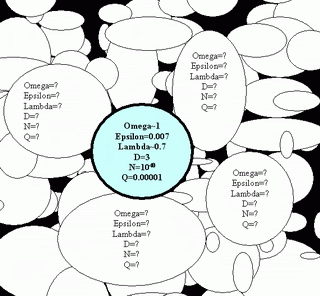
 It's certainly a part of the process. People jump on the traps set by language whenever they can. The principle of evolution by natural selection can be seen as a design generating principle. The fact that the designs have to "stand up" implies a degree of intelligence, yet the principle can be seen to contain no intelligence of the sort we employ in our decision making. We select our materials and the way we configure them in a different way to the way evolution does it but the end-results can be similar.
