Justin108 wrote:JehovahsWitness wrote:
The only thing we do know is he broke the law, we can reasonably suppose he was fully aware of the law, the Sabbath law was first orally pronounced and agreed upon by the nation as a whole
It was agreed upon at one point by the nation as a whole, but that does not mean that later generations would agree.
I have already addressed this point but I will write a post to add some detail.
QUESTION: Is it conceivable that the Sabbath Breaker was ignorant of the law?
We do not know exactly when this incident happened but there are enough details provided in scripture to come to some reasonable conclusions as to time frame.
According to bible chronology, the nation left Egypt in the Jewish month of Nisan (Late March/April) 1513 BCE. The law was given a little time after that and the tablenacle (the Jewish center for worship) completed in the same month one year later (Nisan 1-7, 1512 B.C.E). Several events ensued, with the nation breaking camp from Mount Sinai, delaying because of Miriams leprosy, and culminating in the report of the ten spies and the Korathite rebellion which ultimately marked the beginning of the 40 year sejourn in the desert (Numbers chapters 14 - 19). It is in the middle of this final pre-40 year sejourn that the specific case is mentioned (Numbers 15).
What can we resonably conclude? That we obviously were not dealing with a different generation. The older generation was to die off during that 40 years of wandering in the desert, and that generation, including Moses himself were still active in the events directly mentioned along with the incident. Even if the events are not recorded in a strictly chronological order the indications are that we are looking at a period of less than 2 or 3 years after the law was given when Moses, Aaron, Miriam, Korah, Dathan etc were contenders for tribal authority and certainly NOT a generation after the giving of the national law.
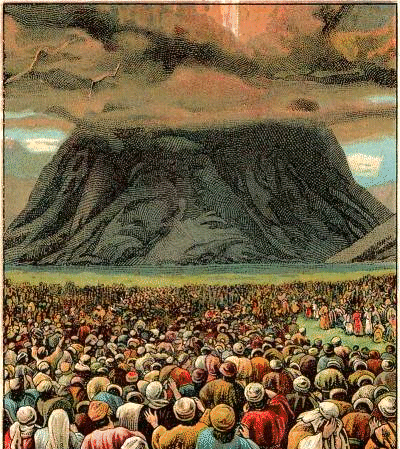
Laws given at Mount Sinai For anyone that reads the giving of the Ten Commandements in Exodus Chapter 19 (Deut chap 4,5) it is evident that it is highly improbable any adult didn't know about the 4th Commandement. The entire nation was instructed to congregate at the base of the mountain which smokes and rocks [Ex 19:16-19 ; Ps 68:8]; God's voice is heard pronouncing the Ten Commandements from the midst of the fire and the cloud within the hearing of the people. [Ex 20:22; ; De 4:12, 36, Deut 5]. The words are recorded (written down) and early the next morning validate in a public ceremony. Later God himself writes them on tablets of stone and the nation keeps them as a memorial. To suggest after all that there were people that lived through all this but not know the sabbath Law stretches credulity to a ridiulous degree.
The Nation of Israel hearing the Ten Commandements
 "Speak to the Sons of Israel
": Unlike most countries today, the Mosaic Law was also part of the nation's system of worship. In other words, law and worship were tied together. This is in fact most evident in the self same Sabbath Law (the 4th of the "Ten commandements"). It was for this reason that firstly elders (older respected men in the community) and then Priests where appointed to instruct the people about the law. Of all the laws given, that sanctity of the Sabbath was one that directly affected the population on a weekly basis. So not working on the Sabbath would have not only been enshrined in law but
was part of the nations culture. In short, it would have been virtually impossible to live in the community and not be aware that work (including the daily task of collecting wood to make fire to cook food) was not done on the Sabbath.
Can it be argued that if the lawbreaker was not personally present when the law was adopted or did not personally say he agreed with it, he should therefore be free to violate it with impunity?
Does being born in a nation mean you automatically agree with its laws? One can disagree with any law one wishes but one usually has to abide by them regardless. Those that do not automatically become criminals regardless of their motivation.
It is an unspoken given that if someone wishes to live and benefit from the security of a nation, he or she agrees to submit to the laws of that nation. Part of the Mosaic law specifically stated there would be no exceptions for foreigners, all that lived within Israel's terrortories were expected to respect the law. Whether they were personally present when it was put in place or not. How many people were personally present when the American constitution was signed?
Can an American citizen reason that, since he was not personally present in 1787 did not agree to it, he has the automatic right to violate the constitution with impunity? Anyone born to a free nation (as was the case for the Israelites) is upon reaching adulthood free to signal their disaccord with the National law
by leaving, but those that choose to benefit from the security and provisions of a nations are by doing so
automatically agreeing to respect its law. That was the case for the Israelites and is the case for most nations today.
CONCLUSION: While ignorance is a legitimate defence when breaking any given law, the context of this incident indicates it is most unlikely if not probably impossible that the individual was ignorant of the law. Given the legal, chronological and cultural context, it seems reasonable to conclude that the individual was fully aware of the 4th commandement and by his presence within the nation had automatically submitted to the obligation to respect (obey) the national law code or face the consequences.
RELATED LINKS
Severity of the punishment
http://debatingchristianity.com/forum/v ... 700#837700
Act of Rebellion
http://debatingchristianity.com/forum/v ... 591#861591



