
G'day.
There are many that make the claim that the bible contains no contradictions. A former preacher, that now considers himself an atheist, Dan Barker, presented the challenge below for christians in his book, Losing Faith In Faith: From Preacher To Atheist, chapter 24.
Questions for debate:
1. Can one progressive story of what is believed by christians about the character known of as 'Jesus', that apparently took place as described in the 'New Testament', be presented in the light of the contradictions that the story contains ?
2. If the contradictions cannot be reconciled into one progressive story, then does this mean that the story itself is a fable ?
3. If one story is presented from the contradictions between the apparent authors of the 'gospels', or one version is considered truthful, does this negate the authenticity of other claims made by those 'gospel' writers that are not considered the truthful version of the 'Easter' story ?
4. Is it true when Dan Barker states that, "without the resurrection, there is no Christianity" ?
5. Considering the contradictions of the 'gospel' accounts of the 'Easter' story, does this negate the claims of fundamentalists that the 'bible is the inerrant Word of God' ?
If any christian is willing to take up former preacher Dan Barker's challenge, would you please provide in a post, the story of what took place on 'Easter' that you purport is the true accounting of events. If you have any evidence to back up your version of what took place, would you please provide that within the post as well. Thank you.
[center]Leave No Stone Unturned
An Easter Challenge For Christians[/center]
I HAVE AN EASTER challenge for Christians. My challenge is simply this: tell me what happened on Easter. I am not asking for proof. My straightforward request is merely that Christians tell me exactly what happened on the day that their most important doctrine was born.
Believers should eagerly take up this challenge, since without the resurrection, there is no Christianity. Paul wrote, "And if Christ be not risen, then is our preaching vain, and your faith is also vain. Yea, and we are found false witnesses of God; because we have testified of God that he raised up Christ: whom he raised not up, if so be that the dead rise not." (I Corinthians 15:14-15)
The conditions of the challenge are simple and reasonable. In each of the four Gospels, begin at Easter morning and read to the end of the book: Matthew 28, Mark 16, Luke 24, and John 20-21. Also read Acts 1:3-12 and Paul's tiny version of the story in I Corinthians 15:3-8. These 165 verses can be read in a few moments. Then, without omitting a single detail from these separate accounts, write a simple, chronological narrative of the events between the resurrection and the ascension: what happened first, second, and so on; who said what, when; and where these things happened.
Since the gospels do not always give precise times of day, it is permissible to make educated guesses. The narrative does not have to pretend to present a perfect picture--it only needs to give at least one plausible account of all of the facts. Additional explanation of the narrative may be set apart in parentheses. The important condition to the challenge, however, is that not one single biblical detail be omitted. Fair enough?
I have tried this challenge myself. I failed. An Assembly of God minister whom I was debating a couple of years ago on a Florida radio show loudly proclaimed over the air that he would send me the narrative in a few days. I am still waiting. After my debate at the University of Wisconsin, "Jesus of Nazareth: Messiah or Myth," a Lutheran graduate student told me he accepted the challenge and would be contacting me in about a week. I have never heard from him. Both of these people, and others, agreed that the request was reasonable and crucial. Maybe they are slow readers.
Many bible stories are given only once or twice, and are therefore hard to confirm. The author of Matthew, for example, was the only one to mention that at the crucifixion dead people emerged from the graves of Jerusalem, walking around showing themselves to everyone--an amazing event that could hardly escape the notice of the other Gospel writers, or any other historians of the period. But though the silence of others might weaken the likelihood of a story, it does not disprove it. Disconfirmation comes with contradictions.
Thomas Paine tackled this matter two hundred years ago in The Age of Reason, stumbling across dozens of New Testament discrepancies:
"I lay it down as a position which cannot be controverted," he wrote, "first, that the agreement of all the parts of a story does not prove that story to be true, because the parts may agree and the whole may be false; secondly, that the disagreement of the parts of a story proves the whole cannot be true."
Since Easter is told by five different writers, it gives one of the best chances to confirm or disconfirm the account. Christians should welcome the opportunity.
One of the first problems I found is in Matthew 28:2, after two women arrived at the tomb: "And, behold, there was a great earthquake: for the angel of the Lord descended from heaven, and came and rolled back the stone from the door, and sat upon it." (Let's ignore the fact that no other writer mentioned this "great earthquake.") This story says that the stone was rolled away after the women arrived, in their presence.
Yet Mark's Gospel says it happened before the women arrived: "And they said among themselves, Who shall roll away the stone from the door of the sepulchre? And when they looked, they saw that the stone was rolled away: for it was very great."
Luke writes: "And they found the stone rolled away from the sepulchre." John agrees. No earthquake, no rolling stone. It is a three-to-one vote: Matthew loses. (Or else the other three are wrong.) The event cannot have happened both before and after they arrived.
Some bible defenders assert that Matthew 28:2 was intended to be understood in the past perfect, showing what had happened before the women arrived. But the entire passage is in the aorist (past) tense, and it reads, in context, like a simple chronological account. Matthew 28:2 begins, "And, behold," not "For, behold." If this verse can be so easily shuffled around, then what is to keep us from putting the flood before the ark, or the crucifixion before the nativity?
Another glaring problem is the fact that in Matthew the first post-resurrection appearance of Jesus to the disciples happened on a mountain in Galilee (not in Jerusalem, as most Christians believe), as predicted by the angel sitting on the newly moved rock: "And go quickly, and tell his disciples that he is risen from the dead; and, behold, he goeth before you into Galilee; there shall ye see him." This must have been of supreme importance, since this was the message of God via the angel(s) at the tomb. Jesus had even predicted this himself sixty hours earlier, during the Last Supper (Matthew 26:32).
After receiving this angelic message, "Then the eleven disciples went away into Galilee, into a mountain where Jesus had appointed them. And when they saw him, they worshipped him: but some doubted." (Matthew 28:16-17) Reading this at face value, and in context, it is clear that Matthew intends this to have been the first appearance. Otherwise, if Jesus had been seen before this time, why did some doubt?
Mark agrees with Matthew's account of the angel's Galilee message, but gives a different story about the first appearance. Luke and John give different angel messages and then radically contradict Matthew. Luke shows the first appearance on the road to Emmaus and then in a room in Jerusalem. John says it happened later than evening in a room, minus Thomas. These angel messages, locations, and travels during the day are impossible to reconcile.
Believers sometimes use the analogy of the five blind men examining an elephant, all coming away with a different definition: tree trunk (leg), rope (tail), hose (trunk), wall (side), and fabric (ear). People who use this argument forget that each of the blind men was wrong: an elephant is not a rope or a tree. You can put the five parts together to arrive at a noncontradictory aggregate of the entire animal. This hasn't been done with the resurrection.
Another analogy sometimes used by apologists is comparing the resurrection contradictions to differing accounts given by witnesses of an auto accident. If one witness said the vehicle was green and the other said it was blue, that could be accounted for by different angles, lighting, perception, or definitions of words. The important thing, they claim, is that they do agree on the basic story--there was an accident, there was a resurrection.
I am not a fundamentalist inerrantist. I'm not demanding that the evangelists must have been expert, infallible witnesses. (None of them claims to have been at the tomb itself, anyway.) But what if one person said the auto accident happened in Chicago and the other said it happened in Milwaukee? At least one of these witnesses has serious problems with the truth.
Luke says the post-resurrection appearance happened in Jerusalem, but Matthew says it happened in Galilee, sixty to one hundred miles away! Could they all have traveled 150 miles that day, by foot, trudging up to Galilee for the first appearance, then back to Jerusalem for the evening meal? There is no mention of any horses, but twelve well-conditioned thoroughbreds racing at breakneck speed, as the crow flies, would need about five hours for the trip, without a rest. And during this madcap scenario, could Jesus have found time for a leisurely stroll to Emmaus, accepting, "toward evening," an invitation to dinner? Something is very wrong here.
This is just the tip of the iceberg. Of course, none of these contradictions prove that the resurrection did not happen, but they do throw considerable doubt on the reliability of the supposed witnesses. Some of them were wrong. Maybe they were all wrong.
This challenge could be harder. I could ask why reports of supernatural beings, vanishing and materializing out of thin air, long-dead corpses coming back to life, and people levitating should be given serious consideration at all. Thomas Paine was one of the first to point out that outrageous claims require outrageous proof.
Protestants and Catholics seem to have no trouble applying healthy skepticism to the miracles of Islam, or to the "historical" visit between Joseph Smith and the angel Moroni. Why should Christians treat their own outrageous claims any differently? Why should someone who was not there be any more eager to believe than doubting Thomas, who lived during that time, or the other disciples who said that the women's news from the tomb "seemed to them as idle tales, and they believed them not" (Luke 24:11)?
Paine also points out that everything in the bible is hearsay. For example, the message at the tomb (if it happened at all) took this path, at minimum, before it got to our eyes: God, angel(s), Mary, disciples, Gospel writers, copyists, translators. (The Gospels are all anonymous and we have no original versions.)
But first things first: Christians, either tell me exactly what happened on Easter Sunday, or let's leave the Jesus myth buried next to Eastre (Ishtar, Astarte), the pagan Goddess of Spring after whom your holiday was named.
Here are some of the discrepancies among the resurrection accounts:
What time did the women visit the tomb?
* Matthew: "as it began to dawn" (28:1)
* Mark: "very early in the morning . . . at the rising of the sun" (16:2, KJV); "when the sun had risen" (NRSV); "just after sunrise" (NIV)
* Luke: "very early in the morning" (24:1, KJV) "at early dawn" (NRSV)
* John: "when it was yet dark" (20:1)
Who were the women?
* Matthew: Mary Magdalene and the other Mary (28:1)
* Mark: Mary Magdalene, the mother of James, and Salome (16:1)
* Luke: Mary Magdalene, Joanna, Mary the mother of James, and other women (24:10)
* John: Mary Magdalene (20:1)
What was their purpose?
* Matthew: to see the tomb (28:1)
* Mark: had already seen the tomb (15:47), brought spices (16:1)
* Luke: had already seen the tomb (23:55), brought spices (24:1)
* John: the body had already been spiced before they arrived (19:39,40)
Was the tomb open when they arrived?
* Matthew: No (28:2)
* Mark: Yes (16:4)
* Luke: Yes (24:2)
* John: Yes (20:1)
Who was at the tomb when they arrived?
* Matthew: One angel (28:2-7)
* Mark: One young man (16:5)
* Luke: Two men (24:4)
* John: Two angels (20:12)
Where were these messengers situated?
* Matthew: Angel sitting on the stone (28:2)
* Mark: Young man sitting inside, on the right (16:5)
* Luke: Two men standing inside (24:4)
* John: Two angels sitting on each end of the bed (20:12)
What did the messenger(s) say?
* Matthew: "Fear not ye: for I know that ye seek Jesus, which was crucified. He is not here for he is risen, as he said. Come, see the place where the Lord lay. And go quickly, and tell his disciples that he is risen from the dead: and, behold, he goeth before you into Galilee; there shall ye see him: lo, I have told you." (28:5-7)
* Mark: "Be not afrighted: Ye seek Jesus of Nazareth, which was crucified: he is risen; he is not here: behold the place where they laid him. But go your way, tell his disciples and Peter that he goeth before you into Galilee: there shall ye see him, as he said unto you." (16:6-7)
* Luke: "Why seek ye the living among the dead? He is not here, but is risen: remember how he spake unto you when he was yet in Galilee, Saying, The Son of man must be delivered into the hands of sinful men, and be crucified, and the third day rise again." (24:5-7)
* John: "Woman, why weepest thou?" (20:13)
Did the women tell what happened?
* Matthew: Yes (28:8)
* Mark: No. "Neither said they any thing to any man." (16:8)
* Luke: Yes. "And they returned from the tomb and told all these things to the eleven, and to all the rest." (24:9, 22-24)
* John: Yes (20:18)
When Mary returned from the tomb, did she know Jesus had been resurrected?
* Matthew: Yes (28:7-8)
* Mark: Yes (16:10,11)
* Luke: Yes (24:6-9,23)
* John: No (20:2)
When did Mary first see Jesus?
* Matthew: Before she returned to the disciples (28:9)
* Mark: Before she returned to the disciples (16:9,10)
* John: After she returned to the disciples (20:2,14)
Could Jesus be touched after the resurrection?
* Matthew: Yes (28:9)
* John: No (20:17), Yes (20:27)
After the women, to whom did Jesus first appear?
* Matthew: Eleven disciples (28:16)
* Mark: Two disciples in the country, later to eleven (16:12,14)
* Luke: Two disciples in Emmaus, later to eleven (24:13,36)
* John: Ten disciples (Judas and Thomas were absent) (20:19, 24)
* Paul: First to Cephas (Peter), then to the twelve. (Twelve? Judas was dead). (I Corinthians 15:5)
Where did Jesus first appear to the disciples?
* Matthew: On a mountain in Galilee (60-100 miles away) (28:16-17)
* Mark: To two in the country, to eleven "as they sat at meat" (16:12,14)
* Luke: In Emmaus (about seven miles away) at evening, to the rest in a room in Jerusalem later that night. (24:31, 36)
* John: In a room, at evening (20:19)
Did the disciples believe the two men?
* Mark: No (16:13)
* Luke: Yes (24:34--it is the group speaking here, not the two)
What happened at the appearance?
* Matthew: Disciples worshipped, some doubted, "Go preach." (28:17-20)
* Mark: Jesus reprimanded them, said "Go preach" (16:14-19)
* Luke: Christ incognito, vanishing act, materialized out of thin air, reprimand, supper (24:13-51)
* John: Passed through solid door, disciples happy, Jesus blesses them, no reprimand (21:19-23)
Did Jesus stay on earth for a while?
* Mark: No (16:19) Compare 16:14 with John 20:19 to show that this was all done on Sunday
* Luke: No (24:50-52) It all happened on Sunday
* John: Yes, at least eight days (20:26, 21:1-22)
* Acts: Yes, at least forty days (1:3)
Where did the ascension take place?
* Matthew: No ascension. Book ends on mountain in Galilee
* Mark: In or near Jerusalem, after supper (16:19)
* Luke: In Bethany, very close to Jerusalem, after supper (24:50-51)
* John: No ascension
* Paul: No ascension
* Acts: Ascended from Mount of Olives (1:9-12)
http://ffrf.org/legacy/books/lfif/?t=stone
An Easter Challenge For Christians
Moderator: Moderators
-
I AM ALL I AM
- Guru
- Posts: 1516
- Joined: Sun Nov 16, 2008 8:14 pm
An Easter Challenge For Christians
Post #1WHEN PAIRED OPPOSITES DEFINE YOUR BELIEFS,
YOUR BELIEFS WILL IMPRISON YOU.
You cannot reason someone out of a position they did not reason themselves into.
Author Unknown
''God''/''Jesus'' - Invisible/Imaginary Friends For Adults
http://debatingchristianity.com/forum/v ... 426#398426
YOUR BELIEFS WILL IMPRISON YOU.
You cannot reason someone out of a position they did not reason themselves into.
Author Unknown
''God''/''Jesus'' - Invisible/Imaginary Friends For Adults
http://debatingchristianity.com/forum/v ... 426#398426
-
Goat

- Site Supporter
- Posts: 24999
- Joined: Fri Jul 21, 2006 6:09 pm
- Has thanked: 25 times
- Been thanked: 207 times
Post #31
You see, only the most naive and scientifically ignorant think 'intelligent design' is science. This was demonstrated beyond a reasonable doubt that 'intelligent design' is creationism repackaged in the 'Dover vs PA' trial.winepusher wrote:I am only aware of creationist groups trying to get intelligent design taught alongside evolution as theory, not fact..........goat wrote:And tries to poison the education system by having to teach their myths as scientific fact.
“What do you think science is? There is nothing magical about science. It is simply a systematic way for carefully and thoroughly observing nature and using consistent logic to evaluate results. So which part of that exactly do you disagree with? Do you disagree with being thorough? Using careful observation? Being systematic? Or using consistent logic?�
Steven Novella
Steven Novella
-
Zzyzx
- Site Supporter
- Posts: 25152
- Joined: Sat Mar 10, 2007 10:38 pm
- Location: Bible Belt USA
- Has thanked: 58 times
- Been thanked: 99 times
Re: An Easter Challenge For Christians
Post #32.
1) There were witnesses who believed the event to have happened
2) There were stories that were basically true reported as though witnessed
3) There were legends that may have contained some kernel of truth
4) The stories are pious fiction written in promotion of a religion
I tend to favor numbers two and three.
What difference does it make if a claim is believed to be true by writers? Their beliefs are not binding upon anyone other than themselves.
What difference does it make that those same writers claim a high number of witnesses when the writers veracity cannot be evaluated?
Someone else long ago and far away may have written stories about leprechauns that he truly believed existed. He may claim to have talked to a high number of people who relayed their claims about leprechauns.
So what?
However, I note that this is the same man who believed he met Jesus in a vision that cannot be verified. Thus, I have no incentive to take the mans word about what he wrote or to trust his veracity or judgment.
Those who claim to have met Jesus (or to be Jesus) are not high on my credibility list.
What other characters are of concern? Angels? Women?
That is NOT a prescription for highly accurate and unbiased truth and accuracy in my opinion. Others seem to believe that every word is accurate " and it is their right to believe that " but they encounter difficulty when announcing such opinions as truth in public debate.
I do not question that a person known as Jesus existed. WHO that person was is open to question. Some claim that he was the son of god or divine, others claim that he was a charismatic preacher (and some claim that he was a myth).
Stories in a book make the divinity claim. There is no other evidence. I do not accept that claim.
Thus, we have four accounts written by unidentified people connected to or supporting the religion being promoted. We have NO independent or disconnected reports.
Is it surprising to discover that the reports we have from people writing in favor of the emerging religion have some similarities (particularly to the extent that they may have copied from one another)? Can agreement between involved, connected, or favorably biased people be regarded as indication of truth?
If we encounter product promotional literature written by people connected to the company and product being promoted, do we assume that similarities in their accounts indicate truth?
Nothing was said about dying or lying in the question.
In the case of the storied resurrection, there may have been no lies or conspiracy at all " but simply a gradual exaggeration of the tale with repeated retellings of the tale over the decades by anonymous people before it was recorded by anonymous people (all of whom were company men " followers of the religion) who might have had reason to put positive spin on the tale glorifying their long dead icon.
A charismatic preacher who died could well have been deified through well-intentioned exaggerations during repeated retelling of the tale.
People believe or have believed all manner of tales about fairies, leprechauns, mermaids, and thousands of different gods. Often those tales were in the form of legends created over the decades or generations by repeated retelling and gradual growth of tales told earlier. Some may even contain a kernel of truth.
If one want my agreement that a supernatural dimension exists, they will have to produce EVIDENCE " beyond speculation, conjecture, opinion and unverifiable tales.
In the case of the supposed Jesus tomb, there are no independent / disconnected sources that indicate that a body was placed in a tomb. The supposed donor of the tomb is unknown except for mention in the story. Those who need to believe, believe " others do not, but ask for evidence beyond the tales themselves.
Since choosing between the alternative possibilities is nothing more than speculation and personal opinion, why should any view be declared to be truthful and accurate?
When I am uncertain about something, I clearly specify that or place clear limiting terms on my statement. I am not opposed to saying, I do not know or in my opinion or it appears to be.
However, saying that I do not know does NOT obligate me to accept statements from others who have no more way of knowing than I have, but declare that they KNOW what is true. Nor does it obligate me to prove their speculation wrong. Those who declare to others that they know truth obligate themselves to prove their claims if challenged with something more than a book says so or I think so (except to the most nave and gullible).
I have no objection to that position " provided that it is acknowledged that the accounts were written long after the reported events, that the sources of information (or witnesses) are unidentified (and in unknown numbers), and that the identity of the writers is unknown.mich wrote:My argument centers only on the gospels having been written by individuals who acquired information concerning a resurrection event and "believed" to having been witnessed.Zzyzx wrote:Are you arguing for the biblical accounts of resurrection being true or against them being true? I ask because this post seems to present about equal amounts of supportive and non-supportive information
As I see the major possibilities they are:mich wrote:I am not arguing as to whether the resurrection truly happened or not, just whether the historical evidence point to a witnessed event believed to have happened or whether it was a story simply invented by the authors.
1) There were witnesses who believed the event to have happened
2) There were stories that were basically true reported as though witnessed
3) There were legends that may have contained some kernel of truth
4) The stories are pious fiction written in promotion of a religion
I tend to favor numbers two and three.
It IS a story beyond all question. Story is defined as: an account of some incident or event. Note, a story may be true or false, literally true or fictional.mich wrote:If it was a story,
If similar stories were written by promoters it is not logical to assume that they would be flawlessly structured or reported.mich wrote:it would seem logical that the structure would be flawless between each separate gospel accounts.
Agreed. Also, if the gospels represent legend, myth, hearsay, retold tales it is understandable that there may be differences.mich wrote:However, if the gospels were written through witnesses accounts, it is indeed understandable that the stories might differ in some manners.
Why prefer what you identify as later in a series of reports " furthest removed in time from the event?mich wrote:Now, Luke starts his gospel by saying that "many trials " were made in writting down the gospel accounts before his own. Why many? Probably because of the difficulty in synchronizing all of the wirnesses accounts with a some chronological order. Therefore it would seem that Luke's gospel might be the best to use.
Notice the phrase handed down to usmich wrote:Notice that he is writing to an important individual (high priest?) who has heard all sorts of stories, certainly some of which were not reliable, being the reason as to why Luke write's his own investigated version.
Luke 1
Introduction
1Many have undertaken to draw up an account of the things that have been fulfilled[a] among us, 2just as they were handed down to us by those who from the first were eyewitnesses and servants of the word. 3Therefore, since I myself have carefully investigated everything from the beginning, it seemed good also to me to write an orderly account for you, most excellent Theophilus, 4so that you may know the certainty of the things you have been taught.
I did not ask about a claim being refuted " but DID ask how can the claim of witness be verified if identity is unknown? I am not asking if Paul / Saul believed his claimed witnesses, but if WE should believe what he wrote.mich wrote:Paul is making a claim which could easily be refuted if only a handfull did actually claim to have witnessed the resurection.Zzyzx wrote:How can one determine if claimed direct witnesses were alive since their identity is unknown?
The OP questions do include consideration of whether the tales should be considered truthful.mich wrote:Again, the argument is not in whether the claim is true or not, but whether it was believed to be true, and the claim is that 500, which need not to be an exact number.
What difference does it make if a claim is believed to be true by writers? Their beliefs are not binding upon anyone other than themselves.
What difference does it make that those same writers claim a high number of witnesses when the writers veracity cannot be evaluated?
Someone else long ago and far away may have written stories about leprechauns that he truly believed existed. He may claim to have talked to a high number of people who relayed their claims about leprechauns.
So what?
I have no basis for deciding if Paul / Saul believed there were witnesses (and therefore do not take any position on the matter " and certainly do not maintain that he lied).mich wrote:Do you believe that Paul directly lied about this, or simply had the incorrect info?
However, I note that this is the same man who believed he met Jesus in a vision that cannot be verified. Thus, I have no incentive to take the mans word about what he wrote or to trust his veracity or judgment.
Those who claim to have met Jesus (or to be Jesus) are not high on my credibility list.
Can anyone say when the different versions split away from each other? If they split a relatively short time before recording (and after potentially being modified during decades or generations of retelling) they could retain elements of similarity.mich wrote:But we're left with versions which are so close in agreement that the unity is hypothized as being due to a synoptic theory, and, at the same time,Zzyzx wrote:Twenty years removal leaves a great deal of opportunity for misremembering, embellishing, exaggerating or inventing facts and details. Can we be assured that none of the above occurred and that the accounts are truthful and accurate?
Scholars and theologians acknowledge the likelihood that gospel writers copied from one another " particularly when substantial length passages are nearly word for word.mich wrote:the differences are as such that some believe the story isn't factual because of the differences involved.
Which characters do you ask about? Jesus was, in my opinion, likely to have existed as a preacher of some note -- but not, in my opinion, a miracle worker, THE son of god, or divine (simply because there is no evidence outside promotional literature to verify such claims).mich wrote:In other words, if you believe that the story is an invention because of the differences involved, then, what would be your approach, let's say to the resurrection story found within the gospels. Are the characters involved real persons?
What other characters are of concern? Angels? Women?
What unidentified people believed they witnessed was told to unidentified others who told unidentified others that may have passed on the story any number of times before being recorded by unidentified proponents of the emerging religion.mich wrote:Do you think that such persons believed what they claimed to have witnessed to be true, even if this would render them as being disolusioned?
That is NOT a prescription for highly accurate and unbiased truth and accuracy in my opinion. Others seem to believe that every word is accurate " and it is their right to believe that " but they encounter difficulty when announcing such opinions as truth in public debate.
I have NO agenda in mind because I do not purport to know the thinking of any individual, particularly one who lived thousands of years ago in a totally different culture. However, it would not be unlikely that he had an agenda of promoting his version of the emerging religion.mich wrote:Very possible; what agenda did you have in mind?Zzyzx wrote:The key phrase is according to Paul. We have ONE mans writing " a man who is clearly VERY biased in favor of the religion he is promoting " and he is promoting -- he has an agenda.
EXACTLY. People writing Christian promotional literature are likely to be biased. Therefore, it is reasonable to ask for evidence from non-connected sources.mich wrote:I would think that any chrisitan claim would be considered biased towards the christians' agenda, which doesn't prove much of anything.Zzyzx wrote:Why should a claim by one man, who is known to be biased, be accepted as truthful and accurate?
Exactly. We have no way of knowing who exaggerated or to what extent " or if they made up the number to enhance the impact of what they wrote.mich wrote:He never claimed to have spoken to or met all of them, but simply relayed some information; and of course, the number could have been exagerated; it certainly was an approximation. However, Luke speaks of there having over 120 believers in one house.He did also claim that Jesus appeared to rhem as well.Zzyzx wrote:Is it POSSIBLE that Paul exaggerated the number or even the existence of direct witnesses? Can anyone be even reasonably certain that he actually spoke to 500 people to be able to say they were witnesses?
That is not my position.mich wrote:We are mearly trying to make sense with the information we have on hand. Everything within scriptures can indeed be questioned if you will. This would bring about the hypothesis that the person of Jesus is a myth who never existed historically, if you want...Is this your position?Zzyzx wrote:If someone declares that Pauls word is true, they have the obligation to give reason for others to accept that claim. I ask, why should Paul be believed?
I do not question that a person known as Jesus existed. WHO that person was is open to question. Some claim that he was the son of god or divine, others claim that he was a charismatic preacher (and some claim that he was a myth).
Stories in a book make the divinity claim. There is no other evidence. I do not accept that claim.
Absolutely not. Those who observe differences in detail and note that such differences cause doubt of the truth and accuracy of a report are NOT expected or required to speculate about why those differences occur.mich wrote:If accounts of any event differ in SIGNIFICANT derails? Certainly, however, an hypothesis explaning the inaccuracy is also needed in such a case, wouldn't you think?Zzyzx wrote:If accounts of any event differ in SIGNIFICANT details, does that not call into question the accuracy of ALL the accounts UNLESS one version can be shown to be accurate?
When talking about the resurrection we have FOUR accounts which CLAIM to have had witnesses. We have no idea what the similarities and differences were between WITNESS accounts as told to gospel writers (or told to others who told others).mich wrote:On the basis that if we have hypotherically 100 different versions of a witnessed event, the information which corrolates exactly will be regarded as true, the similarities as being highly probable, and the conflicts as being uncertain.Zzyzx wrote:Why would you make that assumption?mich wrote:For this reason, it seems that the chronological order was not regarded as being important. However, if the story had been crafted and invented, it would seem that a perfect unison among the four gospels would have been used.
Thus, we have four accounts written by unidentified people connected to or supporting the religion being promoted. We have NO independent or disconnected reports.
Is it surprising to discover that the reports we have from people writing in favor of the emerging religion have some similarities (particularly to the extent that they may have copied from one another)? Can agreement between involved, connected, or favorably biased people be regarded as indication of truth?
If we encounter product promotional literature written by people connected to the company and product being promoted, do we assume that similarities in their accounts indicate truth?
Why not just answer the question asked instead of modifying the question and adding emotion? Is that because the honest answer (that bias is a strong potential) shows a defect in a religious tale " and that to answer honestly and openly acknowledges that defect?mich wrote:Why would you think that lies woud be made concerning a boss "dying" due to an incident? Why would the health and safety commitee try to hide the truth?Zzyzx wrote:If all reports of an incident are written by employees of a single company and their boss was involved in the incident, is there any potential for bias?
Nothing was said about dying or lying in the question.
In the case of the storied resurrection, there may have been no lies or conspiracy at all " but simply a gradual exaggeration of the tale with repeated retellings of the tale over the decades by anonymous people before it was recorded by anonymous people (all of whom were company men " followers of the religion) who might have had reason to put positive spin on the tale glorifying their long dead icon.
A charismatic preacher who died could well have been deified through well-intentioned exaggerations during repeated retelling of the tale.
I have no objection IF all that is being claimed is that people believed.mich wrote:Remember that we are not trying to prove such things did actually happen, but only whether the authors and followers"believed" that such events did indeed happenZzyzx wrote:Yes, Matthew COULD also have been adding that claim or speaking allegorically or in hyperbole. Is there any way to know? If not, how can his mention of an earthquake be evaluated intelligently?mich wrote:They arrive at the tomb and are greeted by one or more people dressed in dazzling white (Elvis perhaps?).
Yes, the angels COULD have been those who were raised from the dead, or they COULD have been the product of an overactive imagination, or they COULD have been any number of things. Is there any way to know?
There are many accounts in literature of strange events and characters " reported with only hearsay or testimonial evidence. Are they ALL to be believed? If not, why are some accounts to be believed and others not? How is the determination made?
People believe or have believed all manner of tales about fairies, leprechauns, mermaids, and thousands of different gods. Often those tales were in the form of legends created over the decades or generations by repeated retelling and gradual growth of tales told earlier. Some may even contain a kernel of truth.
Your are quite focused on what the writers believed " I am not, in keeping with the OP.mich wrote:Of course it's possible . However, again, we are trying to understand what the authors themselves, along with the followers believed; and no, they did not believe the resurrection to be a satanic deception.Zzyzx wrote:Is there any reason that the people dressed in dazzling white could not be Satan (and helper)? Since that character is presented in bible stories as being supernatural and a deceiver of humans, he could have been setting the sage for Paul to construct a false religion (to compete with Judaism) centered upon a dead preacher named Jesus.
I do NOT claim this version to be true " BUT correctly state that it is a POSSIBILITY that cannot be ruled out. It is no less fantastic than the angel version.
I absolutely do not agree that a supernatural dimension exists " but merely mention satanic deception as a possibility when one is speculating about supernatural matters.mich wrote:While I do agree with you that it's possible, we would then be in agreement that a spiritual dimention does indeed exist.
If one want my agreement that a supernatural dimension exists, they will have to produce EVIDENCE " beyond speculation, conjecture, opinion and unverifiable tales.
Agreed. However, there are historical records from independent (disconnected) sources that describe the ships, their dimensions and sail configurations, and at least some of their eventual fate is known.mich wrote:There's no physical evidence of a cross as well. Then again, there's also no physical evidence for the existance of the Nina, Pinta and Santa Maria.Zzyzx wrote:Also, the story assumes a tomb " though there is no assurance aside from the stories themselves that a tomb was involved.
In the case of the supposed Jesus tomb, there are no independent / disconnected sources that indicate that a body was placed in a tomb. The supposed donor of the tomb is unknown except for mention in the story. Those who need to believe, believe " others do not, but ask for evidence beyond the tales themselves.
Does Lukes account agree with Mark, Matthew and John about who was present and what they said to whom? From where does Luke get his information?mich wrote:I would disagree with you here. Luke readsZzyzx wrote:Actually the event becomes blurred before that when the characters said to be present are variously identified and in different numbers.mich wrote:Here, the event becomes blurred.
1On the first day of the week, very early in the morning, the women took the spices they had prepared and went to the tomb
9When they (the women) came back from the tomb, they told all these things to the Eleven and to all the others. 10It was Mary Magdalene, Joanna, Mary the mother of James, and the others with them who told this to the apostles.
Yes, there COULD have been too many to mention. It COULD also have been that the claimed women were NOT there.mich wrote: None of the gospel accounts mentions the name of "all" the women, possibly because there could have been too many to mention.
Since choosing between the alternative possibilities is nothing more than speculation and personal opinion, why should any view be declared to be truthful and accurate?
When I am uncertain about something, I clearly specify that or place clear limiting terms on my statement. I am not opposed to saying, I do not know or in my opinion or it appears to be.
However, saying that I do not know does NOT obligate me to accept statements from others who have no more way of knowing than I have, but declare that they KNOW what is true. Nor does it obligate me to prove their speculation wrong. Those who declare to others that they know truth obligate themselves to prove their claims if challenged with something more than a book says so or I think so (except to the most nave and gullible).
.
Non-Theist
ANY of the thousands of "gods" proposed, imagined, worshiped, loved, feared, and/or fought over by humans MAY exist -- awaiting verifiable evidence
Non-Theist
ANY of the thousands of "gods" proposed, imagined, worshiped, loved, feared, and/or fought over by humans MAY exist -- awaiting verifiable evidence
Re: An Easter Challenge For Christians
Post #33Yes and no; for we will have disagreement in this as well. How long after the crucifixion would you claim the gospels were written? Close to the year 100? 80? 70?Zzyzx wrote:I have no objection to that position " provided that it is acknowledged that the accounts were written long after the reported events, that the sources of information (or witnesses) are unidentified (and in unknown numbers), and that the identity of the writers is unknown.mich wrote: My argument centers only on the gospels having been written by individuals who acquired information concerning a resurrection event and "believed" to having been witnessed.
Since Luke writes his version of the gospel to an important non christian person (most excellent Theophilus) asking information about the event, the possibility of Theophilus being a high priest is highly probable. If so, Theophilus would have been a high priest between the year 37 and 41 AD. I would not consider this as a long period after the crucifixion especially since Luke wrote of "many" arrempts already being made to write down an account of the event prior to his own, existed. This pushes the first gospels "attempts" as "possibly" having been written almost immediately after the crucifixion and the "claimed" resurrection. As for the unidentity of the author; whether his name was Luke
or Clarence doesn't do anything to the document we call the gospel of Luke as being in existance. It is the document as such and the contents within that is important. Notice that I'm writing to someone named Zzyzx and it doesn't bother me a bit.
While I personally accept #1, all 4 are indeed reasonable. However, #2 and #3 are vague in essence and will need ro be elaborated.Zzyzx wrote: As I see the major possibilities they are:
1) There were witnesses who believed the event to have happened
2) There were stories that were basically true reported as though witnessed
3) There were legends that may have contained some kernel of truth
4) The stories are pious fiction written in promotion of a religion
I tend to favor numbers two and three.
My error; I meant "fictional" story. The gospel having been written in the same manner a fiction writer would write a story, in order to either entertain or to provoke and deceive.Zzyzx wrote: It IS a story beyond all question. Story is defined as: an account of some incident or event. Note, a story may be true or false, literally true or fictional.
If the event is told by the survivors of those who claimed to be direct witnesses, it wouldn't make much difference when the document was written.Zzyzx wrote:
Why prefer what you identify as later in a series of reports " furthest removed in time from the event?
If you would interview someone who took part in the first world war, would you be incredulous because the events he's telling you about happened
so long ago? Of course we would need in being careful when documenting the accounts which who would say "My dad told me stories about his dad in the first world war". This would not mean the stories would be untrue, but some interpolations and personal interpretations and omissions could indeed change the real story a bit. However, the gospels are "supposed" to be written accounts of direct witnesses. If there are not, then a direct lie and deception has been committed by the leaders of the church, who themselves claim to be, not simply believers, but direct witnesses.
Luke 1
Introduction
1Many have undertaken to draw up an account of the things that have been fulfilled[a] among us, 2just as they were handed down to us by those who from the first were eyewitnesses and servants of the word. 3Therefore, since I myself have carefully investigated everything from the beginning, it seemed good also to me to write an orderly account for you, most excellent Theophilus, 4so that you may know the certainty of the things you have been taught. [/quote]
"...by those who from the first were eyewitnesses and servants of the word. "Zzyzx wrote: Notice the phrase handed down to us
Lukes writes his account, as a reporter would, through the investigation of documents and/or interrogations of those who claimed to be direct wirnesses.
If Paul claimed that he knows a great number of direct witnesses are still living as he writes his epistle, eventhough he doesn't know them personally, he would be lying or at least would have been lied to, if this wasn't true. I have knowledge that my town has a population of 6,000 and I don't know all of them personally...also, 6000 is an approximation....isn't this what Paul was claiming? Did he not displace himself from city to city, speaking with many who claimed to be direct witnesses and being told of others like them who were direct witnesses eventhough Paul himself never met them personally?Zzyzx wrote: I did not ask about a claim being refuted " but DID ask how can the claim of witness be verified if identity is unknown? I am not asking if Paul / Saul believed his claimed witnesses, but if WE should believe what he wrote.
Opinions as to why the tales are false need to be considered as well, don't you think?Zzyzx wrote: The OP questions do include consideration of whether the tales should be considered truthful.
A grear deal of difference. If the author believes in what he/she writes is true, then the document can be more readily scrutinized. If the author didn't believe in what he wrote, then direct evidence for deception must exist, unless one can find a reason why such authors wrote for the purpose of entertaining an audience.Zzyzx wrote:
What difference does it make if a claim is believed to be true by writers? Their beliefs are not binding upon anyone other than themselves.
What difference does it make that those same writers claim a high number of witnesses when the writers veracity cannot be evaluated?
Someone else long ago and far away may have written stories about leprechauns that he truly believed existed. He may claim to have talked to a high number of people who relayed their claims about leprechauns.
So what?
If the author wrote of some infotmation he personaly knew was true, for he did not write "I was told that approximately close to 500 direct witnesses exist",he must have some sort of personal evidence to support this. He wrote that he travelled to many places meeting many church members (one source of evidence)and he had
communicated with the direct leaders of the church, which he called "pillars"(another source of evidence).
If people would have lived and died remaining certain to have seen leprechauns, I would be prepared to look at the evidence.
In order to have an opinion as to how one can explain the existance of the early christian church, don't you think this is an important factor?Zzyzx wrote: I have no basis for deciding if Paul / Saul believed there were witnesses (and therefore do not take any position on the matter " and certainly do not maintain that he lied).
Could you specify? I know that you will not "believe" those who claimed to have witnessed the resurection, but on what grounds? Were they liars?Zzyzx wrote:
However, I note that this is the same man who believed he met Jesus in a vision that cannot be verified. Thus, I have no incentive to take the mans word about what he wrote or to trust his veracity or judgment.
Those who claim to have met Jesus (or to be Jesus) are not high on my credibility list.
I can't see how you wouldn't have an opinion on this at all. One could easily claim to disbelieve the theory of Relativity but, if one does nor put his/her opinon as to why not, the statement is simply meaningless
Good; however, this would point to the author Luke believing the accounts being heard as authentic but hard to connect chronologically, which is why he personally investigated the accounts in order to write down his own, would you agree? ...and by being a believer, there is no reason for us to claim that whatever he wrote down as his own personal experience, to be untrue, would you agree?Zzyzx wrote:Can anyone say when the different versions split away from each other? If they split a relatively short time before recording (and after potentially being modified during decades or generations of retelling) they could retain elements of similarity.
Zzyzx wrote: Scholars and theologians acknowledge the likelihood that gospel writers copied from one another " particularly when substantial length passages are nearly word for word.
This can be easily be explained through the existance of a document where the sayings of Jesus had been written and preserved by the followers while Jesus was preaching. Certainly the words of Jesus will be written by all the authors "word for word".
I respect this.Zzyzx wrote: Which characters do you ask about? Jesus was, in my opinion, likely to have existed as a preacher of some note -- but not, in my opinion, a miracle worker, THE son of god, or divine (simply because there is no evidence outside promotional literature to verify such claims).
Mary Magdelene, Peter, John, the other apostles....Zzyzx wrote: What other characters are of concern? Angels? Women?
Also, the resurrection account itself; while you don't believe in the resurrection itself what part of the account would you consider probable...the women going to the tomb, the women seeing the body having been taken away, Mary Magdelene "claiming" to having seen Jesus, the apostles "claiming" in having seen Jesus ect...
If scriptures and other christian documents insist on the true existance of Peter and the apsotles, on what grounds do one claim they never existed?Zzyzx wrote:
What unidentified people believed they witnessed was told to unidentified others who told unidentified others that may have passed on the story any number of times before being recorded by unidentified proponents of the emerging religion.
Then you bring about the discrepencies found within the scriptures to those who believe that every word must be accepted as impecable; but this post is not one of them.Zzyzx wrote:
That is NOT a prescription for highly accurate and unbiased truth and accuracy in my opinion. Others seem to believe that every word is accurate " and it is their right to believe that " but they encounter difficulty when announcing such opinions as truth in public debate.
But as I said, it doesn't prove anything for or against the resurrection theory. Certainly the witnesses will be biased towards the christian agenda if the resurrection did indeed happen and certainly the non believers will be biased against the movement.There's nothing to argue here.However, a fair question would be for what reason would the claimed witnesses hold on to their stories if the story isn't true?A political agenda "might" be a reason. Another hypothesis would be the claimed witnesses have been disolusioned in really believing their master had risen.Zzyzx wrote: EXACTLY. People writing Christian promotional literature are likely to be biased. Therefore, it is reasonable to ask for evidence from non-connected sources.
We still need to give reasons for the assumptions used though. To what degree of enhancement would the numbers of claimed direct witnesses be exagerated if the author knew that such an attempt could seriously damage the work of evangilization? It could easily be proven by anyone living in those days that the number claimed direct witnesses were a great deal much lower.Zzyzx wrote:
Exactly. We have no way of knowing who exaggerated or to what extent " or if they made up the number to enhance the impact of what they wrote.
Again. I highly respect your positionZzyzx wrote:
That is not my position.
I do not question that a person known as Jesus existed. WHO that person was is open to question. Some claim that he was the son of god or divine, others claim that he was a charismatic preacher (and some claim that he was a myth).
Stories in a book make the divinity claim. There is no other evidence. I do not accept that claim.
However, each of the witnesses accounts are indeed still separate accounts eventhough we do not have them on hand.In other words, according to Luke, if I had been living at the time he wrote the gospel, I would have heard countless accounts of the resurrection. The fact that today, the information has been lost, does not take away the fact that it was there at one time.Read closely what I wrote; I am trying to visualize what a christian was exposed to 2000 years ago...not in view of what is a christian today.Zzyzx wrote: When talking about the resurrection we have FOUR accounts which CLAIM to have had witnesses. We have no idea what the similarities and differences were between WITNESS accounts as told to gospel writers (or told to others who told others).
Again, the unidentified author does not take anything away from the document itself and it's contents within, just because the author is unidentified.Zzyzx wrote: Thus, we have four accounts written by unidentified people connected to or supporting the religion being promoted. We have NO independent or disconnected reports.
We have, in my opinion, within the generation of the claimed witnessess, the synoptic gospels and the letters of Paul. We have documents of those who claimed have known personally some of the direct witnesses, such as Clement, Ignatius Polycarp.
It certainly is possible that a collaboration and editing was present before the synoptic gospels were released. However, my personal problem with this assumption is that they would have probably edited the resurrection account so that it would agree in every details. I do indeed accept that a seperate document had been used (Q document) being possibly the discourses of Jesus, the reason as to why the gospels are seen as being synoptic. However, some added some possibly reliable information which the Q document didn't have.Zzyzx wrote: Is it surprising to discover that the reports we have from people writing in favor of the emerging religion have some similarities (particularly to the extent that they may have copied from one another)? Can agreement between involved, connected, or favorably biased people be regarded as indication of truth?
Notice that the promotional literature usally contain lies or half truth (deceptive tactics) in order to sell the product. Was christianity a product the leaders wanted to sell in you opinion? The similarities would involve simply the compagny advertisment firm as coughing up the adds, and so, no, the similarity doesn't prove it to be true....but I'm afraid I don't quite see your point.Zzyzx wrote:
If we encounter product promotional literature written by people connected to the company and product being promoted, do we assume that similarities in their accounts indicate truth?
If some event happened...let's say a ufo sighting. It was claimed that over 500 people wirnessed the event.However, a mear dozen were interviewed.Would this constituted a reason for not believing the ufo sighting did not happen? Would it be a reason for disbelieving that over 500 peope witnessed the event? I would not think so.
However, the event certainly could be interpretated differently. Ufo stands for unidentified...this does not mean that marsians or people from the planet Venus, nor Nibiru are proven to exist.
read your story in light of the gospel account. If you want a parallel you need some similarity.So if you want me to answer your question, you need to be much more specific than this... Why would they be biased unless they believed in what they wrote? If they believed what they wrote, why the need to embellish the storyZzyzx wrote:
Why not just answer the question asked instead of modifying the question and adding emotion? Is that because the honest answer (that bias is a strong potential) shows a defect in a religious tale " and that to answer honestly and openly acknowledges that defect?
Nothing was said about dying or lying in the question.
and how could the story be embellished more than claiming a physical resurrection? If I would want to embellish an event, it would be due to the event being somewhat uneventful in the first place, wouldn't you think?
I respect this form of thought, but am greatly confused as to how a physical resurrection can be seen as being not a lie but simply an exaggeration .Whar type of "truth" can exist in the claim of a resurrection if no resurrection happened? I could indeed see the possibility of the witnesses receiving an experience of somekindZzyzx wrote: In the case of the storied resurrection, there may have been no lies or conspiracy at all " but simply a gradual exaggeration of the tale with repeated retellings of the tale over the decades by anonymous people before it was recorded by anonymous people (all of whom were company men " followers of the religion) who might have had reason to put positive spin on the tale glorifying their long dead icon.
which they interpreted as a resurrection...is this what you're saying?
What well intended tale could have brought forth the resurrection story? Many tales are seen in scriptures, such as Moses speaking directly to God. But I personally don't see any well intentioned doings if this story is not true. I would agree that such a plot would have been done in order to manipulate a people.Zzyzx wrote:
A charismatic preacher who died could well have been deified through well-intentioned exaggerations during repeated retelling of the tale.
I fully agree; but would only add this point. Those who believed, such as Luke or Paul, do also claim that they listened to those who claimed to be direct witnesses of the event, and Paul claims himself to be a direct witness in "experincing" the risen Jesus....what are we to do with this? Is their testimonies to be recieved as lies or would they have also been deceived, and if so, how?Zzyzx wrote: I have no objection IF all that is being claimed is that people believed.
People believe or have believed all manner of tales about fairies, leprechauns, mermaids, and thousands of different gods. Often those tales were in the form of legends created over the decades or generations by repeated retelling and gradual growth of tales told earlier. Some may even contain a kernel of truth.
We first need to understand the frame of mind of the authors, it's important that we know whether they wrote in order to deceive or whether they wrote in order for the people to believe as they do.Zzyzx wrote: Your are quite focused on what the writers believed " I am not, in keeping with the OP.
Their records are simply written words.Unless we find the ships, we do not have any direct evidenceZzyzx wrote: Agreed. However, there are historical records from independent (disconnected) sources that describe the ships, their dimensions and sail configurations, and at least some of their eventual fate is known.
The only witness report is that there was a tomb involved. If another contradictory piece of evidence claimed otherwise, I would understand your point, however, if you believe Jesus was crucified, why he wouldn't be put into a tomb?Zzyzx wrote: In the case of the supposed Jesus tomb, there are no independent / disconnected sources that indicate that a body was placed in a tomb. The supposed donor of the tomb is unknown except for mention in the story. Those who need to believe, believe " others do not, but ask for evidence beyond the tales themselves.
Luke claims that many accounts existed, and that he investigated them. He still may not have the event chronologically correct; however, we know that he ar least tried whereas the other gospels do not acertain us of this.Zzyzx wrote:
Does Lukes account agree with Mark, Matthew and John about who was present and what they said to whom? From where does Luke get his information?
A personal judgment is simply used. ou do not accept the acount as being "fairly accurate" and so you don't believe the event happened. Speculation exists on your part as well.Zzyzx wrote: Since choosing between the alternative possibilities is nothing more than speculation and personal opinion, why should any view be declared to be truthful and accurate?
...same here. The reason why I use the word "belief and faith" when speaking of my stand on christianity, is precisely because I do not "know" that my stance isZzyzx wrote: When I am uncertain about something, I clearly specify that or place clear limiting terms on my statement. I am not opposed to saying, I do not know or in my opinion or it appears to be.
without error.
I have no problems with the above...Zzyzx wrote: However, saying that I do not know does NOT obligate me to accept statements from others who have no more way of knowing than I have, but declare that they KNOW what is true. Nor does it obligate me to prove their speculation wrong. Those who declare to others that they know truth obligate themselves to prove their claims if challenged with something more than a book says so or I think so (except to the most nave and gullible).
Andre
-
I AM ALL I AM
- Guru
- Posts: 1516
- Joined: Sun Nov 16, 2008 8:14 pm
Post #34
G'day.
It appears to be that time of year where this thread is topical.
So for all those worshiping at this time, here is the opportunity to present a coherent response that gives forth a rational account of the 'lynch-pin' of the christian faith ... the supposed crucifixion of 'Jesus' and the supposed resurrection of a dead 'Jesus'.
I eagerly await a christian that will step up to the plate and have a swing in answering the challenge presented in the OP by Dan Barker.
It appears to be that time of year where this thread is topical.
So for all those worshiping at this time, here is the opportunity to present a coherent response that gives forth a rational account of the 'lynch-pin' of the christian faith ... the supposed crucifixion of 'Jesus' and the supposed resurrection of a dead 'Jesus'.
I eagerly await a christian that will step up to the plate and have a swing in answering the challenge presented in the OP by Dan Barker.
WHEN PAIRED OPPOSITES DEFINE YOUR BELIEFS,
YOUR BELIEFS WILL IMPRISON YOU.
You cannot reason someone out of a position they did not reason themselves into.
Author Unknown
''God''/''Jesus'' - Invisible/Imaginary Friends For Adults
http://debatingchristianity.com/forum/v ... 426#398426
YOUR BELIEFS WILL IMPRISON YOU.
You cannot reason someone out of a position they did not reason themselves into.
Author Unknown
''God''/''Jesus'' - Invisible/Imaginary Friends For Adults
http://debatingchristianity.com/forum/v ... 426#398426
-
Wootah

- Savant
- Posts: 9571
- Joined: Wed Nov 24, 2010 1:16 am
- Has thanked: 235 times
- Been thanked: 122 times
Post #35
It is logically not a contradiction.I AM ALL I AM wrote:G'day Bjs.bjs wrote:As a general rule I have found that people who want to find contradictions between the Gospels manage to find them. ... a quick look through these so-called contradictions I did not see any that were genuine or that could not be explained
Would you be able to explain the four different stories given in each gospel cited below ?
Who was at the tomb when they arrived?
* Matthew: One angel (28:2-7)
* Mark: One young man (16:5)
* Luke: Two men (24:4)
* John: Two angels (20:12)
Do you consider this as not a "genuine" contracdiction ?
If so, would you please offer your reason for doing so ?
A contradiction is when statement A and statement B cannot both be true. I don't see which of the four variations contradicts the other three.
If you see one apple and I see two - we can both be right.
If you see two men and I see two angels - we can both be right.
A true statement and a false statement need not be contradictory.
The real problem you have when you present evidence like this is that you present evidence of something happening.
-
I AM ALL I AM
- Guru
- Posts: 1516
- Joined: Sun Nov 16, 2008 8:14 pm
Post #36
G'day Wootah.Wootah wrote:It is logically not a contradiction.I AM ALL I AM wrote:G'day Bjs.bjs wrote:As a general rule I have found that people who want to find contradictions between the Gospels manage to find them. ... a quick look through these so-called contradictions I did not see any that were genuine or that could not be explained
Would you be able to explain the four different stories given in each gospel cited below ?
Who was at the tomb when they arrived?
* Matthew: One angel (28:2-7)
* Mark: One young man (16:5)
* Luke: Two men (24:4)
* John: Two angels (20:12)
Do you consider this as not a "genuine" contracdiction ?
If so, would you please offer your reason for doing so ?
A contradiction is when statement A and statement B cannot both be true. I don't see which of the four variations contradicts the other three.
If you see one apple and I see two - we can both be right.
If you see two men and I see two angels - we can both be right.
A true statement and a false statement need not be contradictory.
The real problem you have when you present evidence like this is that you present evidence of something happening.
If I see 1 man and you see 2 angels, one of us has problems with our eyesight.

Apart from that, the reports about how many where at the tomb are contradictory.
And no, it is not a presentation of something happening. It is a presentation of what is claimed to have happened and the contradictions between the claims made.
Care to take the full challenge presented in the OP ?
WHEN PAIRED OPPOSITES DEFINE YOUR BELIEFS,
YOUR BELIEFS WILL IMPRISON YOU.
You cannot reason someone out of a position they did not reason themselves into.
Author Unknown
''God''/''Jesus'' - Invisible/Imaginary Friends For Adults
http://debatingchristianity.com/forum/v ... 426#398426
YOUR BELIEFS WILL IMPRISON YOU.
You cannot reason someone out of a position they did not reason themselves into.
Author Unknown
''God''/''Jesus'' - Invisible/Imaginary Friends For Adults
http://debatingchristianity.com/forum/v ... 426#398426
-
JehovahsWitness

- Savant
- Posts: 23625
- Joined: Wed Sep 29, 2010 6:03 am
- Has thanked: 934 times
- Been thanked: 1357 times
- Contact:
Re: An Easter Challenge For Christians
Post #37**FORWARD: WHICH CAME FIRST: A Word on Sequencing.
Many questions are rather liberal with the word "first"; it should be noted that this expression is rarely employed in the description of the resurrection events and even when it is, is not necessarily used in an absolute sense. It is not possible to give a definitive answer as to which events happened FIRST although an appraisal of all four gospels can provide a probable sequence of events. It's reported Jesus appeared on multiple occassions over a period of over a month to many different individuals and none of the accounts explicitly state nothing happened PRIOR (or FOLLOWING) or state the date and time of events, thus questions as to which event came "first" are largely redundant.
Source: https://www.merriam-webster.com/diction ... tradiction
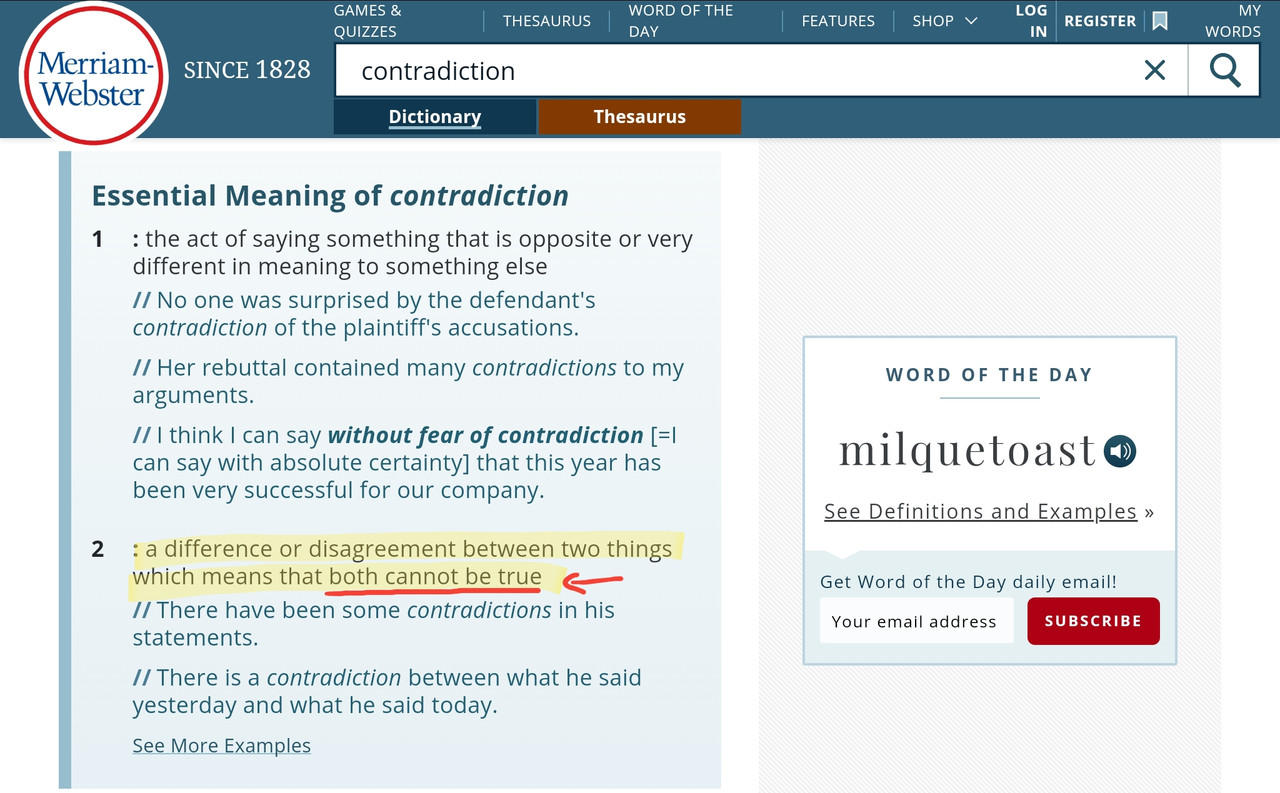
Many questions are rather liberal with the word "first"; it should be noted that this expression is rarely employed in the description of the resurrection events and even when it is, is not necessarily used in an absolute sense. It is not possible to give a definitive answer as to which events happened FIRST although an appraisal of all four gospels can provide a probable sequence of events. It's reported Jesus appeared on multiple occassions over a period of over a month to many different individuals and none of the accounts explicitly state nothing happened PRIOR (or FOLLOWING) or state the date and time of events, thus questions as to which event came "first" are largely redundant.
Source: https://www.merriam-webster.com/diction ... tradiction
TRANSPONDER wrote: ↑Wed Dec 08, 2021 2:47 am
COMBINING THE VARIOUS ACCOUNTS
#The women started out just before dawn (Sunday morning) and got there as the sun was rising (they being all the women although Mary played a leading role)
#They go to the tomb to finish what had been hurredly done before the sabbath
#when they arrive the tomb, they see it is empty
#Mary immediately leaves the group running back to tell Peter and John leaving behind the other women. The rest of the women remain at the tomb.
# An angel appears to "the women" (Mary is not specifically mentioned in connection with this appearance) followed by another 'encouter at the entrance' (2nd angel). The angels tell the women of the ressurection and sent them to inform the disciples.
#On their way to deliver this message, it is these women (EXCLUDING Mary) who meet Jesus himself(28:8 .).
# Mary reports the empty tomb to John and Peter and her conclusion tha the body has been stolen. All three head back to inspect.
#When Mary gets back with Peter and John they inspect the empty tomb and the men leave perplexed. Mary, however stays behind alone weeping. She's questioned by a third man who she mistakes for the gardener who in fact is the resurrected Jesus.
# Jesus never tells Mary he 'cannot be touched' but he does tell this hysterically happy woman clinging to him no doubt like a limpet, that she'll have to let him go; he cannot stay with her. He has people to see and things to do, notabley ascend to his Father in heaven.
# After appearing on sunday morning to the (1) women and (2) Mary (neither of which are believed by the Apostles) Jesus appears to other various individuals:
* Peter: sunday early afternoon(Luke 24: 3) evidently the first of the men (3) and the one that has enough clout to convince everyone (or nearly everyone, more later)
* cleopas & his companion (late sunday afternoon)(4)
* the apostles (minus thomas) sunday evening (5)
* 8 days later, "the twelve"* including thomas this time (6)
.... and on various other occassions before his ascended to heaven, some (like Thomas did initially) doubted the reports but all (the disciples) are eventually convinced (Math 28: 16).
#At some point during the month or so jesus is present on earth, he arranges to meet the 11 on a specific mountain location in Galilee.
# "they" (referring to the disciples - male and female) where not intially publically declare the ressurectiont to non-believers until instructed to do so more than a month later.
#Word of the Galilean appointment gets out and instead of 11 upward of 500 disciples turn up. Jesus Assures them of his authority and tells them of their commission to spread the word. He promises them he will always watch over them.
#His final meeting is private with the 11 alone just outside Bethany (not far from Jerusalem) on the mount of olives.
# Jesus tells them to stay in the capital and wait for the holy spirit. It arrives 10 days later. Enthused they set to work proclaiming the good news as instructed back up in Galilee.
# And the rest, as they say, is history...
<< INDEX (SFBT - Off site)
#What time did the women visit the tomb?
Matthew: "as it began to dawn" (28:1)
Mark: "very early in the morning . . . at the rising of the sun" (16:2, KJV); "when the sun had risen" (NRSV); "just after sunrise" (NIV)
Luke: "very early in the morning" (24:1, KJV) "at early dawn" (NRSV)
John: "when it was yet dark" (20:1)
#ANSWER: Evidently, they set out just before the dawn and arrived as the sun rose.
<< WAS IT DARK WHEN THE WOMEN ARRIVED AT THE TOMB?
http://www.getphpbb.com/phpbb/viewtopic ... rum=jw#395
#Who were the women?
Matthew: Mary Magdalene and the other Mary (28:1)
Mark: Mary Magdalene, the mother of James, and Salome (16:1)
Luke: Mary Magdalene, Joanna, Mary the mother of James, and other women (24:10)
John: Mary Magdalene (20:1)
#ANSWER: All of the above
# What was their purpose of the trip?
Matthew: to see the tomb (28:1)
Mark: had already seen the tomb (15:47), brought spices (16:1)
Luke: had already seen the tomb (23:55), brought spices (24:1)
John: the body had already been spiced before they arrived (19:39,40)
#ANSWER: All of the above
#Was the tomb open when they arrived?
Matthew: No (28:2) *
Mark: Yes (16:4)
Luke: Yes (24:2)
John: Yes (20:1)
#ANSWER: Open ; [Matthew 28:2 says that"Jehovah's angel had descended form heaven and [...] rolled away the stone" the past perfect use in english depicting an earlier event.
#Who was at the tomb when they arrived?
Matthew: One angel (28:2-7)
Mark: One young man (16:5)
Luke: Two men (24:4)
John: Two angels (20:12)
#ANSWER: Depends on who "they" are and what time is being referred to - there was a lot of coming and going that morning (see above)
# Where were these messengers (angels) situated?
Matthew: Angel sitting on the stone (28:2)
Mark: Young man sitting inside, on the right (16:5)
Luke: Two men standing inside (24:4)
John: Two angels sitting on each end of the bed (20:12)
#ANSWER: Angels are not immobile; where they were depends on what moment of the day it was; and who was witnessing the event
What did the messenger(s) say?
* Matthew: "Fear not ye: for I know that ye seek Jesus, which was crucified. He is not here for he is risen, as he said. Come, see the place where the Lord lay. And go quickly, and tell his disciples that he is risen from the dead: and, behold, he goeth before you into Galilee; there shall ye see him: lo, I have told you." (28:5-7)
* Mark: "Be not afrighted: Ye seek Jesus of Nazareth, which was crucified: he is risen; he is not here: behold the place where they laid him. But go your way, tell his disciples and Peter that he goeth before you into Galilee: there shall ye see him, as he said unto you." (16:6-7)
* Luke: "Why seek ye the living among the dead? He is not here, but is risen: remember how he spake unto you when he was yet in Galilee, Saying, The Son of man must be delivered into the hands of sinful men, and be crucified, and the third day rise again." (24:5-7)
* John: "Woman, why weepest thou?" (20:13)
#ANSWER: During the course of events ALL OF THE ABOVE
Did the women tell what happened?
Yes... EVENTUALLY. They were instructed to tell the Apostles and they would have obeyed that instruction. Mark does not say HOW LONG they kept silent about the matter, but logically it would have been on for the duration of the trip back to find the Apostles, not declaring to all assunder that Jesus had been resurrected BEFORE they got over their fear and reported the events to the proper authority (The Apostles).Mark gives no indication they never spoke to a man for the rest of their lives about the matter but links their "strong emotion" to their silence. No doubt they had calmed down when they got to Peter's house.
- Mark 16 verse 7 reports that the women were instructed to "... go, tell his disciples and Peter, ... 8 So when they came out they fled from the memorial tomb, for trembling and strong emotion were gripping them. And they told nobody anything, for they were in fear."
When Mary returned from the tomb, did she know Jesus had been resurrected?
ANSWER: That would depend on if it was before or after she met Jesus: Initially, no. Mary left the group as soon as they found an empty tomb and only returned later with Peter and John. Staying behind after those two had inspected the empty tomb she encounters Jesus alone.
* Matthew: NO (Mat 28:7-8) Note: Mary is not mentioned specifically as still being in the group of women WHEN they are addressed by the angels.
* Mark: NO (16:10,11) NOTE: It is generally accepted that neither conclusions were in Marks original text. Even taking the words into account, however Mk 16:10 says nothing of WHAT Mary initally reported. or WHEN the Apostles heard from her that Jesus had been ressurected (see above)
* Luke: No : (24:6-9,23) NOTE that Luke 24:8,9 is clearly summarizing the outcome of all the events since in verse nine he says the women reported {quote} "to the eleven and to all the rest {unquote}. At no point the intitial comings and goings were all the woment with ALL the Apostles AND all the rest of the disciples. Luke is summarizing the net outcome of all the reports from all the women named in verse 10 since by the end of the morning Mary could add her encouter to those of the other women.
* John: No : John 20:2 shows that intially Mary only reported to Peter and John, and was not aware of the resurrection until her second visit to the tomb with those two (see above).
# What did the women DO [when they found an empty tomb]?
Mark 16:8 - The women were amazed and afraid, so they kept quiet
Matthew 28:6-8 - The women ran away with [fear and] great joy
Luke 24:9-12 - The women left the tomb and told the disciples
John 20:1-2 - Mary told the disciples that the body had been stolen
#ANSWER: All of the above The women* were initially instructed to tell ONLY the disciples so they did not stop on the way and explain what they had seen. Mark's reference to their telling noone may well refer to "noone" outside of those authorized to know, namely , the 11 Apostles. The believers as a group following Jesus instruction NOT to publicize his resurrection to "non-Christians" until a later date.
*It seems that Mary Magdalene dashed off to get Peter and John after seeing the tomb empty, leaving her companions at the tombside.
WHO SAW WHAT "FIRST"?
There is no reference to sequence in any of the scriptures sited, any suggestion that they are therefore contradictory is a "strawman" argument, best suited to those that have not actually read the references provided (further detail please see the FORWARD at the top of the post)
# Where and when did Jesus first appear?
Matthew 28:8-9 - first** appears near his tomb
Mark 16:14-15 - appears to Mary Magdalena but its not clear where
Luke 24:13-15 - first** appears near Emmaus, several miles from Jerusalem
John 20:13-14 - first** appears at his tomb
#ANSWER: Probably appeared first** to the women (excluding Mary Magdalene) somehere between the tomb site and where the Apostles Peter and John were at the time, some time on Sunday morning. Please note that none of the accounts explicitly state exact times and none of the individual accounts state that this was his "first"** appearance or that Jesus had not appeared to anyone previously (see note ** See "FOWARD3 above
[comment: Matthew does not use the term "near" the scripture only indicates somewhere between the tombsite and where the disciples were located]
After the women, to whom did Jesus "first" appear?
Matthew: Eleven disciples (28:16) - there is no mention of sequence in this verse The events in Mat 28:16 take place, not in Jerusalem but in the North of the country in Galilee. Jesus was on earth for over a month and this seems to be his last (certainly not his first) appearance.
Mark: Two disciples in the country, later to eleven (Mark 16:12,14) The only mention of sequence in these verses is that the two disciples (cleopas and his companion) report to the eleven after their particular encounter.
Luke: Two disciples in Emmaus, later to eleven (24:13,36) These are the same people Mark refers to.
John: Ten disciples (Judas and Thomas were absent) (20:19, 24) There is no reference to sequence in this report.
Paul: First to Cephas (Peter), then to the twelve. (Twelve*? Judas was dead). (I Corinthians 15:5) Peter does indeed seem to be the first of the Apostles that Jesus appeared to privately.
*used as a group name
# Who saw Jesus first? [NOTE: This question was not addressed due to its lack of references ]
Matthew - appears first to Mary Magdalena, then to the other Mary, and finally to the eleven
Mark - appears first** to Mary Magdalena then later to the eleven
Luke - appears first** to two, then to Simon, then to the eleven
John - appears first** to Mary Magdalena, then the disciples without Thomas, then the disciples with Thomas
** SEE ABOVE
Where did Jesus "first" appear to the disciples?
* Matthew: On a mountain in Galilee (60-100 miles away) (28:16-17)
* Mark: To two in the country, to eleven "as they sat at meat" (16:12,14)
* Luke: In Emmaus (about seven miles away) at evening, to the rest in a room in Jerusalem later that night. (24:31, 36)
* John: In a room, at evening (20:19)
#ANSWER: See sequencing above.
When did Mary "first" see Jesus?
* Matthew: Before she returned to the disciples (28:9) - no mention of Mary
* Mark: Before she returned to the disciples (16:9,10) - does not sequence event in relation to any other.
* John: After she returned to the disciples (20:2,14) At John 20:2 Mary does NOT report that she has seen Jesus only {quote} "They have taken away the Lord out of the memorial tomb, and we do not know where they have laid him.{unquote} clearly at that point she had not seen Jesus. Verse 14 therefore is obviously a LATER visit.
# How did Jesus first** behave?
Matthew 28:9 - Jesus lets Mary Magdalene and another Mary hold his feet
Mark 16:14-15 - Jesus commissions the eleven to preach the gospel
John 20:17 - Jesus forbids Mary to touch him because he hasnt ascended to heaven yet, but a week later he lets Thomas touch him anyway
#ANSWER: Possibly either "the Women" (excuding Mary) or Mary Magdalene by herself saw Jesus first**. The commission recorded in Mark was likely given that given Galilee (where he initially instructed his disciples to go) so it is extremely unlikely this is the first thing he did.
# Did Jesus let anyone touch him?
Matthew 28:9 - Jesus lets Mary Magdalene and another Mary hold his feet
Mark 16:14-15 - Jesus commissions the eleven to preach the gospel
John 20:17 - Jesus forbids Mary to touch him because he hasnt ascended to heaven yet, but a week later he lets Thomas touch him anyway
#ANSWER: Yes. The greek expression used by John regarding Mary is literally "to cling" and is employed in the continuous tense ("stop clinging to me"), so overcome by emotion Mary was permitted to "touch" the resurrected Jesus but evidently she didn't want to let him go, which she has to. Jesus' words indicate she couldn't keep him with her, since his time on earth would be temporary. The above passages clearly show Jesus let all his disciples touch his resurrected body.
What happened at the appearance? SINCE THERE WAS NO "APPEARANCE" BUT SEVERAL APPEARENCES THE ANSWER IS OBVIOUSLY, IT WOULD DEPEND ON WHICH OF THE MANY APPEARANCES ARE BEING REFERRED TO.
Jesus appeared over a period of 40 days, in at least 3 towns and dozens of locations to various groups of individuals: In short the Answer is, all of the below.
Matthew: Disciples worshipped, some doubted, "Go preach." (28:17-20)
Mark: Jesus reprimanded them, said "Go preach" (16:14-19)
Luke: Christ incognito, vanishing act, materialized out of thin air, reprimand, supper (24:13-51)
John: Passed through solid door, disciples happy, Jesus blesses them, no reprimand (21:19-23)
# How did his disciples take the news [of Jesus resurrection]?
Matthew 28:16 - Some doubt, but most believe
Mark 16:11 [...] Everyone doubts and/or is scared at first, but eventually they go along with it
Luke 24:11 - Everyone doubts [...] but eventually they go along with it
John 20:24-28 - Everyone believes but Thomas, whose doubts are eliminated when he gets physical proof
#ANSWER: All of the above. As with any major event, people reacted differently as different times. Matthew reports Jesus' appearance in Galilee (Northern Territories) nearly a month after his initial appearance to the Apostles. By this time the report of his resurrection had reached multitudes of disciples so the "some" that doubted evidently did not by this time include to the Apostles.
Mark, Luke and John here refer to the Apostles who initially doubted the women's reports (evidently Thomas was not present for Jesus' the early encounter with the Apostles).
[Please note: Mark 16:11 & Luke 24:11 do NOT refer to feeling "scared" although no doubt this may well have been an emotion felt by one or more of the disciples at some time or other in relation to something connected to the events].[/i]
Did the disciples believe the two men (Cleopus & his companion)?
* Mark: No (Mk 16:13) Mark says the two (we can only presume it was cleopus but this is not certain) reported to "the rest". He does not make clear who "the rest" constitute.
* Luke: Yes (24:34--it is the group speaking here, not the two)
#ANSWER: As Luke reports they believe not on the word of Cleopus but because by the time they report their encounter word of Peter's has already reached "the eleven". Since Peter has more authority it seems its his report that finally convinces the central body (the eleven).
# Where, when, and how did [did the ascencention take place]?
Mark 16:14-19 - While he and his disciples are seated at a table in or near Jerusalem
Luke 24:50-51 - Outside, after dinner, and at Bethany and on the same day as the resurrection
Acts 1:9-12 - At least 40 days after his resurrection, at Mt. Olivet
#ANSWER: Jesus ascended to heaven was 40 days after his resurrection from Bethany (near Jerusalem) at the Mount of Olives. Luke gives no timeframe for his statement that Jesus"But he led them out as far a Bethany" [end quote] so we don't know if he (Luke) is referring to Jesus final encounter with this disciples (in Chap 24:50-53) or another such occassion.
Luke does not say that the Bethany event was "after dinner"; his reference to "the eleven" may well have been used in as a title rather than a reference to how many people where in the room (since evidently on the occassion when Cleopas and his companion report their encounter, Thomas was not present). Mark also gives no distinct timeframe for his words (16:14-19). [It should be noted that there is considerable doubt as to whether the conclusion of Mark (16:9 - 19) were part of the original text.]
Last edited by JehovahsWitness on Wed Dec 08, 2021 6:26 am, edited 1 time in total.
-
salvation2011
- Apprentice
- Posts: 122
- Joined: Mon Apr 11, 2011 8:15 am
Re: An Easter Challenge For Christians
Post #38Im a very recent former Christian, so I can kind of give this a go.I AM ALL I AM wrote:G'day.
There are many that make the claim that the bible contains no contradictions. A former preacher, that now considers himself an atheist, Dan Barker, presented the challenge below for christians in his book, Losing Faith In Faith: From Preacher To Atheist, chapter 24.
Questions for debate:
1. Can one progressive story of what is believed by christians about the character known of as 'Jesus', that apparently took place as described in the 'New Testament', be presented in the light of the contradictions that the story contains ?
2. If the contradictions cannot be reconciled into one progressive story, then does this mean that the story itself is a fable ?
3. If one story is presented from the contradictions between the apparent authors of the 'gospels', or one version is considered truthful, does this negate the authenticity of other claims made by those 'gospel' writers that are not considered the truthful version of the 'Easter' story ?
4. Is it true when Dan Barker states that, "without the resurrection, there is no Christianity" ?
5. Considering the contradictions of the 'gospel' accounts of the 'Easter' story, does this negate the claims of fundamentalists that the 'bible is the inerrant Word of God' ?
If any christian is willing to take up former preacher Dan Barker's challenge, would you please provide in a post, the story of what took place on 'Easter' that you purport is the true accounting of events. If you have any evidence to back up your version of what took place, would you please provide that within the post as well. Thank you.
[center]Leave No Stone Unturned
An Easter Challenge For Christians[/center]
I HAVE AN EASTER challenge for Christians. My challenge is simply this: tell me what happened on Easter. I am not asking for proof. My straightforward request is merely that Christians tell me exactly what happened on the day that their most important doctrine was born.
Believers should eagerly take up this challenge, since without the resurrection, there is no Christianity. Paul wrote, "And if Christ be not risen, then is our preaching vain, and your faith is also vain. Yea, and we are found false witnesses of God; because we have testified of God that he raised up Christ: whom he raised not up, if so be that the dead rise not." (I Corinthians 15:14-15)
The conditions of the challenge are simple and reasonable. In each of the four Gospels, begin at Easter morning and read to the end of the book: Matthew 28, Mark 16, Luke 24, and John 20-21. Also read Acts 1:3-12 and Paul's tiny version of the story in I Corinthians 15:3-8. These 165 verses can be read in a few moments. Then, without omitting a single detail from these separate accounts, write a simple, chronological narrative of the events between the resurrection and the ascension: what happened first, second, and so on; who said what, when; and where these things happened.
Since the gospels do not always give precise times of day, it is permissible to make educated guesses. The narrative does not have to pretend to present a perfect picture--it only needs to give at least one plausible account of all of the facts. Additional explanation of the narrative may be set apart in parentheses. The important condition to the challenge, however, is that not one single biblical detail be omitted. Fair enough?
I have tried this challenge myself. I failed. An Assembly of God minister whom I was debating a couple of years ago on a Florida radio show loudly proclaimed over the air that he would send me the narrative in a few days. I am still waiting. After my debate at the University of Wisconsin, "Jesus of Nazareth: Messiah or Myth," a Lutheran graduate student told me he accepted the challenge and would be contacting me in about a week. I have never heard from him. Both of these people, and others, agreed that the request was reasonable and crucial. Maybe they are slow readers.
Many bible stories are given only once or twice, and are therefore hard to confirm. The author of Matthew, for example, was the only one to mention that at the crucifixion dead people emerged from the graves of Jerusalem, walking around showing themselves to everyone--an amazing event that could hardly escape the notice of the other Gospel writers, or any other historians of the period. But though the silence of others might weaken the likelihood of a story, it does not disprove it. Disconfirmation comes with contradictions.
Thomas Paine tackled this matter two hundred years ago in The Age of Reason, stumbling across dozens of New Testament discrepancies:
"I lay it down as a position which cannot be controverted," he wrote, "first, that the agreement of all the parts of a story does not prove that story to be true, because the parts may agree and the whole may be false; secondly, that the disagreement of the parts of a story proves the whole cannot be true."
Since Easter is told by five different writers, it gives one of the best chances to confirm or disconfirm the account. Christians should welcome the opportunity.
One of the first problems I found is in Matthew 28:2, after two women arrived at the tomb: "And, behold, there was a great earthquake: for the angel of the Lord descended from heaven, and came and rolled back the stone from the door, and sat upon it." (Let's ignore the fact that no other writer mentioned this "great earthquake.") This story says that the stone was rolled away after the women arrived, in their presence.
Yet Mark's Gospel says it happened before the women arrived: "And they said among themselves, Who shall roll away the stone from the door of the sepulchre? And when they looked, they saw that the stone was rolled away: for it was very great."
Luke writes: "And they found the stone rolled away from the sepulchre." John agrees. No earthquake, no rolling stone. It is a three-to-one vote: Matthew loses. (Or else the other three are wrong.) The event cannot have happened both before and after they arrived.
Some bible defenders assert that Matthew 28:2 was intended to be understood in the past perfect, showing what had happened before the women arrived. But the entire passage is in the aorist (past) tense, and it reads, in context, like a simple chronological account. Matthew 28:2 begins, "And, behold," not "For, behold." If this verse can be so easily shuffled around, then what is to keep us from putting the flood before the ark, or the crucifixion before the nativity?
Another glaring problem is the fact that in Matthew the first post-resurrection appearance of Jesus to the disciples happened on a mountain in Galilee (not in Jerusalem, as most Christians believe), as predicted by the angel sitting on the newly moved rock: "And go quickly, and tell his disciples that he is risen from the dead; and, behold, he goeth before you into Galilee; there shall ye see him." This must have been of supreme importance, since this was the message of God via the angel(s) at the tomb. Jesus had even predicted this himself sixty hours earlier, during the Last Supper (Matthew 26:32).
After receiving this angelic message, "Then the eleven disciples went away into Galilee, into a mountain where Jesus had appointed them. And when they saw him, they worshipped him: but some doubted." (Matthew 28:16-17) Reading this at face value, and in context, it is clear that Matthew intends this to have been the first appearance. Otherwise, if Jesus had been seen before this time, why did some doubt?
Mark agrees with Matthew's account of the angel's Galilee message, but gives a different story about the first appearance. Luke and John give different angel messages and then radically contradict Matthew. Luke shows the first appearance on the road to Emmaus and then in a room in Jerusalem. John says it happened later than evening in a room, minus Thomas. These angel messages, locations, and travels during the day are impossible to reconcile.
Believers sometimes use the analogy of the five blind men examining an elephant, all coming away with a different definition: tree trunk (leg), rope (tail), hose (trunk), wall (side), and fabric (ear). People who use this argument forget that each of the blind men was wrong: an elephant is not a rope or a tree. You can put the five parts together to arrive at a noncontradictory aggregate of the entire animal. This hasn't been done with the resurrection.
Another analogy sometimes used by apologists is comparing the resurrection contradictions to differing accounts given by witnesses of an auto accident. If one witness said the vehicle was green and the other said it was blue, that could be accounted for by different angles, lighting, perception, or definitions of words. The important thing, they claim, is that they do agree on the basic story--there was an accident, there was a resurrection.
I am not a fundamentalist inerrantist. I'm not demanding that the evangelists must have been expert, infallible witnesses. (None of them claims to have been at the tomb itself, anyway.) But what if one person said the auto accident happened in Chicago and the other said it happened in Milwaukee? At least one of these witnesses has serious problems with the truth.
Luke says the post-resurrection appearance happened in Jerusalem, but Matthew says it happened in Galilee, sixty to one hundred miles away! Could they all have traveled 150 miles that day, by foot, trudging up to Galilee for the first appearance, then back to Jerusalem for the evening meal? There is no mention of any horses, but twelve well-conditioned thoroughbreds racing at breakneck speed, as the crow flies, would need about five hours for the trip, without a rest. And during this madcap scenario, could Jesus have found time for a leisurely stroll to Emmaus, accepting, "toward evening," an invitation to dinner? Something is very wrong here.
This is just the tip of the iceberg. Of course, none of these contradictions prove that the resurrection did not happen, but they do throw considerable doubt on the reliability of the supposed witnesses. Some of them were wrong. Maybe they were all wrong.
This challenge could be harder. I could ask why reports of supernatural beings, vanishing and materializing out of thin air, long-dead corpses coming back to life, and people levitating should be given serious consideration at all. Thomas Paine was one of the first to point out that outrageous claims require outrageous proof.
Protestants and Catholics seem to have no trouble applying healthy skepticism to the miracles of Islam, or to the "historical" visit between Joseph Smith and the angel Moroni. Why should Christians treat their own outrageous claims any differently? Why should someone who was not there be any more eager to believe than doubting Thomas, who lived during that time, or the other disciples who said that the women's news from the tomb "seemed to them as idle tales, and they believed them not" (Luke 24:11)?
Paine also points out that everything in the bible is hearsay. For example, the message at the tomb (if it happened at all) took this path, at minimum, before it got to our eyes: God, angel(s), Mary, disciples, Gospel writers, copyists, translators. (The Gospels are all anonymous and we have no original versions.)
But first things first: Christians, either tell me exactly what happened on Easter Sunday, or let's leave the Jesus myth buried next to Eastre (Ishtar, Astarte), the pagan Goddess of Spring after whom your holiday was named.
Here are some of the discrepancies among the resurrection accounts:
What time did the women visit the tomb?
* Matthew: "as it began to dawn" (28:1)
* Mark: "very early in the morning . . . at the rising of the sun" (16:2, KJV); "when the sun had risen" (NRSV); "just after sunrise" (NIV)
* Luke: "very early in the morning" (24:1, KJV) "at early dawn" (NRSV)
* John: "when it was yet dark" (20:1)
Who were the women?
* Matthew: Mary Magdalene and the other Mary (28:1)
* Mark: Mary Magdalene, the mother of James, and Salome (16:1)
* Luke: Mary Magdalene, Joanna, Mary the mother of James, and other women (24:10)
* John: Mary Magdalene (20:1)
What was their purpose?
* Matthew: to see the tomb (28:1)
* Mark: had already seen the tomb (15:47), brought spices (16:1)
* Luke: had already seen the tomb (23:55), brought spices (24:1)
* John: the body had already been spiced before they arrived (19:39,40)
Was the tomb open when they arrived?
* Matthew: No (28:2)
* Mark: Yes (16:4)
* Luke: Yes (24:2)
* John: Yes (20:1)
Who was at the tomb when they arrived?
* Matthew: One angel (28:2-7)
* Mark: One young man (16:5)
* Luke: Two men (24:4)
* John: Two angels (20:12)
Where were these messengers situated?
* Matthew: Angel sitting on the stone (28:2)
* Mark: Young man sitting inside, on the right (16:5)
* Luke: Two men standing inside (24:4)
* John: Two angels sitting on each end of the bed (20:12)
What did the messenger(s) say?
* Matthew: "Fear not ye: for I know that ye seek Jesus, which was crucified. He is not here for he is risen, as he said. Come, see the place where the Lord lay. And go quickly, and tell his disciples that he is risen from the dead: and, behold, he goeth before you into Galilee; there shall ye see him: lo, I have told you." (28:5-7)
* Mark: "Be not afrighted: Ye seek Jesus of Nazareth, which was crucified: he is risen; he is not here: behold the place where they laid him. But go your way, tell his disciples and Peter that he goeth before you into Galilee: there shall ye see him, as he said unto you." (16:6-7)
* Luke: "Why seek ye the living among the dead? He is not here, but is risen: remember how he spake unto you when he was yet in Galilee, Saying, The Son of man must be delivered into the hands of sinful men, and be crucified, and the third day rise again." (24:5-7)
* John: "Woman, why weepest thou?" (20:13)
Did the women tell what happened?
* Matthew: Yes (28:8)
* Mark: No. "Neither said they any thing to any man." (16:8)
* Luke: Yes. "And they returned from the tomb and told all these things to the eleven, and to all the rest." (24:9, 22-24)
* John: Yes (20:18)
When Mary returned from the tomb, did she know Jesus had been resurrected?
* Matthew: Yes (28:7-8)
* Mark: Yes (16:10,11)
* Luke: Yes (24:6-9,23)
* John: No (20:2)
When did Mary first see Jesus?
* Matthew: Before she returned to the disciples (28:9)
* Mark: Before she returned to the disciples (16:9,10)
* John: After she returned to the disciples (20:2,14)
Could Jesus be touched after the resurrection?
* Matthew: Yes (28:9)
* John: No (20:17), Yes (20:27)
After the women, to whom did Jesus first appear?
* Matthew: Eleven disciples (28:16)
* Mark: Two disciples in the country, later to eleven (16:12,14)
* Luke: Two disciples in Emmaus, later to eleven (24:13,36)
* John: Ten disciples (Judas and Thomas were absent) (20:19, 24)
* Paul: First to Cephas (Peter), then to the twelve. (Twelve? Judas was dead). (I Corinthians 15:5)
Where did Jesus first appear to the disciples?
* Matthew: On a mountain in Galilee (60-100 miles away) (28:16-17)
* Mark: To two in the country, to eleven "as they sat at meat" (16:12,14)
* Luke: In Emmaus (about seven miles away) at evening, to the rest in a room in Jerusalem later that night. (24:31, 36)
* John: In a room, at evening (20:19)
Did the disciples believe the two men?
* Mark: No (16:13)
* Luke: Yes (24:34--it is the group speaking here, not the two)
What happened at the appearance?
* Matthew: Disciples worshipped, some doubted, "Go preach." (28:17-20)
* Mark: Jesus reprimanded them, said "Go preach" (16:14-19)
* Luke: Christ incognito, vanishing act, materialized out of thin air, reprimand, supper (24:13-51)
* John: Passed through solid door, disciples happy, Jesus blesses them, no reprimand (21:19-23)
Did Jesus stay on earth for a while?
* Mark: No (16:19) Compare 16:14 with John 20:19 to show that this was all done on Sunday
* Luke: No (24:50-52) It all happened on Sunday
* John: Yes, at least eight days (20:26, 21:1-22)
* Acts: Yes, at least forty days (1:3)
Where did the ascension take place?
* Matthew: No ascension. Book ends on mountain in Galilee
* Mark: In or near Jerusalem, after supper (16:19)
* Luke: In Bethany, very close to Jerusalem, after supper (24:50-51)
* John: No ascension
* Paul: No ascension
* Acts: Ascended from Mount of Olives (1:9-12)
http://ffrf.org/legacy/books/lfif/?t=stone
1- Yes, one story can be presented, it will just by devoid of the details... the story could be shortened to read... Jesus was born and was visited upon, then lived with his family for approx 30 years reading the bible and teaching the words contained therein. Then one day, he began to preach and tell parables and challenge the minds and hearts of the people he came across. He healed and provided and scolded and condemned. When he profaned the sabbath it was enough to put him to death according to the word of God, so he was set up on a cross to die with criminals. His body disappeared and then Jesus reappeared to his family and disciples and others.
2- no, not being able to reconcile contradictions does not render something a fable.
3- no, think of it as operator, its the same story going down the line of people and each time words or backgrounds change and by the time it gets to the other end of the line... its different but the gist is there. We all write stories differently, even looking at the same exact thing we would use different words, different aspects of the scene would seem more important of description than others, we may miscount, or misplace, we may get something right that others leave out completely... and so on.
4- yes, bc that is the absolute basis... Jesus died on the cross for your sins... faith in this grants you grace by God via the trinity bc Jesus is God.
5- I dont think it would be the contradictions that would make it an invalid claim on the part of the fundamentalists. A claim would be invalid if it is false... Christians believe that it is the word of God... the contradictions wouldnt make it false, the resurrection not taking place at all, or Jesus not really dying for your sins, or the only way to the Father is through me, the trinity... those things could invalidate to NT word of God. The NT words are only considered words of God if you believe in the trinity which makes Jesus god... this then is what would invalidate... Jesus is not God or Jesus did not die on the cross.
All I have time for right now... dinnertime!
Let those who have ears hear, those discerning ones will see the truth, not what the world wants them to see as "truth." Let your biases go so you can truly hear the word of God...
-
I AM ALL I AM
- Guru
- Posts: 1516
- Joined: Sun Nov 16, 2008 8:14 pm
Post #39
G'day JehovahsWitness.
WOW ... you made a whole bunch of replies that make absolutely no sense whatsoever.
"All of the above" used to choose contradicting passages is not a genuine response in relationship to the actual contradictions. Are those responses meant to be taken seriously by anyone reading them ?
I think it would be great to know that even those of 'faith' recognised your disingenuous responses and hand-waving-away of obvious contradictions ... though after years of observing the 'faithful', I won't be holding my breath waiting for it to occur.
WOW ... you made a whole bunch of replies that make absolutely no sense whatsoever.
"All of the above" used to choose contradicting passages is not a genuine response in relationship to the actual contradictions. Are those responses meant to be taken seriously by anyone reading them ?
I think it would be great to know that even those of 'faith' recognised your disingenuous responses and hand-waving-away of obvious contradictions ... though after years of observing the 'faithful', I won't be holding my breath waiting for it to occur.
WHEN PAIRED OPPOSITES DEFINE YOUR BELIEFS,
YOUR BELIEFS WILL IMPRISON YOU.
You cannot reason someone out of a position they did not reason themselves into.
Author Unknown
''God''/''Jesus'' - Invisible/Imaginary Friends For Adults
http://debatingchristianity.com/forum/v ... 426#398426
YOUR BELIEFS WILL IMPRISON YOU.
You cannot reason someone out of a position they did not reason themselves into.
Author Unknown
''God''/''Jesus'' - Invisible/Imaginary Friends For Adults
http://debatingchristianity.com/forum/v ... 426#398426
-
I AM ALL I AM
- Guru
- Posts: 1516
- Joined: Sun Nov 16, 2008 8:14 pm
Re: An Easter Challenge For Christians
Post #40G'day Salvation2011.salvation2011 wrote:Im a very recent former Christian, so I can kind of give this a go.I AM ALL I AM wrote:G'day.
There are many that make the claim that the bible contains no contradictions. A former preacher, that now considers himself an atheist, Dan Barker, presented the challenge below for christians in his book, Losing Faith In Faith: From Preacher To Atheist, chapter 24.
Questions for debate:
1. Can one progressive story of what is believed by christians about the character known of as 'Jesus', that apparently took place as described in the 'New Testament', be presented in the light of the contradictions that the story contains ?
2. If the contradictions cannot be reconciled into one progressive story, then does this mean that the story itself is a fable ?
3. If one story is presented from the contradictions between the apparent authors of the 'gospels', or one version is considered truthful, does this negate the authenticity of other claims made by those 'gospel' writers that are not considered the truthful version of the 'Easter' story ?
4. Is it true when Dan Barker states that, "without the resurrection, there is no Christianity" ?
5. Considering the contradictions of the 'gospel' accounts of the 'Easter' story, does this negate the claims of fundamentalists that the 'bible is the inerrant Word of God' ?
If any christian is willing to take up former preacher Dan Barker's challenge, would you please provide in a post, the story of what took place on 'Easter' that you purport is the true accounting of events. If you have any evidence to back up your version of what took place, would you please provide that within the post as well. Thank you.
<snip for brevity>
1- Yes, one story can be presented, it will just by devoid of the details... the story could be shortened to read... Jesus was born and was visited upon, then lived with his family for approx 30 years reading the bible and teaching the words contained therein. Then one day, he began to preach and tell parables and challenge the minds and hearts of the people he came across. He healed and provided and scolded and condemned. When he profaned the sabbath it was enough to put him to death according to the word of God, so he was set up on a cross to die with criminals. His body disappeared and then Jesus reappeared to his family and disciples and others.
2- no, not being able to reconcile contradictions does not render something a fable.
3- no, think of it as operator, its the same story going down the line of people and each time words or backgrounds change and by the time it gets to the other end of the line... its different but the gist is there. We all write stories differently, even looking at the same exact thing we would use different words, different aspects of the scene would seem more important of description than others, we may miscount, or misplace, we may get something right that others leave out completely... and so on.
4- yes, bc that is the absolute basis... Jesus died on the cross for your sins... faith in this grants you grace by God via the trinity bc Jesus is God.
5- I dont think it would be the contradictions that would make it an invalid claim on the part of the fundamentalists. A claim would be invalid if it is false... Christians believe that it is the word of God... the contradictions wouldnt make it false, the resurrection not taking place at all, or Jesus not really dying for your sins, or the only way to the Father is through me, the trinity... those things could invalidate to NT word of God. The NT words are only considered words of God if you believe in the trinity which makes Jesus god... this then is what would invalidate... Jesus is not God or Jesus did not die on the cross.
All I have time for right now... dinnertime!
1. The story outline you give is not one progressive story when those giving it contradict each other as to the apparent details of it.
2. What do you believe a story full of contradictions is then ?
3. 'Chinese whispers' is one thing, direct and blatant contradictions in the storyline are something else.
4. As far as I am aware, that appears to be the christian belief from my observation as well.
5. A contradiction in a storyline would be considered an error. If 'God' is apparently perfect, how could there be any errors in the 'Word of God' ?
WHEN PAIRED OPPOSITES DEFINE YOUR BELIEFS,
YOUR BELIEFS WILL IMPRISON YOU.
You cannot reason someone out of a position they did not reason themselves into.
Author Unknown
''God''/''Jesus'' - Invisible/Imaginary Friends For Adults
http://debatingchristianity.com/forum/v ... 426#398426
YOUR BELIEFS WILL IMPRISON YOU.
You cannot reason someone out of a position they did not reason themselves into.
Author Unknown
''God''/''Jesus'' - Invisible/Imaginary Friends For Adults
http://debatingchristianity.com/forum/v ... 426#398426

