The Demands of Occupy Wall Street

Two hot topics for the price of one

Moderator: Moderators

Post Reply
WinePusher

The Demands of Occupy Wall Street

Post #1

Post by WinePusher »

People at occupy wall street have released unofficial lists of demands here and there. There are apparently many out there and they don't seem to correspond to eachtother, but here's one unofficial list of demands:
-Demand 1: Restoration of the living wage. This demand can only be met by ending Freetrade by re-imposing trade tariffs on all imported goods entering the American market to level the playing field for domestic family farming and domestic manufacturing as most nations that are dumping cheap products onto the American market have radical wage and environmental regulation advantages. Another policy that must be instituted is raise the minimum wage to twenty dollars an hr.
-Demand 2: Institute a universal single payer healthcare system. To do this all private insurers must be banned from the healthcare market as their only effect on the health of patients is to take money away from doctors, nurses and hospitals preventing them from doing their jobs and hand that money to wall st. investors.
-Demand 3: Guaranteed living wage income regardless of employment.
-Demand 4: Free college education.
-Demand 5: Begin a fast track process to bring the fossil fuel economy to an end while at the same bringing the alternative energy economy up to energy demand.
-Demand 6: One trillion dollars in infrastructure (Water, Sewer, Rail, Roads and Bridges and Electrical Grid) spending now.
-Demand 7: One trillion dollars in ecological restoration planting forests, reestablishing wetlands and the natural flow of river systems and decommissioning of all of Americas nuclear power plants.
-Demand 8: Racial and gender equal rights amendment.
-Demand 9: Open borders migration. anyone can travel anywhere to work and live.
-Demand 10: Bring American elections up to international standards of a paper ballot precinct counted and recounted in front of an independent and party observers system.
-Demand 11: Immediate across the board debt forgiveness for all. Debt forgiveness of sovereign debt, commercial loans, home mortgages, home equity loans, credit card debt, student loans and personal loans now! All debt must be stricken from the Books. World Bank Loans to all Nations, Bank to Bank Debt and all Bonds and Margin Call Debt in the stock market including all Derivatives or Credit Default Swaps, all 65 trillion dollars of them must also be stricken from the Books. And I dont mean debt that is in default, I mean all debt on the entire planet period.
-Demand 12: Outlaw all credit reporting agencies.
-Demand 13: Allow all workers to sign a ballot at any time during a union organizing campaign or at any time that represents their yeah or nay to having a union represent them in collective bargaining or to form a union.
http://toddkinsey.com/blog/2011/10/08/o ... f-demands/

1) What do you make of these demands? Are they reasonable or unreasonable?
2) In a list of demands seperate from this list, OWS protestors have expressed disapproval towards the ruling in Citizens United v. Federal Election Commision. Do you agree or disagree with the ruling?
3) Although absent from the list of demands, OWS have expressed disdainment towards what they percieve to be a growing gap between the top 1% of society and the remaining 99% of society. What is the truth regarding wealth and income inequality?

User avatar
nygreenguy
Guru
Posts: 2349
Joined: Mon Jul 07, 2008 8:23 am
Location: Syracuse

Re: The Demands of Occupy Wall Street

Post #2

Post by nygreenguy »

WinePusher wrote:
-Demand 1: Restoration of the living wage. This demand can only be met by ending Freetrade by re-imposing trade tariffs on all imported goods entering the American market to level the playing field for domestic family farming and domestic manufacturing as most nations that are dumping cheap products onto the American market have radical wage and environmental regulation advantages. Another policy that must be instituted is raise the minimum wage to twenty dollars an hr.
I am in support of raising the min. wage, trade tariffs, while they sound good, do scare me. One of the problems with international trade is it is not a level playing field. Some countries have no problem paying children slave wages in dangerous work conditions to produce a cheap product. There is no way to compete with that because we are morally opposed to resorting to such conditions to make a profit. So international trade is unfair. Adding tariffs can make it harder to export US goods as well. Countries tend to not like it when you make it harder to buy their stuff.

However, it would be nice to see the US use its economic muscle to try to push for a level playing field.


-Demand 2: Institute a universal single payer healthcare system. To do this all private insurers must be banned from the healthcare market as their only effect on the health of patients is to take money away from doctors, nurses and hospitals preventing them from doing their jobs and hand that money to wall st. investors.
Agree 100%. Its WAY cheaper, EVERYONE gets covered, I have yet to see a case where universal coverage is NOT better than the majority of private insurance and I think it is better for businesses because it will free people up to pick a job w/o having to consider health care. Although I think we could/should many still allow supplemental private insurance like many other countries do.
-Demand 3: Guaranteed living wage income regardless of employment.
How is this different from #1?
-Demand 4: Free college education.
Well, another on the fence. I could agree up to associates or bachelors. I may be more inclined to increase federal support rather than free. I would think about regulation of cost and loans though.
-Demand 5: Begin a fast track process to bring the fossil fuel economy to an end while at the same bringing the alternative energy economy up to energy demand.
Once again, the devil is in the details. A lot of natural gas (considered a "fossil fuel" comes from landfill dumps and is captured. That is essentially FREE energy and creates no net carbon increase. Also, fossil fuels are essential in many industries (plastics) even though new technology is coming.
-Demand 6: One trillion dollars in infrastructure (Water, Sewer, Rail, Roads and Bridges and Electrical Grid) spending now.
Seems arbitrary, but we
could use it.
-Demand 7: One trillion dollars in ecological restoration planting forests, reestablishing wetlands and the natural flow of river systems and decommissioning of all of Americas nuclear power plants.
There is a lot I could say about the first half, and overall it is a good idea. As for nuclear, I tend to think they are ok.
-Demand 8: Racial and gender equal rights amendment.
Yes
-Demand 9: Open borders migration. anyone can travel anywhere to work and live.
Sounds good, but seems impractical/unnecessary?
-Demand 10: Bring American elections up to international standards of a paper ballot precinct counted and recounted in front of an independent and party observers system.
Yes
-Demand 11: Immediate across the board debt forgiveness for all. Debt forgiveness of sovereign debt, commercial loans, home mortgages, home equity loans, credit card debt, student loans and personal loans now! All debt must be stricken from the Books. World Bank Loans to all Nations, Bank to Bank Debt and all Bonds and Margin Call Debt in the stock market including all Derivatives or Credit Default Swaps, all 65 trillion dollars of them must also be stricken from the Books. And I dont mean debt that is in default, I mean all debt on the entire planet period.
This makes no sense
-Demand 12: Outlaw all credit reporting agencies.
Not sure without an argument.
-Demand 13: Allow all workers to sign a ballot at any time during a union organizing campaign or at any time that represents their yeah or nay to having a union represent them in collective bargaining or to form a union.
absolutely

2) In a list of demands seperate from this list, OWS protestors have expressed disapproval towards the ruling in Citizens United v. Federal Election Commision. Do you agree or disagree with the ruling?
Disagree. It turns free speech into "those with the biggest pockets have the most speech"


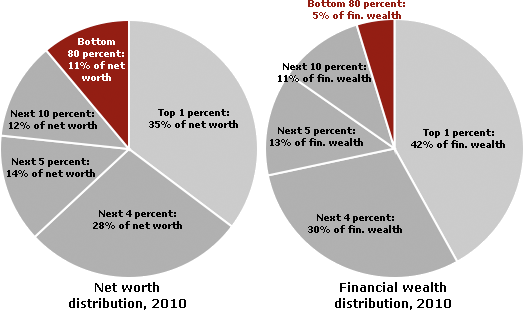
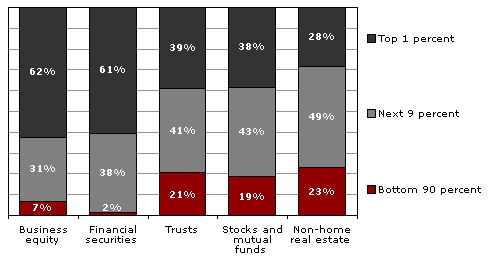
3) Although absent from the list of demands, OWS have expressed disdainment towards what they percieve to be a growing gap between the top 1% of society and the remaining 99% of society. What is the truth regarding wealth and income inequality?
Its not a perceived gap, its really there.
Image

Image

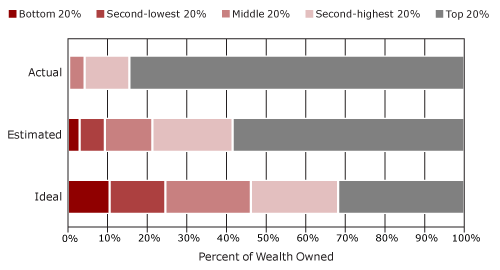
Americans dont even realize the disparity. This next graphic shows what it really is, what they think it is and what they think it OUGHT to be:
Image

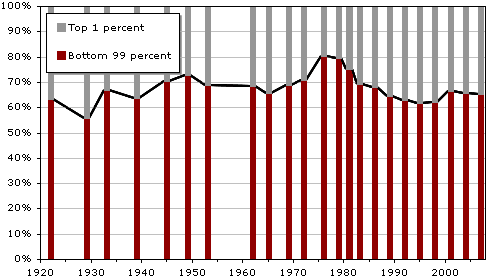
And we can see the long term trends:
Image Source


Image Source

So the gap is there, and it is growing. To make matters worse, movement into higher classes is also decreasing and in many cases is negative (people moving into lower classes).

WinePusher

Re: The Demands of Occupy Wall Street

Post #3

Post by WinePusher »

1) What do you make of these demands? Are they reasonable or unreasonable?
I really don't care about these demands. Most of them are absurd, a few of them are reasonable. It's not as if these people are suggesting anything novel, the left has been pushing for these measures for years. Occupy Wall Street apparently couldn't think of anything original and had to copy off of the liberal agenda.
2) In a list of demands seperate from this list, OWS protestors have expressed disapproval towards the ruling in Citizens United v. Federal Election Commision. Do you agree or disagree with the ruling?
I agree with the ruling because it struck down prohibitions on speech that existed prior to the case. The ruling essentially gurantees the free expression of political speech regardless of who the speaker actually is, whether it's one individual or a group of individuals. And the criticisms leveled against the ruling are pretty absurd. It does nothing to harm democracy nor does it give corporations unlimited influence in D.C. In any case, you're bound to get a situation that Bryan Caplan refers to as the miracle of aggregation. Since there are a large pool of profit and non-profit insitutions, donations and advertisement will be evenly split among the two parties and discredit one another. Thus, elections will be decided ultimately by the people, no corporations. The amount of influence money and advertisement has among the electorate is questionable anyways.
3) Although absent from the list of demands, OWS have expressed disdainment towards what they percieve to be a growing gap between the top 1% of society and the remaining 99% of society. What is the truth regarding wealth and income inequality?
The truth is that this is a non-issue. The makeup of the top 1% is always changing, individuals are always entering and leaving this quintile because income changes. And the problem with statistics is that they only sample income at one given moment in time without taking into account the changes and fluctuations among income quintiles. The top 1% isn't an exclusive, permanent class of individuals, it's a heterogeneous group made up of different people at different times. And it's funny how people villify the earnings corporate executives yet say nothing when it comes to earnings television and movie personalities. Yes, there is a huge quantitative difference between average executive compensation and average wages, but they are also qualitatively different. Wages are determined by productivity, executive compensation is determined by performance. The decisions made by corporate executives can either bring in millions and billions of new dollars into the company, or cost the company millions and billions of dollars thus increasing or decreasing their net worth. People forget that there is a competitive market surrounding corporate executives, which justifies companies offering large compensation packages to executives who perform well. If you don't you drive talented executives out of the market.

User avatar
Slopeshoulder
Banned
Banned
Posts: 3367
Joined: Wed Mar 10, 2010 1:46 pm
Location: San Francisco

Post #4

Post by Slopeshoulder »

I won't comment on the specific demands, but I will comment that if OWS formalizes demands that can be seen as representing a progressive-socialist-utopian lefty fringe, they will probably fail. If they say they are the 99%, they'll need a platform with broad appeal, at least 51%. I think they should stick to making moral arguments and be very pragmatic as to solutions. we don't need another tea party inviting ridicule, but this time on the left. Still, I'm glad that this is one way that liberals are waking up and getting in the ring. A little late, but whatever.

EDIT: Actually, I will comment: the demands are absurd and they just committed public suicide if this is what they want. There were more subtle ways to do this. Instead they used a hammer, but it's pointed at them. Again, they should make a moral and cultural argument, and then engage in informed and pragmatic policy initiatives, as grown ups. This is utopian idiocy IMO.

Hey I'll add one: how about fair trade sugar free free range marshmellow Fridays for all, independant of race, gender, height, belief, country of origin, emplyment status, legal status, location in the superstructure, favorite basball team, or level of fondness for marshmellows?

User avatar
Adurumus
Scholar
Posts: 368
Joined: Mon Sep 12, 2011 8:59 am
Location: Virginia

Post #5

Post by Adurumus »

-Demand 1: Restoration of the living wage.
Solid idea, bad execution. Impose tariffs on other countries, and they'll impose on you- making it much harder to get rid of our debt. Restricting competition to that degree is, and I hate the phrase, "Un-American." Surely there is a good way to reach the goal, though.
-Demand 2: Institute a universal single payer healthcare system.
I'm in favor of a minimal coverage public option, if it can be shown to be feasible, but eliminating privatized... A bit too far. Someone throw me some numbers?
-Demand 3: Guaranteed living wage income regardless of employment.
Define living wage and we might have a deal. Not sure if 'wage' is the best term.
-Demand 4: Free college education.
Government support for exceptional students, maybe. Completely free, though? I'm loathe to think about that. Public school gets a bad wrap as is.
-Demand 5: Begin a fast track process to bring the fossil fuel economy to an end while at the same bringing the alternative energy economy up to energy demand.
I won't lie, I'd like to see this happen. But I'd like to see it happen through a sort of... necessity. While I'd like to see the Government sponsor green energy more, I can't see us progressing fast enough to call it a "fast track." More details?

Code: Select all

[color=green]-Demand 6: One trillion dollars in infrastructure (Water, Sewer, Rail, Roads and Bridges and Electrical Grid) spending now.[/color]
Get rid of the arbitrary "trillion" amount, and sure. Improve where improvements are needed, and improvements are definitely needed.
-Demand 7: One trillion dollars in ecological restoration planting forests... decommissioning of all of Americas nuclear power plants.
Correct me if I'm wrong, but Nuclear power isn't terrible. It just requires an insane amount of regulation and careful-ness to use. This is too much for me to back. I would support preserving, but restoration isn't in the budget.
-Demand 8: Racial and gender equal rights amendment.
Sure. Aren't there already a few? We can't force personal bias, but we have already forbid discrimination against these.
-Demand 9: Open borders migration. anyone can travel anywhere to work and live.
Unnecessary and potential disastrous.
-Demand 10: Bring American elections up to international standards of a paper ballot precinct counted and recounted in front of an independent and party observers system.
Why not?
-Demand 11: Immediate across the board debt forgiveness for all.
Nope. I can see how case by case could be nice, but this is too unwieldy.
-Demand 12: Outlaw all credit reporting agencies.
...why?
-Demand 13: Allow all workers to sign a ballot at any time during a union organizing campaign or at any time that represents their yeah or nay to having a union represent them in collective bargaining or to form a union.
Democratic unions, sure.

Basically, put me up for agreeing with NyGreenguy.
[center]Let me light the way[/center]

WinePusher

Post #6

Post by WinePusher »

1) What do you make of these demands? Are they reasonable or unreasonable?
I really don't care about these demands. Most of them are absurd, a few of them are reasonable. It's not as if these people are suggesting anything novel, the left has been pushing for these measures for years. Occupy Wall Street apparently couldn't think of anything original and had to copy off of the liberal agenda.
2) In a list of demands seperate from this list, OWS protestors have expressed disapproval towards the ruling in Citizens United v. Federal Election Commision. Do you agree or disagree with the ruling?
I agree with the ruling because it struck down prohibitions on speech that existed prior to the case. The ruling essentially gurantees the free expression of political speech regardless of who the speaker actually is, whether it's one individual or a group of individuals. And the criticisms leveled against the ruling are pretty absurd. It does nothing to harm democracy nor does it give corporations unlimited influence in D.C. In any case, you're bound to get a situation that Bryan Caplan refers to as the miracle of aggregation. Since there are a large pool of profit and non-profit insitutions, donations and advertisement will be evenly split among the two parties and discredit one another. Thus, elections will be decided ultimately by the people, no corporations. The amount of influence money and advertisement has among the electorate is questionable anyways.
3) Although absent from the list of demands, OWS have expressed disdainment towards what they percieve to be a growing gap between the top 1% of society and the remaining 99% of society. What is the truth regarding wealth and income inequality?
The truth is that this is a non-issue. The makeup of the top 1% is always changing, individuals are always entering and leaving this quintile because income changes. And the problem with statistics is that they only sample income at one given moment in time without taking into account the changes and fluctuations among income quintiles. The top 1% isn't an exclusive, permanent class of individuals, it's a heterogeneous group made up of different people at different times. And it's funny how people villify the earnings corporate executives yet say nothing when it comes to earnings television and movie personalities. Yes, there is a huge quantitative difference between average executive compensation and average wages, but they are also qualitatively different. Wages are determined by productivity, executive compensation is determined by performance. The decisions made by corporate executives can either bring in millions and billions of new dollars into the company, or cost the company millions and billions of dollars thus increasing or decreasing their net worth. People forget that there is a competitive market surrounding corporate executives, which justifies companies offering large compensation packages to executives who perform well. If you don't you drive talented executives out of the market.

chris_brown207
Sage
Posts: 608
Joined: Sun May 23, 2010 4:49 pm
Location: Boise, Idaho

Post #7

Post by chris_brown207 »

WinePusher wrote:I agree with the ruling because it struck down prohibitions on speech that existed prior to the case. The ruling essentially gurantees the free expression of political speech regardless of who the speaker actually is, whether it's one individual or a group of individuals. And the criticisms leveled against the ruling are pretty absurd. It does nothing to harm democracy nor does it give corporations unlimited influence in D.C. In any case, you're bound to get a situation that Bryan Caplan refers to as the miracle of aggregation. Since there are a large pool of profit and non-profit insitutions, donations and advertisement will be evenly split among the two parties and discredit one another. Thus, elections will be decided ultimately by the people, no corporations. The amount of influence money and advertisement has among the electorate is questionable anyways.
I think this is at best a overly optimistic view of the ruling, and at worst it is a blind disregard of the fact that it created even more loopholes for big business to influence the political process. These Super Pacs that can be created as a result have unlimited power to donate (where the individual only can donate $5000 at a time). The abuses of the system are easy enough to find - people shadow donating millions to a PAC in the names of employees ("just check yes, and you will get a bonus this year that will go to a PAC of our choice"), not to mention the pressure to follow along since the employees jobs could be felt to be at stake.

It has allowed people that have influence over a wide population of people (such as large business execs) to be able to bring millions to an election campaign. To say that has no influence on the political process is a disregard for the truth. How much face time have any of us in this blog gotten with any political candidate? The organizers of these PACS get days access to "their" candidate - over dinners, over meetings, etc.

And to say that they have no influence is just ignoring human nature. "I want you to do something".... "But I don't want to do that.".... "If I gave you $20 million toward your reelection campaign would you want to then?"..... "Uh, lets talk more."
The truth is that this is a non-issue. The makeup of the top 1% is always changing, individuals are always entering and leaving this quintile because income changes. And the problem with statistics is that they only sample income at one given moment in time without taking into account the changes and fluctuations among income quintiles. The top 1% isn't an exclusive, permanent class of individuals, it's a heterogeneous group made up of different people at different times. And it's funny how people villify the earnings corporate executives yet say nothing when it comes to earnings television and movie personalities. Yes, there is a huge quantitative difference between average executive compensation and average wages, but they are also qualitatively different. Wages are determined by productivity, executive compensation is determined by performance. The decisions made by corporate executives can either bring in millions and billions of new dollars into the company, or cost the company millions and billions of dollars thus increasing or decreasing their net worth. People forget that there is a competitive market surrounding corporate executives, which justifies companies offering large compensation packages to executives who perform well. If you don't you drive talented executives out of the market.
The truth is that the change in wealth is a very big issue. You normally only find this imbalance in the incomes of a society in third world nations. Just 30 years ago, CEO pay was only 30 times that of the average employee. Nowadays, CEO pay has ballooned up to 300 times that of the average worker. Mix that with the fact that these CEOs oversaw the biggest crash in our market since the Great Depression, and it is hard to believe that their pay is tied to performance. In a true free market, performance begets reward... we have long since left that arena.

Put those two things together - Super Pacs, and increasing ability of the wealthy to influence the process due to increased wealth (and not too mention the lowest taxes on the wealthy since before Ronald Reagan) - and you find a country that is looking less and less like the "Power to the People" that the founding fathers intended.

User avatar
nygreenguy
Guru
Posts: 2349
Joined: Mon Jul 07, 2008 8:23 am
Location: Syracuse

Post #8

Post by nygreenguy »

WinePusher wrote:

The truth is that this is a non-issue. The makeup of the top 1% is always changing, individuals are always entering and leaving this quintile because income changes. And the problem with statistics is that they only sample income at one given moment in time without taking into account the changes and fluctuations among income quintiles. The top 1% isn't an exclusive, permanent class of individuals, it's a heterogeneous group made up of different people at different times.
This isnt true at all. The higher to the top one is, the more likely they, and their children will stay there. The same is true for the lowest. Those from the lowest are most likely to go lower, as with their children.
There has been a great disparity of income growth between 1979 and 2004 in the United States. The real, after-tax income of the top 1% earners has grown by 176% percent during that time, compared to a 69% rise for the top 20%, and an increase of 9% for the lowest 20%[1]. Increasing income inequality, however, does not necessarily imply decreasing mobility. Median family income has risen 29% and mean family income has risen 43%, compared to the income of the previous generation for people that were children in 1968[3]. Most of this growth in total family income can be attributed to the increasing number of women who work since male earnings have stayed relatively stable throughout this time[3]. Two thirds of those who were children in 1968 reported more income than their parents, but only half of them exceeded their parents economic standing by moving up one or more quintiles[3]. Although one third of the nation is moving up quintiles, another third is downwardly mobile " experiencing a decrease in income and economic standing compared to their parents[3].
Moving between quintiles is more frequent in the middle quintiles (2-4) than in the lowest and highest quintiles. Of those in one of the quintiles 2-4 in 1996, approximately 35% stayed in the same quintile; and approximately 22% went up one quintile or down one quintile (moves of more than one quintile are rarer). However, 42% of children born in the bottom quintile are most likely to stay there, and another 42% move up to the second and middle quintile[3]. On the opposite end of the spectrum, 39% of those who were born into the top quintile as children in 1968 are likely to stay there, and 23% end up in the fourth quintile[3]. Children previously from lower-income families had only a 1% chance of having an income that ranks in the top 5%[4]. On the other hand, the children of wealthy families have a 22% chance of reaching the top 5%[4].
http://en.wikipedia.org/wiki/Economic_mobility

And it's funny how people villify the earnings corporate executives yet say nothing when it comes to earnings television and movie personalities.
Corporations have more power than even singular rich individuals. Another issue is how the ceo's get rich and that off the labor of those beneath them. People work FOR the ceo's in the corporations, so they see it as an injustice their executive wages increase while labor wages decrease.
Yes, there is a huge quantitative difference between average executive compensation and average wages, but they are also qualitatively different. Wages are determined by productivity, executive compensation is determined by performance.
When will we stop this libertarian nonsense. These concepts have been empirically falsified for decades. Compensation has nothing to do with productivity. That has been a big issue for years. We see these CEO's bankrupting companies while their wages INCREASE. Now, I have no problem with executives getting higher pay, I think they should. I do, however, think there is a limit to what is reasonable.

The decisions made by corporate executives can either bring in millions and billions of new dollars into the company, or cost the company millions and billions of dollars thus increasing or decreasing their net worth. People forget that there is a competitive market surrounding corporate executives, which justifies companies offering large compensation packages to executives who perform well. If you don't you drive talented executives out of the market.
A paper by Anderson and Batemann Journal of Organizational Behavior Volume 18, Issue 5, pages 449"469, September 1997 showed that higher executive pay actually led to DECREASED performance.

Then look at the companies that got bailouts. The executives still got bonuses. They failed, and got rewarded.

User avatar
nursebenjamin
Sage
Posts: 823
Joined: Fri Jan 07, 2011 11:38 am
Location: Massachusetts

Post #9

Post by nursebenjamin »

WinePusher wrote:I agree with the ruling because it struck down prohibitions on speech that existed prior to the case. The ruling essentially gurantees the free expression of political speech regardless of who the speaker actually is, whether it's one individual or a group of individuals. And the criticisms leveled against the ruling are pretty absurd. It does nothing to harm democracy nor does it give corporations unlimited influence in D.C. In any case, you're bound to get a situation that Bryan Caplan refers to as the miracle of aggregation. Since there are a large pool of profit and non-profit insitutions, donations and advertisement will be evenly split among the two parties and discredit one another. Thus, elections will be decided ultimately by the people, no corporations. The amount of influence money and advertisement has among the electorate is questionable anyways.
Weve been lead to believe that the Citizens United Case is about the First Amendment right of free speech. But its not; this case is about money. Money is not speech. If you think otherwise, the next time you fill up the gas tank in your car, trying paying for the gas with a witty quip instead of cash.

It is a fallacy of immense proportion to equate free spending with free speech. This problem predates the Citizens United ruling. Free speech is a corner stone of our Constitutional rights; however, money is the equivalent of volume, not speech. When it comes to determining the political course of the country, a few voices should not be allowed to YELL LOUDER and drown out the voices of those who have no money.

Corporations are an independent legal entity that is separate from the people who own, control and manage it, created for the purpose of limiting legal liabilities. If a corporation fails, shareholders may lose their investments, and employees may lose their jobs, but neither will be liable for debts to the corporation's creditors.[1] Corporations do not care about the country or citizens. They dont care about justice, domestic tranquility, the general welfare, or the blessings of liberty. In fact, corporations have no opinion of any kind. This is because corporations are not people.

The corporation, however, is made up of shareholders, CEOs and employees who do have opinions. Individuals within the corporation have the right to free speech and to participate within the political process. But this free speech should not come by way of donations from a corporate account. Corporations do not vote, and should not participate in the political process, period. The political process should tightly regulate corporate activity, but corporate activity should not be allowed to influence the political process.

Justice Stevens, in his dissenting opinion says, [T]he distinction between corporate and human speakers is significant. Although they make enormous contributions to our society, corporations are not actually members of it. They cannot vote or run for office. Because they may be managed and controlled by nonresidents, their interests may conflict in fundamental respects with the interests of eligible voters. The financial resources, legal structure, and instrumental orientation of corporations raise legitimate concerns about their role in the electoral process. Our lawmakers have a compelling constitutional basis, if not also a democratic duty, to take measures designed to guard against the potentially deleterious effects of corporate spending in local and national races.[2]


<<<The ruling essentially gurantees the free expression of political speech regardless of who the speaker actually is, whether it's one individual or a group of individuals.>>>
A corporation is not simply a group of individuals. Its a group of individuals with limited legal liabilities. The political contributions of the corporation dont necessarily represent the political views of all the shareholders. Some of the shareholders are not citizens, and should not even be participating in our political process. Political donations should come from individual citizens, not the corporate account.


<<<And the criticisms leveled against the ruling are pretty absurd. It does nothing to harm democracy nor does it give corporations unlimited influence in D.C.>>>
I disagree. As I stated above, this ruling has nothing to do with speech, and everything to do is money. And if money doesnt influence our democracy and political process, then why are there so many lobbyists running around Washington? If the vast majority of Americans want taxes increased on millionaires and large corporations, then why cant our politicians achieve this? Why was the public option not allowed to even be apart of the debate on health insurance reform?

<<<In any case, you're bound to get a situation that Bryan Caplan refers to as the miracle of aggregation. Since there are a large pool of profit and non-profit insitutions, donations and advertisement will be evenly split among the two parties and discredit one another.>>>
So if politicians of both parties are beholden to large corporations, to whom can the average person turn?

<<<Thus, elections will be decided ultimately by the people, no corporations. The amount of influence money and advertisement has among the electorate is questionable anyways.>>>
I dont see how anyone could make such a statement with a straight face. The role money plays in American politics are an unfortunate reality. In modern elections, 9 out of 10 races are decided by who raises more campaign cash. In 2008, 93 percent of House of Representatives races and 94 percent of Senate races were won by the candidate who spent the most money. In 2006, top spenders won 94 percent of House races and 73 percent of Senate races. In 2004, 98 percent of House seats went to the biggest spender, as did 88 percent of Senate seats.[3]

It is clear that money plays an important role in who wins or who loses an election. However, I fear that the political influence that comes to those who have made large contributions is often far more important than the actual buying and selling of an election.

WinePusher

Post #10

Post by WinePusher »

WinePusher wrote:The truth is that this is a non-issue. The makeup of the top 1% is always changing, individuals are always entering and leaving this quintile because income changes. And the problem with statistics is that they only sample income at one given moment in time without taking into account the changes and fluctuations among income quintiles. The top 1% isn't an exclusive, permanent class of individuals, it's a heterogeneous group made up of different people at different times.
nygreenguy wrote:This isnt true at all. The higher to the top one is, the more likely they, and their children will stay there. The same is true for the lowest. Those from the lowest are most likely to go lower, as with their children.


You can be at the very top of the top 1% or at the very bottom of the bottom 1%. Fact-Your income will change over time. The popular argument from people like you rests upon the premise that the top 1% have some sort of absolute monopoly on income and the truth is they don't. The more experience you have in the labor market the more income you get, which is why the very poor are people who don't have jobs at all or work in positions that literally anybody could do and why the very rich are people who have vast experience in the market and work in positions that require specialization.
WinePusher wrote:And it's funny how people villify the earnings corporate executives yet say nothing when it comes to earnings television and movie personalities.
nygreenguy wrote:Corporations have more power than even singular rich individuals. Another issue is how the ceo's get rich and that off the labor of those beneath them. People work FOR the ceo's in the corporations, so they see it as an injustice their executive wages increase while labor wages decrease.
And corporations do more good for society than single rich individuals. They employ hundreds, if not thousands, of more people. They provide essential services and products that are in demand and they drive the economy through investments, savings and production. So it's understandable that criticism of socialists like Michael Moore is directed primarily at Corporations, since they are such a plague on society. And executives don't get rich of the labor of those beneath them. They get paid corresponding amounts of money to their performance. Steve Jobs was worth billions of dollars because of his high quality performance in business, and if a company wants his performance and insight they offer him a sum of money proportionate to his record of performance and net worth. This is what I mean when I say that a competitive market exists around corporate executives.
WinePusher wrote:Yes, there is a huge quantitative difference between average executive compensation and average wages, but they are also qualitatively different. Wages are determined by productivity, executive compensation is determined by performance.
nygreenguy wrote:When will we stop this libertarian nonsense. These concepts have been empirically falsified for decades. Compensation has nothing to do with productivity. That has been a big issue for years. We see these CEO's bankrupting companies while their wages INCREASE. Now, I have no problem with executives getting higher pay, I think they should. I do, however, think there is a limit to what is reasonable.
What you think doesn't matter. You don't sit on the board of directors of every single corporation out there, you don't understand the internal finances and operations of every single corporation out there. The reasonable amount of pay is determined by people who do actually understand these things, and these people don't include Congress or incoherent, violent and destructive Wall Street Protestors.
WinePusher wrote:The decisions made by corporate executives can either bring in millions and billions of new dollars into the company, or cost the company millions and billions of dollars thus increasing or decreasing their net worth. People forget that there is a competitive market surrounding corporate executives, which justifies companies offering large compensation packages to executives who perform well. If you don't you drive talented executives out of the market.
nygreenguy wrote:A paper by Anderson and Batemann Journal of Organizational Behavior Volume 18, Issue 5, pages 449"469, September 1997 showed that higher executive pay actually led to DECREASED performance.
Either you mis stated the title, or the people who did this study don't know what they're talking about. Executives are offered pay after their performance as been evaluated. The pay doesn't lead to a particular type of performance, the performance leads to a particular amount of pay.
WinePusher wrote:I agree with the ruling because it struck down prohibitions on speech that existed prior to the case. The ruling essentially gurantees the free expression of political speech regardless of who the speaker actually is, whether it's one individual or a group of individuals. And the criticisms leveled against the ruling are pretty absurd. It does nothing to harm democracy nor does it give corporations unlimited influence in D.C. In any case, you're bound to get a situation that Bryan Caplan refers to as the miracle of aggregation. Since there are a large pool of profit and non-profit insitutions, donations and advertisement will be evenly split among the two parties and discredit one another. Thus, elections will be decided ultimately by the people, no corporations. The amount of influence money and advertisement has among the electorate is questionable anyways.
nursebenjamin wrote:Weve been lead to believe that the Citizens United Case is about the First Amendment right of free speech. But its not; this case is about money. Money is not speech. If you think otherwise, the next time you fill up the gas tank in your car, try paying for the gas with a witty quip instead of cash.
You're wrong. Money is considered an expression of speech because the use of money is speech. If I donate money to my Church, I am expressing support for them and their projects and ministries. nursebenjamin, you are under the false impression that political speech only means words coming out of someone's mouth. That is not true, political speech takes variety of different forms including. And the ruling dealt specifically with advertisements run by corporations, not monetary donations.
nursebenjamin wrote:It is a fallacy of immense proportion to equate free spending with free speech. This problem predates the Citizens United ruling. Free speech is a corner stone of our Constitutional rights; however, money is the equivalent of volume, not speech. When it comes to determining the political course of the country, a few voices should not be allowed to YELL LOUDER and drown out the voices of those who have no money.
This misconception has already been refuted. There are hundreds of profit and non-profit organizations, and each of them have their own seperate interests. Meaning the ads they run will be split evenly among the two parties and will essentially neutralize eachother. And no ones voice is being drowned out because when a corporation runs an ad or holds a fundraiser for a candidate, they are unknowingly representing a certain section of population. If the AFL-CIO runs ads in support of Obama's re-election, every single person in the country who is an Obama supporter is being represented through their advertisements.
nursbenjamin wrote:Corporations are an independent legal entity that is separate from the people who own, control and manage it, created for the purpose of limiting legal liabilities. If a corporation fails, shareholders may lose their investments, and employees may lose their jobs, but neither will be liable for debts to the corporation's creditors.[1] Corporations do not care about the country or citizens. They dont care about justice, domestic tranquility, the general welfare, or the blessings of liberty. In fact, corporations have no opinion of any kind. This is because corporations are not people.
Did you know you can sue a corporation? Did you know you can even tax a corporation? Your argument is trivial and inconsistent, nursebenjamin. Yea, corporations aren't people they have many of the same rights people do have. If you were actualyl consistent, you would be in favor of insulating corporations against lawsuits and abolished all taxes on corporations.
nursebenjamin wrote:The corporation, however, is made up of shareholders, CEOs and employees who do have opinions. Individuals within the corporation have the right to free speech and to participate within the political process. But this free speech should not come by way of donations from a corporate account. Corporations do not vote, and should not participate in the political process, period. The political process should tightly regulate corporate activity, but corporate activity should not be allowed to influence the political process.
You, just like John Paul Stevens, don't base your argument upon the constitution because nothing in the constitution supports your position. The first amendment is explicit, it says that no law shall be made prohibiting the free exercise of speech period. It does make distinctions between different types of speakers.
nursebenjamin wrote:Justice Stevens, in his dissenting opinion says, [T]he distinction between corporate and human speakers is significant. Although they make enormous contributions to our society, corporations are not actually members of it. They cannot vote or run for office. Because they may be managed and controlled by nonresidents, their interests may conflict in fundamental respects with the interests of eligible voters. The financial resources, legal structure, and instrumental orientation of corporations raise legitimate concerns about their role in the electoral process. Our lawmakers have a compelling constitutional basis, if not also a democratic duty, to take measures designed to guard against the potentially deleterious effects of corporate spending in local and national races.[2]
You see, this is a perfect example of activism, luckily he isn't on the court anymore. Steven's based his vote on his personal preferences rather than what the Constitution says. He thinks that the interests of corporations will conflict with the interests of eligible voters, and he is wrong. Give me one example of this, give me one example where corporate interests conflict with voter interests. They don't, they coincide with the interests of voters and it creates more liability for corporations because if a corporations has a reputation of supporting democrat candidates they will most likely alienate republican voters.
WinePusher wrote:The ruling essentially gurantees the free expression of political speech regardless of who the speaker actually is, whether it's one individual or a group of individuals.
nursebenjamin wrote:A corporation is not simply a group of individuals. Its a group of individuals with limited legal liabilities. The political contributions of the corporation dont necessarily represent the political views of all the shareholders. Some of the shareholders are not citizens, and should not even be participating in our political process. Political donations should come from individual citizens, not the corporate account.
This is nonsense. Who do you think will determine political contributions made by the corporation? The board of directors, the shareholders and the governing body. Your under the impression that this ruling forces corporations to participate in the political process and it doesn't. It allows profit and non-profit institutions to run advertisments for candidates, if an institution doesn't want to they don't have to. And if participating in elections causes to much internal strife within the institution they probably won't. All the ruling does is leave the option on the table.
WinePusher wrote:And the criticisms leveled against the ruling are pretty absurd. It does nothing to harm democracy nor does it give corporations unlimited influence in D.C.
nursebenjamin wrote:I disagree. As I stated above, this ruling has nothing to do with speech, and everything to do is money. And if money doesnt influence our democracy and political process, then why are there so many lobbyists running around Washington? If the vast majority of Americans want taxes increased on millionaires and large corporations, then why cant our politicians achieve this? Why was the public option not allowed to even be apart of the debate on health insurance reform?
Do you know why a Public Option wasn't including in Obamacare? Because a few democrats, scared of being voted out of office by their constituents, fought against it. The thing politicians operate according to is not money, special interests, or their personal opinions, it's what their constituents want because if they go against the will of their constituents they get thrown out of office. You're just reinforcing my point that money and lobbyists have no real control in Politics.
WinePusher wrote:Thus, elections will be decided ultimately by the people, no corporations. The amount of influence money and advertisement has among the electorate is questionable anyways.
nursebenjamin wrote:I dont see how anyone could make such a statement with a straight face. The role money plays in American politics are an unfortunate reality. In modern elections, 9 out of 10 races are decided by who raises more campaign cash. In 2008, 93 percent of House of Representatives races and 94 percent of Senate races were won by the candidate who spent the most money. In 2006, top spenders won 94 percent of House races and 73 percent of Senate races. In 2004, 98 percent of House seats went to the biggest spender, as did 88 percent of Senate seats.[3]

It is clear that money plays an important role in who wins or who loses an election. However, I fear that the political influence that comes to those who have made large contributions is often far more important than the actual buying and selling of an election.
The amount of cash doesn't determine who wins an election, the amount of votes do. Let me ask you something, how many television adveretisments, billboard signs, bumper stickers and telephone calls would it take for you to vote for Michele Bachmann? No amount of campaigning, ads or signs will persuade me to vote for Barack Obama. And this is true for almost all informed, opinionated voters.

Post Reply