

Let's assume for sake of argument that if non-theism were the objective reality, we would be able to offer some positive and non-fallacious argument to support the philosophical viewpoint known as non-theism.
In this discussion, we will use the following definitions:
Theism: the philosophical viewpoint that the non-contingent source and fount of all possibility is not less than personal.
Non-theism: the philosophical viewpoint that theism need not be the case.
God: the non-contingent, not-less-than-personal source and fount of all possibility.
Our universe and our selves constitute the evidence, and we must provide arguments as to why, given this evidence, we should adopt the philosophical viewpoint known as non-theism. In this thread we are not allowed to rely on some supposed "default position of non-theism"; rather, we must provide an actual, non-fallacious argument for non-theism.
After all, if non-theism can be asserted (or adopted, or held) without evidence, then non-theism can be dismissed without evidence.
Are there any non-fallacious arguments for non-theism?
Moderator: Moderators
Are there any non-fallacious arguments for non-theism?
Post #1I am a work in process; I do not claim absolute knowledge or absolute certainty; I simply present the best working hypothesis I have at the moment, always pending new information and further insight.
α β γ δ ε ζ η θ ι κ λ μ ν ξ ο π � σ ς τ υ φ χ ψ ω - Α Β Γ Δ Ε Ζ Η Θ Ι Κ Λ Μ � Ξ Ο ΠΡ Σ Τ Υ Φ Χ Ψ Ω
α β γ δ ε ζ η θ ι κ λ μ ν ξ ο π � σ ς τ υ φ χ ψ ω - Α Β Γ Δ Ε Ζ Η Θ Ι Κ Λ Μ � Ξ Ο ΠΡ Σ Τ Υ Φ Χ Ψ Ω

Post #121
The only way to prove that is to have observed the universe coming into existence. It's like asking "can you provide a non-fallacious argument to prove that Stonehenge did not in fact come from aliens?" The only sure way to prove it is to have observed it. Or else I could argue that there is no evidence that aliens had a hand in Stonehenge but I'm guessing you won't be satisfied by a response that simply states there is no evidence that suggests God had a hand in creating the universe.EduChris wrote: What good, non-fallacious argument(s) can you provide that there can be such a thing as a universe without God (as defined in the OP)?
.
Why does it HAVE to be logically necessary? No one has even claimed an atheistic universe is "logically necessary". You're basically requesting we prove there is no god and we all know by now that that is impossible to prove. I can make an argument for a non-personal god by simply arguing that a god need not be personal... but I cannot "prove" god is not in fact personal. If you expect proof then you're wasting your time.EduChris wrote:What good, non-fallacious argument(s) can you provide that the non-contingent source and fount of all possibility is less than personal? Note that your argument here would need to provide actual evidence or argumentation that this universe is logically necessary.
You're speaking as though Theism is exempt from being a "faint, unargued, unevidenced possibility". I'd argue that my alternatives of deism or atheism is more likely than your theism on the grounds that it makes less assumptions than your theism.EduChris wrote: It appears as though several here have adopted the view that theism need not be the case simply by the virtue that there is some faint, unargued, unevidenced possibility that theism need not be the case. But what this thread is all about is whether there are any actual, good, non-fallacious arguments that theism need not be the case.
The following assumptions are made for each case:
Atheism: the assumption that a universe can exist without a god
Desim: the assumption that the universe can not exist without a god
Theism: the assumption that the universe needs a god, that this god is male, that this god spoke to such-and-such, that this god commanded x and y, etc.
A theory with fewer assumptions is usually superior as it is based more solidly on what evidence suggests and less on thin air.
-
Fuzzy Dunlop

- Guru
- Posts: 1137
- Joined: Tue Aug 30, 2011 3:24 am
Post #122
Yes, you can make arguments one way or the other. Nonetheless, we do no know whether or not our universe is logically necessary, thus theism rests upon an unproven assumption while agnostic atheism does not.EduChris wrote:Consider the statement, "Our universe need not have existed."Fuzzy Dunlop wrote:...we don't know whether or not our universe is logically necessary...
This statement entails no logical contradiction. Moreover, it contradicts no known facts. Therefore, there is greater justification for the view that our universe is contingent than there is for the view that our universe is logically necessary.
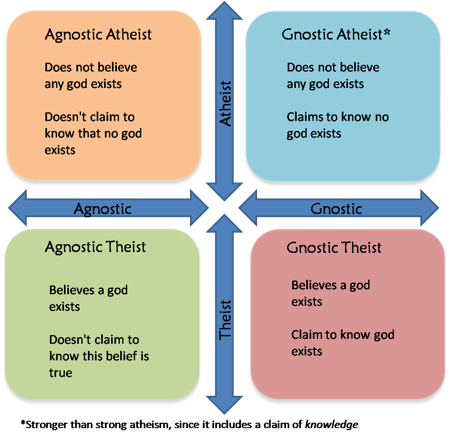
This is false, the default position is a position by definition. Agnostic atheism is one of four possible positions with regard to belief in and the existence of God along with gnostic atheism, agnostic theism, and gnostic theism. To illustrate:EduChris wrote:You are comparing apples to oranges. Theism is an actual position, whereas "agnostic atheism" is a lack of a position.Fuzzy Dunlop wrote:...Theism thus relies upon an unproven assumption while agnostic atheism does not...
The issue is with quality, not quantity. The evidence is insufficient to form a conclusion. Furthermore, we are dealing with an unfalsifiable concept (God) that can be imagined as consistent with any possible evidence.EduChris wrote:Unless you exercise due diligence, how do you know that the evidence and/or arguments are insufficient? The evidence certainly is not lacking--it is all around us. The evidence consists of our universe and our selves.Fuzzy Dunlop wrote:...It is not "proactive due diligence" to proceed towards conclusions when sufficient evidence is not available...
Agnostic atheism is a position with regard to God's existence. "I will recuse myself without prejudice to any position until after I have performed due diligence" is not a position with regard to God's existence, it's a description of what you want us to do in this thread (ie the fallacy of shifting the burden of proof).EduChris wrote:Anyway, on this thread the "default position," if we may use that term, is "I will recuse myself without prejudice to any position until after I have performed due diligence." No position of any kind is allowed until after due diligence has been performed.
Also, I would ask you to define some of your terminology:
What do you mean by the "source" of all possibility?
What do you mean by the "fount" of all possibility?
What is the distinction between these two terms?

Post #123
As far as I'm concerned, it's unquestionably been demonstrated beyond reasonable doubt, but with the pre-conceived notion that consciousness cannot possibly be of such a form, it's unsurprising that some disagree.[color=indigo]EduChris[/color] wrote:Even if your speculation is true (and we have no good reason to suppose that it is)
Alas, that's an argument for another thread.
What is important is that the if stands, and that you cannot show it to be untrue or show any alternative to be more valid as a basis.
I'd like to begin by quoting you:[color=green]EduChris[/color] wrote:your argument still involves a non-sequitur:...If consciousness in humans can be shown to be entirely the product of matter-energy interactions, no other form of consciousness is known. Given this, one would logically default to the position that anything preceding matter cannot be conscious
I see nothing to suggest that your conclusion follows. It is simply a bare assertion without any connecting tissue of argument.
Next, I'd like you to recall your favoured argument for Theism, in which our consciousness being non-determined and self-evidencing is pretty central. Even given this, it's pretty straightforward that, given my initial supposition, your argument would not be the case.[color=violet]EduChris[/color] wrote:There is no need to suppose that our consciousness is of a different form than God's. It may be that our consciousness is limited in degree and therefore cannot be the source and fount of all possibility, but a difference in degree does not entail a difference in form.
Evidence in this context is not a requirement, as it is true by definition. 'Matter' is that which follows the apparent laws of quantum mechanics, and interacts with other 'matter'. If consciousness(As we know it; to suppose other forms exist is a non-sequitur) is an emergent property of matter, that which allows such consciousness to exist must behave in the same manner as matter. Thanks to the postulates of quantum mechanics(Arguing against them is viable, but a bit futile), we know the aforementioned is an if-and-only-if.[color=blue]EduChris[/color] wrote:What is "matter"? Is "matter" created? What precedes "matter"? What actual evidence do you have to show that "pre-matter" cannot provide a context for consciousness?
I think you're now misunderstanding your OP.[color=red]EduChris[/color] wrote:Any answers you might offer will be necessarily speculative (as I think even you would admit). And speculation does not count as a positive argument for anything.
Theism need not be the case if I am correct, and there is nothing other than your speculation to suggest that I am not.
You would undoubtedly classify all your arguments for theism as 'positive arguments', but all(I've seen nothing to the contrary) of them involve some reasonable level of speculation.
Post #125
You seem to think that: 1) God is hiding from you; 2) that God is obligated to provide "sufficient evidence" to you (and more generally, to anyone else); and that 3) God's alleged failure to provide "sufficient evidence" indicates either God's incompetence or God's absence.Divine Insight wrote:...Anyone who would like to know that their creator exists should be provided sufficient evidence by any creator who is not playing hide-and-seek...If such a creator exists, he/she/or it, is certainly playing hide-and-seek with me to the hilt...If there really existed such an entity, that entity should know how to properly communicate with his creation. Anything short of that would imply an inept creator that created something he can not longer control or properly communicate with...
It seems to me that you are wrong on all three counts. Firstly, it appears as though humans may be hardwired to seek and find meaning, especially the sort of meaning provided by theism. Secondly, throughout all of human history, human culture has evidenced a strong bias toward theism. Indeed, according to Richard Dawkins, not until Darwin could atheism become intellectually fulfilling (Blind Watchmaker, p. 6). Given the power of both biology and culture, it seems we are predisposed to believe in God. Theism is the "default position" from the standpoint of biology and culture, and for most people these factors are far more powerful influences than either philosophy or science. Indeed, these forces are so powerful that most non-theists (especially a majority of non-theists on this forum) seem to think that they can protect themselves from the dangers of theism only by adopting a harsh, abrasive attitude of theophobia (irrational fear and loathing of theism).
Secondly, you seem to think that intellectual assent to theism is unwarranted, even though no one seems to be able to make a non-fallacious argument for non-theism, and even though I have presented a solid positive philosophical argument for theism which apparently can only be circumvented by appeal to all manner of unprovable, untestable hypothetical speculations.
Lastly, you seem to think that it is somehow obligatory to have unambiguous intellectual knowledge rather than an intense longing, an abiding hope, and an indefatigable will to believe that there is more to life than just the absurd meanderings of quarks and leptons. Why should that be? If we one day come to realize the unambiguous objective reality of the object of our affections, how would this be turn out to be inferior to never having experienced the self-determining, self-actualizing capacity to hold any measure of legitimate intellectual doubt?
I am a work in process; I do not claim absolute knowledge or absolute certainty; I simply present the best working hypothesis I have at the moment, always pending new information and further insight.
α β γ δ ε ζ η θ ι κ λ μ ν ξ ο π � σ ς τ υ φ χ ψ ω - Α Β Γ Δ Ε Ζ Η Θ Ι Κ Λ Μ � Ξ Ο ΠΡ Σ Τ Υ Φ Χ Ψ Ω
α β γ δ ε ζ η θ ι κ λ μ ν ξ ο π � σ ς τ υ φ χ ψ ω - Α Β Γ Δ Ε Ζ Η Θ Ι Κ Λ Μ � Ξ Ο ΠΡ Σ Τ Υ Φ Χ Ψ Ω
Post #126
It might have been the case that no pipe had ever been fabricated. It might have been the case that no water or humidity was present in the room where the pipe was. It might have been the case that the pipe had been made of some other material with special water-wicking properties. It might have been the case that the temperature and/or atmospheric pressure in the room was different. It might have been the case that the physical laws were different. For all of these reasons, the water forming on the pipe is a contingency, rather than a logical necessity. It would only be a logical necessity if all of the requisite factors themselves were logical necessities--and in this case it seems reasonable to suppose that any of the aforementioned factors might have been different than they were.Artie wrote:...So the water drops forming on a pipe in a humid room are not logically necessary?...Can you use this example to explain your point?
Logical necessities can only be justified if the negation of the statement produces a logical contradiction in every possible circumstance.
I am a work in process; I do not claim absolute knowledge or absolute certainty; I simply present the best working hypothesis I have at the moment, always pending new information and further insight.
α β γ δ ε ζ η θ ι κ λ μ ν ξ ο π � σ ς τ υ φ χ ψ ω - Α Β Γ Δ Ε Ζ Η Θ Ι Κ Λ Μ � Ξ Ο ΠΡ Σ Τ Υ Φ Χ Ψ Ω
α β γ δ ε ζ η θ ι κ λ μ ν ξ ο π � σ ς τ υ φ χ ψ ω - Α Β Γ Δ Ε Ζ Η Θ Ι Κ Λ Μ � Ξ Ο ΠΡ Σ Τ Υ Φ Χ Ψ Ω
Post #127
Contingency is preferred over non-contingency per the standard and ordinary rules of epistemology. In the absence of "proof" either way, we are justified in preferring (or constrained to prefer) the epistemologically "most privative" option available.Fuzzy Dunlop wrote:...we do no know whether or not our universe is logically necessary, thus theism rests upon an unproven assumption while agnostic atheism does not...
Since neither agnostic theism nor agnostic atheism involve knowledge claims, the only difference between them is the subjective psychological conditions of the respective adherents. Since we cannot expect people to justify their subjective psychological state of mind, neither side involves a "position" which entails any burden of proof; therefore, neither forms of agnosticism can be viewed as a "default position"; instead, they are both recusals from debate.Fuzzy Dunlop wrote:...the default position is a position by definition. Agnostic atheism is one of four possible positions with regard to belief in and the existence of God along with gnostic atheism, agnostic theism, and gnostic theism...
No particular distinction is implied. The source and fount of all possibility can be thought of as in some sense analogous to the non-theist's "Great Quantum Nothing," in which anything is said to be possible.Fuzzy Dunlop wrote:...What do you mean by the "source" of all possibility?...What do you mean by the "fount" of all possibility?...What is the distinction between these two terms?
I am a work in process; I do not claim absolute knowledge or absolute certainty; I simply present the best working hypothesis I have at the moment, always pending new information and further insight.
α β γ δ ε ζ η θ ι κ λ μ ν ξ ο π � σ ς τ υ φ χ ψ ω - Α Β Γ Δ Ε Ζ Η Θ Ι Κ Λ Μ � Ξ Ο ΠΡ Σ Τ Υ Φ Χ Ψ Ω
α β γ δ ε ζ η θ ι κ λ μ ν ξ ο π � σ ς τ υ φ χ ψ ω - Α Β Γ Δ Ε Ζ Η Θ Ι Κ Λ Μ � Ξ Ο ΠΡ Σ Τ Υ Φ Χ Ψ Ω
Post #128
It is easy to provide adequate justification for the proposition that aliens did not produce Stonehenge. All you have to do is say that "aliens need not exist." No logical contradiction is entailed by this statement, and no generally accepted body of factual evidence contradicts this statement.Justin108 wrote:...It's like asking "can you provide a non-fallacious argument to prove that Stonehenge did not in fact come from aliens?"...
By contrast, an immediate logical contradiction results from the statement that "the source and fount of all possibility need not exist." The only way to avoid the contradiction would be to say that nothing ever could have existed, nothing does exist now, and nothing ever can exist going forward. Clearly our own existence gives the lie to such propositions. Moreover, the source and fount of all possibility must be viewed as personal, since to assume otherwise violates the normal epistemic rule that one should always make the fewest assumptions possible. Logical necessity is the only alternative available to personal causation, and to assume logically necessity is to make the largest assumption possible.
I am a work in process; I do not claim absolute knowledge or absolute certainty; I simply present the best working hypothesis I have at the moment, always pending new information and further insight.
α β γ δ ε ζ η θ ι κ λ μ ν ξ ο π � σ ς τ υ φ χ ψ ω - Α Β Γ Δ Ε Ζ Η Θ Ι Κ Λ Μ � Ξ Ο ΠΡ Σ Τ Υ Φ Χ Ψ Ω
α β γ δ ε ζ η θ ι κ λ μ ν ξ ο π � σ ς τ υ φ χ ψ ω - Α Β Γ Δ Ε Ζ Η Θ Ι Κ Λ Μ � Ξ Ο ΠΡ Σ Τ Υ Φ Χ Ψ Ω
Post #129
Again, it appears that you are placing an exclusive emphasis on the "need not" part of my request. But my intention was not to discover some bare glimmer of speculation that somehow provides the flimsiest chimera of possibility that theism "need not" be the case. Rather, I am asking you and others to provide argument that theism need not be the case because there are better (or at least equally good) arguments available. If such arguments are available, let's put them forward so that everyone can see what they are. But let's all agree that unfounded, poorly justified speculations do not constitute good arguments.LiamOS wrote:...Theism need not be the case if I am correct...
Last edited by EduChris on Sun Jan 20, 2013 5:51 pm, edited 2 times in total.
I am a work in process; I do not claim absolute knowledge or absolute certainty; I simply present the best working hypothesis I have at the moment, always pending new information and further insight.
α β γ δ ε ζ η θ ι κ λ μ ν ξ ο π � σ ς τ υ φ χ ψ ω - Α Β Γ Δ Ε Ζ Η Θ Ι Κ Λ Μ � Ξ Ο ΠΡ Σ Τ Υ Φ Χ Ψ Ω
α β γ δ ε ζ η θ ι κ λ μ ν ξ ο π � σ ς τ υ φ χ ψ ω - Α Β Γ Δ Ε Ζ Η Θ Ι Κ Λ Μ � Ξ Ο ΠΡ Σ Τ Υ Φ Χ Ψ Ω
Re: Are there any non-fallacious arguments for non-theism?
Post #130No, that is not correct, and is easily shown to be not correct.EduChris wrote: After all, if non-theism can be asserted (or adopted, or held) without evidence, then non-theism can be dismissed without evidence.
Joe claims fairies exist, but is unable to provide any evidence. Any reasonable person would take the default position that fairies do not exist, unless and until Joe provided evidence that they do. Do you agree with this? (Yes or No)
However, by your reasoning, we would be entitled to say:
After all, as a non-belief in fairies has been adopted without evidence, we can also dismiss the default non-belief in fairies.
Do you agree with this conclusion re the existence of fairies? (Yes or No)
I put it to you that the default non-belief in fairies is obviously correct, and therefore it is wrong to dismiss it.
Last edited by ytrewq on Sun Jan 20, 2013 4:27 pm, edited 1 time in total.

