

If we are to assess how good a man is as a father we would perhaps list the various good things he has done for his children. Let's look back over the past century to see what good God has done for humanity. Of course we could say he's given us RAIN; he's given our cattle GRASS; he has supplied OXYGEN over the Earth's lifetime. But what has he done recently? Some would say he's not been too good, having sent hurricanes, floods and tsunamis and famines.
Are there ANY good things we could say God has done in the last century?
Has he stopped being good?
Would it be right to conclude there is no evidence of goodness, so it would be best to consider there is no God rather than there is a bad God?
What has God done in past century?
Moderator: Moderators
Re: What has God done in past century?
Post #11In a philosophical way, yes. But a four-year-old can tell you if something is good or not.
You are the optimist at the bus stop believing the last bus is just a little late and will soon arrive. Optimism at least keeps us cheery but it does not point to God. I have a friend who dines with God every Wednesday evening and has given me a list of presents God has given him. To me it means he's happy and that is important.1213 wrote:
I personally believe God has taken good care of me and has kept the promises in the Bible. I think that is good. But I also think it doesnt mean anything to you.

Re: What has God done in past century?
Post #12"And so say all of us" is the cry of believers of every shade and shape. Gathering and sustaining are curious practices. One gathers a harvest certainly.JehovahsWitness wrote:
Yes he has gathered and sustained his people to perform a worldwide preaching work, indeed the greatest preaching campaign the world has ever seen. This has only been possible in his strength to the benefit of all the honest hearted people that have responded.
So you would say a handful of folk see some sign in the sky that is the equivalent of God giving them the all clear, while he ignores the majority - or confuses them with false messages. Why send people out to do a God's job?
-
Mithrae

- Prodigy
- Posts: 4326
- Joined: Mon Apr 05, 2010 7:33 am
- Location: Australia
- Has thanked: 112 times
- Been thanked: 195 times
Re: What has God done in past century?
Post #13marco wrote:But what has he done recently? Some would say he's not been too good, having sent hurricanes, floods and tsunamis and famines.
Life in the 21st century is vastly better for most of the world's people than it was in the 19th. Advances in medicine and eradication or improved control over most of the worst diseases of history (plague, smallpox, malaria) should alone be more than enough to show that. Since at least the 1980s, for possibly the first time in history, we've had substantial global food surpluses and the preservation and transportation technologies to ensure that any shortages result almost entirely from political, economic, infrastructure and conflict causes rather than local famines. We've got it so good that in most countries and globally, obesity is a bigger problem than hunger.marco wrote: You can tell me that you believe the Christian God is working hard. I can suggest he's not. My reason? Look around at the misery in the world. No chocolates at all. No manna from heaven and no Red Sea opening up.
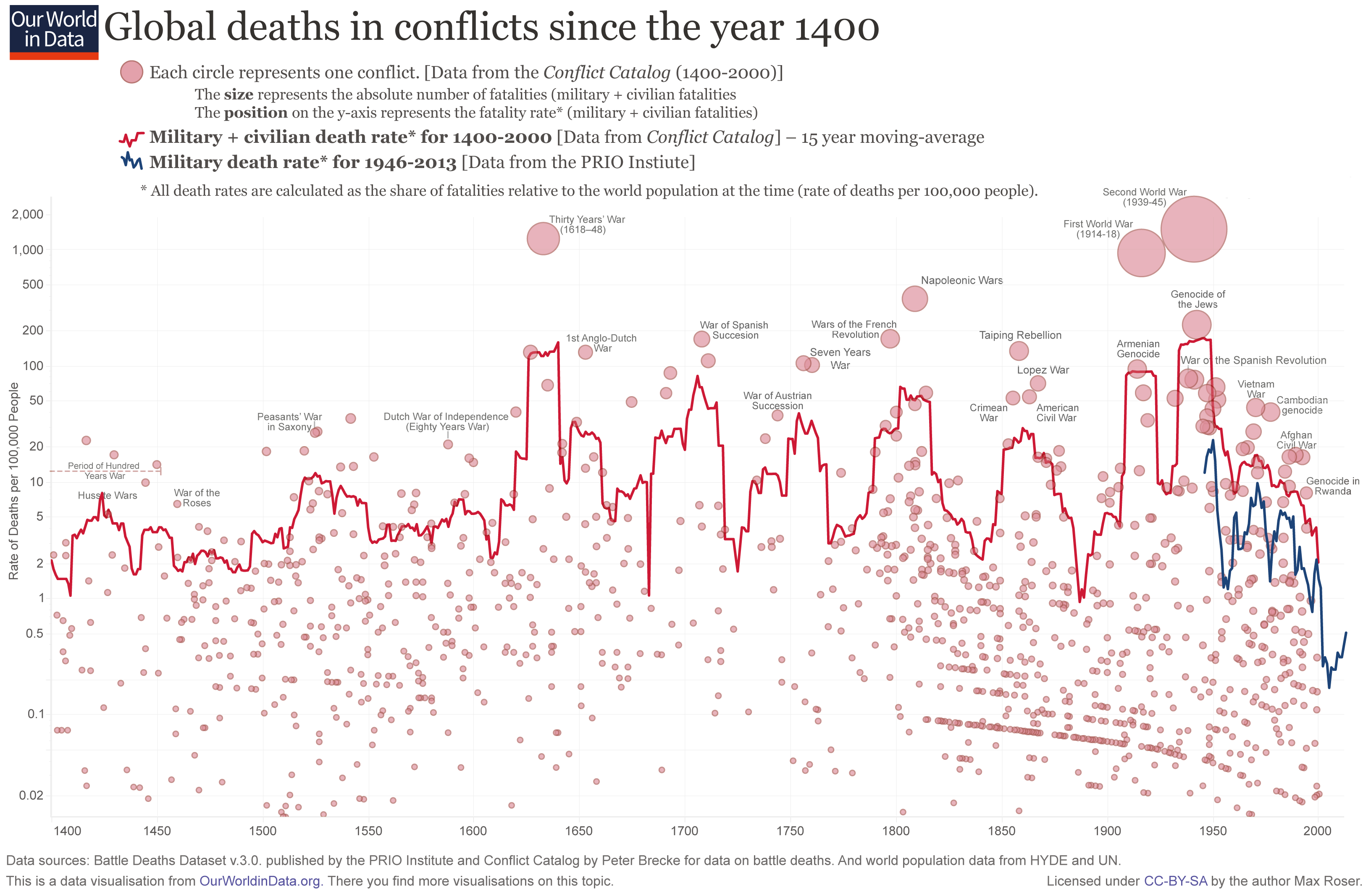
A greater proportion of world population has access to benefits from education and electricity than ever before, and despite painfully slow progress or even regression in some times and places our unprecedented travel and communications technologies are in general leading to erosion of ancient prejudices and injustices and helping the spread of more democratic governance and economics. Conflict-related deaths even in WW1 and WW2 were high, but not exceptionally so as a percentage of world population compared to some earlier historic periods (eg. Napoleonic Wars or the Thirty Years' War), and since 1946 conflict deaths have declined to rival estimates of the most peaceable periods in history.
Whether or not god deserves any credit for the vast improvements in human wellbeing, trying to paint a picture of misery out of the best period in human history in order to denigrate a concept you don't share seems a slightly invalid kind of argument, to my mind.
Of course, it'd fit right in with the religious folk declaring that these are the 'end times' full of sin and suffering.
https://ourworldindata.org/slides/world-poverty
https://ourworldindata.org/war-and-peace/

-
Willum

- Savant
- Posts: 9017
- Joined: Sat Aug 02, 2014 2:14 pm
- Location: Yahweh's Burial Place
- Has thanked: 35 times
- Been thanked: 82 times
Re: What has God done in past century?
Post #14[Replying to post 13 by Mithrae]
Yes, we have finally, within the last 300 years, eclipsed the point that the Judeo-Christian enforced "Dark" or Middle Ages inflicted on us. We can once again enjoy cleanliness and sanitation, medicine, technology and sciences so inhumanely removed from us by a jealous God.
Well presented, at last a point we agree on!
Yes, we have finally, within the last 300 years, eclipsed the point that the Judeo-Christian enforced "Dark" or Middle Ages inflicted on us. We can once again enjoy cleanliness and sanitation, medicine, technology and sciences so inhumanely removed from us by a jealous God.
Well presented, at last a point we agree on!
I will never understand how someone who claims to know the ultimate truth, of God, believes they deserve respect, when they cannot distinguish it from a fairy-tale.
You know, science and logic are hard: Religion and fairy tales might be more your speed.
To continue to argue for the Hebrew invention of God is actually an insult to the very concept of a God. - Divine Insight
You know, science and logic are hard: Religion and fairy tales might be more your speed.
To continue to argue for the Hebrew invention of God is actually an insult to the very concept of a God. - Divine Insight
-
Clownboat

- Savant
- Posts: 10260
- Joined: Fri Aug 29, 2008 3:42 pm
- Has thanked: 1452 times
- Been thanked: 1757 times
Re: What has God done in past century?
Post #15Perhaps easing the suffering of his children.
Christians should enjoy a better quality of life when compared to atheists for example. What I often here though from Christians is how evil the world is and how this is a sign of the end times. I don't hear this outlook from non-believers.
It sounds like this god, in reality is not doing anything at all. 'Your works' for example are not 'his'. Many kids try to behave because of a Santa Claus for example.If you expect God is Christian then I can tell you he is constantly working through his people to share the good news.
You can give a man a fish and he will be fed for a day, or you can teach a man to pray for fish and he will starve to death.
I blame man for codifying those rules into a book which allowed superstitious people to perpetuate a barbaric practice. Rules that must be followed or face an invisible beings wrath. - KenRU
It is sad that in an age of freedom some people are enslaved by the nomads of old. - Marco
If you are unable to demonstrate that what you believe is true and you absolve yourself of the burden of proof, then what is the purpose of your arguments? - brunumb
I blame man for codifying those rules into a book which allowed superstitious people to perpetuate a barbaric practice. Rules that must be followed or face an invisible beings wrath. - KenRU
It is sad that in an age of freedom some people are enslaved by the nomads of old. - Marco
If you are unable to demonstrate that what you believe is true and you absolve yourself of the burden of proof, then what is the purpose of your arguments? - brunumb
Re: What has God done in past century?
Post #16That's a nice piece of social commentary, irrelevant to the question though. We could likewise say that we've had some splendid films: Sound of Music, E.T., the Godfather Trilogy. I pointed out earthquakes and tsunamis because man is not the agent here but, if anything, God is. I cannot think of anything good that he has done but if we claim that the shake of a butterfly's wings is an act of God, we can go home happy.Mithrae wrote:
Whether or not god deserves any credit for the vast improvements in human wellbeing, trying to paint a picture of misery out of the best period in human history in order to denigrate a concept you don't share seems a slightly invalid kind of argument, to my mind.
I am supposing a caring, merciful, loving God exists and I am looking for his recent fingerprints. Man's scientific progress doesn't help.
-
Mithrae
- Prodigy
- Posts: 4326
- Joined: Mon Apr 05, 2010 7:33 am
- Location: Australia
- Has thanked: 112 times
- Been thanked: 195 times
Re: What has God done in past century?
Post #17No doubt that's one interpretation pleasing to many folk, but it fails to account for the stifling of scientific thought from the Ionian Awakening many centuries before Christ was even born. According to Carl Sagan in Cosmos (ch. 7), the greatest enemy of scientific advancement has not been religion specifically, but the social stratification which causes those with money and leisure time - those most able to pursue knowledge for its own sake - to disdain the practical, empirical work associated with the lower classes:Willum wrote: [Replying to post 13 by Mithrae]
Yes, we have finally, within the last 300 years, eclipsed the point that the Judeo-Christian enforced "Dark" or Middle Ages inflicted on us. We can once again enjoy cleanliness and sanitation, medicine, technology and sciences so inhumanely removed from us by a jealous God.
Well presented, at last a point we agree on!
- A disdain for the practical swept the ancient world. Plato urged astronomers to think about the heavens, but not to waste their time observing them. Aristotle believed that: The lower sort are by nature slaves, and it is better for them as for all inferiors that they should be under the rule of a master .... The slave shares in his masters life; the artisan is less closely connected with him, and only attains excellence in proportion as he becomes a slave. The meaner sort of mechanic has a special and separate slavery. Plutarch wrote: It does not of necessity follow that, if the work delight you with its grace, the one who wrought it is worthy of esteem. Xenophons opinion was: What are called the mechanical arts carry a social stigma and are rightly dishonoured in our cities. As a result of such attitudes, the brilliant and promising Ionian experimental method was largely abandoned for two thousand years. Without experiment, there is no way to choose among contending hypotheses, no way for science to advance. The antiempirical taint of the Pythagoreans survives to this day. But why? Where did this distaste for experiment come from?
An explanation for the decline of ancient science has been put forward by the historian of science, Benjamin Farrington: The mercantile tradition, which led to Ionian science, also led to a slave economy. The owning of slaves was the road to wealth and power. Polycrates fortifications were built by slaves. Athens in the time of Pericles, Plato and Aristotle had a vast slave population. All the brave Athenian talk about democracy applied only to a privileged few. What slaves characteristically perform is manual labor.
But scientific experimentation is manual labor, from which the slaveholders are preferentially distanced; while it is only the slaveholders - politely called gentle-men in some societies - who have the leisure to do science. Accordingly, almost no one did science. The Ionians were perfectly able to make machines of some elegance. But the availability of slaves undermined the economic motive for the development of technology. Thus the mercantile tradition contributed to the great Ionian awakening around 600 B.C., and, through slavery, may have been the cause of its decline some two centuries later. There are great ironies here.
Similar trends are apparent throughout the world. The high point in indigenous Chinese astronomy occurred around 1280, with the work of Kuo Shou-ching, who used an observational baseline of 1,500 years and improved both astronomical instruments and mathematical techniques for computation. It is generally thought that Chinese astronomy thereafter underwent a steep decline. Nathan Sivin believes that the reason lies at least partly in increasing rigidity of elite attitudes, so that the educated were less inclined to be curious about techniques and less willing to value science as an appropriate pursuit for a gentleman. The occupation of astronomer became a hereditary office, a practice inconsistent with the advance of the subject. Additionally, the responsibility for the evolution of astronomy remained centered in the Imperial Court and was largely abandoned to foreign technicians, chiefly the Jesuits, who had introduced Euclid and Copernicus to the astonished Chinese, but who, after the censorship of the latters book, had a vested interest in disguising and suppressing heliocentric cosmology. Perhaps science was stillborn in Indian, Mayan and Aztec civilizations for the same reason it declined in Ionia, the pervasiveness of the slave economy. A major problem in the contemporary (political) Third World is that the educated classes tend to be the children of the wealthy, with a vested interest in the status quo, and are unaccustomed either to working with their hands or to challenging conventional wisdom. Science has been very slow to take root.
Plato and Aristotle were comfortable in a slave society. They offered justifications for oppression. They served tyrants. They taught the alienation of the body from the mind (a natural enough ideal in a slave society); they separated matter from thought; they divorced the Earth from the heavens - divisions that were to dominate Western thinking for more than twenty centuries. Plato, who believed that all things are full of gods, actually used the metaphor of slavery to connect his politics with his cosmology. He is said to have urged the burning of all the books of Democritus (he had a similar recommendation for the books of Homer), perhaps because Democritus did not acknowledge immortal souls or immortal gods or Pythagorean mysticism, or because he believed in an infinite number of worlds. Of the seventy-three books Democritus is said to have written, covering all of human knowledge, not a single work survives. All we know is from fragments, chiefly on ethics, and secondhand accounts. The same is true of almost all the other ancient Ionian scientists.
When the religion was co-opted by political authority in the 4th century, unsurprisingly the Roman Catholic Church took shape as an intensely hierarchical institution. Arguably, it wasn't until the advent of the Protestant Reformation in the 16th century - in general terms promoting individual responsibility before God, emphasizing personal biblical understanding and hence prizing literacy, and rejecting the most extreme hierarchical elements of Catholic tradition - that the tide of social stratification could begin to slowly turn in the opposite direction. Even more intriguingly the Jewish tradition which you are so eager to mock and blame has actually produced a vastly disproportionate number of Nobel Laureates relative to population, perhaps partly or entirely because it emphasizes personal study and enquiry even more than Protestantism; almost explicitly a religious devotion to analysis and enquiry against historical traditions as a matter of personal ethical growth and understanding.
Many other factors have contributed to human progress of course, but if Christianity or Judaism were somehow the root of all ignorance and evil, Europe should have been and remained one of the most backward regions of the world. Instead, the stifling of scientific progress can be traced back long before the advent of Christianity, and in fact over the past few centuries it has usually been countries with predominantly Christian backgrounds which have been at the very forefront of scientific, industrial and democratic progress.
Make of that what you will.
-
Mithrae
- Prodigy
- Posts: 4326
- Joined: Mon Apr 05, 2010 7:33 am
- Location: Australia
- Has thanked: 112 times
- Been thanked: 195 times
Re: What has God done in past century?
Post #18Are you therefore implying that frequency, severity and human tolls of "hurricanes, floods and tsunamis and famines" are unaffected by population sizes, coastal and high-density living patterns, land use and soil erosion, or anthropogenic contributions to climate change and geological instability?marco wrote:That's a nice piece of social commentary, irrelevant to the question though. We could likewise say that we've had some splendid films: Sound of Music, E.T., the Godfather Trilogy. I pointed out earthquakes and tsunamis because man is not the agent here but, if anything, God is. I cannot think of anything good that he has done but if we claim that the shake of a butterfly's wings is an act of God, we can go home happy.Mithrae wrote:
Whether or not god deserves any credit for the vast improvements in human wellbeing, trying to paint a picture of misery out of the best period in human history in order to denigrate a concept you don't share seems a slightly invalid kind of argument, to my mind.
I am supposing a caring, merciful, loving God exists and I am looking for his recent fingerprints. Man's scientific progress doesn't help.
If - following your would-be portrait of misery and woe - you can so easily dismiss the fact that this is actually the best period in all of human history as being supposedly just the result of our own genius and actions, why does your thread apparently ignore those same realities in the case of most of the suffering we see?
-
JehovahsWitness

- Savant
- Posts: 23430
- Joined: Wed Sep 29, 2010 6:03 am
- Has thanked: 930 times
- Been thanked: 1349 times
- Contact:
Re: What has God done in past century?
Post #19Elijah John wrote: Wootah, JW, how would either of those things convince anyone but the already convinced?
Why don't you ask the 30 people that become Jehovah's Witneess on average per hour! Convincing people of these truths is not an academic exercise for JWs, its not idle and ideological chat on the internet that ends there.. it's what we do! it is our calling and our mission and if the things we witnesse to were without effect it would indeed be a powerful indication that the message lacked substance.
As it is, hundreds of thousand of people per year, many of them atheist, hindus, muslims from every walk of life and background, religious or not... after studying the evidence are convinced that the preaching work as well as other signs of our present day, is evidence of God's work in our times.
JW
INDEX: More bible based ANSWERS
http://debatingchristianity.com/forum/v ... 81#p826681
"For if we live, we live to Jehovah, and if we die, we die to Jehovah. So both if we live and if we die, we belong to Jehovah" - Romans 14:8
http://debatingchristianity.com/forum/v ... 81#p826681
"For if we live, we live to Jehovah, and if we die, we die to Jehovah. So both if we live and if we die, we belong to Jehovah" - Romans 14:8
-
Elijah John
- Savant
- Posts: 12236
- Joined: Mon Oct 28, 2013 8:23 pm
- Location: New England
- Has thanked: 11 times
- Been thanked: 16 times
Re: What has God done in past century?
Post #20Have you convinced anyone here on this site of the truths of the Watchtower? Any new recruits from our number here?JehovahsWitness wrote:Elijah John wrote: Wootah, JW, how would either of those things convince anyone but the already convinced?
Why don't you ask the 30 people that become Jehovah's Witneess on average per hour! Convincing people of these truths is not an academic exercise for JWs, its not idle and ideological chat on the internet that ends there.. it's what we do! it is our calling and our mission and if the things we witnesse to were without effect it would indeed be a powerful indication that the message lacked substance.
As it is, hundreds of thousand of people per year, many of them atheist, hindus, muslims from every walk of life and background, religious or not... after studying the evidence are convinced that the preaching work as well as other signs of our present day, is evidence of God's work in our times.
JW
Also, is that the only or even the main way you see God working in our present day and age, through recruitment to the WTS?
My theological positions:
-God created us in His image, not the other way around.
-The Bible is redeemed by it's good parts.
-Pure monotheism, simple repentance.
-YHVH is LORD
-The real Jesus is not God, the real YHVH is not a monster.
-Eternal life is a gift from the Living God.
-Keep the Commandments, keep your salvation.
-I have accepted YHVH as my Heavenly Father, LORD and Savior.
I am inspired by Jesus to worship none but YHVH, and to serve only Him.
-God created us in His image, not the other way around.
-The Bible is redeemed by it's good parts.
-Pure monotheism, simple repentance.
-YHVH is LORD
-The real Jesus is not God, the real YHVH is not a monster.
-Eternal life is a gift from the Living God.
-Keep the Commandments, keep your salvation.
-I have accepted YHVH as my Heavenly Father, LORD and Savior.
I am inspired by Jesus to worship none but YHVH, and to serve only Him.

