
http://debatingchristianity.com/forum/v ... 3&start=40
This thread was started because I suddenly had an idea. I know from a Christian point of view what it is like to try and prove something which to me, make perfect sense and fits in with the facts, but others deny much and sometimes all of what is put forth simply because it is the Christians viewpoint.
So I have devised a devious scheme. Time to switch and see if the non-theists can defend a position which we all know to be true. I (and any other theist who wants to join) can play the atheist/skeptic and the non-theists have to be the apologists for the validity of the event.
ready . . . here is the topic to be proven:
Prove to me that Lincoln actually gave the Gettysburg address.
I'll get you all started.
I see no reason to believe that the GA was ever given. Even if some speech was given by someone near Gettysburg, I am sure it wasn't the speech that history records. My reasons for this follow:
1) There were many of bloody battles during the civil war. Gettysburg wasn't the beginning nor the end of the war. In fact there really wasn't any reason at all for this particular battle to deserve a speech.
2) I find it unlikely that Lincoln would have presented a speech totally unrehearsed and unplanned. Once again there was no reason for this to happen.
3) The North needed to rally its troops after the battle to take advantage of the their first major victory. The idea of such an inspiring speech would have made a great platform for recruiting and inspiring their soldiers.
4) Other than NORTHERN people, who would have been biased in favor of the ideas put forth in this address, there are no witness accounts for this speech.
5) The supposed copies we have of "drafts" of the speech differ in several places and have major inconsistencies.
http://www.loc.gov/exhibits/gadd/gadrft.html
6) The drafts we have come from different sources both of whom were very pro-north in their ideology and these two drafts do not match with one another, suggesting that there was never an original or correct coy to begin with. After all how hard is it to simply copy from one paper to another?
7) These two drafts and the only two which were written anytime near the event in question and modern scholars aren't even sure if one of them was written before or after this supposed speech was given.
8) There isn't very much evidence that Lincoln was ever at Gettysburg. There are no photos of him there. The only photo which supposedly has ever been found of him there was unidentified until 1952, is very vague and doesn't contain anything in it which can positively identify a location or even a time.
9) Lincoln was all the way in Washington just a couple hours after this speech was supposedly given so combining this fact with the fact that there is not physical evidence he was ever at Gettysburg, I see no reason to conclude that he ever was at Gettysburg, much less that he stopped to give a speech at a battlefield with no significance at the time.
10) The details of the speech are not agreed upon. If Lincoln did write it, and if he was alive to write out other copies later on, shouldn't all this be clear?
http://spider.georgetowncollege.edu/hta ... /page6.htm
11) Why would Lincoln be at this site for hours and only give a speech with barely 230 words total? Shouldn't a president be given the majority of the time to speak? Why would his speech be cut so short given the amount of time he was supposedly there? This inconsistency is illogical and can not be reconciled with the facts.
Based on the fact that there are extreamly limited and fairly untrustworthy copies of this supposed speech until well after it was already circulated by northern conspirators and that the motive for the North to concoct such a scheme is easy to see, I submit that President Lincoln never actually gave this speech in Gettysburg at the time he was supposedly doing so.
It was obviously a giant media propaganda by Northern war hawks and politicians.
A fun little exercise and a new perspective at Gettysburg
Moderator: Moderators
-
achilles12604

- Site Supporter
- Posts: 3697
- Joined: Mon Jun 19, 2006 3:37 am
- Location: Colorado
A fun little exercise and a new perspective at Gettysburg
Post #1It is a first class human tragedy that people of the earth who claim to believe in the message of Jesus, whom they describe as the Prince of Peace, show little of that belief in actual practice.
-
achilles12604
- Site Supporter
- Posts: 3697
- Joined: Mon Jun 19, 2006 3:37 am
- Location: Colorado
Post #51
I tried to read it but it wouldn't come up. I'll try again when I get more timeCathar1950 wrote:You can read this if you like.
http://www.depts.drew.edu/jhc/PriceSchleiermacher.pdf
This is interesting too.
Of course they are from the Tbingen school and will be dismissed.
It is a first class human tragedy that people of the earth who claim to believe in the message of Jesus, whom they describe as the Prince of Peace, show little of that belief in actual practice.
-
achilles12604
- Site Supporter
- Posts: 3697
- Joined: Mon Jun 19, 2006 3:37 am
- Location: Colorado
Post #52
I think that while it is possible that the synoptic Gospels were not penned by the men who they are attested to, this hypothesis isn't as sound as the alternative that they did in fact pen said Gospels. In other words, from my research, (and yes I have read through the opposing view as well) I find the simplest solution to be the one given by apologists. Without getting into WAY to much detail here are a few reasons.ManBearPig wrote:While growing up I was taught that all of scripture was "God-breathed", and thus 100% correct. So that's the experience I'm going by, though I can believe you when you say most Christian members of this board might disagree.
Yeah, but that's a lot of if's. I think they're all written anonymously (?), and most of what I've read says it's very unlikely that the gospels were written by the men whose names they bear. Just like the dozens of non-canonical gospels. Apparently in those days, gospel-writing was very popular!Matthew is supposed to be an eyewitness so if this is accurate then he did hear and see. If Mark really was recording Peter, then that would hold especially strongly. John may or may not have been an eyewitness depending on who actually wrote his gospel.And if you had something to say, and you wanted people to take it seriously, you wrote it down and then attached a prominent name to it.
Actually that's another good example of what I was talking about. Christians sometimes say, "they wouldn't do that, that's dishonest!" But again, yeah it's dishonest if you're Bob Woodward. It's dishonest if you write for the Chicago Tribune. It's not dishonest if you're a storyteller who lives in a time long before journalistic ethics were even conceived.
I'm not a scholar in this, so I'm starting to get a little over my head
1) They Gospels were written early. How early is debated but these were absolutely the first. They predate the Gnostic Gospels by as much as 100 years.
2) The names attached were no bodies. Hence it isn't likely that the church would give them these names falsely.
3) The Gospels authors are attested to by Papias (indirectly through Eusebius writings) as early as 100-120 CE.
Combining these and a few other factors, and with the complete lack of evidence to the contrary, the simplest solution is that the synoptic Gospels were in fact written by these men.
If you have any evidence to the contrary then by all means present it. I am actually looking for something more to debate than the standard "what if's" and "it can be doubted's" that occur regularly in non-theistic arguments. Most of the time their arguments consist of "we don't know for sure so this is probably what happened." In fact this is what I am trying to debate with them on another thread. So far many non-theists (CATHAR) on this site are happy to claim very late dates and unknown authorship as plain fact, but when I directly ask them to defend this position they politely decline to do so.
It is a first class human tragedy that people of the earth who claim to believe in the message of Jesus, whom they describe as the Prince of Peace, show little of that belief in actual practice.
-
Cathar1950

- Site Supporter
- Posts: 10503
- Joined: Sun Feb 13, 2005 12:12 pm
- Location: Michigan(616)
- Been thanked: 2 times
Post #53
All three of your reasons are full of "what if" or "Maybe".achilles12604 wrote:I think that while it is possible that the synoptic Gospels were not penned by the men who they are attested to, this hypothesis isn't as sound as the alternative that they did in fact pen said Gospels. In other words, from my research, (and yes I have read through the opposing view as well) I find the simplest solution to be the one given by apologists. Without getting into WAY to much detail here are a few reasons.ManBearPig wrote:While growing up I was taught that all of scripture was "God-breathed", and thus 100% correct. So that's the experience I'm going by, though I can believe you when you say most Christian members of this board might disagree.
Yeah, but that's a lot of if's. I think they're all written anonymously (?), and most of what I've read says it's very unlikely that the gospels were written by the men whose names they bear. Just like the dozens of non-canonical gospels. Apparently in those days, gospel-writing was very popular!Matthew is supposed to be an eyewitness so if this is accurate then he did hear and see. If Mark really was recording Peter, then that would hold especially strongly. John may or may not have been an eyewitness depending on who actually wrote his gospel.
Actually that's another good example of what I was talking about. Christians sometimes say, "they wouldn't do that, that's dishonest!" But again, yeah it's dishonest if you're Bob Woodward. It's dishonest if you write for the Chicago Tribune. It's not dishonest if you're a storyteller who lives in a time long before journalistic ethics were even conceived.
I'm not a scholar in this, so I'm starting to get a little over my head
1) They Gospels were written early. How early is debated but these were absolutely the first. They predate the Gnostic Gospels by as much as 100 years.
2) The names attached were no bodies. Hence it isn't likely that the church would give them these names falsely.
3) The Gospels authors are attested to by Papias (indirectly through Eusebius writings) as early as 100-120 CE.
Combining these and a few other factors, and with the complete lack of evidence to the contrary, the simplest solution is that the synoptic Gospels were in fact written by these men.
If you have any evidence to the contrary then by all means present it. I am actually looking for something more to debate than the standard "what if's" and "it can be doubted's" that occur regularly in non-theistic arguments. Most of the time their arguments consist of "we don't know for sure so this is probably what happened." In fact this is what I am trying to debate with them on another thread. So far many non-theists (CATHAR) on this site are happy to claim very late dates and unknown authorship as plain fact, but when I directly ask them to defend this position they politely decline to do so.
100-120 CE are the first the gospels are mentioned.
The writings and history of Eusebius are much later and questionable.
You have been given evidence over and over and it amounts to battling sources where yours seem to follow the party line. I am Not a Non-Theist. I might be a Panentheist.
No one has declined to answer or defend. Granted the argument are complicated and varied but they are not mere opinion. I know for a fact that Goat, Mack, Scotum and others have given you information and sources endlessly and you fall back on Eusebius and traditions that are questionable. There are no manuscripts before the second century.
There are many variations as we go back and not until very late to they start to conform to any kind of standard as they came under the control of the orthodox branch of the church.
But I will get back to you.
-
achilles12604
- Site Supporter
- Posts: 3697
- Joined: Mon Jun 19, 2006 3:37 am
- Location: Colorado
Post #54
You know where the thread is. I'd be happy do continue this debate there.Cathar1950 wrote:All three of your reasons are full of "what if" or "Maybe".achilles12604 wrote:I think that while it is possible that the synoptic Gospels were not penned by the men who they are attested to, this hypothesis isn't as sound as the alternative that they did in fact pen said Gospels. In other words, from my research, (and yes I have read through the opposing view as well) I find the simplest solution to be the one given by apologists. Without getting into WAY to much detail here are a few reasons.ManBearPig wrote:While growing up I was taught that all of scripture was "God-breathed", and thus 100% correct. So that's the experience I'm going by, though I can believe you when you say most Christian members of this board might disagree.
Yeah, but that's a lot of if's. I think they're all written anonymously (?), and most of what I've read says it's very unlikely that the gospels were written by the men whose names they bear. Just like the dozens of non-canonical gospels. Apparently in those days, gospel-writing was very popular!Matthew is supposed to be an eyewitness so if this is accurate then he did hear and see. If Mark really was recording Peter, then that would hold especially strongly. John may or may not have been an eyewitness depending on who actually wrote his gospel.
Actually that's another good example of what I was talking about. Christians sometimes say, "they wouldn't do that, that's dishonest!" But again, yeah it's dishonest if you're Bob Woodward. It's dishonest if you write for the Chicago Tribune. It's not dishonest if you're a storyteller who lives in a time long before journalistic ethics were even conceived.
I'm not a scholar in this, so I'm starting to get a little over my head
1) They Gospels were written early. How early is debated but these were absolutely the first. They predate the Gnostic Gospels by as much as 100 years.
2) The names attached were no bodies. Hence it isn't likely that the church would give them these names falsely.
3) The Gospels authors are attested to by Papias (indirectly through Eusebius writings) as early as 100-120 CE.
Combining these and a few other factors, and with the complete lack of evidence to the contrary, the simplest solution is that the synoptic Gospels were in fact written by these men.
If you have any evidence to the contrary then by all means present it. I am actually looking for something more to debate than the standard "what if's" and "it can be doubted's" that occur regularly in non-theistic arguments. Most of the time their arguments consist of "we don't know for sure so this is probably what happened." In fact this is what I am trying to debate with them on another thread. So far many non-theists (CATHAR) on this site are happy to claim very late dates and unknown authorship as plain fact, but when I directly ask them to defend this position they politely decline to do so.
100-120 CE are the first the gospels are mentioned.
The writings and history of Eusebius are much later and questionable.
You have been given evidence over and over and it amounts to battling sources where yours seem to follow the party line. I am Not a Non-Theist. I might be a Panentheist.
No one has declined to answer or defend. Granted the argument are complicated and varied but they are not mere opinion. I know for a fact that Goat, Mack, Scotum and others have given you information and sources endlessly and you fall back on Eusebius and traditions that are questionable. There are no manuscripts before the second century.
There are many variations as we go back and not until very late to they start to conform to any kind of standard as they came under the control of the orthodox branch of the church.
But I will get back to you.
It is a first class human tragedy that people of the earth who claim to believe in the message of Jesus, whom they describe as the Prince of Peace, show little of that belief in actual practice.
-
achilles12604
- Site Supporter
- Posts: 3697
- Joined: Mon Jun 19, 2006 3:37 am
- Location: Colorado
Post #55
I'm not necessarily trying to bring up this topic again. Rather, I have finally FOUND my overall compilation and essay on the subject and thought it would be appropriate to post it in its entirety.
History Re-made: A New Perspective on Gettysburg
Many times when an atheist and a Christian meet to debate the facts surrounding Jesus and the New Testament, the historicity of the Bible becomes a topic of great importance. During the discussion of these facts, the atheists traditionally attack the Bibles historicity on several levels. For example, the atheist regularly questions the biblical authors motives for writings. (19) They point out the gap of time between the event and the first copies of what transpired. (1) They question the lack of physical evidence of events and inconsistencies between various accounts. (2) They use these and other tactics to try and place the biblical rendition of events into doubt. On the other, hand the Christian apologist uses literature, archeology, and other methods to show that the biblical presentation of events is both plausible, and in most cases, is the most likely explanation for the evidence being presented. Most times the answers given by the Christians are sound, reasonable and very plausible, but this does little to convince the hard-line skeptics. Many skeptics find minor imperfections in the apologists arguments and therefore assume that anything offered by the Christian apologist is untrustworthy and unfounded. Atheists express their skeptical viewpoint both in debate and in their publications. For some atheists, their arguments can be as simple as "It can be doubted . . ." a phrase used by atheists like Richard Carrier and others in their writings.(3)
After reviewing many debates and forging into the debating arena myself for almost a year, I noticed that many times the skeptics arguments, especially those against accounts of events in the Gospels, hinged on their prior assumptions. Just as they accuse the Christian apologists arguments of failing because they stem from a background of belief, so too do the skeptics arguments all stem from a preconception of disbelief. When they apply their arguments from a position of doubt, inevitably they find cause to validate their opinions. However, I do not believe that their method is sound. I believe that their arguments are fatally flawed and are presented in a manner which forces them to reach the conclusion that the skeptic began with. Their methods do not allow for a fair and unbiased analysis of the evidence in question because they reject certain aspects of the evidence a priori. Therefore, I decided to test my hypothesis that their arguments are fatally flawed and they are an unsound method of analyzing history.
I thought it would be interesting to advance an argument from the position of the skeptic. I decided to take an accepted historical event and attempt to cast doubt on its historicity. I employed this tactic on the debating forum I frequently attend online. There I took the role of the doubter and let the skeptics defend the validity of a non-biblical historical event. I chose to conduct this experiment on the speech given by Abraham Lincoln at Gettysburg, known throughout the country as The Gettysburg Address. To conduct my experiment I chose to employ the exact same arguments offered by the skeptics against the historicity of the bible and its accounts. Above, I gave examples of several arguments commonly used to cast doubt on the bible. I will use these same arguments; namely motive for altering the record of history by key players, a gap of time between the events and the first copies, inconsistencies between the copies themselves as well as the witnesses, and total and complete lack of physical evidence to substantiate the event in question. I will present these arguments with the prior assumption that Lincoln did not give the Gettysburg Address and in fact he was probably never there in the first place. I will allow the reader to decide for themselves the effectiveness of my experiment. However, when I presented this same experiment to my online debating forum, the result was astounding. Many of the most avid atheist debaters on the site concurred that given the arguments I am about to present, history certainly could be incorrect. I will let you decide for yourselves.
Before beginning, there is something important which should be kept in mind. I am analyzing a very recent historical event which occurred in the age of modern technology. The skeptics argued against events recorded from ancient history and well before any semblance of technology was available to assist in recording these events. Because ancient history can not be told from the viewpoint of cameras, tape records and other such technology, the standard to which a historian holds ancient history is much more relaxed than modern events. Therefore, my task of disparaging the historicity of the Gettysburg Address becomes much more difficult than that of attacking the validity of the Gospel accounts. With this in mind my next few sections will be my actual argument. Remember that I am taking the position of the skeptic to show how their arguments are flawed and can not be applied fairly to history. To take this stance I will be arguing from the perspective the Gettysburg Address never happened and that Lincoln certainly did not write or present it as history records.
The Historicity of the Gettysburg Address
History records the Gettysburg Address being presented by Abraham Lincoln on Nov. 19, 1863. I plan on showing that this is not likely to be the case. There are several factors which question historys judgment that Lincoln gave the Gettysburg Address and in fact cause the very historicity of this event can be placed into serious doubt. First, there was a strong motivation for the northern politicians to forge an event like this to aid in the public opinion of an otherwise unpopular war. Second there was a very substantial and unexplained gap of time between the event and the discovery of the copies of Lincolns speech. Third, there were numerous and very substantial inconsistencies between the copies which were finally presented. Fourth, there were inconsistencies between "witness" accounts of the speech, and fifth, and most condemning of all, is the mysterious lack of physical evidence that such a historic event ever took place. I will address each of these points in turn and by the end it should be clear how little we can trust the record of history concerning the Gettysburg Address.
Concerning the motivation of the northern politicians, we can see that the northern politicians had a huge motive for invoking a public relations campaign. Up till now the north had been struggling in the war. The south and their arsenal of West Point generals had very nearly won the conflict. The average northern voters opinion of the war was at an all time low. (7) The Battle of Gettysburg was a huge victory for the north. It turned out to be the main turning point in the conflict. So the northern politicians knew they had to capitalize on the victory. Common sense would dictate that Lincoln would be at the fore front of promoting this event. After all he was the driving force behind both the preserved union of America and the new anti-slavery movement. However, this is where we discover our first strange occurrence.(4) We see that David Wills, put in charge of cleaning up the aftermath, invited others to speak on the event, months before the occasion, yet he failed to invite Lincoln until a couple weeks before it took place. His reasons for waiting until the last minute are still being debated by various scholars today. (12) To quote the Library of Congress,
Moving on we can see that there are additionally strange factors to be considered when analyzing the historicity of the Gettysburg Address. Namely the huge gap of time between when the event supposedly took place and when the first copies of the supposed speech appeared. The fact is that the two copies of this speech didnt surface until almost 50 years after the speech supposedly happened. Furthermore, they did not surface together but rather one at a time and 22 years apart. On the surface this may seem only a little strange. Many times documents are misplaced or lost until a researcher finds them. However, this is not the case with the copies of the address. The copies of the Gettysburg Address came from Lincolns secretaries, John Hay and John Nicolay. These men claimed that Lincoln gave them the copies after the speech took place. If that is the truth then it is strange that Nicolay wrote about his draft in 1894, 31 years later, but then Hays copy did not come to light until 1916 a full 53 years after this supposed event. The whereabouts of these copies for the many decades between 1863 and when they were presented is totally unknown. (17) They simply disappeared. Then, suddenly the copies were produced. The circumstances surrounding their "disappearance" are strange to say the least. Lincolns secretaries were said to be in control of the documents. However, we have already established that northern politicians had a motive for fabrication and as we will soon see, the trustworthiness of these men on this subject is even more suspect than their fellow politicians. (8)
Up until now we have only seen circumstantial evidence showing a series of strange events surrounding the event in question. Next we will examine evidence which shows that these strange occurrences are not a coincidence but in fact small parts of a much larger conspiracy. I showed that the only supporting documents of this event were totally unknown until presented by Lincolns secretaries 50 years after the fact. While this is not conclusive proof of a conspiracy, there is a major problem with the copies themselves which casts a lot of doubt about their authenticity and origins.
We now turn our attention to a tool very commonly used by historians to determine the series of events and the authenticity of literary documents. Multiple copies of documents are a terrific aid in determining the course of events. Where one copy is lacking, most of the other copies are correct. However, with the Gettysburg Address we quickly see that this method is of no use for historians. This is likely the reason so much debate and disagreement surrounds the actual series of events. The copies of the speech have major inconsistencies between them and no two copies are the same. To demonstrate the full scope of the problem, below are both the Nicolay and Hay copies. In underlined bold type you can clearly see the inconsistencies between these accounts.
My final argument against the historicity of the Gettysburg Address is simply a total and complete lack of evidence. There is absolutely no physical evidence that Lincoln was ever at Gettysburg on Nov 19. This should strike you as very strange because if this event actually happened, the newspapers would certainly have taken at least one photograph to put into their papers. They should have taken many photos. However, this is exactly what we do not see. Not one newspaper account includes a photograph despite supposedly having hours to take one. The newspapers were not the only ones who failed to document anything physical. In fact there is only one photo of Lincoln which has been attributed to this occasion, and that one photo has a questionable background and details. The photo in question has absolutely no unique attributes. It lacks any structures, railroads or anything else to identify it. On top of that it was totally unknown until 1952 when it was discovered that Lincoln was in a very tiny corner of the photo. (21) To further negate the possibility of this photo being from Gettysburg all we need to do is compare it to Antietam where Lincoln gave his very famous Emancipation Proclamation. Below is the photo in question along with a photo from Antietam. As you can plainly see the photo in question could easily have been taken at Antietam, not Gettysburg.

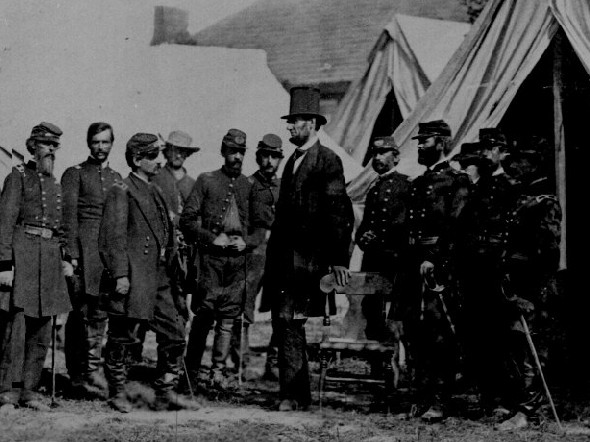
Both of these pictures display military men and wide open fields. Therefore it is easy to see how both were taken from different angles at Antietam. Also the fact that Antietam has not one but 3 other cooborative photographs as well as a very famous speech, the evidence supporting this mystery photo being of Antietam rather than Gettysburg is overwhelming. Again this leaves us with absolutely zero physical evidence that can substantiate historys claims about the Gettysburg Address.
So after examining the internal evidence, the cohesiveness of the accounts, the supposed witnesses and their stories, the mysterious lack of physical evidence, the huge gap of time where the supposed originals were totally missing and the obvious motive for forgery, we have uncovered not a historical event, but a mass of confusion, contradiction and missing pieces. In short what we have discovered is a conspiracy. A conspiracy created and aided by Lincolns secretaries. As was noted by expert Michael Troy, the only method of tracing the authenticity of the only evidence we have, the original copies, forces us to go straight through the two persons who are most suspect in the entire ordeal.
In conclusion, I have just shown how the skeptics arguments simply can not be valid. If their arguments were sound then they should not have been applicable to another historical event. Yet as I plainly showed, each individual point that is used by skeptics, can be evenly applied to other historical events, as recent as 150 years ago. My first example, showing the motivation of the writers, is used by many atheist debaters. From Richard Carrier to Dan Barker, non-theist skeptics have all accused the early Christian writers of having a theological axe to grind. Obviously motivations for writing must be taken into account. However, to disregard entire documents simply because the individuals writing them really believed in what they were writing about, is irresponsible. If we only accepted writings about subjects from opponents to the subject, there would be very little accepted literature at all. My second point about the gap of time between the event and the first written record is used on a regular basis in many skeptic publications. (22) However, the gap of time between Mark, commonly accepted as the first Gospel, and Jesus ministry is generally considered to be about 20-40 years. Notice that even the longer of these estimations places them 10 years before the final copy of the Gettysburg Address appeared. Once again considering the limitations of ancient cultures and the fact that the vast majority of the people living at that time were illiterate, we can plainly see that their objections based on the "huge" gap of time are fallacious. There is a larger gap between the Gettysburg Address and its documentation than Jesus ministry and the gospels. My third point that there were inconsistencies between the accounts is a favorite of skeptics when attacking the bible. However, F. F. Bruce in his book, New Testament Documents: Are They Reliable?, points out that the New Testament is more than 95% congruent. This means that the New Testament books have less than 5 mistakes out of 100 words. Something else to note is that these mistakes include spelling errors. This is a far cry from the twenty two percent variations between the copies of the Gettysburg Address. If the skeptic can disregard literature passed down for 2000 years which contains only about a 5% margin of error, how can they trust much of the rest of history? My fourth point concerning the lack of physical evidence surprised even me. Some skeptics critique the biblical accounts based on lack of physical evidence supporting the events recorded in the bible. However, this is where considering the context of the times becomes important. There were no modern day recording devices. They did not even have enough technology to produce modern paper. Most of the writings of the day were presented on Papyri, a plant which obviously can decompose quickly if not meticulously cared for. Also something to consider is the question of what events recorded in the Gospels should have left a lasting mark. Not very many of the events in question would have left much for archeology to discover. Jesus miracles did not alter the landscape. He did not build any cities nor did he conquer any foreign countries. So for the skeptics to demand physical corroboration of particular events is simply unrealistic. Interestingly this is not so with the Gettysburg Address. As I mentioned there should have been numerous photographs of this event. Newspaper accounts should have been consistent. Yet even though this event occurred less than 150 years ago, there is almost no physical evidence to support its historicity. The book of Acts has dozens of physical markers and archeological digs supporting its validity. Strange that we have more physical evidence for events that occurred 2000 years ago than we do of a major historical turning point, occurring less than 150 years ago.
There can be no more doubt. The harsh viewpoint of the skeptical writer and debater is simply unrealistic. When fairly applied, their arguments can invalidate historical events, not only from ancient times but from recent history. This was probably what Dr. Craig Bloomberg of Denver Seminary meant when he wrote, "The Jesus Seminar and its friends do not reflect any consensus of scholars except for those on the "radical fringe" of the field. Its methodology is seriously flawed and its conclusions are unnecessarily skeptical." (23)
References:
(1) http://www.infidels.org/library/modern/ ... ction.html
(2) http://www.geocities.com/b_d_muller/gospels.html
(3) http://www.infidels.org/library/modern/richard_carrier/
(4) http://www.loc.gov/exhibits/gadd/gainvi.html
(5) http://www.loc.gov/exhibits/treasures/trt030.html
(6) http://www.loc.gov/exhibits/treasures/trt031.html
(7) http://www.freerepublic.com/focus/fr/626343/posts
(8) http://www.loc.gov/exhibits/gadd/gadrft.html
(9) http://www.loc.gov/exhibits/gadd/gatr1.html
(10) http://www.loc.gov/exhibits/gadd/gatr2.html
(11) http://showcase.netins.net/web/creative ... ysburg.htm
(12) http://www.eyewitnesstohistory.com/gtsburgaddress.htm
(13) http://www.eyewitnesstohistory.com/gtsburgaddress.htm
(14) http://showcase.netins.net/web/creative ... ysburg.htm
(15) http://www.loc.gov/exhibits/treasures/trt032.html
(16) http://shs.westport.k12.ct.us/jwb/AP/TLdocs/GetAdd.htm
(17) http://www.historycooperative.org/journ ... hnson.html
(18) http://experts.about.com/q/U-S-History- ... ddress.htm
(19) http://www.infidels.org/library/modern/ ... orner.html
(20) http://www.angelfire.com/my/abrahamlinc ... sburg.html
(21) http://www.loc.gov/exhibits/gadd/gaphot.html
(22) www.infidel.org
(23) Wilkins, Jesus Under Fire. Zondervan Publishing House. 1995
More sources:
http://dictionary.reference.com/browse/logic
Jesus Under Fire (P128)
http://debatingchristianity.com/forum/v ... 42&start=0
http://usinfo.state.gov/usa/infousa/fac ... rac/25.htm
http://showcase.netins.net/web/creative ... ysburg.htm
http://www.loc.gov/exhibits/treasures/trt032.html
http://www.loc.gov/exhibits/gadd/gadrft.html
http://www.loc.gov/exhibits/gadd/gainvi.html
http://www.historyplace.com/civilwar/index.html
http://www.historyplace.com/lincoln/lincpix/visit2.jpg
http://www.civilwar-pictures.com/g/gove ... n_antietam
http://rmc.library.cornell.edu/7milVol/plate23.html
http://www.aeragon.com/01/01-03.html
http://experts.about.com/q/U-S-History- ... ddress.htm
History Re-made: A New Perspective on Gettysburg
Many times when an atheist and a Christian meet to debate the facts surrounding Jesus and the New Testament, the historicity of the Bible becomes a topic of great importance. During the discussion of these facts, the atheists traditionally attack the Bibles historicity on several levels. For example, the atheist regularly questions the biblical authors motives for writings. (19) They point out the gap of time between the event and the first copies of what transpired. (1) They question the lack of physical evidence of events and inconsistencies between various accounts. (2) They use these and other tactics to try and place the biblical rendition of events into doubt. On the other, hand the Christian apologist uses literature, archeology, and other methods to show that the biblical presentation of events is both plausible, and in most cases, is the most likely explanation for the evidence being presented. Most times the answers given by the Christians are sound, reasonable and very plausible, but this does little to convince the hard-line skeptics. Many skeptics find minor imperfections in the apologists arguments and therefore assume that anything offered by the Christian apologist is untrustworthy and unfounded. Atheists express their skeptical viewpoint both in debate and in their publications. For some atheists, their arguments can be as simple as "It can be doubted . . ." a phrase used by atheists like Richard Carrier and others in their writings.(3)
After reviewing many debates and forging into the debating arena myself for almost a year, I noticed that many times the skeptics arguments, especially those against accounts of events in the Gospels, hinged on their prior assumptions. Just as they accuse the Christian apologists arguments of failing because they stem from a background of belief, so too do the skeptics arguments all stem from a preconception of disbelief. When they apply their arguments from a position of doubt, inevitably they find cause to validate their opinions. However, I do not believe that their method is sound. I believe that their arguments are fatally flawed and are presented in a manner which forces them to reach the conclusion that the skeptic began with. Their methods do not allow for a fair and unbiased analysis of the evidence in question because they reject certain aspects of the evidence a priori. Therefore, I decided to test my hypothesis that their arguments are fatally flawed and they are an unsound method of analyzing history.
I thought it would be interesting to advance an argument from the position of the skeptic. I decided to take an accepted historical event and attempt to cast doubt on its historicity. I employed this tactic on the debating forum I frequently attend online. There I took the role of the doubter and let the skeptics defend the validity of a non-biblical historical event. I chose to conduct this experiment on the speech given by Abraham Lincoln at Gettysburg, known throughout the country as The Gettysburg Address. To conduct my experiment I chose to employ the exact same arguments offered by the skeptics against the historicity of the bible and its accounts. Above, I gave examples of several arguments commonly used to cast doubt on the bible. I will use these same arguments; namely motive for altering the record of history by key players, a gap of time between the events and the first copies, inconsistencies between the copies themselves as well as the witnesses, and total and complete lack of physical evidence to substantiate the event in question. I will present these arguments with the prior assumption that Lincoln did not give the Gettysburg Address and in fact he was probably never there in the first place. I will allow the reader to decide for themselves the effectiveness of my experiment. However, when I presented this same experiment to my online debating forum, the result was astounding. Many of the most avid atheist debaters on the site concurred that given the arguments I am about to present, history certainly could be incorrect. I will let you decide for yourselves.
Before beginning, there is something important which should be kept in mind. I am analyzing a very recent historical event which occurred in the age of modern technology. The skeptics argued against events recorded from ancient history and well before any semblance of technology was available to assist in recording these events. Because ancient history can not be told from the viewpoint of cameras, tape records and other such technology, the standard to which a historian holds ancient history is much more relaxed than modern events. Therefore, my task of disparaging the historicity of the Gettysburg Address becomes much more difficult than that of attacking the validity of the Gospel accounts. With this in mind my next few sections will be my actual argument. Remember that I am taking the position of the skeptic to show how their arguments are flawed and can not be applied fairly to history. To take this stance I will be arguing from the perspective the Gettysburg Address never happened and that Lincoln certainly did not write or present it as history records.
The Historicity of the Gettysburg Address
History records the Gettysburg Address being presented by Abraham Lincoln on Nov. 19, 1863. I plan on showing that this is not likely to be the case. There are several factors which question historys judgment that Lincoln gave the Gettysburg Address and in fact cause the very historicity of this event can be placed into serious doubt. First, there was a strong motivation for the northern politicians to forge an event like this to aid in the public opinion of an otherwise unpopular war. Second there was a very substantial and unexplained gap of time between the event and the discovery of the copies of Lincolns speech. Third, there were numerous and very substantial inconsistencies between the copies which were finally presented. Fourth, there were inconsistencies between "witness" accounts of the speech, and fifth, and most condemning of all, is the mysterious lack of physical evidence that such a historic event ever took place. I will address each of these points in turn and by the end it should be clear how little we can trust the record of history concerning the Gettysburg Address.
Concerning the motivation of the northern politicians, we can see that the northern politicians had a huge motive for invoking a public relations campaign. Up till now the north had been struggling in the war. The south and their arsenal of West Point generals had very nearly won the conflict. The average northern voters opinion of the war was at an all time low. (7) The Battle of Gettysburg was a huge victory for the north. It turned out to be the main turning point in the conflict. So the northern politicians knew they had to capitalize on the victory. Common sense would dictate that Lincoln would be at the fore front of promoting this event. After all he was the driving force behind both the preserved union of America and the new anti-slavery movement. However, this is where we discover our first strange occurrence.(4) We see that David Wills, put in charge of cleaning up the aftermath, invited others to speak on the event, months before the occasion, yet he failed to invite Lincoln until a couple weeks before it took place. His reasons for waiting until the last minute are still being debated by various scholars today. (12) To quote the Library of Congress,
While other scholars argue that this is not a good interpretation of Wills reasoning, they offer no alternate motives for the lateness of his invitation. They simply dont know. This creates a serious question as to the series of events even before the supposed presentation took place. What possible reason could Wills have for not wishing to invite his own president and leader of the war effort to a presentation he was arranging? Why would he wait until the Presidents schedule was irreversibly busy to invite him? This is at the least strange and at most suspicious. To further complicate matters Lincolns son fell ill just before the gathering was supposed to take place. (12) Since Lincoln had already lost 2 of his 4 children to sickness, the decision to go to Gettysburg after a sudden invitation while hampered by presidential duties became very unlikely. So even if Lincoln had been invited much earlier, it is hard to believe that he would have left his son. His wife also was pleading with him not to attend this event. (12) All these factors in addition to the impromptu nature of the invitation would indicate that his absence would have been much more likely than his presence. However, this is just the beginning of the strange series of events surrounding the Gettysburg Address.The late date of Judge David Willss invitation, combined with the small role that Lincoln was asked to play in the ceremonies, has led many people to conclude that Wills was simply fulfilling a political or ritual duty in inviting the president to Gettysburg. Some have gone so far as to argue that Wills neither expected nor wanted the president to accept his invitation. (5)
Seventeen days was extraordinarily short notice for presidential participation even by nineteenth-century standards. (6)
Moving on we can see that there are additionally strange factors to be considered when analyzing the historicity of the Gettysburg Address. Namely the huge gap of time between when the event supposedly took place and when the first copies of the supposed speech appeared. The fact is that the two copies of this speech didnt surface until almost 50 years after the speech supposedly happened. Furthermore, they did not surface together but rather one at a time and 22 years apart. On the surface this may seem only a little strange. Many times documents are misplaced or lost until a researcher finds them. However, this is not the case with the copies of the address. The copies of the Gettysburg Address came from Lincolns secretaries, John Hay and John Nicolay. These men claimed that Lincoln gave them the copies after the speech took place. If that is the truth then it is strange that Nicolay wrote about his draft in 1894, 31 years later, but then Hays copy did not come to light until 1916 a full 53 years after this supposed event. The whereabouts of these copies for the many decades between 1863 and when they were presented is totally unknown. (17) They simply disappeared. Then, suddenly the copies were produced. The circumstances surrounding their "disappearance" are strange to say the least. Lincolns secretaries were said to be in control of the documents. However, we have already established that northern politicians had a motive for fabrication and as we will soon see, the trustworthiness of these men on this subject is even more suspect than their fellow politicians. (8)
Up until now we have only seen circumstantial evidence showing a series of strange events surrounding the event in question. Next we will examine evidence which shows that these strange occurrences are not a coincidence but in fact small parts of a much larger conspiracy. I showed that the only supporting documents of this event were totally unknown until presented by Lincolns secretaries 50 years after the fact. While this is not conclusive proof of a conspiracy, there is a major problem with the copies themselves which casts a lot of doubt about their authenticity and origins.
We now turn our attention to a tool very commonly used by historians to determine the series of events and the authenticity of literary documents. Multiple copies of documents are a terrific aid in determining the course of events. Where one copy is lacking, most of the other copies are correct. However, with the Gettysburg Address we quickly see that this method is of no use for historians. This is likely the reason so much debate and disagreement surrounds the actual series of events. The copies of the speech have major inconsistencies between them and no two copies are the same. To demonstrate the full scope of the problem, below are both the Nicolay and Hay copies. In underlined bold type you can clearly see the inconsistencies between these accounts.
Four score and seven years ago our fathers brought forth, upon this continent, a new nation, conceived in liberty, and dedicated to the proposition that "all men are created equal"
Now we are engaged in a great civil war, testing whether that nation, or any nation so conceived, and so dedicated, can long endure. We are met on a great battle field of that war. We have come to dedicate a portion of it, as a final resting place for those who died here, that the nation might live. This we may, in all propriety do. But, in a larger sense, we can not dedicatewe can not consecratewe can not hallow, this groundThe brave men, living and dead, who struggled here, have hallowed it, far above our poor power to add or detract. The world will little note, nor long remember what we say here; while it can never forget what they did here.
It is rather for us, the living, we here be dedicated to the great task remaining before usthat, from these honored dead we take increased devotion to that cause for which they here, gave the last full measure of devotionthat we here highly resolve these dead shall not have died in vain; that the nation, shall have a new birth of freedom, and that government of the people by the people for the people, shall not perish from the earth.
Nicolay draft (9)
The significance of these errors implores attention. Out of 272 words, 61 of them are not in agreement between the two copies. They contain a twenty two percent variation between the accounts. Almost a full quarter of the copies do not agree. While it is possible that Lincoln could not copy from one paper to another, while having the original in hand, this solution is not very likely. It is much more plausible then that these documents were not written by Lincoln at all. It is more likely that two different sources wrote the words on these papers. This becomes extremely important when you examine this fact in light of the motivations of the northern politicians and the huge time gap between the event and the emergence of the documents. It becomes even more suspect when you realize that Hays copy emerged 22 years after Nicolay wrote about his. (8) Examining the copies you can plainly see that it is plausible that Hay used Nicolays copy and then added in two full sentences and altered other words not found in Nicolays copy. We can plainly see a conspiracy between these men begins to form. This conspiracy solidifies further when the other copies of this speech are examined. In fact neither of these copies is the source for our modern day text of the Gettysburg address but in fact a copy which was written later was given to Colonel Bliss as a gift.(11) This copy was certainly created after the other two as a final draft. Interestingly this "final draft" contains different information than either of the previous two. This copy we are fairly sure was written by Lincoln himself as a charity gift much later. (20) But this again compounds the doubt that Lincoln wrote the previous two copies as both of those copies do not agree with the draft given to Bliss. As you can plainly see, there are massive problems with the copies of this supposed speech. However, the inconsistencies do not stop there. The "witness" accounts of this also differ significantly.Four score and seven years ago our fathers brought forth, upon this continent, a new nation, conceived in Liberty, and dedicated to the proposition that all men are created equal.
Now we are engaged in a great civil war, testing whether that nation, or any nation, so conceived, and so dedicated, can long endure. We are met here on a great battlefield of that war. We have come to dedicate a portion of it as a final resting place for those who here gave their lives that that nation might live. It is altogether fitting and proper that we should do this.
But in a larger sense we can not dedicatewe can not consecratewe can not hallow this ground. The brave men, living and dead, who struggled, here, have consecrated it far above our poor power to add or detract. The world will little note, nor long remember, what we say here, but can never forget what they did here. It is for us, the living, rather to be dedicated here to the unfinished work which they have, thus far, so nobly carried on. It is rather for us to be here dedicated to the great task remaining before usthat from these honored dead we take increased devotion to that cause for which they here gave the last full measure of devotionthat we here highly resolve that these dead shall not have died in vain; that this nation shall have a new birth of freedom; and that this government of the people, by the people, for the people, shall not perish from the earth.
Hay draft (10)
So now we are left with major inconsistencies between the copies of the speech, and between the "witness" accounts of the rendition. Finally we are left with newspaper accounts and this is where we see again great evidence for a conspiracy rather than an actual event. Reviewing a historical timeline of United States history we read,The audience's response was muted, probably due to surprise at the brevity of the speech. Seeing his audience's reaction, Lincoln remarked to a companion: "It is a flat failure and the people are disappointed." (13)
Benjamin French, who helped plan the dedication, wrote in his diary, "Anyone who saw & heard as I did, the hurricane of applause that met his every movement at Gettysburg would know that he lived in every heart. It was no cold, faint, shadow of a kind reception -- it was a tumultuous outpouring of exultation, from true and loving hearts, at the sight of a man whom everyone knew to be honest and true and sincere in every act of his life, and every pulsation of his heart. It was the spontaneous outburst of heartfelt confidence in their own President." (14)
Unfortunately, Lincoln had heard only the polite applause commonly awarded men of his station, whatever the occasion, (15)
As you can plainly see, the final hope of a clear cut picture of events is now gone. Inconsistencies plague every aspect of this supposed event. Modern historians simply are not sure of what actually happened. This is extremely strange however. This event did not occur in ancient times. At the time of the supposed speech there were modern newspapers, an audience, speech writers and other ways of tracking what occurred. On top of this the confusion seemed to begin almost immediately after the speech. What possible explanations are there for such disorder concerning an event which history records as monumental? The historicity of this event is now in question. However, this is not the final word on this matter. There is still one area of evidence still to examine.Long considered one of the great speeches of American History the exact text of Abraham Lincoln's short statement at the dedication of the cemetery at Gettysburg Pennsylvania on November 19, 1863 is uncertain. Contemporary transcriptions published in newspaper accounts of the event and even copies hand written by Lincoln himself differ in wording, punctuation and structure. (16)
My final argument against the historicity of the Gettysburg Address is simply a total and complete lack of evidence. There is absolutely no physical evidence that Lincoln was ever at Gettysburg on Nov 19. This should strike you as very strange because if this event actually happened, the newspapers would certainly have taken at least one photograph to put into their papers. They should have taken many photos. However, this is exactly what we do not see. Not one newspaper account includes a photograph despite supposedly having hours to take one. The newspapers were not the only ones who failed to document anything physical. In fact there is only one photo of Lincoln which has been attributed to this occasion, and that one photo has a questionable background and details. The photo in question has absolutely no unique attributes. It lacks any structures, railroads or anything else to identify it. On top of that it was totally unknown until 1952 when it was discovered that Lincoln was in a very tiny corner of the photo. (21) To further negate the possibility of this photo being from Gettysburg all we need to do is compare it to Antietam where Lincoln gave his very famous Emancipation Proclamation. Below is the photo in question along with a photo from Antietam. As you can plainly see the photo in question could easily have been taken at Antietam, not Gettysburg.
Both of these pictures display military men and wide open fields. Therefore it is easy to see how both were taken from different angles at Antietam. Also the fact that Antietam has not one but 3 other cooborative photographs as well as a very famous speech, the evidence supporting this mystery photo being of Antietam rather than Gettysburg is overwhelming. Again this leaves us with absolutely zero physical evidence that can substantiate historys claims about the Gettysburg Address.
So after examining the internal evidence, the cohesiveness of the accounts, the supposed witnesses and their stories, the mysterious lack of physical evidence, the huge gap of time where the supposed originals were totally missing and the obvious motive for forgery, we have uncovered not a historical event, but a mass of confusion, contradiction and missing pieces. In short what we have discovered is a conspiracy. A conspiracy created and aided by Lincolns secretaries. As was noted by expert Michael Troy, the only method of tracing the authenticity of the only evidence we have, the original copies, forces us to go straight through the two persons who are most suspect in the entire ordeal.
Since these people had a great deal to gain by this bogus public relations campaign, their motives are questionable and their trustworthiness on this matter is nil. Therefore, I think it stands to reason that history does not in fact record what actually occurred on Nov. 19 1863. Another answer must be the truth. The simplest answer is that this supposed event never took place. This would easily account for the inconsistencies in the witnesses. A suggestion for what may have occurred is that Hay and Nicolay, seeing the desperate condition of the northern war effort decided to launch a public relations campaign to gain support. They invented this supposed event and then leaked it to the press much like a press conference would give information to the media today. Then the media hoping to get the best story would spread what they were told by Lincolns trusted secretaries and a few individuals hoping to seem important would chime in their opinions on what must have happened. Suddenly this whole event is so powerful that Lincoln decides to capitalize on what has occurred and publicly writes charity copies of "his" speech. Of course there was never a real speech to begin with. Therefore, Lincoln was forced to write his charity copies from what the newspaper were reporting which were inconsistent with each other. Eventually somewhere along the line Hay and Nicolay each wrote out a copy of their own with obvious inconsistencies between them. Now history has its story; a story which is inspiring, daring and heartfelt, but totally fictitious.To determine the authenticity of the document, the best way it so follow the chain of possession. Right after the speech, Lincoln gave it to his personal Secretary John Nicolay. Nicolay kept it until his death when he gave it to another of Lincoln's assistants John Hay, who also had another draft that Lincoln had given him. Hay donated both drafts to the Library of Congress in 1916, where they have remained. Therefore, we can follow the chain of possession and it is unlikely anyone involved would have tried to forge or pass off a false copy. (18)
In conclusion, I have just shown how the skeptics arguments simply can not be valid. If their arguments were sound then they should not have been applicable to another historical event. Yet as I plainly showed, each individual point that is used by skeptics, can be evenly applied to other historical events, as recent as 150 years ago. My first example, showing the motivation of the writers, is used by many atheist debaters. From Richard Carrier to Dan Barker, non-theist skeptics have all accused the early Christian writers of having a theological axe to grind. Obviously motivations for writing must be taken into account. However, to disregard entire documents simply because the individuals writing them really believed in what they were writing about, is irresponsible. If we only accepted writings about subjects from opponents to the subject, there would be very little accepted literature at all. My second point about the gap of time between the event and the first written record is used on a regular basis in many skeptic publications. (22) However, the gap of time between Mark, commonly accepted as the first Gospel, and Jesus ministry is generally considered to be about 20-40 years. Notice that even the longer of these estimations places them 10 years before the final copy of the Gettysburg Address appeared. Once again considering the limitations of ancient cultures and the fact that the vast majority of the people living at that time were illiterate, we can plainly see that their objections based on the "huge" gap of time are fallacious. There is a larger gap between the Gettysburg Address and its documentation than Jesus ministry and the gospels. My third point that there were inconsistencies between the accounts is a favorite of skeptics when attacking the bible. However, F. F. Bruce in his book, New Testament Documents: Are They Reliable?, points out that the New Testament is more than 95% congruent. This means that the New Testament books have less than 5 mistakes out of 100 words. Something else to note is that these mistakes include spelling errors. This is a far cry from the twenty two percent variations between the copies of the Gettysburg Address. If the skeptic can disregard literature passed down for 2000 years which contains only about a 5% margin of error, how can they trust much of the rest of history? My fourth point concerning the lack of physical evidence surprised even me. Some skeptics critique the biblical accounts based on lack of physical evidence supporting the events recorded in the bible. However, this is where considering the context of the times becomes important. There were no modern day recording devices. They did not even have enough technology to produce modern paper. Most of the writings of the day were presented on Papyri, a plant which obviously can decompose quickly if not meticulously cared for. Also something to consider is the question of what events recorded in the Gospels should have left a lasting mark. Not very many of the events in question would have left much for archeology to discover. Jesus miracles did not alter the landscape. He did not build any cities nor did he conquer any foreign countries. So for the skeptics to demand physical corroboration of particular events is simply unrealistic. Interestingly this is not so with the Gettysburg Address. As I mentioned there should have been numerous photographs of this event. Newspaper accounts should have been consistent. Yet even though this event occurred less than 150 years ago, there is almost no physical evidence to support its historicity. The book of Acts has dozens of physical markers and archeological digs supporting its validity. Strange that we have more physical evidence for events that occurred 2000 years ago than we do of a major historical turning point, occurring less than 150 years ago.
There can be no more doubt. The harsh viewpoint of the skeptical writer and debater is simply unrealistic. When fairly applied, their arguments can invalidate historical events, not only from ancient times but from recent history. This was probably what Dr. Craig Bloomberg of Denver Seminary meant when he wrote, "The Jesus Seminar and its friends do not reflect any consensus of scholars except for those on the "radical fringe" of the field. Its methodology is seriously flawed and its conclusions are unnecessarily skeptical." (23)
References:
(1) http://www.infidels.org/library/modern/ ... ction.html
(2) http://www.geocities.com/b_d_muller/gospels.html
(3) http://www.infidels.org/library/modern/richard_carrier/
(4) http://www.loc.gov/exhibits/gadd/gainvi.html
(5) http://www.loc.gov/exhibits/treasures/trt030.html
(6) http://www.loc.gov/exhibits/treasures/trt031.html
(7) http://www.freerepublic.com/focus/fr/626343/posts
(8) http://www.loc.gov/exhibits/gadd/gadrft.html
(9) http://www.loc.gov/exhibits/gadd/gatr1.html
(10) http://www.loc.gov/exhibits/gadd/gatr2.html
(11) http://showcase.netins.net/web/creative ... ysburg.htm
(12) http://www.eyewitnesstohistory.com/gtsburgaddress.htm
(13) http://www.eyewitnesstohistory.com/gtsburgaddress.htm
(14) http://showcase.netins.net/web/creative ... ysburg.htm
(15) http://www.loc.gov/exhibits/treasures/trt032.html
(16) http://shs.westport.k12.ct.us/jwb/AP/TLdocs/GetAdd.htm
(17) http://www.historycooperative.org/journ ... hnson.html
(18) http://experts.about.com/q/U-S-History- ... ddress.htm
(19) http://www.infidels.org/library/modern/ ... orner.html
(20) http://www.angelfire.com/my/abrahamlinc ... sburg.html
(21) http://www.loc.gov/exhibits/gadd/gaphot.html
(22) www.infidel.org
(23) Wilkins, Jesus Under Fire. Zondervan Publishing House. 1995
More sources:
http://dictionary.reference.com/browse/logic
Jesus Under Fire (P128)
http://debatingchristianity.com/forum/v ... 42&start=0
http://usinfo.state.gov/usa/infousa/fac ... rac/25.htm
http://showcase.netins.net/web/creative ... ysburg.htm
http://www.loc.gov/exhibits/treasures/trt032.html
http://www.loc.gov/exhibits/gadd/gadrft.html
http://www.loc.gov/exhibits/gadd/gainvi.html
http://www.historyplace.com/civilwar/index.html
http://www.historyplace.com/lincoln/lincpix/visit2.jpg
http://www.civilwar-pictures.com/g/gove ... n_antietam
http://rmc.library.cornell.edu/7milVol/plate23.html
http://www.aeragon.com/01/01-03.html
http://experts.about.com/q/U-S-History- ... ddress.htm
It is a first class human tragedy that people of the earth who claim to believe in the message of Jesus, whom they describe as the Prince of Peace, show little of that belief in actual practice.

