NGR wrote:The point is we have no data concerning this matter that leads us in any particular direction and we therefore can not make any conclusions at all, we can only speculate for amusement sake.
That's how I see it too.
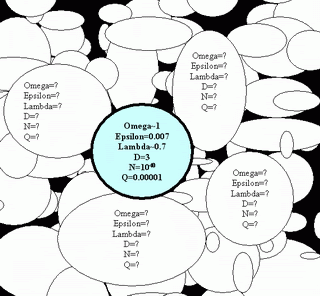
To eliminate unnecessary confusion, for the purposes of this debate, I would like us to consider the "multiverse" as a blanket term for multiple
environments governed by different
natures. Our
environment is the visible universe and our
nature is the particular set of physical constants that seem to hold sway within it. The multiverse might therefore be a repeated expansion/contraction of space-like dimensions (a serial mulitiverse) or it might be an approximate repeat of the ongoing process in our own universe, but outside the dimensions apparent to us (parallel universes -- sometimes poorly termed worlds). It might be a combination of the two, but the key concept is the potential for there to be more than one instance of nature.
Now there might be a case to be made for one instance of nature (ours) that was inevitable, with nature being constrained by necessity. A Theory of Everything could supply an understanding of these constraints but I would expect philosophers to continue arguing for deeper meaning -- and I can't personally see the ratios between the tiny and huge numbers that are so critical for a stable and long-lived universe dropping out of any ToE.
So, back to NGR's observation that any conclusion drawn from our restricted viewpoint can only be speculation: 4gold suggests that Occam's razor can be applied to yield a definitive conclusion.
Max Tegmark wrote:So should you believe in parallel universes? The principal arguments against them are that they are wasteful and that they are weird. The first argument is that multiverse theories are vulnerable to Occam's razor because they postulate the existence of other worlds that we can never observe. Why should nature be so wasteful and indulge in such opulence as an infinity of different worlds? Yet this argument can be turned around to argue for a multiverse. What precisely would nature be wasting? Certainly not space, mass or atoms--the uncontroversial Level I multiverse already contains an infinite amount of all three, so who cares if nature wastes some more? The real issue here is the apparent reduction in simplicity. A skeptic worries about all the information necessary to specify all those unseen worlds.
But an entire ensemble is often much simpler than one of its members. This principle can be stated more formally using the notion of algorithmic information content. The algorithmic information content in a number is, roughly speaking, the length of the shortest computer program that will produce that number as output. For example, consider the set of all integers. Which is simpler, the whole set or just one number? Naively, you might think that a single number is simpler, but the entire set can be generated by quite a trivial computer program, whereas a single number can be hugely long. Therefore, the whole set is actually simpler. [...]
A common feature of all four multiverse levels is that the simplest and arguably most elegant theory involves parallel universes by default. To deny the existence of those universes, one needs to complicate the theory by adding experimentally unsupported processes and ad hoc postulates: finite space, wave function collapse and ontological asymmetry. Our judgment therefore comes down to which we find more wasteful and inelegant: many worlds or many words. Perhaps we will gradually get used to the weird ways of our cosmos and find its strangeness to be part of its charm.
Any explanation that narrows down the infinite array of possibilities to those that pertain will, by necessity, be at least (if not vastly more) intensely complicated. This reflects the
greatness of the supposed designer creator. Such an entity may well be expressed simply in language, but any functional description would be infinitely more demanding. To be fair, I think the two hypotheses ought to carry an equal handicap which dismisses Occam from the argument.
Island has joined in to show his distain for the Weak Anthropic Principle. To Island I would only ask for more of your help in breaking the apparent symmetry between the potential causes of appearances that we have here.