
Why do some claim that Genesis 1 describes the universe when the author shows no knowledge of our solar system much less the universe?
Tcg
Moderator: Moderators


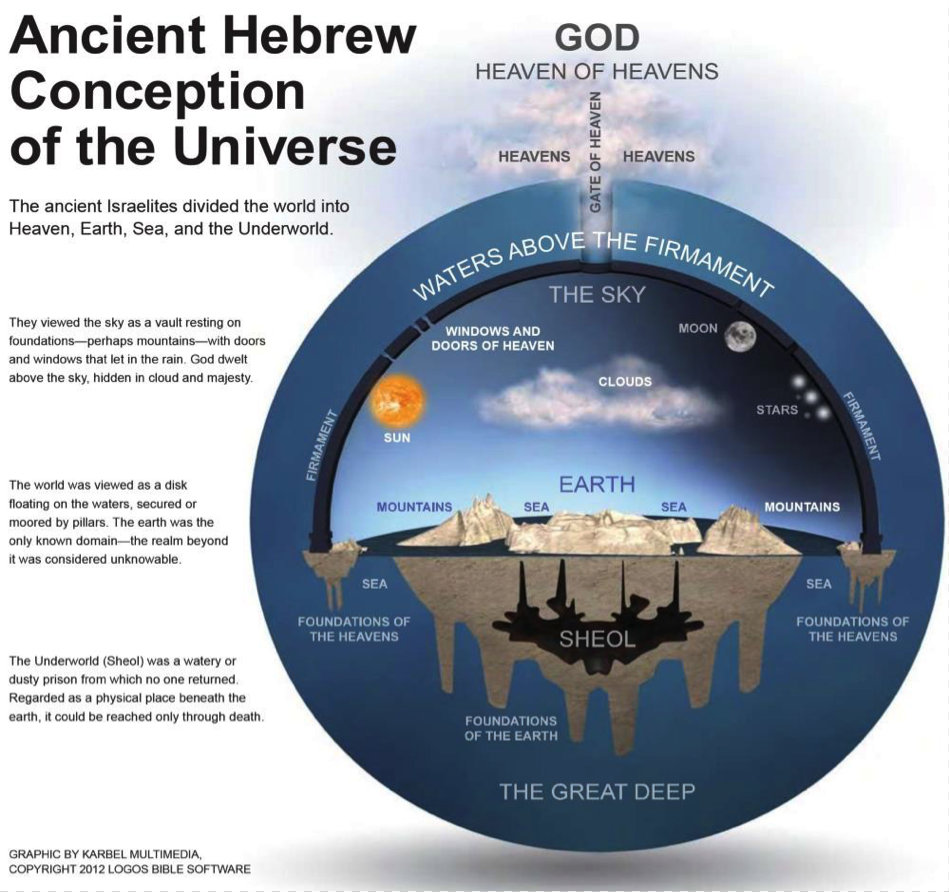
I'm agreeable if you want to characterize what Gen 1 describes as a snow-dome. But to be clear, I think that inside the snow-dome is God's creation, i.e., the heavens and the earth that God explicitly creates in Gen 1:1. The dome itself would represent the (moveable) boundary between creation and non-creation, or known and unknown space (to bring back the cartography analogy). Outside the snow-dome is what I keep calling "the deep" per Gen 1, i.e., a sea-like abyss that surrounds creation, and that God is clearly positioned against in Gen 1:2.TRANSPONDER wrote: ↑Thu Nov 11, 2021 7:42 pmtheophile wrote: ↑Thu Nov 11, 2021 4:15 pmI hear your point, but I actually don't mind the circumferential sea (the quality of the references aside). I prefer the original diagram though that labelled it "the deep," which is an explicit Gen 1 reference. It's like the area outside a known map labelled "here be dragons." (Quite literally even if we equate the deep to other creation myths like the Enuma Elish with its dragon sea goddess Tiamat.)
Also, I think there's an interesting parallel in Gen 2. The deep surrounding the heavens and earth in Gen 1 is like the wilderness surrounding the garden of Eden in Gen 2. That said, I do think it is implied in both cases that the central area is meant to expand, and over time encompass / fill the surrounding abyss.
Anyways, food for thought.
I would agree that Eden itself is a limited area and the humans will eventually expand into it, though the land area itself (geography given in Gen 2. 10-14) will not expand. I also agree that the 'circle of the earth' was seen as being ringed by mountains holding back the outer waters (a view that was shown in the portolan maps on the medieval period until circumnavigating the globe showed this view to be false.
This however only goes to show that the Babylonians snow -dome cosmos illustrated in the posted diagrams and which makes sense of the cosmos described in Genesis and in fact the rest of the Bible, is not the actuality.
You're adding things to the diagram. If you want to make updates to it, like drawing in grass and little fruit trees, go ahead. But I'm referencing the diagram as given. I was also referencing the diagram that had actual references on it, which is different from the one you posted.
Per earlier posts, I think the goal is more to show us what kind of god God is. It's not to relate the biblical view of the universe but to distinguish God from contemporaries (like the gods in the Enuma Elish, which Gen 1 has strong references to). Related to this, it describes our role on the earth (being made in the image of God and called in the text to keep doing what God shows us).Miles wrote: ↑Thu Nov 11, 2021 5:53 pmThen exactly what do you think it's describing? It's got stars, the most distant known objects at the time! So if this isn't a depiction of the universe then just what does it depict?To your last point, I've said multiple times that I don't think Gen 1 describes the universe.
I'm not sure what your point is here. Did I say it was a history text? It has some elements of history - like a very loosely based version of. (Just as you could argue it very loosely touches on science.)Miles wrote: ↑Thu Nov 11, 2021 5:53 pmWell it isn't a history text either, but many people treat it as such. Taking as historical truth the accounts of a guy who long ago raised people from the dead, cured people of major illnesses, turned water into wine, and could walk on water.It is not a science text. So why would I try to show what I don't think is true?
It conveys how we should comport ourselves to make the earth a place where life can prosper. (Hence ethics, politics, and economics.)

My understanding is that The Creator cannot be imaged because as soon as one does so, the image will be false.Am I getting the suggestion that the writers of Genesis knew it wasn't true but they gave a false (Babylonian -style) creation and cosmos because they though nobody would believe it otherwise? Or am I misunderstanding you?

theophile wrote: ↑Fri Nov 12, 2021 9:46 amI'm agreeable if you want to characterize what Gen 1 describes as a snow-dome. But to be clear, I think that inside the snow-dome is God's creation, i.e., the heavens and the earth that God explicitly creates in Gen 1:1. The dome itself would represent the (moveable) boundary between creation and non-creation, or known and unknown space (to bring back the cartography analogy). Outside the snow-dome is what I keep calling "the deep" per Gen 1, i.e., a sea-like abyss that surrounds creation, and that God is clearly positioned against in Gen 1:2.TRANSPONDER wrote: ↑Thu Nov 11, 2021 7:42 pmtheophile wrote: ↑Thu Nov 11, 2021 4:15 pmI hear your point, but I actually don't mind the circumferential sea (the quality of the references aside). I prefer the original diagram though that labelled it "the deep," which is an explicit Gen 1 reference. It's like the area outside a known map labelled "here be dragons." (Quite literally even if we equate the deep to other creation myths like the Enuma Elish with its dragon sea goddess Tiamat.)
Also, I think there's an interesting parallel in Gen 2. The deep surrounding the heavens and earth in Gen 1 is like the wilderness surrounding the garden of Eden in Gen 2. That said, I do think it is implied in both cases that the central area is meant to expand, and over time encompass / fill the surrounding abyss.
Anyways, food for thought.
I would agree that Eden itself is a limited area and the humans will eventually expand into it, though the land area itself (geography given in Gen 2. 10-14) will not expand. I also agree that the 'circle of the earth' was seen as being ringed by mountains holding back the outer waters (a view that was shown in the portolan maps on the medieval period until circumnavigating the globe showed this view to be false.
This however only goes to show that the Babylonians snow -dome cosmos illustrated in the posted diagrams and which makes sense of the cosmos described in Genesis and in fact the rest of the Bible, is not the actuality.
I believe your view implies that God has full knowledge of it all (i.e., not just creation but every inch of the deep as well) and that therefore this represents the full - and patently false - biblical view of the cosmos. I don't think that's justified anywhere in the text (or please point out the verse that says God has full knowledge of it all).
My view is that while God may know the heavens and the earth that God creates in Gen 1 (but even this isn't made explicit), the deep / abyss surrounding it is full of mystery (to God included). Again, God is positioned against it in Gen 1:2. As such, i.e., as an unknown space, it can contain all the galaxies, stars, black holes, planets, multiverses, and whatever else we want to pack in there. It is truly a "here be dragons" kind of space. To God included.
Hence why we shouldn't criticize Gen 1 for not giving us a complete and accurate view of the cosmos.
But again, the goal is for the dome to expand, and for God to eventually know all and become all in all at the end (see 1 Corinthians 15:28). But that is at the end, not the beginning. When Gen 1 wraps, creation is still in its initial stages, and God's knowledge (and power) is limited.
 ) into Jesus denouncing the teachers of the Law for not keeping it.. Yet again (to quote Theramin trees in 'Losing Faith' ... mustwatch video) 'I could do better than this'.
 Again, where in Gen 1 does it say God knows everything? The answer is nowhere. You can't just add things to the text that aren't there, and then proclaim yourself to be right.TRANSPONDER wrote: ↑Fri Nov 12, 2021 12:34 pm What? Another one who doesn't think that God knows everything? Not even the working of the cosmos He created? I suppose it's a viewpoint that might explain a few things, but in fat I think it has no merit - rather like the 'natural explanations' of the Flood, the star, darkness at Noon and miracle healings, which while validating the Bible would invalidate Jesusgod. Because the Better hypothesis is that it is an invented creation -scenario based on Mesopotamian originals ...

Because Christian fundamentalism is a thoroughly modernist form of religion. It developed in an age that highly valued science, and so it assumes that for biblical accounts to be "true" they must necessarily be historically and scientifically accurate.

Other than adding the green to denote the vegetation mentioned in Genesis 1:11-12, exactly what is it I added to the diagram?theophile wrote: ↑Fri Nov 12, 2021 10:34 amYou're adding things to the diagram. If you want to make updates to it, like drawing in grass and little fruit trees, go ahead. But I'm referencing the diagram as given. I was also referencing the diagram that had actual references on it, which is different from the one you posted.

How on earth do you get all of that from Genesis 1? Perhaps you could quote specific passages to illustrate what you are claiming.theophile wrote: ↑Fri Nov 12, 2021 10:34 am It conveys how we should comport ourselves to make the earth a place where life can prosper. (Hence ethics, politics, and economics.)
It's core truth, I would argue, is in the linkage between the action God demonstrates (and calls us to model) with the rest and prosperity (i.e., goodness) that comes from it.
Although this over simplifies, it is basically the argument that IF we keep doing what God shows us, THEN the world will be a happy, wonderful place where we all live happily ever after. So if we want to critique Gen 1 we should do so on that front (IMO).
This is an interesting point. It's difficult to determine whether or not fundamentalists are the only ones who take this approach, but certainly it is a hallmark of Christian fundamentalism. Would you say then that Genesis 1 was not intended to be historically and scientifically accurate and therefore it does not describe the universe at least not in any literal sense? I'm not trying to put words in your mouth, but rather attempting to understand your position.

