
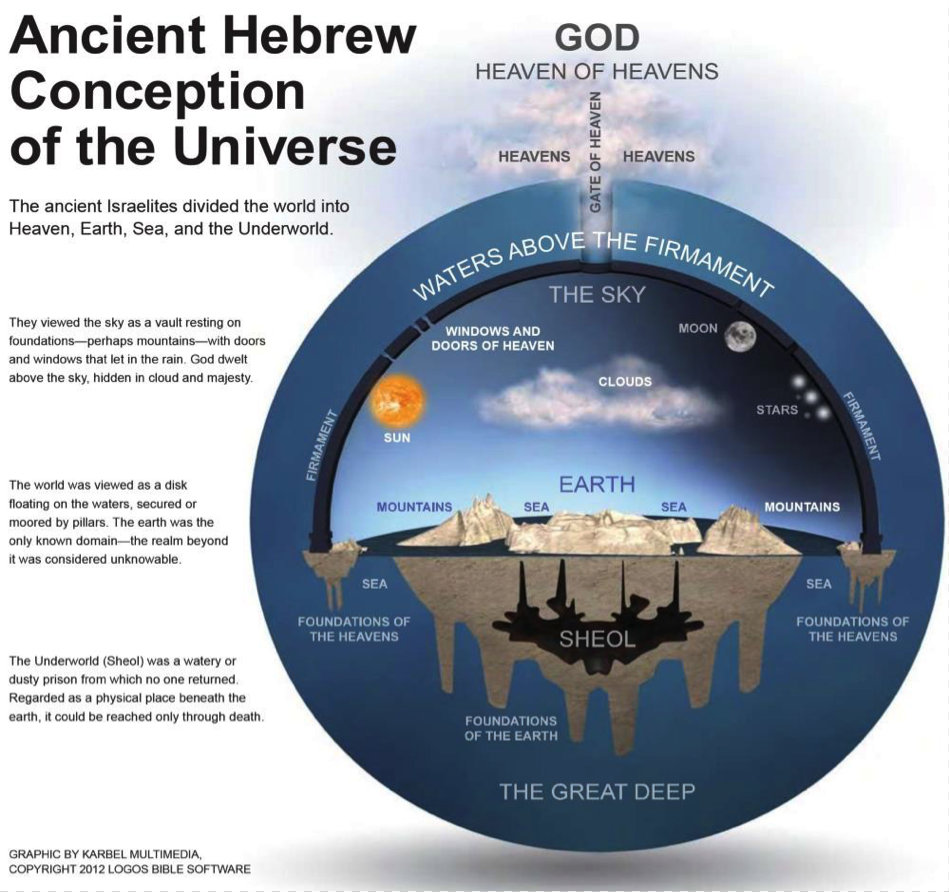
Why do some claim that Genesis 1 describes the universe when the author shows no knowledge of our solar system much less the universe?
Tcg
Moderator: Moderators

That provides evidence only of what you believe.
I use the ESV.
But the O.P. quite clearly is. In fact only one chapter of one book.Psalm 104 may not be part of Genesis, but last I checked it is part of the Bible.
The creation account isn't limited to one book.
It is your duty to provide evidence to support your claim, not mine.Oddly no evidence to the contrary.
This is a fascinating assertion, oddly no evidence to support it has been provided.
Tcg

Beliefs do not equate with truth. Scripture is nothing more than religious propaganda and only has any currency with the religiously indoctrinated. "The truth is out there"...... not in the Bible.We_Are_VENOM wrote: ↑Sun Nov 14, 2021 12:30 pm Um, scripture is clear that God created the heavens and the earth...


We are both operating under belief.
And?
Ok, so lets just deal with Genesis 1.
Been there, done that.
I'm not.
Check out the search using the ESV and you'll understand my point.
Can you support that with evidence?
Perhaps elsewhere. You haven't here.

While the stories in chapters 1-11 are set in the primordial past and are design to account for humanity's position in the world, starting with Abraham, the stories shift to a more local context, and begin to refer to places, customs, and other cultural details that we now know from archeology were typical of the time period that Abraham supposedly lived (but, interestingly, not of the later time period when these stories were written down), and so they seem more grounded in history.

Okay. All I'm saying is apply whatever truth barometer you have to it. And don't outright dismiss it just because it isn't necessarily history or science. Or because its source is human imagination and endeavor. Which I take to be your reasons. Those are very narrow reasons to dismiss something that doesn't even claim to be these things.TRANSPONDER wrote: ↑Sun Nov 14, 2021 5:05 amIt's like this - first off, Genesis is either factually correct (historical events) or it isn't. I've seen so many apologetics that try to make the science wrong or try to adapt Genesis to the science, and people have to make up their own minds - preferably after looking at both sides rather than just the one that says what they want to believe. Bottom line - those who say that the 'Cambrian Explosion' proves Genesis - style creation do not know what the Cambrian Explosion actually was and what (on the fossil evidence) happened.theophile wrote: ↑Sat Nov 13, 2021 1:53 pmI think everything you're saying is correct. e.g., The whole thing is made up. But that doesn't mean it is wrong. Human imagination is at the bottom of a lot of the things we know (including God). I just don't think that necessarily devalues God, or what the bible expresses as God's teaching. I think human imagination and resulting endeavor is fully capable of understanding and expressing such a concept, assessing whether it has any reality (or even potential), and depicting it in an artifact like Gen 1, the bible, and anything else really.TRANSPONDER wrote: ↑Sat Nov 13, 2021 10:15 amI get what you say. I'm just surprised as Omnipotence generally seems to be an unwritten dogma about God. I agree it makes more sense if God doesn't know everything, let alone Jesus. But we do get written implication that Some things are known - prophetic predictions, for instance. It would make more sense if some things are promised and sometimes they happen and sometimes they don't. It would explain why after 1,000 years of backing the Hebrews God suddenly switches his support to Greek Christians. But of course it also makes even more sense if humans had just made the whole thing up.theophile wrote: ↑Fri Nov 12, 2021 1:33 pmAgain, where in Gen 1 does it say God knows everything? The answer is nowhere. You can't just add things to the text that aren't there, and then proclaim yourself to be right.TRANSPONDER wrote: ↑Fri Nov 12, 2021 12:34 pm What? Another one who doesn't think that God knows everything? Not even the working of the cosmos He created? I suppose it's a viewpoint that might explain a few things, but in fat I think it has no merit - rather like the 'natural explanations' of the Flood, the star, darkness at Noon and miracle healings, which while validating the Bible would invalidate Jesusgod. Because the Better hypothesis is that it is an invented creation -scenario based on Mesopotamian originals ...
If you want a broader argument on God's omniscience, just look to all the times God changes in the bible. Would an all-knowing God change course, or regret an action, or knowingly set the whole thing up to fail? It's ridiculous. It's not the biblical view but rather Greek influence (as I believe we've discussed before, but perhaps was someone else).
And I do think there is a knowledge to God that needs to be understood. It's not explicit in Gen 1, but I would suggest that something like omniscience is the goal. It is the end, just as something like omnipotence is the culmination of the biblical God. It's just not necessarily the beginning (Gen 1), or in any step along the way. Regarding those, who knows what actual knowledge and power God has? By which I mean, what knowledge and power has actually been committed to the mandate that God sets in Gen 1:28? Even the bible makes that point time and again (see God's speech to Job for instance in Job 38).
So as a theoretical construct, I think Gen 1 depicts a God that gets its power from the world. From us. From everything else (potentially) that is out there, lurking in the deep of Gen 1:2. That's what we see time and again in Gen 1. God calls ("Let there be...") and the world answers. The world participates in the effort to bring forth what God calls for in the pursuit of life. Literally bringing it forth from all the power residing in the deep.
This means God could have significant power. Even in an actual sense. Especially if we look beyond earth to the cosmic scale, and measure God's power through all those committed to continuing God's work (whether knowingly or not). Things like prophecy and stories depicting great knowledge and power to God start to make a lot of sense. God has (or could have) great knowledge and power, which is what the bible literarily shows. Through those who bring it to God's cause (like Jesus who is biblically speaking the firstborn on earth to do so, and the beginning of a movement to gather the rest).
As such, to circle back and try to bring this diatribe together, I think there is an implicit call in Gen 1 to human imagination and endeavor (i.e., to creativity). This is a critical part of the plan and design so that all knowledge and power can be brought to God, or to the pursuit of life and its conditions in the world.
Very well. Then accepting that Genesis is made up, it is possible to say there was and must be a god behind it and even that somehow it's the god of the Bible. Please yourselves. It could be Allah, Vishnu. Texactichlapoti or none of them. I don't mind. You are free to believe what you want. You can even tell me about it, but there is no shred of a good reason why I should believe it and I won't see any reason not to say so. And will back it up with the science.
There's a story. Napoleon asked Laplace to make him a working model of the 'Universe'. So he made a mechanical orrery (q.v) and Napoleon watched the planets trundling around the sun for a while.
"I see you haven't put God in there."
"It works perfectly well without, Sire."
If you don't believe that God exists, then that itself is a belief.
I did, and I still don't understand your point.
No evidence that you will accept. The Bible is clear that God created everything that was made, and the Genesis 1 is the account of this creation.
Then go elsewhere and you will find your answers.
I lack belief in god/gods. Lack of belief is quite clearly not a belief.We_Are_VENOM wrote: ↑Sun Nov 14, 2021 8:23 pmIf you don't believe that God exists, then that itself is a belief.
I searched on the word you claimed which was "stretching."I did, and I still don't understand your point.
https://www.biblegateway.com/quicksearc ... ersion=ESV
So I repeat; And?
Another claim lacking support.
Odd that you can't address them here.
This raises an interesting connection for me. i.e., there is an element that never gets created in Gen 1:1, but that is nevertheless present in Gen 1:2. This element is the deep (/ sea), or the water against which God's Spirit hovers.We_Are_VENOM wrote: ↑Sun Nov 14, 2021 12:30 pm Above you have multiple scriptures which attest to God stretching out the heavens. "Stretching" is just another word for "expanding"...when scientists say "our universe is expanding", that is the Biblical way of saying "our universe is stretching".
Same thing.
Or, as gotquestions.org so eloquently put it..
Gen 1:1 "In the beginning [TIME] God created the heavens [SPACE] and the earth [MATTER]".
https://www.gotquestions.org/universe-expanding.html
Or, as I am eloquently putting it; God did it.
Science is man's way of figuring out what God already did.

Strangely enough, it appears that neither personality recognized that the mechanism was created, and thereby a 'god' was involved with that creation.There's a story. Napoleon asked Laplace to make him a working model of the 'Universe'. So he made a mechanical orrery (q.v) and Napoleon watched the planets trundling around the sun for a while.
"I see you haven't put God in there."
"It works perfectly well without, Sire."

