
Tcg
Moderator: Moderators


 Indeterminacy, the holographic universe and quantum foam seem as counter - intuitive as 'something from nothing' and in fact support the possibility of Something along those lines whereas infinite regression and a complex intelligent entity without any origin of its' own seems even more counter -intuitive.
 Smearing theistic belief with the dogmatic organized religion broad brush is an equally convenient argument.smearing atheism with the Marxism broad brush is a convenient argument

I've had similar experiences with some of my Christian friends and family. Oftentimes I come away with the impression that there's not much more to it than tribalism and security in numbers. One of my (IRL) friend groups is made up of all Christians, except me. Every so often one of them will say something to me like "Why can't you just be like the rest of us and be a Christian?" There's no appeal to Christianity being the truth or me being in need of salvation, and instead it's just a sort of "join us" type of tribalism, where if I'd only go along with the group then we'd all be that much closer and unified, which I guess would make us better friends.Tcg wrote: ↑Thu Mar 17, 2022 3:06 pm [Replying to TRANSPONDER in post #2]
Well yes, but this speaks more to the perceived moral result of lack of faith. I'm referring to simply the lack of faith.
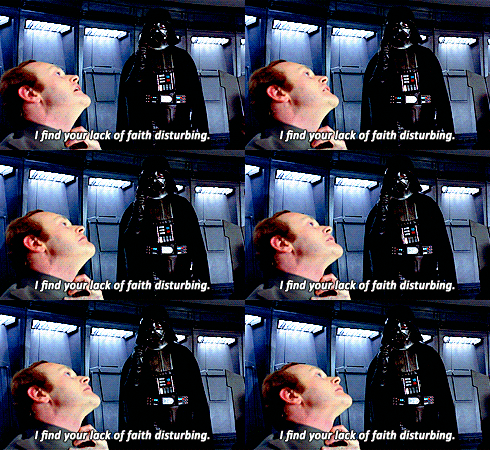
For example, years ago I had a discussion with my pastor at the time and expressed that I was doubting the claim that the Bible is the word of God. He became somewhat incensed with me not because of some moral failing, but simply my lack of faith. He of course had no real answers to address my doubt, but rather threatened me with hell if I didn't believe. I could be wrong, but I got the impression that my lack of faith threatened his faith. He also must have realized he had no real answer and that may have been unnerving as well.
Tcg
I think you're right. It seems that the perceived mental health benefits of faith relate more to the practice of religion, the social aspects and perhaps the rituals more than the faith itself.Jose Fly wrote: ↑Sat Mar 19, 2022 2:25 pmI've had similar experiences with some of my Christian friends and family. Oftentimes I come away with the impression that there's not much more to it than tribalism and security in numbers. One of my (IRL) friend groups is made up of all Christians, except me. Every so often one of them will say something to me like "Why can't you just be like the rest of us and be a Christian?" There's no appeal to Christianity being the truth or me being in need of salvation, and instead it's just a sort of "join us" type of tribalism, where if I'd only go along with the group then we'd all be that much closer and unified, which I guess would make us better friends.Tcg wrote: ↑Thu Mar 17, 2022 3:06 pm [Replying to TRANSPONDER in post #2]
Well yes, but this speaks more to the perceived moral result of lack of faith. I'm referring to simply the lack of faith.
For example, years ago I had a discussion with my pastor at the time and expressed that I was doubting the claim that the Bible is the word of God. He became somewhat incensed with me not because of some moral failing, but simply my lack of faith. He of course had no real answers to address my doubt, but rather threatened me with hell if I didn't believe. I could be wrong, but I got the impression that my lack of faith threatened his faith. He also must have realized he had no real answer and that may have been unnerving as well.
Tcg
When it comes to actual Christian leaders though it's more what you describe (i.e., more aggressive and a bit desperate), where IMO it's about their fear that me being an unbeliever might influence others to stop believing, and if that plays out enough then the Christians will be the outside group that's feeling the pressure to join the majority.
When I was younger and regularly attended church I often wondered what would happen if you removed the social component, and made going to church an individual experience. Somehow I think a significant number of church-goers would quickly lose interest.
It's (IMO) probably all of the above. There's certainly something to be said about achieving certainty about what happens after we die. And so there's no mistake here.....I'm fairly confident that the mental health benefits are quite real, even if I don't think the beliefs that create them are. There's no shortage of psychological studies showing the existence these benefits.
That's really interesting. I've never met a Quaker. Maybe it's time I did!When I first became an atheist, I missed the community that I once shared via the church going experience. A bit of research revealed that Quakers are very open to atheists and in fact have a growing number of non-theists. The town I lived in at the time had an active Meeting so I began attending and continued to for a few years until I moved out of state. The first two Quakers I spoke with were atheists and the theists there were welcoming even knowing I was an atheist. I benefitted greatly from this experience even though it didn't involve faith in God given that I had none.
Tcg

In most cases there are benefits, but this fairly recent study has revealed an exception:Jose Fly wrote: ↑Sat Mar 19, 2022 3:45 pmIt's (IMO) probably all of the above. There's certainly something to be said about achieving certainty about what happens after we die. And so there's no mistake here.....I'm fairly confident that the mental health benefits are quite real, even if I don't think the beliefs that create them are. There's no shortage of psychological studies showing the existence these benefits.
Study Examines Religious Experiences and Depression
A national study examines the link between religious experiences and depression by following more than 12,000 American adolescents from their teens into middle adulthood. The research indicates that attending religious services staves off depression, but it also ties life-changing spiritual experiences and a belief in divine leading and angelic protection to an increased risk for depression, especially in men.
https://neurosciencenews.com/religion-depression-17753/
When I first became an atheist, I missed the community that I once shared via the church going experience. A bit of research revealed that Quakers are very open to atheists and in fact have a growing number of non-theists. The town I lived in at the time had an active Meeting so I began attending and continued to for a few years until I moved out of state. The first two Quakers I spoke with were atheists and the theists there were welcoming even knowing I was an atheist. I benefitted greatly from this experience even though it didn't involve faith in God given that I had none.
Tcg
They're quite a varied group given that they have no set dogma or doctrine one must hold to be a Quaker. One of the men I met had been a bomber in WWII. He described watching people being killed by the bombs he dropped. As a result he became a pacifist which led him to Quakerism. I couldn't agree fully with some aspects of pacifism, but certainly couldn't argue with his reason to be one.That's really interesting. I've never met a Quaker. Maybe it's time I did!
I'd say you've absolutely hit the nail on the head. The religious do at times claim that it has community the way atheism doesn't. But is that what it's all about? Community? The problem about Community is the way it can reject those who don't Fit.Jose Fly wrote: ↑Sat Mar 19, 2022 2:25 pmI've had similar experiences with some of my Christian friends and family. Oftentimes I come away with the impression that there's not much more to it than tribalism and security in numbers. One of my (IRL) friend groups is made up of all Christians, except me. Every so often one of them will say something to me like "Why can't you just be like the rest of us and be a Christian?" There's no appeal to Christianity being the truth or me being in need of salvation, and instead it's just a sort of "join us" type of tribalism, where if I'd only go along with the group then we'd all be that much closer and unified, which I guess would make us better friends.Tcg wrote: ↑Thu Mar 17, 2022 3:06 pm [Replying to TRANSPONDER in post #2]
Well yes, but this speaks more to the perceived moral result of lack of faith. I'm referring to simply the lack of faith.
For example, years ago I had a discussion with my pastor at the time and expressed that I was doubting the claim that the Bible is the word of God. He became somewhat incensed with me not because of some moral failing, but simply my lack of faith. He of course had no real answers to address my doubt, but rather threatened me with hell if I didn't believe. I could be wrong, but I got the impression that my lack of faith threatened his faith. He also must have realized he had no real answer and that may have been unnerving as well.
Tcg
When it comes to actual Christian leaders though it's more what you describe (i.e., more aggressive and a bit desperate), where IMO it's about their fear that me being an unbeliever might influence others to stop believing, and if that plays out enough then the Christians will be the outside group that's feeling the pressure to join the majority.
When I was younger and regularly attended church I often wondered what would happen if you removed the social component, and made going to church an individual experience. Somehow I think a significant number of church-goers would quickly lose interest.


