
Could we have made different choices than the ones we actually made?
Moderator: Moderators
-
Compassionist
- Guru
- Posts: 1524
- Joined: Tue Feb 19, 2008 5:56 pm
- Has thanked: 1070 times
- Been thanked: 252 times
Could we have made different choices than the ones we actually made?
Post #1Could we have made different choices than the ones we actually made? By "we" I mean all living things. For example, I have a potted plant that has tilted westward by twenty degrees. Could the plant have refrained from tilting or tilted at a different direction by a different degree or was it inevitable that it tilted westward by twenty degrees? I ate porridge for breakfast today. Could I have eaten something else or was eating porridge for breakfast inevitable? Nelson Mandela died on 14 June 1999. Was his death on that date inevitable or could he have died at a younger or older age? Albert Einstein was a physicist. Could he have been a professional football player instead of a physicist or was his choice of career inevitable? In your response, please explain how you know what you know.
-
The Tanager

- Savant
- Posts: 6239
- Joined: Wed May 06, 2015 11:08 am
- Has thanked: 90 times
- Been thanked: 275 times
Re: Could we have made different choices than the ones we actually made?
Post #71[Replying to Compassionist in post #70]
I'm writing a quick reply because I don't have a ton of time and I think it hits the main points. Thanks for continuing this with me.
On Science
We are only talking about human choices here, other sciences like pharmacology are not uniquely open to you as a determinist and, therefore, can't be used to support one over the other. Early interventions and behavioral nudges both work and sometimes don't work (although the latter is more mysterious as to why on your view) in both of our views, so that doesn't discriminate between our views. Science doesn't favor either view.
On Causal Explanation
Limiting possible outcomes to one is not a test of truth. Decomposability or complexity of explanation is not a test of truth. Please show otherwise to maintain your points.
Libertarian freedom is an intervention under your definition because putting in a different will can produce a different result, just like putting in different GENEs can produce a different result.
On Rationality
Please clarify the difference between convergence and argument/reason.
On Morality
Moral objectivity doesn't mean there aren't multiple good options or bad options. If Chess had no objective rules, all moves would be equally true/good and anything goes. There are multiple good opening moves because of the objective rules in place.
Libertarian freedom does show humans having control over the causal source of action because humans have control over their will, the causal source of action.
In summary, I think both of our views are causal explanations, science doesn't support one over the other, but philosophical concerns, such as with rationality and objective morality push reason towards libertarian freedom.
I'm writing a quick reply because I don't have a ton of time and I think it hits the main points. Thanks for continuing this with me.
On Science
We are only talking about human choices here, other sciences like pharmacology are not uniquely open to you as a determinist and, therefore, can't be used to support one over the other. Early interventions and behavioral nudges both work and sometimes don't work (although the latter is more mysterious as to why on your view) in both of our views, so that doesn't discriminate between our views. Science doesn't favor either view.
On Causal Explanation
Limiting possible outcomes to one is not a test of truth. Decomposability or complexity of explanation is not a test of truth. Please show otherwise to maintain your points.
Libertarian freedom is an intervention under your definition because putting in a different will can produce a different result, just like putting in different GENEs can produce a different result.
On Rationality
Please clarify the difference between convergence and argument/reason.
On Morality
Moral objectivity doesn't mean there aren't multiple good options or bad options. If Chess had no objective rules, all moves would be equally true/good and anything goes. There are multiple good opening moves because of the objective rules in place.
Libertarian freedom does show humans having control over the causal source of action because humans have control over their will, the causal source of action.
In summary, I think both of our views are causal explanations, science doesn't support one over the other, but philosophical concerns, such as with rationality and objective morality push reason towards libertarian freedom.
-
Kylie
- Scholar
- Posts: 289
- Joined: Thu Jun 04, 2020 2:19 am
- Has thanked: 23 times
- Been thanked: 72 times
Re: Could we have made different choices than the ones we actually made?
Post #72Should people be held responsible for their actions?Miles wrote: ↑Tue Feb 28, 2023 6:09 pmNope.Compassionist wrote: ↑Tue Feb 28, 2023 4:01 pm Could we have made different choices than the ones we actually made?
In fact, no one chooses anything. All is determined.
-
Compassionist
- Guru
- Posts: 1524
- Joined: Tue Feb 19, 2008 5:56 pm
- Has thanked: 1070 times
- Been thanked: 252 times
Re: Could we have made different choices than the ones we actually made?
Post #73[Replying to The Tanager in post #71]
On Science
Human choice is not a sui generis domain insulated from the rest of science. The same sciences you bracket off — neuroscience, pharmacology, developmental psychology, behavioral economics — are precisely the sciences that study human choice.
The question is not whether interventions “sometimes work and sometimes don’t.†Both views allow that.
The discriminating question is:
Which framework explains why success and failure track identifiable variables?
Under hard determinism:
• success correlates with measurable causal leverage,
• failure correlates with missing variables or weak inputs,
• improvement occurs as models incorporate more structure.
Under libertarian freedom:
• success has no principled necessary connection to causal access,
• failure does not diagnose missing structure,
• improvement is coincidental rather than explanatory.
Saying “both views allow mixed outcomes†is not neutrality — it ignores why the mixtures occur.
Science favors the framework that predicts conditional improvement, not one that merely tolerates noise.
On Causal Explanation
The test is not outcome singularity, but explanatory constraint.
Hard determinism does not claim:
“Only one outcome is possible.â€
It claims:
Outcome probabilities are constrained by determinants i.e. genes, environments, nutrients and experiences, when we are looking at choices made by sentient biological organisms.
That is what allows:
• counterfactual reasoning,
• intervention design,
• error correction.
Libertarian freedom explicitly denies that constraint at the decisive point — the will.
An intervention is:
a manipulable change in inputs that predicts a systematic shift in outputs.
Changing:
• neurotransmitter levels,
• incentives,
• information access,
• developmental environments
are interventions because they are causally tractable.
“Putting in a different will†is not an intervention — it is redescribing the outcome in agent-centered language.
You cannot:
• isolate the will,
• vary it independently,
• specify conditions under which it reliably shifts.
That is not intervention. It is narrative substitution.
On Rationality
Argument concerns local coherence:
• consistency,
• validity,
• responsiveness to reasons.
Convergence concerns population-level dynamics:
• independent lines of inquiry aligning,
• disagreement shrinking under shared evidence,
• error correction over time.
Hard determinism explains convergence because:
• beliefs are causally responsive to evidence,
• shared environments produce shared updates,
• correction mechanisms have predictable effects.
Libertarian freedom does not explain convergence — it presupposes it.
If agents are ultimately free to diverge without causal constraint, convergence is accidental.
On Morality
Chess has:
• fixed constraints,
• goal-relative standards,
• instrumental norms.
Morality under determinism works the same way:
• constraints arise from human psychology and social dynamics,
• goals arise from coordination and harm-avoidance,
• norms are evaluated by function, not metaphysical truth.
None of this requires libertarian freedom.
To say “humans control their will†is either:
causal control
— in which case the will is determined by determinants (genes, environments, nutrients, and experiences) , and libertarian freedom is false;
or
non-causal control
— in which case “control†does no explanatory work.
You cannot have:
• control that explains action,
• without causal determination.
Libertarian freedom does not give control over causation — it gives authorship language without authorship power.
Conclusion
You say:
Hard determinism:
• explains causal structure,
• supports rational convergence,
• grounds moral coordination without desert,
• preserves inquiry.
Libertarian freedom:
• terminates explanation at the will,
• treats divergence as primitive,
• smuggles in responsibility without control,
• relies on intuition rather than structure.
Science does not “stand neutral†here.
It consistently rewards the view that keeps explanations open.
The real divide is not science vs philosophy.
It is:
explanatory depth vs explanatory stopping points.
And that is why hard determinism remains the stronger position.
On Science
This framing quietly concedes the central point.We are only talking about human choices here… Science doesn't favor either view.
Human choice is not a sui generis domain insulated from the rest of science. The same sciences you bracket off — neuroscience, pharmacology, developmental psychology, behavioral economics — are precisely the sciences that study human choice.
The question is not whether interventions “sometimes work and sometimes don’t.†Both views allow that.
The discriminating question is:
Which framework explains why success and failure track identifiable variables?
Under hard determinism:
• success correlates with measurable causal leverage,
• failure correlates with missing variables or weak inputs,
• improvement occurs as models incorporate more structure.
Under libertarian freedom:
• success has no principled necessary connection to causal access,
• failure does not diagnose missing structure,
• improvement is coincidental rather than explanatory.
Saying “both views allow mixed outcomes†is not neutrality — it ignores why the mixtures occur.
Science favors the framework that predicts conditional improvement, not one that merely tolerates noise.
On Causal Explanation
Agreed — and this is not the test being appealed to.Limiting possible outcomes to one is not a test of truth.
The test is not outcome singularity, but explanatory constraint.
Hard determinism does not claim:
“Only one outcome is possible.â€
It claims:
Outcome probabilities are constrained by determinants i.e. genes, environments, nutrients and experiences, when we are looking at choices made by sentient biological organisms.
That is what allows:
• counterfactual reasoning,
• intervention design,
• error correction.
Libertarian freedom explicitly denies that constraint at the decisive point — the will.
This is the clearest point of failure.Libertarian freedom is an intervention under your definition because putting in a different will can produce a different result.
An intervention is:
a manipulable change in inputs that predicts a systematic shift in outputs.
Changing:
• neurotransmitter levels,
• incentives,
• information access,
• developmental environments
are interventions because they are causally tractable.
“Putting in a different will†is not an intervention — it is redescribing the outcome in agent-centered language.
You cannot:
• isolate the will,
• vary it independently,
• specify conditions under which it reliably shifts.
That is not intervention. It is narrative substitution.
On Rationality
Certainly.Please clarify the difference between convergence and argument/reason.
Argument concerns local coherence:
• consistency,
• validity,
• responsiveness to reasons.
Convergence concerns population-level dynamics:
• independent lines of inquiry aligning,
• disagreement shrinking under shared evidence,
• error correction over time.
Hard determinism explains convergence because:
• beliefs are causally responsive to evidence,
• shared environments produce shared updates,
• correction mechanisms have predictable effects.
Libertarian freedom does not explain convergence — it presupposes it.
If agents are ultimately free to diverge without causal constraint, convergence is accidental.
On Morality
Exactly — and this analogy proves the determinist point, not the libertarian one.If Chess had no objective rules, all moves would be equally true/good.
Chess has:
• fixed constraints,
• goal-relative standards,
• instrumental norms.
Morality under determinism works the same way:
• constraints arise from human psychology and social dynamics,
• goals arise from coordination and harm-avoidance,
• norms are evaluated by function, not metaphysical truth.
None of this requires libertarian freedom.
This is the central assertion — and it is where the argument collapses.Libertarian freedom does show humans having control over the causal source of action because humans have control over their will.
To say “humans control their will†is either:
causal control
— in which case the will is determined by determinants (genes, environments, nutrients, and experiences) , and libertarian freedom is false;
or
non-causal control
— in which case “control†does no explanatory work.
You cannot have:
• control that explains action,
• without causal determination.
Libertarian freedom does not give control over causation — it gives authorship language without authorship power.
Conclusion
You say:
But this is precisely backwards.Both of our views are causal explanations, and philosophical concerns push reason toward libertarian freedom.
Hard determinism:
• explains causal structure,
• supports rational convergence,
• grounds moral coordination without desert,
• preserves inquiry.
Libertarian freedom:
• terminates explanation at the will,
• treats divergence as primitive,
• smuggles in responsibility without control,
• relies on intuition rather than structure.
Science does not “stand neutral†here.
It consistently rewards the view that keeps explanations open.
The real divide is not science vs philosophy.
It is:
explanatory depth vs explanatory stopping points.
And that is why hard determinism remains the stronger position.
-
Compassionist
- Guru
- Posts: 1524
- Joined: Tue Feb 19, 2008 5:56 pm
- Has thanked: 1070 times
- Been thanked: 252 times
Re: Could we have made different choices than the ones we actually made?
Post #74Two very different meanings of “responsibilityâ€Kylie wrote: ↑Fri Jan 23, 2026 9:24 pmShould people be held responsible for their actions?Miles wrote: ↑Tue Feb 28, 2023 6:09 pmNope.Compassionist wrote: ↑Tue Feb 28, 2023 4:01 pm Could we have made different choices than the ones we actually made?
In fact, no one chooses anything. All is determined.
Much of the disagreement exists because the term responsibility is doing double duty.
1. Convergent responsibility (real and unavoidable)
People are responsible in the convergence of determinants sense.
This means:
• their actions arise from their genes, environments, nutrients and experiences,
• their brain, history, character, and situation produced the behavior,
• the action did not occur “from nowhere.â€
If I harm someone, I am the cause of that harm.
Not fate alone. Not society alone. Not “the universe†abstractly. But I am not separate from my genes, environments, nutrients, and experiences. These determinants make me who I am and determine and constrain my choices. If I had the genes, environments, nutrients, and experiences of Adolf Hitler, I would have made the same choices he did, and vice versa.
2. Moral desert responsibility (does not survive scrutiny)
This is the stronger claim:
This notion collapses once examined carefully.“You deserve blame or praise in itself because you could have chosen otherwise in the exact same conditions.â€
No one:
• chose their genes,
• chose their childhood,
• chose their neurobiology,
• chose the values they initially acquired,
• chose which options would feel compelling or impossible.
If the universe were replayed with everything identical, the same action would occur.
Therefore:
• punishment as deserved suffering fails,
• praise as earned moral credit fails,
• retribution loses its foundation.
This is not leniency.
It is logical consistency.
What should replace blame and praise?
Rejecting moral desert does not lead to nihilism. It leads to clarity.
What remains justified:
• Prevention — reducing future harm,
• Rehabilitation — changing causal conditions (i.e. genes, environments, nutrients, and experiences),
• Deterrence — influencing future behavior (evidence-based),
• Quarantine — when someone poses a serious risk,
• Repair — supporting victims and restoring trust where possible.
All of this treats people as convergent causal agents, not as moral essences with libertarian free will.
Why this actually improves morality
Blame-based systems:
• over-punish the unlucky,
• moralize mental illness,
• neglect prevention,
• satisfy anger more than justice.
Convergent Responsibility without moral desert:
• reduces recidivism,
• increases fairness,
• aligns with neuroscience,
• focuses on outcomes rather than moral fantasy.
This is not moral weakness.
It is mature ethics.
-
The Tanager
- Savant
- Posts: 6239
- Joined: Wed May 06, 2015 11:08 am
- Has thanked: 90 times
- Been thanked: 275 times
Re: Could we have made different choices than the ones we actually made?
Post #75[Replying to Compassionist in post #73]
On Science
You have offered nothing that shows we have scientific success in predicting human choices. Yes, we can give that trends are happening and what parts of the brain are involved, but that isn't predicting human choices and both views’ narratives can fit this in.
So the question is what are the missing variables. Libertarians say the will is a missing variable that isn't available to science, while determinism assumes it is a physical variable that they just don't know enough about. Both are making philosophical moves, so science doesn't favor one or the other.
On Causal Explanation
I'm not sure what you mean by error correction and if it is a valid thing to throw in. What errors are being corrected? Why is that important when trying to understand human choices?
On Rationality
On Morality
On Science
You have offered nothing that shows we have scientific success in predicting human choices. Yes, we can give that trends are happening and what parts of the brain are involved, but that isn't predicting human choices and both views’ narratives can fit this in.
So the question is what are the missing variables. Libertarians say the will is a missing variable that isn't available to science, while determinism assumes it is a physical variable that they just don't know enough about. Both are making philosophical moves, so science doesn't favor one or the other.
On Causal Explanation
Libertarian freedom claims outcome probabilities are constrained by wills influenced but not determined by GENEs. This allows counterfactual reasoning and intervention design.Compassionist wrote: ↑Sat Jan 24, 2026 8:02 amHard determinism does not claim:
“Only one outcome is possible.â€
It claims:
Outcome probabilities are constrained by determinants i.e. genes, environments, nutrients and experiences, when we are looking at choices made by sentient biological organisms.
That is what allows:
• counterfactual reasoning,
• intervention design,
• error correction.
Libertarian freedom explicitly denies that constraint at the decisive point — the will.
I'm not sure what you mean by error correction and if it is a valid thing to throw in. What errors are being corrected? Why is that important when trying to understand human choices?
Oh, so scientists have to have determining control over it for it to qualify as an intervention. Then you've got to support why this is a good test of truth rather than begging determinism.Compassionist wrote: ↑Sat Jan 24, 2026 8:02 amThis is the clearest point of failure.Libertarian freedom is an intervention under your definition because putting in a different will can produce a different result.
An intervention is:
a manipulable change in inputs that predicts a systematic shift in outputs.
Changing:
• neurotransmitter levels,
• incentives,
• information access,
• developmental environments
are interventions because they are causally tractable.
“Putting in a different will†is not an intervention — it is redescribing the outcome in agent-centered language.
You cannot:
• isolate the will,
• vary it independently,
• specify conditions under which it reliably shifts.
That is not intervention. It is narrative substitution.
On Rationality
Independent lines can converge on falsehood (what you believe about belief in free will bring true). Agreement isn't a good test of truth. So you are left with the last. And whether errors are actually being corrected is the whole question. Show errors are being corrected without begging that our perceptions of error correction are reliable.Compassionist wrote: ↑Sat Jan 24, 2026 8:02 amArgument concerns local coherence:
• consistency,
• validity,
• responsiveness to reasons.
Convergence concerns population-level dynamics:
• independent lines of inquiry aligning,
• disagreement shrinking under shared evidence,
• error correction over time.
On Morality
Chess could have different rules, though, and then those moves would be good for those wanting to play the anti-chess game. And proponents of each would like their game better. They are both equal because it's just codifying different preferences. Yes, that is the morality atheism gives us.Compassionist wrote: ↑Sat Jan 24, 2026 8:02 amExactly — and this analogy proves the determinist point, not the libertarian one.If Chess had no objective rules, all moves would be equally true/good.
Chess has:
• fixed constraints,
• goal-relative standards,
• instrumental norms.
Morality under determinism works the same way:
• constraints arise from human psychology and social dynamics,
• goals arise from coordination and harm-avoidance,
• norms are evaluated by function, not metaphysical truth.
None of this requires libertarian freedom.
You are defining alternatives out of existence. You define causal control as determinism by GENEs and then, surprise, determinism is the only example of real casual control.Compassionist wrote: ↑Sat Jan 24, 2026 8:02 amThis is the central assertion — and it is where the argument collapses.Libertarian freedom does show humans having control over the causal source of action because humans have control over their will.
To say “humans control their will†is either:
causal control
— in which case the will is determined by determinants (genes, environments, nutrients, and experiences) , and libertarian freedom is false;
or
non-causal control
— in which case “control†does no explanatory work.
You cannot have:
• control that explains action,
• without causal determination.
Libertarian freedom does not give control over causation — it gives authorship language without authorship power.
-
Compassionist
- Guru
- Posts: 1524
- Joined: Tue Feb 19, 2008 5:56 pm
- Has thanked: 1070 times
- Been thanked: 252 times
Re: Could we have made different choices than the ones we actually made?
Post #76[Replying to The Tanager in post #75]
On Science
Science almost never predicts individual token events with certainty — including in domains no one considers metaphysically free (weather, epidemiology, quantum decay, traffic flow, earthquakes).
The relevant success criterion is:
Does prediction improve when causal variables are better specified?
In human behavior, the answer is unambiguously yes:
• relapse rates shift with medication and therapy,
• crime rates shift with incentives, surveillance, and social conditions,
• decision probabilities shift with framing, priming, fatigue, and stress,
• developmental trajectories shift with early intervention.
These are not post-hoc narratives. They are repeatable, population-level regularities.
Libertarian freedom adds no predictive leverage here. It merely says:
“There is an extra variable — the will — that science cannot access.â€
That move explains nothing about when prediction improves and when it does not.
Determinism predicts:
• improvement tracks causal access,
• failure tracks missing variables.
Libertarianism predicts:
• no principled relationship at all.
That asymmetry matters.
Hard determinism is 100% evidence-based. If I had the genes, environments, nutrients, and experiences of a planarian flatworm, you could behead me, and my head would grow back. With my current genes, environments, nutrients, and experiences, if you behead me, I would die instead of growing my head back. If I had libertarian free will, I would have been able to grow my head back even though I don't have the genes, environments, nutrients, and experiences of a planarian flatworm.
Hard determinism says:
unknown causes are like other unknown causes — discoverable in principle.
Libertarianism says:
the decisive cause is unknowable in principle.
Science always favors the framework that treats ignorance as provisional rather than principled. That is not neutrality; it is methodological realism.
On Causal Explanation
The crucial question is:
What constrains the will itself?
If the answer is:
• reasons,
• character,
• dispositions,
• values,
• motivations,
then those are determinants — and libertarian freedom collapses into hard determinism.
If the answer is:
• nothing further,
then constraint is illusory and probabilities are unconstrained at the decisive point.
You cannot have:
• structured constraint,
• counterfactual dependence,
• intervention sensitivity,
without causal determination somewhere.
It means:
• false beliefs tend to be revised under sustained counter-evidence,
• ineffective interventions are abandoned or refined,
• models converge on better predictors over time.
This is why:
• medicine improves,
• engineering works,
• education strategies evolve.
Hard determinism explains error correction because beliefs are causally responsive to evidence.
Libertarian freedom does not explain why error correction occurs rather than persistent divergence — it presupposes it.
On Intervention
Scientists do not need total control.
They need causal leverage.
An intervention requires:
a manipulable variable whose alteration reliably shifts outcome probabilities.
That is not “begging determinism.â€
It is the minimal definition of causal explanation.
If “the will†cannot be:
• isolated,
• varied independently,
• linked to systematic output shifts,
then it is not an explanatory variable.
Calling this “defining alternatives out of existence†is backwards.
Explanatory variables earn their place by doing work — not by stipulation.
On Rationality
Convergence is not a guarantee of truth.
It is a mechanism for reducing error under certain conditions.
Hard determinism explains why convergence is possible at all:
• shared evidence causally influences belief formation,
• correction mechanisms suppress noise over time.
Libertarian freedom offers no account of why convergence should occur rather than permanent divergence among free choosers.
Saying “maybe it’s all wrong†is not an explanation.
It is global skepticism — and it undercuts libertarianism just as much.
On Morality
Different games exist, yes.
But within a given game:
• some strategies lose more often,
• some destabilize play,
• some cannot scale.
Morality under determinism works the same way.
Human social systems have:
• fixed psychological constraints,
• predictable coordination problems,
• measurable harm thresholds.
Moral systems are evaluated by how well they solve those problems — not by metaphysical “oughts.â€
Calling this “atheist morality†does not refute it.
It describes it.
On Control and Causation
You want a notion of “control†that:
• explains action,
• grounds responsibility,
• is not causally determined.
That is not being excluded by definition.
It is being rejected because it is incoherent.
If control influences action, it is causal.
If it is causal, it is determined by prior states or randomness.
If it is random, it is not control.
Those are not definitions.
They are logical constraints.
Conclusion
What remains is very clear:
• Hard determinism treats human action as fully embedded in the causal order and therefore intelligible, influenceable, and correctable.
• Libertarian freedom inserts an explanatory stop at the will and then declares that stop immune to analysis.
Science does not “stand neutral†here.
It consistently rewards:
frameworks that explain variance, improve prediction, and support intervention.
That is why hard determinism continues to earn its place — not by assumption, but by explanatory depth.
On Science
This sets the bar incorrectly.You have offered nothing that shows we have scientific success in predicting human choices.
Science almost never predicts individual token events with certainty — including in domains no one considers metaphysically free (weather, epidemiology, quantum decay, traffic flow, earthquakes).
The relevant success criterion is:
Does prediction improve when causal variables are better specified?
In human behavior, the answer is unambiguously yes:
• relapse rates shift with medication and therapy,
• crime rates shift with incentives, surveillance, and social conditions,
• decision probabilities shift with framing, priming, fatigue, and stress,
• developmental trajectories shift with early intervention.
These are not post-hoc narratives. They are repeatable, population-level regularities.
Libertarian freedom adds no predictive leverage here. It merely says:
“There is an extra variable — the will — that science cannot access.â€
That move explains nothing about when prediction improves and when it does not.
Determinism predicts:
• improvement tracks causal access,
• failure tracks missing variables.
Libertarianism predicts:
• no principled relationship at all.
That asymmetry matters.
Hard determinism is 100% evidence-based. If I had the genes, environments, nutrients, and experiences of a planarian flatworm, you could behead me, and my head would grow back. With my current genes, environments, nutrients, and experiences, if you behead me, I would die instead of growing my head back. If I had libertarian free will, I would have been able to grow my head back even though I don't have the genes, environments, nutrients, and experiences of a planarian flatworm.
This conflates two very different philosophical moves.Both are making philosophical moves, so science doesn't favor one or the other.
Hard determinism says:
unknown causes are like other unknown causes — discoverable in principle.
Libertarianism says:
the decisive cause is unknowable in principle.
Science always favors the framework that treats ignorance as provisional rather than principled. That is not neutrality; it is methodological realism.
On Causal Explanation
This is simply a restatement, not an explanation.Libertarian freedom claims outcome probabilities are constrained by wills influenced but not determined by GENEs.
The crucial question is:
What constrains the will itself?
If the answer is:
• reasons,
• character,
• dispositions,
• values,
• motivations,
then those are determinants — and libertarian freedom collapses into hard determinism.
If the answer is:
• nothing further,
then constraint is illusory and probabilities are unconstrained at the decisive point.
You cannot have:
• structured constraint,
• counterfactual dependence,
• intervention sensitivity,
without causal determination somewhere.
Error correction is central, not optional.I'm not sure what you mean by error correction.
It means:
• false beliefs tend to be revised under sustained counter-evidence,
• ineffective interventions are abandoned or refined,
• models converge on better predictors over time.
This is why:
• medicine improves,
• engineering works,
• education strategies evolve.
Hard determinism explains error correction because beliefs are causally responsive to evidence.
Libertarian freedom does not explain why error correction occurs rather than persistent divergence — it presupposes it.
On Intervention
No — this is a mischaracterization.Oh, so scientists have to have determining control over it for it to qualify as an intervention.
Scientists do not need total control.
They need causal leverage.
An intervention requires:
a manipulable variable whose alteration reliably shifts outcome probabilities.
That is not “begging determinism.â€
It is the minimal definition of causal explanation.
If “the will†cannot be:
• isolated,
• varied independently,
• linked to systematic output shifts,
then it is not an explanatory variable.
Calling this “defining alternatives out of existence†is backwards.
Explanatory variables earn their place by doing work — not by stipulation.
On Rationality
Yes — and this does not rescue libertarianism.Independent lines can converge on falsehood.
Convergence is not a guarantee of truth.
It is a mechanism for reducing error under certain conditions.
Hard determinism explains why convergence is possible at all:
• shared evidence causally influences belief formation,
• correction mechanisms suppress noise over time.
Libertarian freedom offers no account of why convergence should occur rather than permanent divergence among free choosers.
Saying “maybe it’s all wrong†is not an explanation.
It is global skepticism — and it undercuts libertarianism just as much.
On Morality
This conflates preference with function.Chess could have different rules… they are both equal because it's just codifying preferences.
Different games exist, yes.
But within a given game:
• some strategies lose more often,
• some destabilize play,
• some cannot scale.
Morality under determinism works the same way.
Human social systems have:
• fixed psychological constraints,
• predictable coordination problems,
• measurable harm thresholds.
Moral systems are evaluated by how well they solve those problems — not by metaphysical “oughts.â€
Calling this “atheist morality†does not refute it.
It describes it.
On Control and Causation
No — I am refusing equivocation.You are defining alternatives out of existence.
You want a notion of “control†that:
• explains action,
• grounds responsibility,
• is not causally determined.
That is not being excluded by definition.
It is being rejected because it is incoherent.
If control influences action, it is causal.
If it is causal, it is determined by prior states or randomness.
If it is random, it is not control.
Those are not definitions.
They are logical constraints.
Conclusion
What remains is very clear:
• Hard determinism treats human action as fully embedded in the causal order and therefore intelligible, influenceable, and correctable.
• Libertarian freedom inserts an explanatory stop at the will and then declares that stop immune to analysis.
Science does not “stand neutral†here.
It consistently rewards:
frameworks that explain variance, improve prediction, and support intervention.
That is why hard determinism continues to earn its place — not by assumption, but by explanatory depth.
-
Kylie
- Scholar
- Posts: 289
- Joined: Thu Jun 04, 2020 2:19 am
- Has thanked: 23 times
- Been thanked: 72 times
Re: Could we have made different choices than the ones we actually made?
Post #77This really sounds like it came from ChatGPT or something.Compassionist wrote: ↑Sat Jan 24, 2026 8:16 amTwo very different meanings of “responsibilityâ€Kylie wrote: ↑Fri Jan 23, 2026 9:24 pmShould people be held responsible for their actions?Miles wrote: ↑Tue Feb 28, 2023 6:09 pmNope.Compassionist wrote: ↑Tue Feb 28, 2023 4:01 pm Could we have made different choices than the ones we actually made?
In fact, no one chooses anything. All is determined.
Much of the disagreement exists because the term responsibility is doing double duty.
1. Convergent responsibility (real and unavoidable)
People are responsible in the convergence of determinants sense.
This means:
• their actions arise from their genes, environments, nutrients and experiences,
• their brain, history, character, and situation produced the behavior,
• the action did not occur “from nowhere.â€
If I harm someone, I am the cause of that harm.
Not fate alone. Not society alone. Not “the universe†abstractly. But I am not separate from my genes, environments, nutrients, and experiences. These determinants make me who I am and determine and constrain my choices. If I had the genes, environments, nutrients, and experiences of Adolf Hitler, I would have made the same choices he did, and vice versa.
2. Moral desert responsibility (does not survive scrutiny)
This is the stronger claim:
This notion collapses once examined carefully.“You deserve blame or praise in itself because you could have chosen otherwise in the exact same conditions.â€
No one:
• chose their genes,
• chose their childhood,
• chose their neurobiology,
• chose the values they initially acquired,
• chose which options would feel compelling or impossible.
If the universe were replayed with everything identical, the same action would occur.
Therefore:
• punishment as deserved suffering fails,
• praise as earned moral credit fails,
• retribution loses its foundation.
This is not leniency.
It is logical consistency.
What should replace blame and praise?
Rejecting moral desert does not lead to nihilism. It leads to clarity.
What remains justified:
• Prevention — reducing future harm,
• Rehabilitation — changing causal conditions (i.e. genes, environments, nutrients, and experiences),
• Deterrence — influencing future behavior (evidence-based),
• Quarantine — when someone poses a serious risk,
• Repair — supporting victims and restoring trust where possible.
All of this treats people as convergent causal agents, not as moral essences with libertarian free will.
Why this actually improves morality
Blame-based systems:
• over-punish the unlucky,
• moralize mental illness,
• neglect prevention,
• satisfy anger more than justice.
Convergent Responsibility without moral desert:
• reduces recidivism,
• increases fairness,
• aligns with neuroscience,
• focuses on outcomes rather than moral fantasy.
This is not moral weakness.
It is mature ethics.
In any case, I was asking Miles, who said, "In fact, no one chooses anything. All is determined."
-
Compassionist
- Guru
- Posts: 1524
- Joined: Tue Feb 19, 2008 5:56 pm
- Has thanked: 1070 times
- Been thanked: 252 times
Re: Could we have made different choices than the ones we actually made?
Post #78[Replying to Kylie in post #77]
Miles didn't reply, so I did. Do you agree or disagree? Please explain the basis of your agreement or disagreement. I created the GENE (genes, environments, nutrients and experiences) model many years ago. It was not created by ChatGPT or any other Large Language Model. Please look at the infographic below:
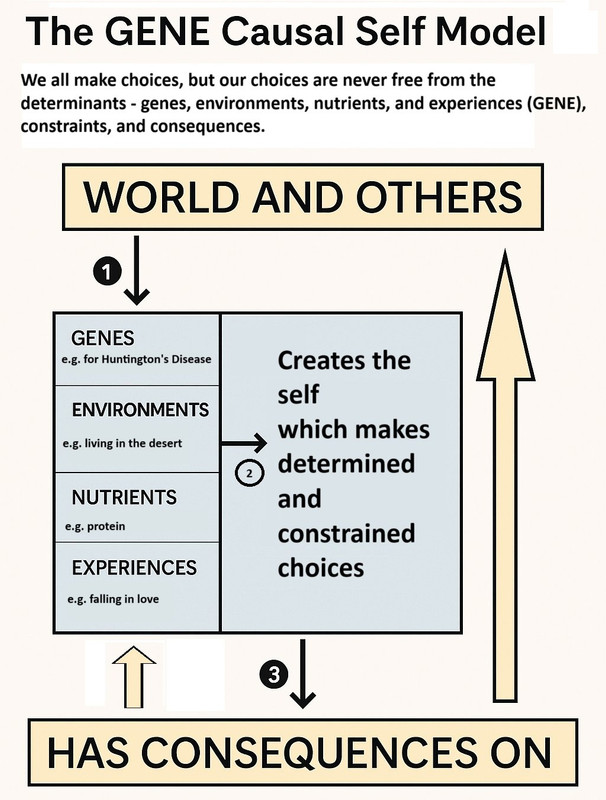
Miles didn't reply, so I did. Do you agree or disagree? Please explain the basis of your agreement or disagreement. I created the GENE (genes, environments, nutrients and experiences) model many years ago. It was not created by ChatGPT or any other Large Language Model. Please look at the infographic below:
Last edited by Compassionist on Thu Jan 29, 2026 6:49 pm, edited 1 time in total.
-
The Tanager
- Savant
- Posts: 6239
- Joined: Wed May 06, 2015 11:08 am
- Has thanked: 90 times
- Been thanked: 275 times
Re: Could we have made different choices than the ones we actually made?
Post #79[Replying to Compassionist in post #76]
On Science
The scientific successes you are talking about do not settle the determinism/free will debate. Libertarians don't believe medication, therapy, incentives, surveillance, etc. don't play a role. All of those things: our bodies, environmental factors, reasons, etc. influence our wills. Neither determinism nor libertarian freedom adds predictive leverage here.
You also always go back to examples like not being able to grow your head back, which is not at all what the determinism/free will debate is about.
On Causal Explanation
You keep saying that constraint, intervention, manipulation of outcome probabilities is the minimal definition of causal explanation, but either (1) you haven't supported it or (2) are simply talking about the scientific success deterministic features, not whether the will is actually deterministic.
On Rationality
The doctrine of a free will is not meant to address rationality; that comes from elsewhere in a libertarian's worldview.
If shared evidence causally influences belief formation, it works both ways (to truth and falsehood), this explains convergence, but not convergence on truth. And talking of correction mechanisms assumes there is truth; it doesn't show it is actually the case.
On Morality
Yes, you have your game where working together wins the goal of your game; the egoist has their own game and goal and strategies that get that goal. Your burden is to show that these differences are more than just different preferences.
On Science
The scientific successes you are talking about do not settle the determinism/free will debate. Libertarians don't believe medication, therapy, incentives, surveillance, etc. don't play a role. All of those things: our bodies, environmental factors, reasons, etc. influence our wills. Neither determinism nor libertarian freedom adds predictive leverage here.
You also always go back to examples like not being able to grow your head back, which is not at all what the determinism/free will debate is about.
Libertarian freedom does not say the decisive cause (the will) is unknowable in principle, it says it is scientifically unknowable in principle. Libertarian freedom, just like determinism, goes beyond the science and makes philosophical claims.Compassionist wrote: ↑Sat Jan 24, 2026 11:53 amThis conflates two very different philosophical moves.Both are making philosophical moves, so science doesn't favor one or the other.
Hard determinism says:
unknown causes are like other unknown causes — discoverable in principle.
Libertarianism says:
the decisive cause is unknowable in principle.
Science always favors the framework that treats ignorance as provisional rather than principled. That is not neutrality; it is methodological realism.
On Causal Explanation
You keep saying that constraint, intervention, manipulation of outcome probabilities is the minimal definition of causal explanation, but either (1) you haven't supported it or (2) are simply talking about the scientific success deterministic features, not whether the will is actually deterministic.
On Rationality
The doctrine of a free will is not meant to address rationality; that comes from elsewhere in a libertarian's worldview.
If shared evidence causally influences belief formation, it works both ways (to truth and falsehood), this explains convergence, but not convergence on truth. And talking of correction mechanisms assumes there is truth; it doesn't show it is actually the case.
On Morality
Yes, you have your game where working together wins the goal of your game; the egoist has their own game and goal and strategies that get that goal. Your burden is to show that these differences are more than just different preferences.
-
Compassionist
- Guru
- Posts: 1524
- Joined: Tue Feb 19, 2008 5:56 pm
- Has thanked: 1070 times
- Been thanked: 252 times
Re: Could we have made different choices than the ones we actually made?
Post #80[Replying to The Tanager in post #79]
On Science
You say:
It’s correct that:
• current science cannot precisely predict individual choices,
• libertarians fully accept causal influence from biology, environment, reasons, etc.
But the disagreement is not about current predictive power.
It is about what kind of explanation we are committed to in principle.
Hard determinism holds:
Unpredictability reflects epistemic limits, not metaphysical indeterminacy.
Libertarian freedom holds:
At the point of choice, causation fundamentally runs out.
Those are not symmetric philosophical moves.
Hard determinism treats human choice like other complex biological phenomena:
• opaque now,
• partially predictable at scale,
• increasingly tractable as models improve.
Libertarianism treats choice as:
• governed by reasons,
• but not determined by them,
• in a way that is not just currently unknown, but not the kind of thing science could ever explain.
That difference matters methodologically.
You reply:
Hard determinism rejects the idea that there is a real explanatory domain that is:
• causally efficacious,
• yet forever inaccessible to scientific explanation.
Once you say:
“This causal factor exists, but no causal law or mechanism could ever explain it,â€
you have exited causal realism.
Science does not “assume determinism†as a metaphysical thesis — but it does assume that causal ignorance is provisional rather than principled. Libertarian freedom denies that assumption at the point where it matters most.
That is why science methodologically aligns with hard determinism even if it does not metaphysically prove it.
On Causal Explanation
You write:
A causal explanation minimally does three things:
• constrains outcomes,
• supports counterfactuals,
• enables intervention in principle.
This is not an arbitrary stipulation — it is what distinguishes:
• explanation from narration,
• causation from mere description.
Saying:
“The will choseâ€
does not explain why that choice occurred rather than another, except by restating the event at a higher level.
By contrast, deterministic explanations say:
• if the causal history had differed, the outcome would have differed,
• changes in inputs change outcomes,
• regularities arise from lawful processes.
Libertarian freedom explicitly denies that final selection is law-governed.
So the objection is not:
“Your explanation is false.â€
It is:
Your explanation does not explain in the causal sense at all.
It identifies an agent, not a mechanism.
On Rationality
You say:
The argument for convergence is not:
“Convergence guarantees truth.â€
It is:
“Convergence under error-correcting pressure is the only process we know that systematically reduces error over time.â€
This is not a metaphysical claim about certainty.
It is a pragmatic, comparative claim about reliability.
Libertarian freedom does not explain:
• why evidence tracking works at all,
• why correction mechanisms improve belief accuracy,
• why irrational beliefs cluster with identifiable causal distortions.
Hard determinism does.
And crucially: libertarian freedom is irrelevant to rationality.
It neither explains why reasoning tracks truth nor how false beliefs are corrected.
So invoking libertarian freedom here adds nothing.
On Morality
You write:
Hard determinism agrees:
• moral systems are preference-laden,
• values are causally generated,
• there is no metaphysically objective moral law.
But this does not mean all moral frameworks are equally justified in practice.
The relevant distinction is not:
• objective vs subjective,
but:
• harm-reducing vs harm-producing,
• stable vs unstable,
• cooperative vs destructive.
The egoist’s “gameâ€:
• scales poorly,
• undermines trust,
• increases conflict and suffering.
That is not a moral condemnation — it is a causal assessment.
Hard determinism does not say:
“Your morality is wrong.â€
It says:
“This framework predictably increases suffering under human constraints.â€
That is sufficient for rejection without invoking moral realism.
The core disagreement remains this:
Hard determinism holds:
Human choices are causally produced by biological, psychological, and environmental processes, even if those processes are complex and partially opaque.
Libertarian freedom holds:
At the decisive point, causation stops — not just in practice, but in principle.
That is not a small difference.
It is a rejection of causal explanation at precisely the point where responsibility is supposed to arise.
From the hard determinist view:
• science favors provisional ignorance, not principled mystery,
• explanation requires constraint, not mere authorship,
• rationality does not need free will,
• morality does not require moral desert.
That is why libertarian freedom adds no explanatory value — and why responsibility, in the deep sense, does not exist.
If humans had libertarian free will, they would have been able to grow their heads back if their heads were chopped off, the way planarian flatworms grow their heads back if their heads are chopped off. It's because the choices of sentient beings are both determined and constrained by their genes, environments, nutrients, and experiences that we see differences in the choices they make.
On Science
You say:
From a hard determinist standpoint, this is only half right.Neither determinism nor libertarian freedom adds predictive leverage here.
It’s correct that:
• current science cannot precisely predict individual choices,
• libertarians fully accept causal influence from biology, environment, reasons, etc.
But the disagreement is not about current predictive power.
It is about what kind of explanation we are committed to in principle.
Hard determinism holds:
Unpredictability reflects epistemic limits, not metaphysical indeterminacy.
Libertarian freedom holds:
At the point of choice, causation fundamentally runs out.
Those are not symmetric philosophical moves.
Hard determinism treats human choice like other complex biological phenomena:
• opaque now,
• partially predictable at scale,
• increasingly tractable as models improve.
Libertarianism treats choice as:
• governed by reasons,
• but not determined by them,
• in a way that is not just currently unknown, but not the kind of thing science could ever explain.
That difference matters methodologically.
You reply:
But this is exactly the point.Libertarian freedom does not say the will is unknowable in principle, only scientifically unknowable.
Hard determinism rejects the idea that there is a real explanatory domain that is:
• causally efficacious,
• yet forever inaccessible to scientific explanation.
Once you say:
“This causal factor exists, but no causal law or mechanism could ever explain it,â€
you have exited causal realism.
Science does not “assume determinism†as a metaphysical thesis — but it does assume that causal ignorance is provisional rather than principled. Libertarian freedom denies that assumption at the point where it matters most.
That is why science methodologically aligns with hard determinism even if it does not metaphysically prove it.
On Causal Explanation
You write:
From a hard determinist view, those are not separable.Either you haven’t supported your definition of causal explanation, or you’re just pointing to scientific success.
A causal explanation minimally does three things:
• constrains outcomes,
• supports counterfactuals,
• enables intervention in principle.
This is not an arbitrary stipulation — it is what distinguishes:
• explanation from narration,
• causation from mere description.
Saying:
“The will choseâ€
does not explain why that choice occurred rather than another, except by restating the event at a higher level.
By contrast, deterministic explanations say:
• if the causal history had differed, the outcome would have differed,
• changes in inputs change outcomes,
• regularities arise from lawful processes.
Libertarian freedom explicitly denies that final selection is law-governed.
So the objection is not:
“Your explanation is false.â€
It is:
Your explanation does not explain in the causal sense at all.
It identifies an agent, not a mechanism.
On Rationality
You say:
Hard determinism agrees — but this does not rescue libertarianism.Shared evidence can lead to convergence on falsehood just as easily as truth.
The argument for convergence is not:
“Convergence guarantees truth.â€
It is:
“Convergence under error-correcting pressure is the only process we know that systematically reduces error over time.â€
This is not a metaphysical claim about certainty.
It is a pragmatic, comparative claim about reliability.
Libertarian freedom does not explain:
• why evidence tracking works at all,
• why correction mechanisms improve belief accuracy,
• why irrational beliefs cluster with identifiable causal distortions.
Hard determinism does.
And crucially: libertarian freedom is irrelevant to rationality.
It neither explains why reasoning tracks truth nor how false beliefs are corrected.
So invoking libertarian freedom here adds nothing.
On Morality
You write:
From a hard determinist perspective, this objection actually concedes too much.Your burden is to show that these differences are more than just different preferences.
Hard determinism agrees:
• moral systems are preference-laden,
• values are causally generated,
• there is no metaphysically objective moral law.
But this does not mean all moral frameworks are equally justified in practice.
The relevant distinction is not:
• objective vs subjective,
but:
• harm-reducing vs harm-producing,
• stable vs unstable,
• cooperative vs destructive.
The egoist’s “gameâ€:
• scales poorly,
• undermines trust,
• increases conflict and suffering.
That is not a moral condemnation — it is a causal assessment.
Hard determinism does not say:
“Your morality is wrong.â€
It says:
“This framework predictably increases suffering under human constraints.â€
That is sufficient for rejection without invoking moral realism.
The core disagreement remains this:
Hard determinism holds:
Human choices are causally produced by biological, psychological, and environmental processes, even if those processes are complex and partially opaque.
Libertarian freedom holds:
At the decisive point, causation stops — not just in practice, but in principle.
That is not a small difference.
It is a rejection of causal explanation at precisely the point where responsibility is supposed to arise.
From the hard determinist view:
• science favors provisional ignorance, not principled mystery,
• explanation requires constraint, not mere authorship,
• rationality does not need free will,
• morality does not require moral desert.
That is why libertarian freedom adds no explanatory value — and why responsibility, in the deep sense, does not exist.
If humans had libertarian free will, they would have been able to grow their heads back if their heads were chopped off, the way planarian flatworms grow their heads back if their heads are chopped off. It's because the choices of sentient beings are both determined and constrained by their genes, environments, nutrients, and experiences that we see differences in the choices they make.

