
Could we have made different choices than the ones we actually made?
Moderator: Moderators
-
Compassionist
- Guru
- Posts: 1524
- Joined: Tue Feb 19, 2008 5:56 pm
- Has thanked: 1070 times
- Been thanked: 252 times
Could we have made different choices than the ones we actually made?
Post #1Could we have made different choices than the ones we actually made? By "we" I mean all living things. For example, I have a potted plant that has tilted westward by twenty degrees. Could the plant have refrained from tilting or tilted at a different direction by a different degree or was it inevitable that it tilted westward by twenty degrees? I ate porridge for breakfast today. Could I have eaten something else or was eating porridge for breakfast inevitable? Nelson Mandela died on 14 June 1999. Was his death on that date inevitable or could he have died at a younger or older age? Albert Einstein was a physicist. Could he have been a professional football player instead of a physicist or was his choice of career inevitable? In your response, please explain how you know what you know.
-
William

- Savant
- Posts: 16490
- Joined: Tue Jul 31, 2012 8:11 pm
- Location: Te Waipounamu
- Has thanked: 1037 times
- Been thanked: 1950 times
- Contact:
Re: Could we have made different choices than the ones we actually made?
Post #81[Replying to Compassionist in post #80]
In this, are you saying that flatworms choose by the act of will, to grow their heads back?If humans had libertarian free will, they would have been able to grow their heads back if their heads were chopped off, the way planarian flatworms grow their heads back if their heads are chopped off. It's because the choices of sentient beings are both determined and constrained by their genes, environments, nutrients, and experiences that we see differences in the choices they make.

The question has never been whether God is speaking. The question has always been whether there is anyone listening - anyone who has stopped hiding long enough to hear.
-
Compassionist
- Guru
- Posts: 1524
- Joined: Tue Feb 19, 2008 5:56 pm
- Has thanked: 1070 times
- Been thanked: 252 times
Re: Could we have made different choices than the ones we actually made?
Post #82[Replying to William in post #81]
I am not saying that planarian flatworms exercise an act of will. Quite the opposite.
My claim is that neither flatworms nor humans possess libertarian free will.
The flatworm example is meant to highlight a structural constraint, not libertarian free will.
Here is the argument, made explicit:
• Planarian flatworms regenerate their heads because they have the genes and the resultant biological mechanisms that make regeneration possible.
• Humans do not regenerate their heads because we lack those genes and the resultant biological mechanisms.
• No amount of “will,†intention, or choice can overcome that biological constraint.
This shows that outcomes are determined and constrained by:
genes, environments, nutrients, and experiences — not by libertarian freedom.
Why this matters for free will
If libertarian free will were real in the strong sense often claimed — i.e. an undetermined power of choice — then biological impossibilities would not be absolute barriers.
But they are.
Humans cannot will themselves to:
• regrow severed heads,
• photosynthesize,
• breathe underwater unaided,
• understand languages they were never exposed to.
These limits are not failures of will.
They are constraints imposed by biology and development.
So the point is this:
The flatworm does not freely choose to regrow its head.
It regrows its head because it is the kind of organism it is.
Likewise, humans make the choices they do because they are the kind of organisms they are — shaped by causal histories they did not choose.
If I had your genes, environments, nutrients, and experiences, I would be reading these words when and where you are reading these words. If you had my genes, environments, nutrients and experiences you would be typing these words when and where I am typing these words.
No appeal to libertarian freedom explains this difference.
Causal explanation does.
I created an infographic to explain my GENE model:
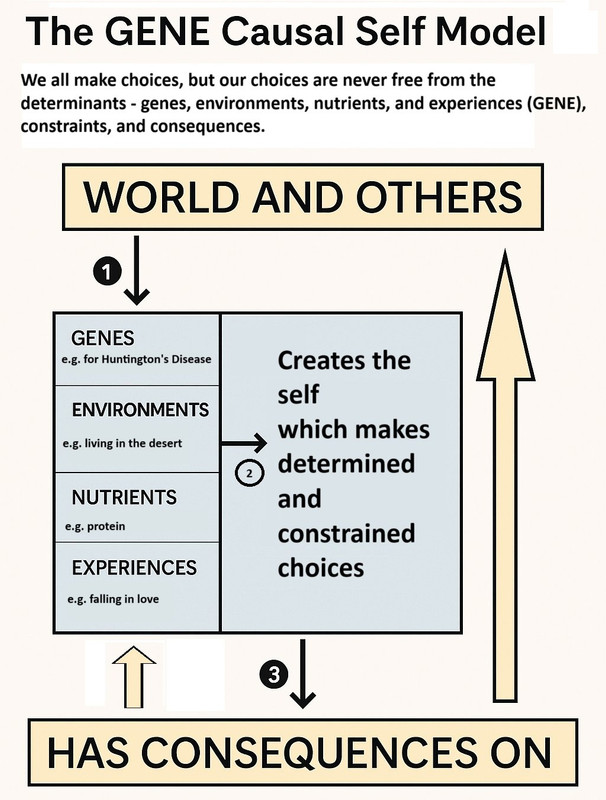
No — and this is a misunderstanding of the point I was making.In this, are you saying that flatworms choose by the act of will, to grow their heads back?
I am not saying that planarian flatworms exercise an act of will. Quite the opposite.
My claim is that neither flatworms nor humans possess libertarian free will.
The flatworm example is meant to highlight a structural constraint, not libertarian free will.
Here is the argument, made explicit:
• Planarian flatworms regenerate their heads because they have the genes and the resultant biological mechanisms that make regeneration possible.
• Humans do not regenerate their heads because we lack those genes and the resultant biological mechanisms.
• No amount of “will,†intention, or choice can overcome that biological constraint.
This shows that outcomes are determined and constrained by:
genes, environments, nutrients, and experiences — not by libertarian freedom.
Why this matters for free will
If libertarian free will were real in the strong sense often claimed — i.e. an undetermined power of choice — then biological impossibilities would not be absolute barriers.
But they are.
Humans cannot will themselves to:
• regrow severed heads,
• photosynthesize,
• breathe underwater unaided,
• understand languages they were never exposed to.
These limits are not failures of will.
They are constraints imposed by biology and development.
So the point is this:
The flatworm does not freely choose to regrow its head.
It regrows its head because it is the kind of organism it is.
Likewise, humans make the choices they do because they are the kind of organisms they are — shaped by causal histories they did not choose.
If I had your genes, environments, nutrients, and experiences, I would be reading these words when and where you are reading these words. If you had my genes, environments, nutrients and experiences you would be typing these words when and where I am typing these words.
No appeal to libertarian freedom explains this difference.
Causal explanation does.
I created an infographic to explain my GENE model:
-
William
- Savant
- Posts: 16490
- Joined: Tue Jul 31, 2012 8:11 pm
- Location: Te Waipounamu
- Has thanked: 1037 times
- Been thanked: 1950 times
- Contact:
Re: Could we have made different choices than the ones we actually made?
Post #83[Replying to The Tanager in post #79]
Coherent Causality
and the Rehabilitation of Free Will
Core Insight
Libertarian free will fails only if agency must be either causeless magic or random indeterminacy. The Coherent Causality Argument (CCA) dissolves this false dilemma by reframing agency as a natural, law-like capacity grounded in a causally coherent source reality.
Coherent Causality
and the Rehabilitation of Free Will
Core Insight
Libertarian free will fails only if agency must be either causeless magic or random indeterminacy. The Coherent Causality Argument (CCA) dissolves this false dilemma by reframing agency as a natural, law-like capacity grounded in a causally coherent source reality.
The question has never been whether God is speaking. The question has always been whether there is anyone listening - anyone who has stopped hiding long enough to hear.
-
The Tanager

- Savant
- Posts: 6239
- Joined: Wed May 06, 2015 11:08 am
- Has thanked: 90 times
- Been thanked: 275 times
Re: Could we have made different choices than the ones we actually made?
Post #84[Replying to Compassionist in post #80]
On Terms
On Science
The reasons libertarians treat human choice as they do also have philosophical moves behind it; my point is just that the difference is philosophical and has no scientific backing one way or the other.
On Causal Explanation
We are just repeating ourselves here. I’ve shared why I think you are making philosophical moves and couching them in the language of science by defining “causal explanation†in a deterministic sense and that’s simply begging the question.
On Rationality
As to libertarian freedom, I already said that it doesn’t address this issue; that comes from other parts of my worldview.
On Morality
Why is (overall) harm-reducing vs harm-producing (and the others) the relevant distinctions? Hard determinism also says that some egoist’s framework will predictably decrease their own suffering while increasing the suffering of others.
On Terms
You say you understand libertarian freedom and then you make a comment like this. This is nowhere close to libertarian free will.Compassionist wrote: ↑Thu Jan 29, 2026 6:59 pmIf humans had libertarian free will, they would have been able to grow their heads back if their heads were chopped off, the way planarian flatworms grow their heads back if their heads are chopped off. It's because the choices of sentient beings are both determined and constrained by their genes, environments, nutrients, and experiences that we see differences in the choices they make.
On Science
Libertarian freedom does not hold that causation runs out, it holds that physical factors determining the causation runs out. You substituting ‘causation’ in there shows you are begging the question by your language. Treating human choice like other complex deterministic phenomena is the philosophical move. What are the reasons for it? They aren’t scientific.Compassionist wrote: ↑Thu Jan 29, 2026 6:59 pmBut the disagreement is not about current predictive power.
It is about what kind of explanation we are committed to in principle.
Hard determinism holds:
Unpredictability reflects epistemic limits, not metaphysical indeterminacy.
Libertarian freedom holds:
At the point of choice, causation fundamentally runs out.
Those are not symmetric philosophical moves.
Hard determinism treats human choice like other complex biological phenomena:
• opaque now,
• partially predictable at scale,
• increasingly tractable as models improve.
Libertarianism treats choice as:
• governed by reasons,
• but not determined by them,
• in a way that is not just currently unknown, but not the kind of thing science could ever explain.
The reasons libertarians treat human choice as they do also have philosophical moves behind it; my point is just that the difference is philosophical and has no scientific backing one way or the other.
Yes, and it does so through philosophy not science. That’s why this section, On Science needs to be dropped. Science aligns equally with determinism and libertarian freedom.Compassionist wrote: ↑Thu Jan 29, 2026 6:59 pmBut this is exactly the point.Libertarian freedom does not say the will is unknowable in principle, only scientifically unknowable.
Hard determinism rejects the idea that there is a real explanatory domain that is:
• causally efficacious,
• yet forever inaccessible to scientific explanation.
On Causal Explanation
We are just repeating ourselves here. I’ve shared why I think you are making philosophical moves and couching them in the language of science by defining “causal explanation†in a deterministic sense and that’s simply begging the question.
On Rationality
Which assumes we can clearly distinguish truth and error, which is the question I originally asked you to prove. That’s why I said you are begging the question and arguing in a circle. How can we be sure we are seeing the truth (if determinism is true)? You settled on “convergenceâ€. But here your support for convergence assumes we are capable of seeing the truth.Compassionist wrote: ↑Thu Jan 29, 2026 6:59 pmThe argument for convergence is not:
“Convergence guarantees truth.â€
It is:
“Convergence under error-correcting pressure is the only process we know that systematically reduces error over time.â€
As to libertarian freedom, I already said that it doesn’t address this issue; that comes from other parts of my worldview.
On Morality
Why is (overall) harm-reducing vs harm-producing (and the others) the relevant distinctions? Hard determinism also says that some egoist’s framework will predictably decrease their own suffering while increasing the suffering of others.
-
Compassionist
- Guru
- Posts: 1524
- Joined: Tue Feb 19, 2008 5:56 pm
- Has thanked: 1070 times
- Been thanked: 252 times
Re: Could we have made different choices than the ones we actually made?
Post #85[Replying to The Tanager in post #84]
On Terms
You write:
It was a reductio, not a characterization.
The point was not:
• “Libertarian free will means you can do anything.â€
The point was:
• If choice were not constrained by prior biological structure, then biological impossibilities would not systematically track species-level limits.
Planarians regenerate heads because:
• they have the genes for it.
Humans don’t because:
• we don’t.
That difference illustrates a general principle hard determinism insists on:
What an organism can choose is always constrained by what it is.
Libertarian freedom often speaks as if “choice†floats free of those constraints at the decisive point. The example highlights that this is false: capacity precedes choice.
So yes — the example is not a definition.
It’s an illustration of constraint that libertarian rhetoric tends to underplay.
On Science
You object to this framing:
But here is the crucial point:
Libertarian freedom holds that no sufficient prior causes — physical or otherwise — fix the outcome of choice.
If the will itself is not causally determined by prior states, then the causal chain terminates at the will.
Calling that “non-physical causation†does not avoid the issue — it merely relocates it.
Hard determinism does not claim:
• “Only physical causes exist.â€
It claims:
Whatever causes exist must operate lawfully enough to explain why this happened rather than that.
If the will is:
• not determined by prior conditions,
• not governed by outcome-selecting laws,
• not explainable in terms of sufficient conditions,
then it is not a cause in the explanatory sense — even if one calls it “non-physical.â€
That is not begging the question.
It is insisting on what causation means in any explanatory framework.
You say this is philosophical rather than scientific. Agreed — but that does not make it neutral.
Science proceeds on the assumption that:
• ignorance is provisional,
• explanation is possible in principle,
• causal structure does not bottom out in brute choice.
Libertarian freedom denies that assumption at the most important explanatory junction. That is why the alignment is asymmetric — even if neither side can be empirically proven.
On Causal Explanation
You say we are repeating ourselves. That’s true — because the disagreement is fundamental.
So let me state it as cleanly as possible:
Hard determinism says:
An explanation must constrain outcomes — it must rule some possibilities out given prior conditions.
Libertarian freedom says:
Given identical prior conditions, multiple incompatible outcomes remain genuinely possible.
That is not merely a different explanation — it is the rejection of explanation at that point.
Calling the will a “cause†does not help unless you can say:
• why it produced A rather than B,
• what conditions would have changed that,
• what outcomes it systematically forbids.
Otherwise “the will chose†is not an explanation — it is a stopping point.
That is the core issue, and it is not resolved by labeling the move “philosophical.â€
On Rationality
You write:
The claim is not:
• “We have access to capital-T Truth.â€
The claim is:
• Some belief-forming processes are more reliable than others.
Reliability does not require certainty.
It requires:
• stability,
• correction,
• improved prediction and control.
If you deny that we can ever tell truth from error even comparatively, then:
• disagreement becomes meaningless,
• reasons lose force,
• argument collapses.
And libertarian freedom does not help here — it makes matters worse.
If beliefs are not causally shaped by evidence in a law-governed way, then convergence becomes miraculous rather than explicable.
Hard determinism, by contrast, explains:
• why evidence changes beliefs,
• why false beliefs persist under certain conditions,
• why correction mechanisms work imperfectly but progressively.
That is enough for rational inquiry. Nothing stronger is needed.
On Morality
You ask:
Because:
• suffering is bad by definition for sentient systems,
• increased suffering destabilizes social systems,
• harm reliably produces retaliation, fear, breakdown, and escalation.
Yes, an egoist may reduce their own suffering temporarily.
But at the system level:
• egoism scales poorly,
• it increases overall instability,
• it increases future harm — including to the egoist.
This is not a value judgment imposed from nowhere.
It is an empirical fact about social dynamics among vulnerable organisms.
Hard determinism does not say:
• “Egoism is morally evil.â€
It says:
Egoism is causally maladaptive for groups of sentient beings who cannot opt out of mutual dependence.
That is sufficient reason to reject it as a guiding framework — without invoking free will, desert, or moral realism.
Bottom line
The disagreement is not semantic, and it is not merely philosophical posturing.
It is this:
Hard determinism holds:
Choices are caused by prior conditions in ways that make them intelligible, even if complex and opaque.
Libertarian freedom holds:
At the decisive point, explanation ends in agent selection without sufficient cause.
Calling that “non-physical causation†does not restore explanatory power.
Hard determinism rejects libertarian freedom not because of science alone — but because it replaces explanation with mystery precisely where responsibility is supposed to arise.
And once that mystery is removed, so is blame, praise, and desert — leaving only what actually matters:
Reducing suffering. Preventing harm. Working with the causal reality we are actually in.
On Terms
You write:
You’re right about one thing: the head-regrowth example is not a definition of libertarian free will. It was never intended to be.This is nowhere close to libertarian free will.
It was a reductio, not a characterization.
The point was not:
• “Libertarian free will means you can do anything.â€
The point was:
• If choice were not constrained by prior biological structure, then biological impossibilities would not systematically track species-level limits.
Planarians regenerate heads because:
• they have the genes for it.
Humans don’t because:
• we don’t.
That difference illustrates a general principle hard determinism insists on:
What an organism can choose is always constrained by what it is.
Libertarian freedom often speaks as if “choice†floats free of those constraints at the decisive point. The example highlights that this is false: capacity precedes choice.
So yes — the example is not a definition.
It’s an illustration of constraint that libertarian rhetoric tends to underplay.
On Science
You object to this framing:
and say I am begging the question by using the word causation rather than physical causation.At the point of choice, causation fundamentally runs out.
But here is the crucial point:
Libertarian freedom holds that no sufficient prior causes — physical or otherwise — fix the outcome of choice.
If the will itself is not causally determined by prior states, then the causal chain terminates at the will.
Calling that “non-physical causation†does not avoid the issue — it merely relocates it.
Hard determinism does not claim:
• “Only physical causes exist.â€
It claims:
Whatever causes exist must operate lawfully enough to explain why this happened rather than that.
If the will is:
• not determined by prior conditions,
• not governed by outcome-selecting laws,
• not explainable in terms of sufficient conditions,
then it is not a cause in the explanatory sense — even if one calls it “non-physical.â€
That is not begging the question.
It is insisting on what causation means in any explanatory framework.
You say this is philosophical rather than scientific. Agreed — but that does not make it neutral.
Science proceeds on the assumption that:
• ignorance is provisional,
• explanation is possible in principle,
• causal structure does not bottom out in brute choice.
Libertarian freedom denies that assumption at the most important explanatory junction. That is why the alignment is asymmetric — even if neither side can be empirically proven.
On Causal Explanation
You say we are repeating ourselves. That’s true — because the disagreement is fundamental.
So let me state it as cleanly as possible:
Hard determinism says:
An explanation must constrain outcomes — it must rule some possibilities out given prior conditions.
Libertarian freedom says:
Given identical prior conditions, multiple incompatible outcomes remain genuinely possible.
That is not merely a different explanation — it is the rejection of explanation at that point.
Calling the will a “cause†does not help unless you can say:
• why it produced A rather than B,
• what conditions would have changed that,
• what outcomes it systematically forbids.
Otherwise “the will chose†is not an explanation — it is a stopping point.
That is the core issue, and it is not resolved by labeling the move “philosophical.â€
On Rationality
You write:
This objection misunderstands the structure of the argument.Which assumes we can clearly distinguish truth and error, which is the question I originally asked you to prove.
The claim is not:
• “We have access to capital-T Truth.â€
The claim is:
• Some belief-forming processes are more reliable than others.
Reliability does not require certainty.
It requires:
• stability,
• correction,
• improved prediction and control.
If you deny that we can ever tell truth from error even comparatively, then:
• disagreement becomes meaningless,
• reasons lose force,
• argument collapses.
And libertarian freedom does not help here — it makes matters worse.
If beliefs are not causally shaped by evidence in a law-governed way, then convergence becomes miraculous rather than explicable.
Hard determinism, by contrast, explains:
• why evidence changes beliefs,
• why false beliefs persist under certain conditions,
• why correction mechanisms work imperfectly but progressively.
That is enough for rational inquiry. Nothing stronger is needed.
On Morality
You ask:
From a hard determinist perspective, the answer is not moral — it is causal.Why is harm-reducing vs harm-producing the relevant distinction?
Because:
• suffering is bad by definition for sentient systems,
• increased suffering destabilizes social systems,
• harm reliably produces retaliation, fear, breakdown, and escalation.
Yes, an egoist may reduce their own suffering temporarily.
But at the system level:
• egoism scales poorly,
• it increases overall instability,
• it increases future harm — including to the egoist.
This is not a value judgment imposed from nowhere.
It is an empirical fact about social dynamics among vulnerable organisms.
Hard determinism does not say:
• “Egoism is morally evil.â€
It says:
Egoism is causally maladaptive for groups of sentient beings who cannot opt out of mutual dependence.
That is sufficient reason to reject it as a guiding framework — without invoking free will, desert, or moral realism.
Bottom line
The disagreement is not semantic, and it is not merely philosophical posturing.
It is this:
Hard determinism holds:
Choices are caused by prior conditions in ways that make them intelligible, even if complex and opaque.
Libertarian freedom holds:
At the decisive point, explanation ends in agent selection without sufficient cause.
Calling that “non-physical causation†does not restore explanatory power.
Hard determinism rejects libertarian freedom not because of science alone — but because it replaces explanation with mystery precisely where responsibility is supposed to arise.
And once that mystery is removed, so is blame, praise, and desert — leaving only what actually matters:
Reducing suffering. Preventing harm. Working with the causal reality we are actually in.
-
The Tanager
- Savant
- Posts: 6239
- Joined: Wed May 06, 2015 11:08 am
- Has thanked: 90 times
- Been thanked: 275 times
Re: Could we have made different choices than the ones we actually made?
Post #86[Replying to Compassionist in post #85]
Thanks for your responses. I'm going to try to keep my posts concise and to the point.
Libertarian freedom does not speak as if choice floats free. We agree capacity precedes choice, we agree that capacity affects choice, but we disagree that capacity determines choice.
Concerning your definition of ‘causal explanation’ being question-begging, my point wasn’t about physical vs. non-physical, but about the need for fixing the outcome via prior states or lawful operation or constraint or the many other ways you’ve said the same thing that only lets determinism in by definition. Claiming that only causes determined by prior causes is a sufficient cause is just another way to beg determinism. You keep saying you are simply insisting on what causation means in any explanatory framework, but you are actually working off of the scientific study of agreed upon deterministic systems and then claiming (really just assuming) that all explanatory frameworks have to be that way. That doesn't follow rationally.
On rationality, “belief-forming processes being more reliable than others†requires a capital-T truth to exist or there is nothing to judge reliable vs. unreliable against. I’m not denying that we can tell the truth from error; I agree we can. I’m denying that determinism could give us that as a reality. You are only assuming it can and then saying what deterministic mechanisms would be involved. And I’m not offering libertarian freedom as the alternative way to get that reality; it’s irrelevant to that issue.
On morality, yes, egoism is maladaptive for groups of sentient beings working together. That's not the issue. If you care about (i.e., prefer) that goal, then don't be an egoist. The issue is why care about that goal in the first place.
Thanks for your responses. I'm going to try to keep my posts concise and to the point.
Libertarian freedom does not speak as if choice floats free. We agree capacity precedes choice, we agree that capacity affects choice, but we disagree that capacity determines choice.
Concerning your definition of ‘causal explanation’ being question-begging, my point wasn’t about physical vs. non-physical, but about the need for fixing the outcome via prior states or lawful operation or constraint or the many other ways you’ve said the same thing that only lets determinism in by definition. Claiming that only causes determined by prior causes is a sufficient cause is just another way to beg determinism. You keep saying you are simply insisting on what causation means in any explanatory framework, but you are actually working off of the scientific study of agreed upon deterministic systems and then claiming (really just assuming) that all explanatory frameworks have to be that way. That doesn't follow rationally.
On rationality, “belief-forming processes being more reliable than others†requires a capital-T truth to exist or there is nothing to judge reliable vs. unreliable against. I’m not denying that we can tell the truth from error; I agree we can. I’m denying that determinism could give us that as a reality. You are only assuming it can and then saying what deterministic mechanisms would be involved. And I’m not offering libertarian freedom as the alternative way to get that reality; it’s irrelevant to that issue.
On morality, yes, egoism is maladaptive for groups of sentient beings working together. That's not the issue. If you care about (i.e., prefer) that goal, then don't be an egoist. The issue is why care about that goal in the first place.
-
Compassionist
- Guru
- Posts: 1524
- Joined: Tue Feb 19, 2008 5:56 pm
- Has thanked: 1070 times
- Been thanked: 252 times
Re: Could we have made different choices than the ones we actually made?
Post #87[Replying to The Tanager in post #86]
On capacity, choice, and determination
You say:
If:
• capacities are fixed,
• reasons arise from prior states,
• motivational weights are fixed,
• evaluative frameworks are fixed,
• and no additional outcome-selecting factor exists,
then nothing remains that could do the determining except those capacities and desires. For example, I desire to make all living things forever happy, but I lack the capacity to do so. Both my desires and capacities are determined by my genes, environments, nutrients, and experiences. My desires and capacities don't arise from an immaterial soul because souls don't exist. I have asked you to prove that souls exist, and you have never managed to do it. I have examined every choice I remember making and all of them were determined by my genes, environments, nutrients, and experiences. None of them were free from my genes, environments, nutrients, and experiences. If they were, I would have become fluent in languages I never heard, I would have been able to regrow limbs, I would have run faster than Usain Bolt, etc.
Saying “capacity affects but does not determine†is incomplete unless you can specify:
• what does determine the outcome,
• how it operates,
• and why it yields this result rather than another.
Otherwise, “does not determine†just means:
“determination stops here, without further explanation.â€
That is not a rival account of determination — it is a refusal to complete the causal story.
On causal explanation and alleged question-begging
You write:
The claim is not:
• “Only deterministic causes exist.â€
The claim is:
Any cause that explains must constrain outcomes.
Explanation requires:
• ruling out alternatives,
• supporting counterfactuals,
• answering “why this rather than that?â€
If a putative cause allows multiple incompatible outcomes under identical conditions with no further explanation, then it is not explanatory — regardless of whether it is physical or non-physical.
This is not imported from physics.
It is built into the concept of explanation itself.
You are right that we learn this most clearly from deterministic systems — but that does not make it arbitrary. It shows what explanation does when it works.
Libertarian freedom rejects outcome-fixing not because of evidence, but by principle. That is precisely why it fails as an explanation.
On rationality and truth
You say:
Hard determinism does not require:
• infallibility,
• access to ultimate truth,
• or guarantees of correctness.
It requires only this:
Some processes systematically reduce error relative to others.
We judge that by:
• prediction,
• coherence across domains,
• correction under feedback,
• control over outcomes.
You say determinism cannot give us truth as a reality.
But determinism does not give truth.
It explains why:
• evidence shifts beliefs,
• false beliefs persist under identifiable conditions,
• correction mechanisms work unevenly but progressively.
Libertarian freedom adds nothing here.
And crucially, rejecting determinism does not solve the problem — it worsens it by removing causal explanation for why evidence ever works at all.
So this objection does not land against hard determinism specifically. It challenges any naturalistic epistemology — and libertarian freedom does not help.
On morality and “why care at all?â€
You write:
Hard determinism does not claim:
• that one ought to care in some objective sense,
• that morality is metaphysically binding,
• or that values are externally justified.
It claims:
Caring itself is a causal fact about sentient organisms.
We care about suffering reduction because:
• suffering is intrinsically aversive to sentient systems,
• empathy is causally built into social mammals,
• cooperative norms stabilize groups,
• harm escalates and feeds back negatively.
Asking “why care?†is like asking “why does pain matter?â€
It matters because:
• organisms are structured to experience it as mattering.
There is no further justification beneath that — and none is needed.
Hard determinism does not ground ethics in objective truth.
It grounds it in:
• causal reality,
• sentience,
• vulnerability,
• and consequences.
If someone genuinely does not care — that itself is a fact about them, to be managed causally, not morally condemned.
The disagreement now stands cleanly here:
You want an account where:
• capacity constrains choice,
• but does not determine it,
• and no further outcome-fixing explanation is required.
Hard determinism says:
That is not an explanation — it is a stopping point.
Not because of physics.
Not because of scientism.
But because explanation, as such, requires constraint.
And once that is accepted, everything else follows:
• no ultimate authorship,
• no desert-based responsibility,
• no moral blame,
• only causal management of harm and suffering.
That is not pessimism.
That is intellectual honesty about the kind of beings we actually are.
On capacity, choice, and determination
You say:
This is exactly where the disagreement crystallizes — and here is the hard determinist response:We agree capacity precedes choice, we agree that capacity affects choice, but we disagree that capacity determines choice.
If:
• capacities are fixed,
• reasons arise from prior states,
• motivational weights are fixed,
• evaluative frameworks are fixed,
• and no additional outcome-selecting factor exists,
then nothing remains that could do the determining except those capacities and desires. For example, I desire to make all living things forever happy, but I lack the capacity to do so. Both my desires and capacities are determined by my genes, environments, nutrients, and experiences. My desires and capacities don't arise from an immaterial soul because souls don't exist. I have asked you to prove that souls exist, and you have never managed to do it. I have examined every choice I remember making and all of them were determined by my genes, environments, nutrients, and experiences. None of them were free from my genes, environments, nutrients, and experiences. If they were, I would have become fluent in languages I never heard, I would have been able to regrow limbs, I would have run faster than Usain Bolt, etc.
Saying “capacity affects but does not determine†is incomplete unless you can specify:
• what does determine the outcome,
• how it operates,
• and why it yields this result rather than another.
Otherwise, “does not determine†just means:
“determination stops here, without further explanation.â€
That is not a rival account of determination — it is a refusal to complete the causal story.
On causal explanation and alleged question-begging
You write:
This misunderstands the hard determinist claim.Claiming that only causes fixed by prior causes count as causes is just begging determinism.
The claim is not:
• “Only deterministic causes exist.â€
The claim is:
Any cause that explains must constrain outcomes.
Explanation requires:
• ruling out alternatives,
• supporting counterfactuals,
• answering “why this rather than that?â€
If a putative cause allows multiple incompatible outcomes under identical conditions with no further explanation, then it is not explanatory — regardless of whether it is physical or non-physical.
This is not imported from physics.
It is built into the concept of explanation itself.
You are right that we learn this most clearly from deterministic systems — but that does not make it arbitrary. It shows what explanation does when it works.
Libertarian freedom rejects outcome-fixing not because of evidence, but by principle. That is precisely why it fails as an explanation.
On rationality and truth
You say:
No — it requires comparative success, not metaphysical certainty.“Belief-forming processes being more reliable than others†requires capital-T truth, or there is nothing to judge reliability against.
Hard determinism does not require:
• infallibility,
• access to ultimate truth,
• or guarantees of correctness.
It requires only this:
Some processes systematically reduce error relative to others.
We judge that by:
• prediction,
• coherence across domains,
• correction under feedback,
• control over outcomes.
You say determinism cannot give us truth as a reality.
But determinism does not give truth.
It explains why:
• evidence shifts beliefs,
• false beliefs persist under identifiable conditions,
• correction mechanisms work unevenly but progressively.
Libertarian freedom adds nothing here.
And crucially, rejecting determinism does not solve the problem — it worsens it by removing causal explanation for why evidence ever works at all.
So this objection does not land against hard determinism specifically. It challenges any naturalistic epistemology — and libertarian freedom does not help.
On morality and “why care at all?â€
You write:
From the hard determinist perspective, this question is misplaced.The issue is why care about that goal in the first place.
Hard determinism does not claim:
• that one ought to care in some objective sense,
• that morality is metaphysically binding,
• or that values are externally justified.
It claims:
Caring itself is a causal fact about sentient organisms.
We care about suffering reduction because:
• suffering is intrinsically aversive to sentient systems,
• empathy is causally built into social mammals,
• cooperative norms stabilize groups,
• harm escalates and feeds back negatively.
Asking “why care?†is like asking “why does pain matter?â€
It matters because:
• organisms are structured to experience it as mattering.
There is no further justification beneath that — and none is needed.
Hard determinism does not ground ethics in objective truth.
It grounds it in:
• causal reality,
• sentience,
• vulnerability,
• and consequences.
If someone genuinely does not care — that itself is a fact about them, to be managed causally, not morally condemned.
The disagreement now stands cleanly here:
You want an account where:
• capacity constrains choice,
• but does not determine it,
• and no further outcome-fixing explanation is required.
Hard determinism says:
That is not an explanation — it is a stopping point.
Not because of physics.
Not because of scientism.
But because explanation, as such, requires constraint.
And once that is accepted, everything else follows:
• no ultimate authorship,
• no desert-based responsibility,
• no moral blame,
• only causal management of harm and suffering.
That is not pessimism.
That is intellectual honesty about the kind of beings we actually are.
-
The Tanager
- Savant
- Posts: 6239
- Joined: Wed May 06, 2015 11:08 am
- Has thanked: 90 times
- Been thanked: 275 times
Re: Could we have made different choices than the ones we actually made?
Post #88[Replying to Compassionist in post #87]
Both of our answers here are philosophical moves, not scientific. You say you’ve asked me to prove the soul exists and that I haven’t. I haven’t tried because that would be agreeing to your shifting of the burden. I came into this thread because you made a positive claim that determinism is true and I wanted to see if you had a good case. The burden here is yours. I’ve offered arguments for the soul in other threads, with you, but this thread is about your claim.
The wrinkle is that you do seem to think your cares are more justified as how humans ought to act than the egoist’s cares (and this is truly what morality is about…how humans ought to act). This is writ large all over most of your posts here as you always come back to how much you want to end suffering and so much more. I agree with you. What a wonderful desire! The problem is that your naturalistic determinism cannot rationally ground that amazing desire you have. Theism is the only thing that I can see that will ground your very real and very important moral cares.
You agree that there are additional outcome-selecting factors that science hasn’t been able to pin down. The difference between us is that you say they are scientifically discoverable, we just haven’t figured that out yet (and may never be able to) and I say that there is an immaterial soul responsible for the key part of that. You say that my answer is a refusal to complete the causal explanation, but that’s because you only accept a causal explanation as complete if it is deterministic (although I think that is clearly couched with a bunch of other words that make you think you’ve distanced yourself from its question-begging nature).Compassionist wrote: ↑Sun Feb 01, 2026 7:32 amThis is exactly where the disagreement crystallizes — and here is the hard determinist response:We agree capacity precedes choice, we agree that capacity affects choice, but we disagree that capacity determines choice.
If:
• capacities are fixed,
• reasons arise from prior states,
• motivational weights are fixed,
• evaluative frameworks are fixed,
• and no additional outcome-selecting factor exists,
then nothing remains that could do the determining except those capacities and desires.
Both of our answers here are philosophical moves, not scientific. You say you’ve asked me to prove the soul exists and that I haven’t. I haven’t tried because that would be agreeing to your shifting of the burden. I came into this thread because you made a positive claim that determinism is true and I wanted to see if you had a good case. The burden here is yours. I’ve offered arguments for the soul in other threads, with you, but this thread is about your claim.
Requiring causes to constrain outcomes by definition guarantees the only result can be that only deterministic causes exist because what you mean by constraining outcomes is determining them in a way that allows no freedom.Compassionist wrote: ↑Sun Feb 01, 2026 7:32 amThe claim is not:
• “Only deterministic causes exist.â€
The claim is:
Any cause that explains must constrain outcomes.
The only way one can know that something is a success is to have an objective standard/capital-T truth to judge it as a success against/by.Compassionist wrote: ↑Sun Feb 01, 2026 7:32 amNo — it requires comparative success, not metaphysical certainty.“Belief-forming processes being more reliable than others†requires capital-T truth, or there is nothing to judge reliability against.
Okay, then this is just describing your cares. We can also describe the egoist’s cares, which differ from yours and mine. You (and me) and the egoist are on equal footing, if different footing. That’s been my point all along.Compassionist wrote: ↑Sun Feb 01, 2026 7:32 amFrom the hard determinist perspective, this question is misplaced.The issue is why care about that goal in the first place.
Hard determinism does not claim:
• that one ought to care in some objective sense,
• that morality is metaphysically binding,
• or that values are externally justified.
It claims:
Caring itself is a causal fact about sentient organisms.
We care about suffering reduction because:
• suffering is intrinsically aversive to sentient systems,
• empathy is causally built into social mammals,
• cooperative norms stabilize groups,
• harm escalates and feeds back negatively.
Asking “why care?†is like asking “why does pain matter?â€
It matters because:
• organisms are structured to experience it as mattering.
There is no further justification beneath that — and none is needed.
The wrinkle is that you do seem to think your cares are more justified as how humans ought to act than the egoist’s cares (and this is truly what morality is about…how humans ought to act). This is writ large all over most of your posts here as you always come back to how much you want to end suffering and so much more. I agree with you. What a wonderful desire! The problem is that your naturalistic determinism cannot rationally ground that amazing desire you have. Theism is the only thing that I can see that will ground your very real and very important moral cares.
-
Compassionist
- Guru
- Posts: 1524
- Joined: Tue Feb 19, 2008 5:56 pm
- Has thanked: 1070 times
- Been thanked: 252 times
Re: Could we have made different choices than the ones we actually made?
Post #89[Replying to The Tanager in post #88]
On “additional outcome-selecting factorsâ€
You write:
The hard-determinist position is:
There are additional causal factors we have not yet identified, but they are not “outcome-selecting†in a sui generis way.
They are:
• micro-causal,
• dispositional,
• probabilistic,
• interactional,
but still part of the same causal fabric.
Saying “there is an immaterial soul that selects outcomes†is not merely adding an unknown variable — it is adding a different kind of variable that:
• does not operate under constraints,
• does not fix outcomes via sufficient conditions,
• and terminates explanation by stipulation.
That is why it is not “an alternative completion†of the causal story — it is a refusal to complete it.
This has nothing to do with scientism.
It has everything to do with what explaining means.
On burden-shifting and positive claims
You say:
I have not claimed:
• “Science proves determinism.â€
• “The soul is impossible.â€
I have claimed:
Libertarian freedom fails as an explanation because it halts causal explanation at precisely the point where explanation is required.
That is a negative claim about libertarianism’s explanatory adequacy.
You are the one asserting that:
• explanation can legitimately stop at agent selection,
• without outcome-fixing constraints,
• without sufficient conditions.
That is a substantive philosophical claim — and it bears justificatory burden.
On “constraint†allegedly smuggling in determinism
You write:
Constraint ≠inevitability.
Constraint means:
• ruling some outcomes out,
• biasing probabilities,
• supporting counterfactuals.
Indeterministic systems can still be constrained.
What is ruled out is not indeterminism — but arbitrariness.
Libertarian freedom insists that:
• identical conditions can yield different outcomes,
• with no further explanation.
That is not indeterminism.
That is explanatory silence.
Hard determinism rejects that silence, not relative freedom per se.
On truth, reliability, and “capital-T truthâ€
You write:
This conflates truth with certainty.
Reliability only requires:
• stable feedback,
• predictive improvement,
• error reduction over time.
A thermometer can be more reliable than a guess, even if neither reaches perfect accuracy.
Hard determinism explains why:
• evidence tends to move beliefs toward better models,
• false beliefs persist under identifiable distortions,
• correction mechanisms improve performance.
None of this requires metaphysical guarantees of Truth.
It requires causal tracking — which libertarian freedom does not explain.
On morality, egoism, and “equal footingâ€
You say:
• neither position is metaphysically “commanded.â€
But it is false in the sense that matters.
Hard determinism distinguishes:
• descriptive equality (both are causally generated),
• from functional equivalence (both perform equally well).
Egoism:
• destabilizes cooperation,
• escalates retaliation,
• increases long-term suffering,
• undermines trust systems it depends on.
Compassionate frameworks:
• reduce harm,
• stabilize groups,
• improve future outcomes.
This is not moral realism.
It is causal evaluation.
On “ought†and grounding moral concern
You write:
Hard determinism grounds moral concern in:
• sentience,
• vulnerability,
• causal consequence,
• and shared dependence.
It does not claim:
• that caring is carried out by souls with libertarian free will,
• or that non-carers are metaphysically wrong.
It claims:
If you care about suffering — and many humans do — then certain strategies work and others don’t.
No theism is required for that.
Theism does not ground compassion. In fact, the Biblical God condemns non-believers to eternal torture - the most opposite of compassionate acts.
The disagreement is now fully exposed:
You want:
• explanation to stop at agent selection,
• morality to be normatively binding,
• freedom to be non-determinative.
Hard determinism says:
Stopping explanation is not explanation.
Calling values “grounded†does not make them causally effective.
Freedom without authorship is illusion.
Your moral instincts are admirable.
But they do not require a soul to be real.
They require sentient beings who can suffer — and causal honesty about what can actually reduce that suffering.
That is not a moral failure.
It is the only framework that doesn’t smuggle mystery in where understanding is needed most.
On “additional outcome-selecting factorsâ€
You write:
No — this is a crucial misreading.You agree that there are additional outcome-selecting factors that science hasn’t been able to pin down.
The hard-determinist position is:
There are additional causal factors we have not yet identified, but they are not “outcome-selecting†in a sui generis way.
They are:
• micro-causal,
• dispositional,
• probabilistic,
• interactional,
but still part of the same causal fabric.
Saying “there is an immaterial soul that selects outcomes†is not merely adding an unknown variable — it is adding a different kind of variable that:
• does not operate under constraints,
• does not fix outcomes via sufficient conditions,
• and terminates explanation by stipulation.
That is why it is not “an alternative completion†of the causal story — it is a refusal to complete it.
This has nothing to do with scientism.
It has everything to do with what explaining means.
On burden-shifting and positive claims
You say:
And I have met that burden — but not in the way you seem to expect.I came into this thread because you made a positive claim that determinism is true. The burden here is yours.
I have not claimed:
• “Science proves determinism.â€
• “The soul is impossible.â€
I have claimed:
Libertarian freedom fails as an explanation because it halts causal explanation at precisely the point where explanation is required.
That is a negative claim about libertarianism’s explanatory adequacy.
You are the one asserting that:
• explanation can legitimately stop at agent selection,
• without outcome-fixing constraints,
• without sufficient conditions.
That is a substantive philosophical claim — and it bears justificatory burden.
On “constraint†allegedly smuggling in determinism
You write:
This is false.Requiring causes to constrain outcomes by definition guarantees determinism.
Constraint ≠inevitability.
Constraint means:
• ruling some outcomes out,
• biasing probabilities,
• supporting counterfactuals.
Indeterministic systems can still be constrained.
What is ruled out is not indeterminism — but arbitrariness.
Libertarian freedom insists that:
• identical conditions can yield different outcomes,
• with no further explanation.
That is not indeterminism.
That is explanatory silence.
Hard determinism rejects that silence, not relative freedom per se.
On truth, reliability, and “capital-T truthâ€
You write:
No.The only way to judge success is to have an objective standard / capital-T truth.
This conflates truth with certainty.
Reliability only requires:
• stable feedback,
• predictive improvement,
• error reduction over time.
A thermometer can be more reliable than a guess, even if neither reaches perfect accuracy.
Hard determinism explains why:
• evidence tends to move beliefs toward better models,
• false beliefs persist under identifiable distortions,
• correction mechanisms improve performance.
None of this requires metaphysical guarantees of Truth.
It requires causal tracking — which libertarian freedom does not explain.
On morality, egoism, and “equal footingâ€
You say:
This is only true in one narrow sense:You and the egoist are on equal footing. That’s been my point all along.
• neither position is metaphysically “commanded.â€
But it is false in the sense that matters.
Hard determinism distinguishes:
• descriptive equality (both are causally generated),
• from functional equivalence (both perform equally well).
Egoism:
• destabilizes cooperation,
• escalates retaliation,
• increases long-term suffering,
• undermines trust systems it depends on.
Compassionate frameworks:
• reduce harm,
• stabilize groups,
• improve future outcomes.
This is not moral realism.
It is causal evaluation.
On “ought†and grounding moral concern
You write:
This is simply false.Your naturalistic determinism cannot rationally ground that amazing desire you have.
Hard determinism grounds moral concern in:
• sentience,
• vulnerability,
• causal consequence,
• and shared dependence.
It does not claim:
• that caring is carried out by souls with libertarian free will,
• or that non-carers are metaphysically wrong.
It claims:
If you care about suffering — and many humans do — then certain strategies work and others don’t.
No theism is required for that.
Theism does not ground compassion. In fact, the Biblical God condemns non-believers to eternal torture - the most opposite of compassionate acts.
The disagreement is now fully exposed:
You want:
• explanation to stop at agent selection,
• morality to be normatively binding,
• freedom to be non-determinative.
Hard determinism says:
Stopping explanation is not explanation.
Calling values “grounded†does not make them causally effective.
Freedom without authorship is illusion.
Your moral instincts are admirable.
But they do not require a soul to be real.
They require sentient beings who can suffer — and causal honesty about what can actually reduce that suffering.
That is not a moral failure.
It is the only framework that doesn’t smuggle mystery in where understanding is needed most.
-
The Tanager
- Savant
- Posts: 6239
- Joined: Wed May 06, 2015 11:08 am
- Has thanked: 90 times
- Been thanked: 275 times
Re: Could we have made different choices than the ones we actually made?
Post #90[Replying to Compassionist in post #89]
I'd just be repeating myself and not in any effectively new way, so I'll end it here. Thanks for sharing your thoughts and listening to mine. You helped me to grown deeper in my thoughts here. Thank you!
I'd just be repeating myself and not in any effectively new way, so I'll end it here. Thanks for sharing your thoughts and listening to mine. You helped me to grown deeper in my thoughts here. Thank you!

