
1. Astronomy & Cosmology: pre-scientific mythology
The Bible reflects an ancient Near Eastern cosmology, not hidden advanced knowledge:
Flat or dome-covered Earth (the firmament)
Waters above the sky
Sun, moon, and stars placed inside the firmament
Earth established before stars
Light existing before light sources
This isn’t “metaphor misunderstood later.â€
It’s exactly what you’d expect from pre-astronomical humans with no telescopes, no physics, no cosmology.
A being who created galaxies would not accidentally endorse Bronze Age sky myths.
2. Physics: magical causation and category errors
Biblical physics routinely violates conservation laws, thermodynamics, and basic causality:
Matter appearing without physical mechanism
Instantaneous global floods
Heat, light, and motion without sources
Supernatural suspension of physical regularities without constraints
These aren’t exceptions explained by deeper laws.
They are storytelling devices, indistinguishable from myth.
3. Biology: creationism and biological impossibilities
The Bible gets biology wrong in structural ways:
Fixed “kinds†instead of common descent
Humans formed separately from animals
No understanding of genetics, evolution, extinction, deep time
Global bottlenecks that would have destroyed biodiversity
This is not a matter of missing details.
It reflects zero awareness of how life actually works.
4. Ethics: tribal morality, not universal compassion
Biblical ethics are deeply inconsistent and often morally indefensible:
Genocide endorsed
Slavery regulated, not abolished
Women treated as property
Children punished for ancestral sins
Infinite punishment for finite “belief errorsâ€
These are not moral heights we failed to reach.
They are moral baselines we have since outgrown.
The best ethical moments in the Bible come from humans pushing against its own framework, not from divine command.
5. History: legendary development, not eyewitness rigor
The Bible fails basic historical standards:
Anonymous authorship
Decades-to-centuries-late composition
Theological agendas driving narrative
Contradictory accounts
No contemporary corroboration for central miracles
What we see is exactly what we see in myth formation everywhere else:
oral tradition → embellishment → canonization → dogma.
6. The pattern matters more than any single error
Any one mistake could be excused.
But the Bible fails:
astronomy,
physics,
biology,
ethics,
and history,
systematically, in the same direction, at the same level, with the same cultural fingerprints.
That pattern is diagnostic.
It looks exactly like what it is: a collection of human texts written by sincere but ignorant people trying to explain the world before science existed.
7. Why this matters morally
I care about reducing suffering and death, not about defending meaning or tradition.
That’s crucial.
Texts that:
misdescribe reality,
misassign blame,
moralize ignorance,
and sanctify error,
don’t just fail intellectually — they cause harm.
Religious certainty built on false premises has:
justified violence,
delayed medicine,
stigmatized illness,
excused cruelty,
and obstructed progress.
Rejecting that isn’t nihilism.
It’s ethical seriousness.
How the Bible fails
Moderator: Moderators
-
Compassionist
- Guru
- Posts: 1524
- Joined: Tue Feb 19, 2008 5:56 pm
- Has thanked: 1070 times
- Been thanked: 252 times
-
Compassionist
- Guru
- Posts: 1524
- Joined: Tue Feb 19, 2008 5:56 pm
- Has thanked: 1070 times
- Been thanked: 252 times
Re: How the Bible fails
Post #11[Replying to 1213 in post #10]
If:
• God does X
and
• God does not do X
in the same moral category, that is not merely “tension.†That is contradiction unless qualified in a way grounded in the text — not imposed after the fact.
But the issue is moral coherence.
James 1:13 says:
“God tempts no one.â€
Genesis 22:1 says:
“God tested Abraham.â€
If God deliberately places someone in a situation designed to provoke morally significant action under threat of losing a child, the distinction between “test†and “tempt†becomes morally thin.
You are relying on lexical distinction to avoid the moral tension, not resolving the ethical issue. Besides, why would an all-knowing being need to test anyone? It makes no sense. Testing is done by those who don't know in order to learn.
“God will send to them a working of error, for them to believe the lie.â€
Sending delusion so that people believe falsehood is not merely “not being peaceful.†It is actively causing epistemic failure.
You cannot maintain:
• God never causes confusion
while also affirming
• God sends delusion so people believe lies
That is not semantics — it is agency attribution.
If God intentionally manipulates circumstances knowing with certainty the outcome (because He is omniscient), then the hardening is functionally part of His plan. It's not ethical.
If even one contradiction stands, inerrancy fails. The standard for inerrancy is perfection, not “mostly consistent.â€
I am going to list each of the 560 contradictions from the website: https://skepticsannotatedbible.com/firs ... _list.html Here is the 1st one:
If morality is merely preference, then genocide is only disliked behavior — not objectively wrong.
The Bible presupposes objective moral accountability. If morality reduces to preference, divine judgment collapses into arbitrary power.
Earlier:
• Adam died eventually, so warning valid.
Now:
• Death began spiritually that day.
Notice the pattern: the interpretation changes to protect the text from falsification.
If “in the day†does not mean an actual day in any recognizable sense, then the warning becomes unfalsifiable.
A warning that cannot be wrong communicates no testable information.
Importing later theology into earlier narrative is harmonization, not textual clarity.
“I will greatly increase your pain.â€
If a being intentionally increases suffering, that action requires moral justification.
The mechanism is irrelevant. Intentional infliction is the issue.
“Should evil people live forever?â€
That presumes:
• Evil identity is fixed permanently
• Transformation is impossible
• Eternal existence must equal ongoing evil
Those are not logically necessary.
Rehabilitation removes evil without removing the person. That is neither “yes†nor “eternal evil.†It is a third category.
Reducing complex moral metaphysics to binary framing oversimplifies.
Annihilation without suffering ≠eternal conscious torment.
Rehabilitation ≠destruction.
Containment ≠non-existence.
You are collapsing morally distinct categories into one for rhetorical convenience.
That is a defensible annihilationist view.
But then you must concede that traditional eternal conscious torment is not textually mandatory — which weakens many historical doctrines of hell.
The following verses clearly talk about eternal torture in hell:
Revelation 14:10-11 (ESV)
“He also will drink the wine of God’s wrath … and he will be tormented with fire and sulfur in the presence of the holy angels and in the presence of the Lamb. And the smoke of their torment goes up forever and ever, and they have no rest, day or night.â€
Mark 9:43-48 (ESV)
“It is better for you to enter life crippled than with two hands to go to hell, to the unquenchable fire … where their worm does not die and the fire is not quenched.â€
Summary: Eternal conscious torment for unbelievers - infinite punishment for finite crimes.
Matthew 25:41 (ESV)
“Then he will say to those on his left, ‘Depart from me, you cursed, into the eternal fire prepared for the devil and his angels.’â€
Revelation 20:10 (ESV)
“...and the devil who had deceived them was thrown into the lake of fire and sulfur where the beast and the false prophet were, and they will be tormented day and night forever and ever.â€
Luke 13:27-28 (ESV)
“But he will say, ‘I tell you, I do not know where you come from. Depart from me, all you workers of evil!’ In that place there will be weeping and gnashing of teeth, when you see Abraham and Isaac and Jacob and all the prophets in the kingdom of God but you yourselves cast out.â€
Matthew 13:49-50 (ESV)
“So it will be at the close of the age. The angels will come out and separate the evil from the righteous and throw them into the fiery furnace. In that place there will be weeping and gnashing of teeth.â€
• Mammals possess nociceptors (pain receptors).
• They display avoidance behavior.
• They exhibit stress hormones under injury.
• They show long-term trauma responses.
• Brain imaging reveals similar neural pain pathways as humans.
Pain is not mere detection. It is integrated neural processing associated with aversive experience.
A thermostat does not suffer. A dog under anesthesia stops responding to pain stimuli — indicating subjective processing was occurring when awake.
The burden of proof lies on the claim that complex vertebrates are mere machines despite overwhelming neurobiological evidence.
Detection = signal registration.
Suffering = negatively valenced conscious experience.
A pressure sensor registers force. It does not dislike it.
Subjective experience requires central nervous integration — not mere input.
Conflating these is a category error in philosophy of mind.
If every morally troubling passage is reinterpreted away while every supportive passage is read plainly, that is asymmetrical hermeneutics.
The consistent principle should be:
Interpret straightforwardly unless strong textual reasons require otherwise.
Not:
Interpret literally when comfortable, metaphorically when morally inconvenient.
Core Issue Restated Clearly
The central question remains untouched:
If a being is:
• All-knowing
• All-powerful
• All-good
Then that being is morally responsible for a system containing suffering, injustice, and death:
• Childhood cancer
• Animal predation over millions of years
• Parasites
• Natural disasters
• Genetic diseases
• Neuropsychological disorders
• Accidents
• Infectious diseases
• Famine
• Mass Extinction Events such as asteroid strikes on the Earth
Appealing to:
• “Maybe it means something elseâ€
• “Maybe it was coincidenceâ€
• “Maybe we misunderstandâ€
does not resolve the structural problem of omnipotent moral responsibility. The Biblical God, if it is real, must be held accountable for its choices. With omniscience and omnipotence comes omniculpability.
That is the issue.
Not word games.
Not smiley faces.
Not semantics.
Moral coherence.
A contradiction is a type of internal tension where two propositions cannot both be true in the same sense at the same time.1213 wrote:Internal tensions? I thought we were speaking about contradictions.

If:
• God does X
and
• God does not do X
in the same moral category, that is not merely “tension.†That is contradiction unless qualified in a way grounded in the text — not imposed after the fact.
Correct — they are not identical words.1213 wrote:Test and tempt are not the same.
But the issue is moral coherence.
James 1:13 says:
“God tempts no one.â€
Genesis 22:1 says:
“God tested Abraham.â€
If God deliberately places someone in a situation designed to provoke morally significant action under threat of losing a child, the distinction between “test†and “tempt†becomes morally thin.
You are relying on lexical distinction to avoid the moral tension, not resolving the ethical issue. Besides, why would an all-knowing being need to test anyone? It makes no sense. Testing is done by those who don't know in order to learn.
2 Thessalonians 2:11:1213 wrote:Sending “working of error†is not the same as being author of confusion.
“God will send to them a working of error, for them to believe the lie.â€
Sending delusion so that people believe falsehood is not merely “not being peaceful.†It is actively causing epistemic failure.
You cannot maintain:
• God never causes confusion
while also affirming
• God sends delusion so people believe lies
That is not semantics — it is agency attribution.
This does not remove the issue — it intensifies it.1213 wrote:God caused the situation… so it can be said they both did it.
If God intentionally manipulates circumstances knowing with certainty the outcome (because He is omniscient), then the hardening is functionally part of His plan. It's not ethical.
Dismissing without engagement is not rebuttal.1213 wrote:If they are as poor as these that you gave, there is no point reading it.
If even one contradiction stands, inerrancy fails. The standard for inerrancy is perfection, not “mostly consistent.â€
I am going to list each of the 560 contradictions from the website: https://skepticsannotatedbible.com/firs ... _list.html Here is the 1st one:
That's four contradictory statements about when heaven was created.When was heaven created?
In the beginning.
In the beginning God created the heaven and the earth. Genesis 1:1
On the second day of creation.
And God said, Let there be a firmament in the midst of the waters, and let it divide the waters from the waters.
And God made the firmament and divided the waters which were under the firmament from the waters which were above the firmament: and it was so.
And God called the firmament Heaven. And the evening and the morning were the second day. Genesis 1:6-8
When the earth was created.
Then shall the King say unto them on his right hand, Come, ye blessed of my Father, inherit the kingdom prepared for you from the foundation of the world. Matthew 25:34
Sometime after the ascension of Jesus.
In my Father's house are many mansions: if it were not so, I would have told you. I go to prepare a place for you. John 14:2
Torture is not a matter of taste like preferring chocolate over vanilla.1213 wrote:I think it does, in matters that are about personal preferences.
If morality is merely preference, then genocide is only disliked behavior — not objectively wrong.
The Bible presupposes objective moral accountability. If morality reduces to preference, divine judgment collapses into arbitrary power.
Now the meaning shifts again.1213 wrote:The more accurate translation says “dying thou shalt dieâ€â€¦ The death started that day.
Earlier:
• Adam died eventually, so warning valid.
Now:
• Death began spiritually that day.
Notice the pattern: the interpretation changes to protect the text from falsification.
If “in the day†does not mean an actual day in any recognizable sense, then the warning becomes unfalsifiable.
A warning that cannot be wrong communicates no testable information.
That idea appears much later (e.g., 2 Peter 3:8). Genesis does not say “God’s day equals thousands of years.â€1213 wrote:Bible shows that God’s days are not the same as the days of humans.
Importing later theology into earlier narrative is harmonization, not textual clarity.
The text says:1213 wrote:When it is not said how the pain increased, it is not possible to say was it wrong.
“I will greatly increase your pain.â€
If a being intentionally increases suffering, that action requires moral justification.
The mechanism is irrelevant. Intentional infliction is the issue.
The question itself smuggles assumptions.1213 wrote:Yes, the options to answer were yes or no.
“Should evil people live forever?â€
That presumes:
• Evil identity is fixed permanently
• Transformation is impossible
• Eternal existence must equal ongoing evil
Those are not logically necessary.
Rehabilitation removes evil without removing the person. That is neither “yes†nor “eternal evil.†It is a third category.
Reducing complex moral metaphysics to binary framing oversimplifies.
Not equivalent.1213 wrote:All of those are the same as no, evil people should not live forever.
Annihilation without suffering ≠eternal conscious torment.
Rehabilitation ≠destruction.
Containment ≠non-existence.
You are collapsing morally distinct categories into one for rhetorical convenience.
If punishment is eternal in effect but not experience, then “eternal punishment†means irreversible consequence, not ongoing suffering.1213 wrote:The eternal punishment is enduring. There is no coming back ever.
That is a defensible annihilationist view.
But then you must concede that traditional eternal conscious torment is not textually mandatory — which weakens many historical doctrines of hell.
The following verses clearly talk about eternal torture in hell:
Revelation 14:10-11 (ESV)
“He also will drink the wine of God’s wrath … and he will be tormented with fire and sulfur in the presence of the holy angels and in the presence of the Lamb. And the smoke of their torment goes up forever and ever, and they have no rest, day or night.â€
Mark 9:43-48 (ESV)
“It is better for you to enter life crippled than with two hands to go to hell, to the unquenchable fire … where their worm does not die and the fire is not quenched.â€
Summary: Eternal conscious torment for unbelievers - infinite punishment for finite crimes.
Matthew 25:41 (ESV)
“Then he will say to those on his left, ‘Depart from me, you cursed, into the eternal fire prepared for the devil and his angels.’â€
Revelation 20:10 (ESV)
“...and the devil who had deceived them was thrown into the lake of fire and sulfur where the beast and the false prophet were, and they will be tormented day and night forever and ever.â€
Luke 13:27-28 (ESV)
“But he will say, ‘I tell you, I do not know where you come from. Depart from me, all you workers of evil!’ In that place there will be weeping and gnashing of teeth, when you see Abraham and Isaac and Jacob and all the prophets in the kingdom of God but you yourselves cast out.â€
Matthew 13:49-50 (ESV)
“So it will be at the close of the age. The angels will come out and separate the evil from the righteous and throw them into the fiery furnace. In that place there will be weeping and gnashing of teeth.â€
Yes, it does.1213 wrote:Doesn’t mean they were made to be believers…
We know because:1213 wrote:How can we know do animals experience pain more than any object?
• Mammals possess nociceptors (pain receptors).
• They display avoidance behavior.
• They exhibit stress hormones under injury.
• They show long-term trauma responses.
• Brain imaging reveals similar neural pain pathways as humans.
Pain is not mere detection. It is integrated neural processing associated with aversive experience.
A thermostat does not suffer. A dog under anesthesia stops responding to pain stimuli — indicating subjective processing was occurring when awake.
The burden of proof lies on the claim that complex vertebrates are mere machines despite overwhelming neurobiological evidence.
No.1213 wrote:“detects stimulus†is basically the same as “can experience sufferingâ€.
Detection = signal registration.
Suffering = negatively valenced conscious experience.
A pressure sensor registers force. It does not dislike it.
Subjective experience requires central nervous integration — not mere input.
Conflating these is a category error in philosophy of mind.
True — but interpretation must be constrained by textual grammar, historical context, and narrative flow.1213 wrote:Passage can always mean something else than what people interpret them to mean.
If every morally troubling passage is reinterpreted away while every supportive passage is read plainly, that is asymmetrical hermeneutics.
The consistent principle should be:
Interpret straightforwardly unless strong textual reasons require otherwise.
Not:
Interpret literally when comfortable, metaphorically when morally inconvenient.
Core Issue Restated Clearly
The central question remains untouched:
If a being is:
• All-knowing
• All-powerful
• All-good
Then that being is morally responsible for a system containing suffering, injustice, and death:
• Childhood cancer
• Animal predation over millions of years
• Parasites
• Natural disasters
• Genetic diseases
• Neuropsychological disorders
• Accidents
• Infectious diseases
• Famine
• Mass Extinction Events such as asteroid strikes on the Earth
Appealing to:
• “Maybe it means something elseâ€
• “Maybe it was coincidenceâ€
• “Maybe we misunderstandâ€
does not resolve the structural problem of omnipotent moral responsibility. The Biblical God, if it is real, must be held accountable for its choices. With omniscience and omnipotence comes omniculpability.
That is the issue.
Not word games.
Not smiley faces.
Not semantics.
Moral coherence.
-
1213

- Savant
- Posts: 13597
- Joined: Thu Jul 14, 2011 11:06 am
- Location: Finland
- Has thanked: 519 times
- Been thanked: 518 times
Re: How the Bible fails
Post #12I don’t think it happened because God needed it.Compassionist wrote: ↑Thu Feb 12, 2026 7:21 am You are relying on lexical distinction to avoid the moral tension, not resolving the ethical issue. Besides, why would an all-knowing being need to test anyone? It makes no sense. Testing is done by those who don't know in order to learn.
I don’t think so, when it is said that it is people who rejected the truth, which is why it happens.Compassionist wrote: ↑Thu Feb 12, 2026 7:21 amSending delusion so that people believe falsehood is not merely “not being peaceful.†It is actively causing epistemic failure.
That is the same as saying, it was not ethical to end plague, or to demand freeing of the slaves. Because those are what caused the hardening of heart. In my opinion it would have been not ethical to allow the people to be slaves just to keep pharaohs heart soft.Compassionist wrote: ↑Thu Feb 12, 2026 7:21 amIf God intentionally manipulates circumstances knowing with certainty the outcome (because He is omniscient), then the hardening is functionally part of His plan. It's not ethical.
It is amazing how anyone can see a contradiction in those. second day is also in the beginning, which is why the first two are not in contradiction. Third speaks about God’s kingdom, which is not necessary the same as heaven. But, even if it would be, it also indicates it was founded in the beginning. And the fourth point. Preparing a mansion does not mean heaven did not exist already.Compassionist wrote: ↑Thu Feb 12, 2026 7:21 amThat's four contradictory statements about when heaven was created.When was heaven created?
In the beginning.
In the beginning God created the heaven and the earth. Genesis 1:1
…
On the second day of creation.
…
When the earth was created.
Then shall the King say unto them on his right hand, Come, ye blessed of my Father, inherit the kingdom prepared for you from the foundation of the world. Matthew 25:34
Sometime after the ascension of Jesus.
In my Father's house are many mansions: if it were not so, I would have told you. I go to prepare a place for you. John 14:2
Some people like to do those, they think it is right. How would you say their preference is objectively wrong?Compassionist wrote: ↑Thu Feb 12, 2026 7:21 amTorture is not a matter of taste like preferring chocolate over vanilla.
If morality is merely preference, then genocide is only disliked behavior — not objectively wrong.
By what I know, most atheist think God’s moral, the Biblical moral, is arbitrary personal preference of God. They don’t think Biblical moral is right, because they think many things God forbids should not be forbidden.Compassionist wrote: ↑Thu Feb 12, 2026 7:21 amThe Bible presupposes objective moral accountability. If morality reduces to preference, divine judgment collapses into arbitrary power.
Or it is just pointing out something that was obvious in ancient times but forgotten later.Compassionist wrote: ↑Thu Feb 12, 2026 7:21 amThat idea appears much later (e.g., 2 Peter 3:8). Genesis does not say “God’s day equals thousands of years.â€
Importing later theology into earlier narrative is harmonization, not textual clarity.
The person is then not the same anymore and it can be said that the old evil person is dead.Compassionist wrote: ↑Thu Feb 12, 2026 7:21 amRehabilitation removes evil without removing the person.
The torment is the fire, and it torments, burns forever anything that is there. Doesn’t mean the burning things are alive.Compassionist wrote: ↑Thu Feb 12, 2026 7:21 amThe following verses clearly talk about eternal torture in hell:
Revelation 14:10-11 (ESV)
“He also will drink the wine of God’s wrath … and he will be tormented with fire and sulfur in the presence of the holy angels and in the presence of the Lamb. And the smoke of their torment goes up forever and ever, and they have no rest, day or night.â€
“Worm doesn’t die†and fire burning for ever does not necessary mean the people are alive there.Compassionist wrote: ↑Thu Feb 12, 2026 7:21 amMark 9:43-48 (ESV)
“It is better for you to enter life crippled than with two hands to go to hell, to the unquenchable fire … where their worm does not die and the fire is not quenched.â€
Summary: Eternal conscious torment for unbelievers - infinite punishment for finite crimes.
Fire being eternal is not the same as people living in hell eternally.Compassionist wrote: ↑Thu Feb 12, 2026 7:21 amMatthew 25:41 (ESV)
“Then he will say to those on his left, ‘Depart from me, you cursed, into the eternal fire prepared for the devil and his angels.’â€
Burning for ever is possible, even if one is not alive.Compassionist wrote: ↑Thu Feb 12, 2026 7:21 amRevelation 20:10 (ESV)
“...and the devil who had deceived them was thrown into the lake of fire and sulfur where the beast and the false prophet were, and they will be tormented day and night forever and ever.â€
Weeping and gnashing of teeth does not mean someone is alive in hell eternally. It is possible that at the moment one is entering hell, there is weeping and gnashing of teeth. And it can be also because person understands that it is the end, not necessary because of pain from the fire.Compassionist wrote: ↑Thu Feb 12, 2026 7:21 amLuke 13:27-28 (ESV)
“But he will say, ‘I tell you, I do not know where you come from. Depart from me, all you workers of evil!’ In that place there will be weeping and gnashing of teeth, when you see Abraham and Isaac and Jacob and all the prophets in the kingdom of God but you yourselves cast out.â€
In this case, it is also interesting, what is the fire, when it is said:
And the tongue is a fire. The world of iniquity among our members is the tongue, which defiles the whole body, and sets on fire the course of nature, and is set on fire by Gehenna.
James 3:6
If I am wrong and people live eternally in hell, I believe it is themselves that causes all the suffering.
By that standard I understand why some think trees are also sentient, they show all the same traits, just in a little different way.Compassionist wrote: ↑Thu Feb 12, 2026 7:21 am• Mammals possess nociceptors (pain receptors).
• They display avoidance behavior.
• They exhibit stress hormones under injury.
• They show long-term trauma responses.
• Brain imaging reveals similar neural pain pathways as humans.
Yes, and humans are responsible of their own choices.Compassionist wrote: ↑Thu Feb 12, 2026 7:21 am The Biblical God, if it is real, must be held accountable for its choices.
My new book can be read freely from here:
https://drive.google.com/file/d/1rIkqxC ... xtqFY/view
Old version can be read from here:
http://web.archive.org/web/202212010403 ... x_eng.html
https://drive.google.com/file/d/1rIkqxC ... xtqFY/view
Old version can be read from here:
http://web.archive.org/web/202212010403 ... x_eng.html
-
Compassionist
- Guru
- Posts: 1524
- Joined: Tue Feb 19, 2008 5:56 pm
- Has thanked: 1070 times
- Been thanked: 252 times
Re: How the Bible fails
Post #13[Replying to 1213 in post #12]
If God did not need to test Abraham, then the test served no epistemic function for God. So either:
• The test was for Abraham’s benefit,
• It was for observers,
• Or it was unnecessary.
But commanding a father to prepare to kill his son is morally extreme. Even if “symbolic,†it involves intentional psychological trauma.
If an omnipotent being can achieve growth without commanding simulated filicide, why choose that method?
Saying “God didn’t need it†intensifies the problem: then it was gratuitous.
“God sends them a working of error so that they may believe the lie.â€
That is active causation language.
Even if people rejected truth first, actively causing them to believe falsehood compounds the epistemic harm.
Punishment for rejecting truth is one thing. Forcing deeper falsehood is another.
Ending a plague is ethical.
But if:
• God knows Pharaoh will harden his heart,
• God repeatedly escalates events,
• God declares beforehand he will harden Pharaoh’s heart,
then Pharaoh’s resistance becomes part of the narrative design.
The issue is not freeing slaves.
The issue is deliberately structuring events to magnify stubbornness for dramatic judgment.
Exodus 9:16 explicitly says:
“For this purpose I have raised you up…â€
That implies instrumentalization.
Genesis 1 describes “heaven†being created in the beginning.
Matthew 25:34 speaks of a kingdom prepared from the foundation of the world.
John 14:2 says Jesus goes to prepare a place.
If “prepare†does not mean create, then fine — but that means the language is fluid and metaphorical.
Which means appeals to strict literalism elsewhere become selective.
You cannot insist on literal precision in one debate and fluid metaphor in another without consistency.
Here is the 2nd contradiction from the list: https://skepticsannotatedbible.com/firs ... _list.html
If a society prefers genocide, that does not make genocide right.
The capacity for disagreement does not negate objectivity.
If morality reduces to preference, then divine commands reduce to divine preference — which is exactly what critics call arbitrary.
You cannot defend objective divine justice while grounding morality in subjective preference.
If something is good only because God commands it, then goodness depends on will, not principle.
If God commanded cruelty, would cruelty become good?
If the answer is no, then goodness exists independently of command.
If the answer is yes, then morality is arbitrary.
That is the Euthyphro dilemma.
Genesis presents “day†using ordinal sequence and evening/morning structure. That reads like normal temporal language.
Importing later theological elasticity to rescue earlier specificity is harmonization.
Rehabilitation preserves identity while transforming character.
If moral growth equals death of identity, then every redeemed believer is “dead†and replaced — which undermines continuity of personhood.
“They will be tormented day and night forever and ever.â€
Torment requires a conscious subject.
“Day and night†implies ongoing experience.
If there is no conscious subject, torment language becomes metaphorical — which again weakens strict literalism elsewhere.
You are oscillating between literal and metaphorical readings depending on theological need. That is not consistent.
Repeated imagery of:
• Tormented day and night
• Smoke of torment rising forever
• Worm not dying
• Fire not quenched
collectively conveys ongoing conscious torture in most traditional readings.
If all of it is metaphor, then doctrinal certainty about hell weakens considerably. How do you know if it is literal or metaphorical? The Bible doesn't say it is metaphorical. It reads like a literal description.
• Their psychology
• Their environment
• The cosmic structure
• The final judgment mechanism
then ultimate responsibility cannot be fully shifted onto the creature.
Self-inflicted suffering inside a system designed by an omniscient and omnipotent being still points back to the designer.
But they lack:
• Centralized nervous systems
• Brains
• Integrated neural pain networks
• Evidence of subjective states
Mammalian nociception is not merely stimulus detection — it integrates into affective experience via limbic processing.
There is overwhelming neuroscientific evidence that vertebrates experience pain in a morally relevant way.
Equating plant signaling with mammalian suffering collapses distinct biological architectures.
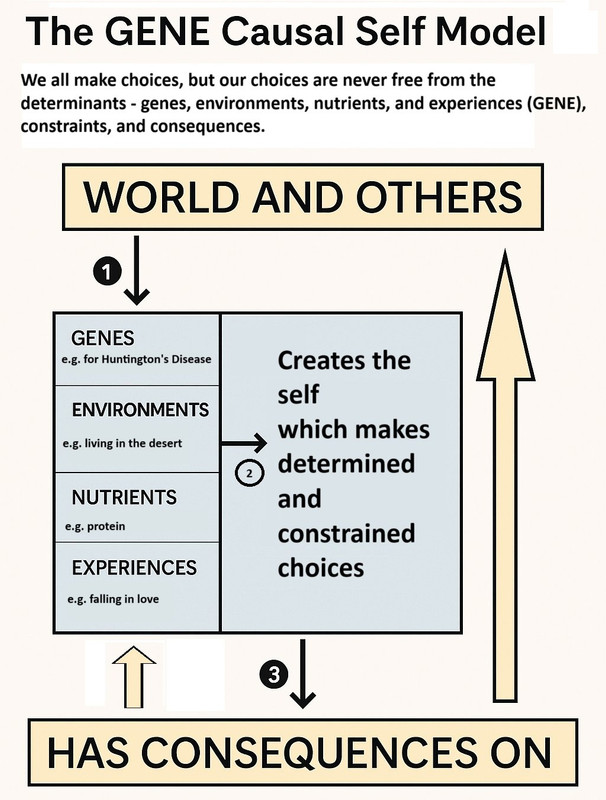
Creatine Transporter Deficiency (CTD) Inside the GENE Causal Self Model
Let’s examine how Creatine Transporter Deficiency (CTD) fits into the GENE framework step by step.
CTD is caused by mutation in the SLC6A8 gene, which encodes the creatine transporter. It is typically X-linked and results in impaired transport of creatine into brain cells.
Creatine is essential for ATP buffering in neurons. When transport fails, brain energy metabolism is compromised.
Now let’s map this directly into my GENE model.
1. GENES
In the GENE model:
GENES → create the self
In CTD:
Mutation → defective creatine transporter → reduced neuronal energy availability → altered neural development → constrained cognitive architecture.
The “self†that develops is already shaped by this constraint before any conscious choice occurs.
This is not philosophical speculation. It is biochemical causation.
2. NUTRIENTS
Creatine is related to nutrients.
However, in CTD:
Adequate dietary creatine ≠adequate brain creatine.
The problem is not nutrient availability.
The problem is nutrient transport.
So this demonstrates something important in the GENE model:
Nutrients only matter insofar as genes allow them to be processed and used.
This is a G × N interaction.
3. ENVIRONMENTS
Environmental factors still matter:
• Early intervention
• Speech therapy
• Special education
• Structured caregiving
These can improve functional outcomes.
But they operate within biological limits set by the mutation.
So we have:
Genes constrain → Environment modifies within bounds.
4. EXPERIENCES
Because of cognitive and communication limitations, individuals with CTD may experience:
• Frustration
• Social exclusion
• Reinforcement of maladaptive patterns
• Dependency on caregivers
These experiences further shape the developing self.
So the causal chain becomes:
Gene mutation → neurodevelopmental constraint → altered experiences → further shaping of behaviour and identity.
5. CHOICE UNDER CONSTRAINT
Executive functions commonly affected in CTD include:
• Working memory
• Language processing
• Impulse inhibition
• Planning
• Emotional regulation
So the available action space is smaller.
Not metaphorically smaller.
Computationally smaller.
Choice is downstream of neurobiology.
6. CONSEQUENCES AND FEEDBACK
The individual’s actions affect:
• Family dynamics
• Educational systems
• Healthcare resources
• Social responses
Those responses then feed back into:
Environment and Experience variables in GENE.
The model is recursive.
What CTD Demonstrates About the GENE model
CTD clearly shows:
1. A single gene mutation can alter the trajectory of the self.
2. Cognitive capacity depends on metabolic constraints.
3. Executive control is biologically instantiated.
4. “Freedom†is bounded by neurobiology.
5. Moral responsibility must be graded.
When constraints are obvious (as in CTD), everyone recognises reduced responsibility.
The GENE model simply extends that same principle to all cases in degree.
In CTD, we can trace:
Gene mutation
→ Impaired creatine transport
→ Reduced ATP buffering
→ Altered neural development
→ Reduced executive function
→ Constrained choice space
→ Altered consequences
→ Environmental feedback
The system is causally continuous.
There is no metaphysical gap where an uncaused “free self†appears.
CTD therefore serves as a concrete neurological case study supporting the GENE Causal Self Model.
But if:
• God creates the person,
• God creates their temperament,
• God creates their environment,
• God foreknows every outcome,
then ultimate moral responsibility cannot rest on the creature.
Foreknown certainty + deliberate creation = responsibility at the highest causal level. If God is real, all suffering, injustice and death are 100% God's fault.
The Core Issue Remains
The fundamental question persists:
If God is:
• Omniscient
• Omnipotent
• Omnibenevolent
Then why design a system containing:
• Natural disasters
• Predation
• Childhood cancer
• Psychological torment
• Eternal torment in hell
Appeals to:
• “It could mean something elseâ€
• “Maybe metaphorâ€
• “Maybe symbolicâ€
• “Maybe annihilation, not tormentâ€
do not resolve the structural problems caused by unlimited power and vast suffering.
They relocate the problem — they do not remove it.
The issue is not wordplay.
It is moral coherence.
That avoids the question rather than answering it.1213 wrote:I don’t think it happened because God needed it.
If God did not need to test Abraham, then the test served no epistemic function for God. So either:
• The test was for Abraham’s benefit,
• It was for observers,
• Or it was unnecessary.
But commanding a father to prepare to kill his son is morally extreme. Even if “symbolic,†it involves intentional psychological trauma.
If an omnipotent being can achieve growth without commanding simulated filicide, why choose that method?
Saying “God didn’t need it†intensifies the problem: then it was gratuitous.
2 Thessalonians 2:11 does not say merely that God permits delusion. It says:1213 wrote:I don’t think so, when it is said that it is people who rejected the truth, which is why it happens.
“God sends them a working of error so that they may believe the lie.â€
That is active causation language.
Even if people rejected truth first, actively causing them to believe falsehood compounds the epistemic harm.
Punishment for rejecting truth is one thing. Forcing deeper falsehood is another.
No.1213 wrote:That is the same as saying it was not ethical to end plague…
Ending a plague is ethical.
But if:
• God knows Pharaoh will harden his heart,
• God repeatedly escalates events,
• God declares beforehand he will harden Pharaoh’s heart,
then Pharaoh’s resistance becomes part of the narrative design.
The issue is not freeing slaves.
The issue is deliberately structuring events to magnify stubbornness for dramatic judgment.
Exodus 9:16 explicitly says:
“For this purpose I have raised you up…â€
That implies instrumentalization.
Let’s clarify.1213 wrote:It is amazing how anyone can see a contradiction in those.
Genesis 1 describes “heaven†being created in the beginning.
Matthew 25:34 speaks of a kingdom prepared from the foundation of the world.
John 14:2 says Jesus goes to prepare a place.
If “prepare†does not mean create, then fine — but that means the language is fluid and metaphorical.
Which means appeals to strict literalism elsewhere become selective.
You cannot insist on literal precision in one debate and fluid metaphor in another without consistency.
Here is the 2nd contradiction from the list: https://skepticsannotatedbible.com/firs ... _list.html
Who created heaven and earth?
God the Father did it all by himself.
In the beginning God created the heaven and the earth. Genesis 1:1
Thus saith the LORD, thy redeemer, and he that formed thee from the womb, I am the LORD that maketh all things; that stretcheth forth the heavens alone; that spreadeth abroad the earth by myself.Isaiah 44:24
Jesus did it.
There was a man sent from God, whose name was John. The same came for a witness, to bear witness of the Light, that all men through him might believe. He was not that Light, but was sent to bear witness of that Light. That was the true Light, which lighteth every man that cometh into the world. He was in the world, and the world was made by him, and the world knew him not. John 1:6-10
By him [Jesus] were all things created, that are in heaven, and that are in earth, visible and invisible, whether they be thrones, or dominions, or principalities, or powers: all things were created by him, and for him. Colossians 1:16
Both of them did it.
Yet for us there is one God, the Father, from whom all things are and for whom we exist, and one Lord, Jesus Christ, through whom all things are and through whom we exist. 1 Corinthians 8:6
Because moral truth is not determined by preference.1213 wrote:Some people like to do those, they think it is right. How would you say their preference is objectively wrong?
If a society prefers genocide, that does not make genocide right.
The capacity for disagreement does not negate objectivity.
If morality reduces to preference, then divine commands reduce to divine preference — which is exactly what critics call arbitrary.
You cannot defend objective divine justice while grounding morality in subjective preference.
Correct — and that criticism follows directly from Divine Command Theory.1213 wrote:Most atheists think God’s moral is arbitrary personal preference of God.
If something is good only because God commands it, then goodness depends on will, not principle.
If God commanded cruelty, would cruelty become good?
If the answer is no, then goodness exists independently of command.
If the answer is yes, then morality is arbitrary.
That is the Euthyphro dilemma.
That is speculation, not textual evidence.1213 wrote:Or it is just pointing out something that was obvious in ancient times but forgotten later.
Genesis presents “day†using ordinal sequence and evening/morning structure. That reads like normal temporal language.
Importing later theological elasticity to rescue earlier specificity is harmonization.
That is poetic language, not metaphysics.1213 wrote:The person is then not the same anymore and it can be said that the old evil person is dead.
Rehabilitation preserves identity while transforming character.
If moral growth equals death of identity, then every redeemed believer is “dead†and replaced — which undermines continuity of personhood.
Revelation 20:10 states:1213 wrote:Burning forever is possible, even if one is not alive.
“They will be tormented day and night forever and ever.â€
Torment requires a conscious subject.
“Day and night†implies ongoing experience.
If there is no conscious subject, torment language becomes metaphorical — which again weakens strict literalism elsewhere.
You are oscillating between literal and metaphorical readings depending on theological need. That is not consistent.
If it happens only momentarily, the text does not say so.1213 wrote:Weeping and gnashing of teeth does not mean someone is alive in hell eternally.
Repeated imagery of:
• Tormented day and night
• Smoke of torment rising forever
• Worm not dying
• Fire not quenched
collectively conveys ongoing conscious torture in most traditional readings.
If all of it is metaphor, then doctrinal certainty about hell weakens considerably. How do you know if it is literal or metaphorical? The Bible doesn't say it is metaphorical. It reads like a literal description.
If God created:1213 wrote:If I am wrong and people live eternally in hell, I believe it is themselves that causes all the suffering.
• Their psychology
• Their environment
• The cosmic structure
• The final judgment mechanism
then ultimate responsibility cannot be fully shifted onto the creature.
Self-inflicted suffering inside a system designed by an omniscient and omnipotent being still points back to the designer.
Trees exhibit chemical signaling and adaptive behavior.1213 wrote:By that standard I understand why some think trees are also sentient…
But they lack:
• Centralized nervous systems
• Brains
• Integrated neural pain networks
• Evidence of subjective states
Mammalian nociception is not merely stimulus detection — it integrates into affective experience via limbic processing.
There is overwhelming neuroscientific evidence that vertebrates experience pain in a morally relevant way.
Equating plant signaling with mammalian suffering collapses distinct biological architectures.
This assumes libertarian free will. Evidence does not support libertarian free will. Evidence shows that all biological organisms (including humans) make choices according to genes, environments, nutrients, and experiences. We are not free agents. Our choices are both determined and constrained by variables we did not choose.1213 wrote:Yes, and humans are responsible of their own choices.
Creatine Transporter Deficiency (CTD) Inside the GENE Causal Self Model
Let’s examine how Creatine Transporter Deficiency (CTD) fits into the GENE framework step by step.
CTD is caused by mutation in the SLC6A8 gene, which encodes the creatine transporter. It is typically X-linked and results in impaired transport of creatine into brain cells.
Creatine is essential for ATP buffering in neurons. When transport fails, brain energy metabolism is compromised.
Now let’s map this directly into my GENE model.
1. GENES
In the GENE model:
GENES → create the self
In CTD:
Mutation → defective creatine transporter → reduced neuronal energy availability → altered neural development → constrained cognitive architecture.
The “self†that develops is already shaped by this constraint before any conscious choice occurs.
This is not philosophical speculation. It is biochemical causation.
2. NUTRIENTS
Creatine is related to nutrients.
However, in CTD:
Adequate dietary creatine ≠adequate brain creatine.
The problem is not nutrient availability.
The problem is nutrient transport.
So this demonstrates something important in the GENE model:
Nutrients only matter insofar as genes allow them to be processed and used.
This is a G × N interaction.
3. ENVIRONMENTS
Environmental factors still matter:
• Early intervention
• Speech therapy
• Special education
• Structured caregiving
These can improve functional outcomes.
But they operate within biological limits set by the mutation.
So we have:
Genes constrain → Environment modifies within bounds.
4. EXPERIENCES
Because of cognitive and communication limitations, individuals with CTD may experience:
• Frustration
• Social exclusion
• Reinforcement of maladaptive patterns
• Dependency on caregivers
These experiences further shape the developing self.
So the causal chain becomes:
Gene mutation → neurodevelopmental constraint → altered experiences → further shaping of behaviour and identity.
5. CHOICE UNDER CONSTRAINT
Executive functions commonly affected in CTD include:
• Working memory
• Language processing
• Impulse inhibition
• Planning
• Emotional regulation
So the available action space is smaller.
Not metaphorically smaller.
Computationally smaller.
Choice is downstream of neurobiology.
6. CONSEQUENCES AND FEEDBACK
The individual’s actions affect:
• Family dynamics
• Educational systems
• Healthcare resources
• Social responses
Those responses then feed back into:
Environment and Experience variables in GENE.
The model is recursive.
What CTD Demonstrates About the GENE model
CTD clearly shows:
1. A single gene mutation can alter the trajectory of the self.
2. Cognitive capacity depends on metabolic constraints.
3. Executive control is biologically instantiated.
4. “Freedom†is bounded by neurobiology.
5. Moral responsibility must be graded.
When constraints are obvious (as in CTD), everyone recognises reduced responsibility.
The GENE model simply extends that same principle to all cases in degree.
In CTD, we can trace:
Gene mutation
→ Impaired creatine transport
→ Reduced ATP buffering
→ Altered neural development
→ Reduced executive function
→ Constrained choice space
→ Altered consequences
→ Environmental feedback
The system is causally continuous.
There is no metaphysical gap where an uncaused “free self†appears.
CTD therefore serves as a concrete neurological case study supporting the GENE Causal Self Model.
But if:
• God creates the person,
• God creates their temperament,
• God creates their environment,
• God foreknows every outcome,
then ultimate moral responsibility cannot rest on the creature.
Foreknown certainty + deliberate creation = responsibility at the highest causal level. If God is real, all suffering, injustice and death are 100% God's fault.
The Core Issue Remains
The fundamental question persists:
If God is:
• Omniscient
• Omnipotent
• Omnibenevolent
Then why design a system containing:
• Natural disasters
• Predation
• Childhood cancer
• Psychological torment
• Eternal torment in hell
Appeals to:
• “It could mean something elseâ€
• “Maybe metaphorâ€
• “Maybe symbolicâ€
• “Maybe annihilation, not tormentâ€
do not resolve the structural problems caused by unlimited power and vast suffering.
They relocate the problem — they do not remove it.
The issue is not wordplay.
It is moral coherence.
-
1213
- Savant
- Posts: 13597
- Joined: Thu Jul 14, 2011 11:06 am
- Location: Finland
- Has thanked: 519 times
- Been thanked: 518 times
Re: How the Bible fails
Post #14I think those both are correct.Compassionist wrote: ↑Fri Feb 13, 2026 12:10 pm ...• The test was for Abraham’s benefit,
• It was for observers,...
Then God did the right thing.Compassionist wrote: ↑Fri Feb 13, 2026 12:10 pm2 Thessalonians 2:11 does not say merely that God permits delusion. It says:
Jesus says he can do nothing of himself, so I believe it is ultimately God who created through Jesus.Compassionist wrote: ↑Fri Feb 13, 2026 12:10 pm Here is the 2nd contradiction from the list: https://skepticsannotatedbible.com/firs ... _list.html
Who created heaven and earth?
God the Father did it all by himself.
In the beginning God created the heaven and the earth. Genesis 1:1
Thus saith the LORD, thy redeemer, and he that formed thee from the womb, I am the LORD that maketh all things; that stretcheth forth the heavens alone; that spreadeth abroad the earth by myself.Isaiah 44:24
Jesus did it.
There was a man sent from God, whose name was John. The same came for a witness, to bear witness of the Light, that all men through him might believe. He was not that Light, but was sent to bear witness of that Light. That was the true Light, which lighteth every man that cometh into the world. He was in the world, and the world was made by him, and the world knew him not. John 1:6-10
By him [Jesus] were all things created, that are in heaven, and that are in earth, visible and invisible, whether they be thrones, or dominions, or principalities, or powers: all things were created by him, and for him. Colossians 1:16
Both of them did it.
Yet for us there is one God, the Father, from whom all things are and for whom we exist, and one Lord, Jesus Christ, through whom all things are and through whom we exist. 1 Corinthians 8:6
Jesus therefore answered them, "Most assuredly, I tell you, the Son can do nothing of himself, but what he sees the Father do-ing. For whatever things he does, these the Son also does like-wise.
John 5:19
…who is the image of the invisible God, the firstborn of all creation. ...all things have been created through him...
Col. 1:14-18
They think it is right, you think it is wrong, how to determine objectively who is right?Compassionist wrote: ↑Fri Feb 13, 2026 12:10 pmBecause moral truth is not determined by preference.
If a society prefers genocide, that does not make genocide right.
In God's opinion.Compassionist wrote: ↑Fri Feb 13, 2026 12:10 pm If God commanded cruelty, would cruelty become good?
I think that is why Jesus taught that we must be born anew, there must happen a change.Compassionist wrote: ↑Fri Feb 13, 2026 12:10 pm If moral growth equals death of identity, then every redeemed believer is “dead†and replaced — which undermines continuity of personhood.
Don’t marvel that I said to you, ‘You must be born anew.’
John 3:3-7
...Whoever is born of God doesn’t commit sin, because his seed remains in him, and he can’t sin, because he is born of God. In this the children of God are revealed, and the children of the devil. Whoever doesn’t do righteousness is not of God, neither is he who doesn’t love his brother.
1 John 3:7-10
Then put to death your members which are on the earth: fornication; uncleanness; passion; evil lust; and covetousness, which is idolatry;
Col. 3:5
No it doesn't. It can for example be said that a wood in fire is tormented by the fire and the wood is not alive.
If that would be true, humans would be just biological machines, without own mind.Compassionist wrote: ↑Fri Feb 13, 2026 12:10 pm Evidence shows that all biological organisms (including humans) make choices according to genes, environments, nutrients, and experiences. We are not free agents. Our choices are both determined and constrained by variables we did not choose.
...
The “self†that develops is already shaped by this constraint before any conscious choice occurs.
This is not philosophical speculation. It is biochemical causation.
I believe this world is a lesson for us, so that we can learn what good and evil means, as people in the beginning wanted. I don't think this is a problem, because nothing of this world can destroy our souls, which are the important thing. In Biblical point of view, body can be replaced and this is like virtual reality in Matrix, not real life.Compassionist wrote: ↑Fri Feb 13, 2026 12:10 pm...
If God is:
• Omniscient
• Omnipotent
• Omnibenevolent
Then why design a system containing:
• Natural disasters
• Predation
• Childhood cancer
• Psychological torment
• Eternal torment in hell...
My new book can be read freely from here:
https://drive.google.com/file/d/1rIkqxC ... xtqFY/view
Old version can be read from here:
http://web.archive.org/web/202212010403 ... x_eng.html
https://drive.google.com/file/d/1rIkqxC ... xtqFY/view
Old version can be read from here:
http://web.archive.org/web/202212010403 ... x_eng.html
-
Compassionist
- Guru
- Posts: 1524
- Joined: Tue Feb 19, 2008 5:56 pm
- Has thanked: 1070 times
- Been thanked: 252 times
Re: How the Bible fails
Post #15[Replying to 1213 in post #14]
Could an omnipotent being achieve those purposes without commanding a father to prepare to kill his son?
Growth, demonstration, and moral formation do not logically require simulated child sacrifice. If less traumatic means were available (and omnipotence implies they were), then choosing the extreme option remains morally questionable.
Appealing to “benefit†does not justify the method if the method was unnecessary.
But the question is not whether ending plagues is good.
The question is whether repeatedly structuring events in a way that ensures Pharaoh’s predictable resistance — after declaring in advance that his heart will be hardened — makes Pharaoh a moral agent or an instrument in a demonstration.
Exodus 9:16 says:
“For this purpose I have raised you up…â€
That language implies intentional narrative use, not neutral observation.
However:
Isaiah 44:24 says:
“I am the LORD… who stretches out the heavens alone.â€
If “alone†means without any other agent, then introducing Jesus as co-creator requires theological reconciliation beyond the plain reading.
You resolve this by appealing to unity of Father and Son. That is coherent within Trinitarianism — but it demonstrates that the text does not speak with simple, surface uniformity.
It requires doctrinal synthesis.
If genocide destroys conscious beings against their will, causes extreme suffering, and violates principles of mutual respect necessary for stable social existence, it is objectively harmful.
The mere fact that someone approves of harm does not neutralize the harm.
Preference does not determine moral truth any more than preference determines mathematical truth.
If cruelty becomes good simply because God commands it, then goodness reduces to divine will.
If tomorrow God commanded torture of children, would that become morally good?
If yes, morality is arbitrary.
If no, morality exists independently of command.
That is the Euthyphro dilemma — and it remains unresolved by appealing to “God’s opinion.â€
If rehabilitation equals death of the old self, then moral growth is indistinguishable from replacement.
But Christian theology affirms continuity of personhood — not metaphysical deletion.
Transformation ≠destruction.
Therefore rehabilitation does not support the claim that the “old person is dead†in any literal sense.
Wood does not experience torment. It undergoes combustion.
Biblical hell language includes:
• “No rest day or nightâ€
• “Weeping and gnashing of teethâ€
• “Tormented in the presence of the Lambâ€
These are experiential terms, not combustion mechanics.
If all of this is metaphor, then doctrinal certainty about hell diminishes significantly.
You cannot simultaneously defend vivid experiential language and deny experiential implication.
Determinism does not eliminate mind — it explains mind as emerging from physical processes.
The brain is a biological system generating consciousness through neural activity.
Saying choices are shaped by genes, environment, nutrients, and experiences does not deny experience. It explains its causal structure.
You are assuming that determined processes cannot generate awareness — but there is no logical contradiction in determined consciousness.
If this world is merely a “lesson simulation,†then:
• Childhood cancer is pedagogical.
• Animal predation over millions of years is instructional design.
• Psychological trauma is curriculum.
Even in a simulation, suffering is experienced as real by the participant.
If an omnipotent being could design moral education without extreme suffering but chose not to, the problem remains.
Additionally, if bodies are replaceable and only souls matter, why design embodiment at all? Why require death, disease, and catastrophe as teaching tools?
Appealing to “it’s just a lesson†does not remove moral responsibility from the designer of the lesson.
Here is the 3rd contradiction from https://skepticsannotatedbible.com/firs ... _list.html
If God is:
• Omniscient
• Omnipotent
• Omnibenevolent
Then any system containing preventable extreme suffering requires explanation.
Appeals to:
• “It’s a lessonâ€
• “It’s virtualâ€
• “Souls are what matterâ€
• “God’s opinion defines goodâ€
do not eliminate the structural tension.
They relocate it.
The question remains:
Could an all-powerful, all-knowing, perfectly good being have achieved the same ultimate good without designing a world saturated with suffering?
If yes — then why this design?
If no — then omnipotence is limited.
That is the moral coherence problem.
If the test was for Abraham’s benefit and for observers, then we must ask:1213 wrote:I think those both are correct.
Could an omnipotent being achieve those purposes without commanding a father to prepare to kill his son?
Growth, demonstration, and moral formation do not logically require simulated child sacrifice. If less traumatic means were available (and omnipotence implies they were), then choosing the extreme option remains morally questionable.
Appealing to “benefit†does not justify the method if the method was unnecessary.
Ending the plague was right.1213 wrote:Then God did the right thing.
But the question is not whether ending plagues is good.
The question is whether repeatedly structuring events in a way that ensures Pharaoh’s predictable resistance — after declaring in advance that his heart will be hardened — makes Pharaoh a moral agent or an instrument in a demonstration.
Exodus 9:16 says:
“For this purpose I have raised you up…â€
That language implies intentional narrative use, not neutral observation.
That interpretation presupposes Trinitarian theology.1213 wrote:Jesus says he can do nothing of himself, so I believe it is ultimately God who created through Jesus.
However:
Isaiah 44:24 says:
“I am the LORD… who stretches out the heavens alone.â€
If “alone†means without any other agent, then introducing Jesus as co-creator requires theological reconciliation beyond the plain reading.
You resolve this by appealing to unity of Father and Son. That is coherent within Trinitarianism — but it demonstrates that the text does not speak with simple, surface uniformity.
It requires doctrinal synthesis.
Through moral reasoning grounded in harm, well-being, reciprocity, and consistency.1213 wrote:They think it is right, you think it is wrong, how to determine objectively who is right?
If genocide destroys conscious beings against their will, causes extreme suffering, and violates principles of mutual respect necessary for stable social existence, it is objectively harmful.
The mere fact that someone approves of harm does not neutralize the harm.
Preference does not determine moral truth any more than preference determines mathematical truth.
That answer confirms arbitrariness.1213 wrote:If God commanded cruelty, would cruelty become good?
In God's opinion.
If cruelty becomes good simply because God commands it, then goodness reduces to divine will.
If tomorrow God commanded torture of children, would that become morally good?
If yes, morality is arbitrary.
If no, morality exists independently of command.
That is the Euthyphro dilemma — and it remains unresolved by appealing to “God’s opinion.â€
Metaphorical rebirth does not imply annihilation of identity.1213 wrote:I think that is why Jesus taught that we must be born anew…
If rehabilitation equals death of the old self, then moral growth is indistinguishable from replacement.
But Christian theology affirms continuity of personhood — not metaphysical deletion.
Transformation ≠destruction.
Therefore rehabilitation does not support the claim that the “old person is dead†in any literal sense.
That is metaphorical language.1213 wrote:No it doesn't. It can for example be said that a wood in fire is tormented by the fire and the wood is not alive.
Wood does not experience torment. It undergoes combustion.
Biblical hell language includes:
• “No rest day or nightâ€
• “Weeping and gnashing of teethâ€
• “Tormented in the presence of the Lambâ€
These are experiential terms, not combustion mechanics.
If all of this is metaphor, then doctrinal certainty about hell diminishes significantly.
You cannot simultaneously defend vivid experiential language and deny experiential implication.
Not necessarily.1213 wrote:If that would be true, humans would be just biological machines, without own mind.
Determinism does not eliminate mind — it explains mind as emerging from physical processes.
The brain is a biological system generating consciousness through neural activity.
Saying choices are shaped by genes, environment, nutrients, and experiences does not deny experience. It explains its causal structure.
You are assuming that determined processes cannot generate awareness — but there is no logical contradiction in determined consciousness.
This raises serious ethical concerns.1213 wrote:I believe this world is a lesson for us… like virtual reality in Matrix, not real life.
If this world is merely a “lesson simulation,†then:
• Childhood cancer is pedagogical.
• Animal predation over millions of years is instructional design.
• Psychological trauma is curriculum.
Even in a simulation, suffering is experienced as real by the participant.
If an omnipotent being could design moral education without extreme suffering but chose not to, the problem remains.
Additionally, if bodies are replaceable and only souls matter, why design embodiment at all? Why require death, disease, and catastrophe as teaching tools?
Appealing to “it’s just a lesson†does not remove moral responsibility from the designer of the lesson.
Here is the 3rd contradiction from https://skepticsannotatedbible.com/firs ... _list.html
The Core Issue Still StandsWhen were the stars made?
On the fourth day of creation, after the earth was made.
In the beginning God created the heaven and the earth. Genesis 1:1
He made the stars also. And God set them in the firmament of the heaven.... And the evening and the morning were the fourth day. Genesis 1:16-19
Before the earth was made.
Where wast thou when I laid the foundations of the earth? ... When the morning stars sang together. Job 38:4-7
If God is:
• Omniscient
• Omnipotent
• Omnibenevolent
Then any system containing preventable extreme suffering requires explanation.
Appeals to:
• “It’s a lessonâ€
• “It’s virtualâ€
• “Souls are what matterâ€
• “God’s opinion defines goodâ€
do not eliminate the structural tension.
They relocate it.
The question remains:
Could an all-powerful, all-knowing, perfectly good being have achieved the same ultimate good without designing a world saturated with suffering?
If yes — then why this design?
If no — then omnipotence is limited.
That is the moral coherence problem.
-
1213
- Savant
- Posts: 13597
- Joined: Thu Jul 14, 2011 11:06 am
- Location: Finland
- Has thanked: 519 times
- Been thanked: 518 times
Re: How the Bible fails
Post #16Pharaoh could have released his slaves, but decided not. I think it shows he was evil.Compassionist wrote: ↑Sun Feb 15, 2026 8:40 am ...The question is whether repeatedly structuring events in a way that ensures Pharaoh’s predictable resistance — after declaring in advance that his heart will be hardened — makes Pharaoh a moral agent or an instrument in a demonstration...
If I build a boat with a hammer, was the hammer a co-builder?Compassionist wrote: ↑Sun Feb 15, 2026 8:40 am...
Isaiah 44:24 says:
“I am the LORD… who stretches out the heavens alone.â€
If “alone†means without any other agent, then introducing Jesus as co-creator requires theological reconciliation beyond the plain reading.
But not wrong, in the other peoples opinion.Compassionist wrote: ↑Sun Feb 15, 2026 8:40 amIf genocide destroys conscious beings against their will, causes extreme suffering, and violates principles of mutual respect necessary for stable social existence, it is objectively harmful.
Dead have nothing, not even rest. Weeping and gnashing of teeth is possible, when people are losing their life. And as said before, torment does not necessary mean the bodies are alive. And because Bible promises eternal life only for righteous, it is not logical to think people in hell live forever.Compassionist wrote: ↑Sun Feb 15, 2026 8:40 am • “No rest day or nightâ€
• “Weeping and gnashing of teethâ€
• “Tormented in the presence of the Lambâ€
Yes it does.
Perhaps "morning stars" is not the same as stars. Do you have some reason to think they are the same? For example Venus is called a morning star, although as a planet it is not actually a star in modern sense. Morning star could also refer to angel(s).Compassionist wrote: ↑Sun Feb 15, 2026 8:40 am Here is the 3rd contradiction from https://skepticsannotatedbible.com/firs ... _list.html
When were the stars made?
On the fourth day of creation, after the earth was made.
In the beginning God created the heaven and the earth. Genesis 1:1
He made the stars also. And God set them in the firmament of the heaven.... And the evening and the morning were the fourth day. Genesis 1:16-19
Before the earth was made.
Where wast thou when I laid the foundations of the earth? ... When the morning stars sang together. Job 38:4-7
Because people wanted to learn it by this hard way.Compassionist wrote: ↑Sun Feb 15, 2026 8:40 amCould an all-powerful, all-knowing, perfectly good being have achieved the same ultimate good without designing a world saturated with suffering?
If yes — then why this design?
My new book can be read freely from here:
https://drive.google.com/file/d/1rIkqxC ... xtqFY/view
Old version can be read from here:
http://web.archive.org/web/202212010403 ... x_eng.html
https://drive.google.com/file/d/1rIkqxC ... xtqFY/view
Old version can be read from here:
http://web.archive.org/web/202212010403 ... x_eng.html
-
Compassionist
- Guru
- Posts: 1524
- Joined: Tue Feb 19, 2008 5:56 pm
- Has thanked: 1070 times
- Been thanked: 252 times
Re: How the Bible fails
Post #17[Replying to 1213 in post #16]
Exodus repeatedly states:
• Pharaoh hardened his heart.
• God hardened Pharaoh’s heart.
• God declared beforehand He would harden Pharaoh’s heart.
Exodus 9:16:
“For this purpose I have raised you up, to show you my power…â€
If God:
• Foreknew Pharaoh’s reactions,
• Structured escalating plagues,
• Announced in advance the hardening,
then Pharaoh’s resistance becomes part of a declared demonstration.
A moral agent can still be culpable — but when a sovereign designer intentionally arranges events knowing the exact psychological outcome, the line between agent and instrument becomes blurred.
That is the problem.
However, Colossians 1:16 says:
“All things were created by him and for him.â€
John 1:3:
“All things were made through him.â€
The Son is portrayed as a personal agent, not an inanimate instrument.
Isaiah 44:24 says:
“I alone stretched out the heavens.â€
If “alone†excludes other personal agents, then introducing a distinct person as co-creator requires theological reconciliation (i.e., Trinitarian metaphysics).
You may accept that reconciliation — but it is not as simple as hammer and carpenter.
If a society believed torture of children was good, their approval would not erase the suffering inflicted or make it moral.
Harm exists independent of endorsement.
If morality reduces to preference, then divine commands reduce to preference — which makes divine justice indistinguishable from power.
Objective moral claims cannot rest on subjective approval.
“They have no rest day or night.â€
“No rest†presupposes a subject capable of rest.
Revelation 20:10:
“They will be tormented day and night forever and ever.â€
“Day and night†describes ongoing temporal experience. Torment requires a conscious being capable of being tormented.
If all of this is metaphor for annihilation, then the language of conscious suffering becomes symbolic.
But then:
• Why use experiential language repeatedly?
• Why contrast eternal punishment with eternal life in parallel form (Matthew 25:46)?
You cannot claim strict literal clarity in other passages while dissolving experiential language here.
Consistency matters.
Determinism states that mental states arise from prior causes. It does not deny the existence of mental states.
Your thoughts right now arise from:
• Neural activity
• Past experiences
• Genetic predispositions
• Environmental inputs
That does not make them unreal.
A determined process can and does generate consciousness.
To say “caused†equals “nonexistent†is a category mistake.
Weather is determined by physics — but storms are real.
Thought is determined by neurobiology — but awareness is real.
Causation does not eliminate existence.
“When the morning stars sang together…â€
In Hebrew poetry, “morning stars†parallels “sons of God,†suggesting angelic beings.
That is a plausible interpretation.
However, Genesis 1:16 explicitly says:
“He made the stars also… on the fourth day.â€
If Job uses poetic metaphor for angels, that supports the idea that these texts are not rigid chronological science narratives.
Which strengthens the case that Genesis is theological poetry, not literal astrophysics.
That concession undercuts arguments insisting on strict literal chronology elsewhere.
But consider:
• Did infants with cancer who die from it choose the lesson? What lesson did a dead infant learn?
• Did animals in prehuman eras choose predation? What lesson did they learn?
• Did all the extinct species request suffering and extinction? What lesson did they learn?
If souls pre-existed and chose this curriculum, where is that stated in the Bible? What evidence do you have to prove your claim?
If they did not pre-choose it, then the designer selected the curriculum.
If an omnipotent being could teach moral knowledge without earthquakes, parasites, and childhood leukemia but chose not to, the question remains.
If he could not, he is not omniscient and omnipotent.
If he could but chose not to, he is not omnibenevolent.
The Core Tension Remains
You consistently resolve difficulties by saying:
• It could mean something else.
• It’s metaphor.
• It’s poetic.
• It’s a lesson.
• People wanted it.
But none of those addresses the central structural issue:
If an all-knowing, all-powerful, all-loving being designed this system, then the suffering within it ultimately traces back to that design.
The question is not whether humans commit evil.
The question is:
Why create a framework in which extreme suffering is built into the structure of reality?
That remains unanswered.
And that is the moral coherence problem.
Here is the 4th contradiction from https://skepticsannotatedbible.com/firs ... _list.html
The issue is not whether Pharaoh acted wickedly. The issue is whether his role was purely self-determined or narratively engineered.1213 wrote:Pharaoh could have released his slaves, but decided not. I think it shows he was evil.
Exodus repeatedly states:
• Pharaoh hardened his heart.
• God hardened Pharaoh’s heart.
• God declared beforehand He would harden Pharaoh’s heart.
Exodus 9:16:
“For this purpose I have raised you up, to show you my power…â€
If God:
• Foreknew Pharaoh’s reactions,
• Structured escalating plagues,
• Announced in advance the hardening,
then Pharaoh’s resistance becomes part of a declared demonstration.
A moral agent can still be culpable — but when a sovereign designer intentionally arranges events knowing the exact psychological outcome, the line between agent and instrument becomes blurred.
That is the problem.
That analogy reduces Jesus to an impersonal tool.1213 wrote:If I build a boat with a hammer, was the hammer a co-builder?
However, Colossians 1:16 says:
“All things were created by him and for him.â€
John 1:3:
“All things were made through him.â€
The Son is portrayed as a personal agent, not an inanimate instrument.
Isaiah 44:24 says:
“I alone stretched out the heavens.â€
If “alone†excludes other personal agents, then introducing a distinct person as co-creator requires theological reconciliation (i.e., Trinitarian metaphysics).
You may accept that reconciliation — but it is not as simple as hammer and carpenter.
Opinion does not determine moral truth.1213 wrote:But not wrong, in the other peoples opinion.
If a society believed torture of children was good, their approval would not erase the suffering inflicted or make it moral.
Harm exists independent of endorsement.
If morality reduces to preference, then divine commands reduce to preference — which makes divine justice indistinguishable from power.
Objective moral claims cannot rest on subjective approval.
Revelation 14:11:1213 wrote:Dead have nothing, not even rest… torment does not necessarily mean alive.
“They have no rest day or night.â€
“No rest†presupposes a subject capable of rest.
Revelation 20:10:
“They will be tormented day and night forever and ever.â€
“Day and night†describes ongoing temporal experience. Torment requires a conscious being capable of being tormented.
If all of this is metaphor for annihilation, then the language of conscious suffering becomes symbolic.
But then:
• Why use experiential language repeatedly?
• Why contrast eternal punishment with eternal life in parallel form (Matthew 25:46)?
You cannot claim strict literal clarity in other passages while dissolving experiential language here.
Consistency matters.
No, it does not.1213 wrote:Determinism eliminates mind. Yes it does.
Determinism states that mental states arise from prior causes. It does not deny the existence of mental states.
Your thoughts right now arise from:
• Neural activity
• Past experiences
• Genetic predispositions
• Environmental inputs
That does not make them unreal.
A determined process can and does generate consciousness.
To say “caused†equals “nonexistent†is a category mistake.
Weather is determined by physics — but storms are real.
Thought is determined by neurobiology — but awareness is real.
Causation does not eliminate existence.
In Job 38:7:1213 wrote:Perhaps "morning stars" is not the same as stars.
“When the morning stars sang together…â€
In Hebrew poetry, “morning stars†parallels “sons of God,†suggesting angelic beings.
That is a plausible interpretation.
However, Genesis 1:16 explicitly says:
“He made the stars also… on the fourth day.â€
If Job uses poetic metaphor for angels, that supports the idea that these texts are not rigid chronological science narratives.
Which strengthens the case that Genesis is theological poetry, not literal astrophysics.
That concession undercuts arguments insisting on strict literal chronology elsewhere.
This shifts responsibility from designer to participant.1213 wrote:Because people wanted to learn it by this hard way.
But consider:
• Did infants with cancer who die from it choose the lesson? What lesson did a dead infant learn?
• Did animals in prehuman eras choose predation? What lesson did they learn?
• Did all the extinct species request suffering and extinction? What lesson did they learn?
If souls pre-existed and chose this curriculum, where is that stated in the Bible? What evidence do you have to prove your claim?
If they did not pre-choose it, then the designer selected the curriculum.
If an omnipotent being could teach moral knowledge without earthquakes, parasites, and childhood leukemia but chose not to, the question remains.
If he could not, he is not omniscient and omnipotent.
If he could but chose not to, he is not omnibenevolent.
The Core Tension Remains
You consistently resolve difficulties by saying:
• It could mean something else.
• It’s metaphor.
• It’s poetic.
• It’s a lesson.
• People wanted it.
But none of those addresses the central structural issue:
If an all-knowing, all-powerful, all-loving being designed this system, then the suffering within it ultimately traces back to that design.
The question is not whether humans commit evil.
The question is:
Why create a framework in which extreme suffering is built into the structure of reality?
That remains unanswered.
And that is the moral coherence problem.
Here is the 4th contradiction from https://skepticsannotatedbible.com/firs ... _list.html
When did God divide light from darkness?
On the first day of creation.
God divided the light from the darkness. And God called the light Day, and the darkness he called Night. And the evening and the morning were the first day. - Genesis 1:4-5
On the fourth day.
And God made two great lights; the greater light to rule the day, and the lesser light to rule the night ... to divide the light from the darkness: and God saw that it was good. And the evening and the morning were the fourth day. - Genesis 1:16-19
-
1213
- Savant
- Posts: 13597
- Joined: Thu Jul 14, 2011 11:06 am
- Location: Finland
- Has thanked: 519 times
- Been thanked: 518 times
Re: How the Bible fails
Post #18I don't think it is a problem, when it comes from the demand to release the slaves.Compassionist wrote: ↑Mon Feb 16, 2026 7:51 am .... but when a sovereign designer intentionally arranges events knowing the exact psychological outcome, the line between agent and instrument becomes blurred.
That is the problem.
Jesus tells:Compassionist wrote: ↑Mon Feb 16, 2026 7:51 amIf “alone†excludes other personal agents, then introducing a distinct person as co-creator requires theological reconciliation
I can of myself do nothing....
John 5:30
That is why i think it is God alone, even if Jesus was there.
What does, your feelings?
I don't think Bible has the language of conscious suffering, especially when you read it wholly.Compassionist wrote: ↑Mon Feb 16, 2026 7:51 am then the language of conscious suffering becomes symbolic.
I don't think i have said it would.
What evil means.Compassionist wrote: ↑Mon Feb 16, 2026 7:51 am• Did infants with cancer who die from it choose the lesson? What lesson did a dead infant learn?
I don't think animals are conscious beings that learn things the same way as humans.Compassionist wrote: ↑Mon Feb 16, 2026 7:51 am• Did animals in prehuman eras choose predation? What lesson did they learn?
• Did all the extinct species request suffering and extinction? What lesson did they learn?
It was Adam and Eve who chose (Gen. 3).Compassionist wrote: ↑Mon Feb 16, 2026 7:51 amIf souls pre-existed and chose this curriculum, where is that stated in the Bible? What evidence do you have to prove your claim?
If they did not pre-choose it, then the designer selected the curriculum.
Evil has been made possible in this world for people to know what it means.Compassionist wrote: ↑Mon Feb 16, 2026 7:51 am Why create a framework in which extreme suffering is built into the structure of reality?
It is interesting that my translation says "to divide between the day and the night" in Genesis 1:14. Not "divided the light from the darkness". But, God divided the light from the darkness on the first day. On the forth day he made the sun to divide it to earth. Sun and moon are to earth to divide times. The light and darkness before that was obviously something else than sun light, and divides darkness in some other level.Compassionist wrote: ↑Mon Feb 16, 2026 7:51 amHere is the 4th contradiction from https://skepticsannotatedbible.com/firs ... _list.html
When did God divide light from darkness?
On the first day of creation.
God divided the light from the darkness. And God called the light Day, and the darkness he called Night. And the evening and the morning were the first day. - Genesis 1:4-5
On the fourth day.
And God made two great lights; the greater light to rule the day, and the lesser light to rule the night ... to divide the light from the darkness: and God saw that it was good. And the evening and the morning were the fourth day. - Genesis 1:16-19
My new book can be read freely from here:
https://drive.google.com/file/d/1rIkqxC ... xtqFY/view
Old version can be read from here:
http://web.archive.org/web/202212010403 ... x_eng.html
https://drive.google.com/file/d/1rIkqxC ... xtqFY/view
Old version can be read from here:
http://web.archive.org/web/202212010403 ... x_eng.html
-
Compassionist
- Guru
- Posts: 1524
- Joined: Tue Feb 19, 2008 5:56 pm
- Has thanked: 1070 times
- Been thanked: 252 times
Re: How the Bible fails
Post #19[Replying to 1213 in post #18]
The issue is this:
If God:
• Declares beforehand that He will harden Pharaoh’s heart,
• Repeatedly escalates events knowing the outcome,
• States He raised Pharaoh up for this very purpose (Ex. 9:16),
then Pharaoh’s resistance is not merely spontaneous evil — it is part of a declared demonstration.
Even if Pharaoh is wicked, intentionally structuring events to amplify his wickedness for display purposes raises the question of instrumentalization.
A just end does not automatically justify every chosen means.
Colossians 1:16 says:
“All things were created through him and for him.â€
That is active participatory language.
If Jesus is a personal agent through whom all things were made, calling Him merely an instrument like a hammer reduces personhood to toolhood.
If the Father creates “alone†yet creates “through†the Son, that requires theological synthesis (i.e., Trinitarian metaphysics).
It is not a surface-level reading; it is doctrinal reconciliation.
Moral reasoning grounded in:
• Harm and well-being
• Reciprocity
• Consistency
• Avoidance of unnecessary suffering
• Universalizability
If an action causes intense suffering to conscious beings without necessity, that harm is real regardless of approval.
Pain is not erased by opinion.
If morality reduces to “whoever has authority decides,†then moral truth collapses into power.
“They will be tormented day and night forever and ever.â€
Revelation 14:11:
“They have no rest day or night.â€
Matthew 25:46:
“These will go away into eternal punishment…â€
These are experiential phrases about conscious suffering.
Consistency matters in interpretation.
Compassionist wrote: 15 Feb 2026, 13:40
If mental states are caused by prior physical states, that does not make them unreal — it makes them structured.
Determinism and consciousness are not mutually exclusive.
If the lesson is for observers, then the infant becomes an instrument in someone else’s education.
That returns us to the instrumentalization problem.
If an omnipotent being could teach moral truth without causing infant death, choosing infant death as pedagogy raises ethical concerns.
Mammals exhibit:
• Nociceptive neural systems
• Stress hormone responses
• Trauma behaviors
• Pain-avoidance learning
Even if animals do not philosophically reflect, suffering is still real.
If predation over millions of years is built into creation for human moral lessons, then vast non-human suffering becomes collateral pedagogy.
That magnifies the moral question rather than resolving it.
• Genetic diseases
• Plate tectonics
• Parasitic ecosystems
• Mass extinctions
• Pediatric leukemia
If all natural evil is attributed to a single human act, then billions of sentient creatures suffer consequences for a choice they did not make.
That raises proportionality concerns.
To know that fire burns, one does not need global forest infernos.
To know that harm exists, one does not need childhood bone cancer.
An omnipotent being could permit moral freedom without embedding extreme natural suffering into the structure of reality.
The scale and distribution matter.
“God divided the light from the darkness.â€
Genesis 1:16–18:
“He made the two great lights… to divide the light from the darkness.â€
You resolve this by distinguishing:
• Cosmic light/darkness (Day 1)
• Solar regulation (Day 4)
That is a possible harmonization.
However, this again shows that interpretation requires layered theological explanation rather than straightforward reading.
If Genesis is poetic cosmology rather than literal astrophysical sequencing, that weakens appeals to strict literalism elsewhere.
The Core Question Remains
You consistently explain suffering as:
• A lesson
• A result of human choice
• A necessary exposure to evil
But the deeper question persists:
If an omnipotent, omniscient, omnibenevolent being designed reality, why is extreme suffering structurally embedded in it?
Could moral knowledge be achieved with less suffering?
If yes — why not design it that way?
If no — then omnipotence is limited.
That is the coherence challenge.
Not whether humans commit evil.
But why the architecture of reality contains so much unavoidable suffering in the first place.
Here is the 5th contradiction from https://skepticsannotatedbible.com/firs ... _list.html
The moral goodness of freeing slaves is not in dispute.1213 wrote:I don't think it is a problem, when it comes from the demand to release the slaves.
The issue is this:
If God:
• Declares beforehand that He will harden Pharaoh’s heart,
• Repeatedly escalates events knowing the outcome,
• States He raised Pharaoh up for this very purpose (Ex. 9:16),
then Pharaoh’s resistance is not merely spontaneous evil — it is part of a declared demonstration.
Even if Pharaoh is wicked, intentionally structuring events to amplify his wickedness for display purposes raises the question of instrumentalization.
A just end does not automatically justify every chosen means.
John 5:30 speaks about dependence of will, not absence of agency.1213 wrote:Jesus tells: “I can of myself do nothing.†That is why I think it is God alone.
Colossians 1:16 says:
“All things were created through him and for him.â€
That is active participatory language.
If Jesus is a personal agent through whom all things were made, calling Him merely an instrument like a hammer reduces personhood to toolhood.
If the Father creates “alone†yet creates “through†the Son, that requires theological synthesis (i.e., Trinitarian metaphysics).
It is not a surface-level reading; it is doctrinal reconciliation.
Not feelings.1213 wrote:What does determine moral truth, your feelings?
Moral reasoning grounded in:
• Harm and well-being
• Reciprocity
• Consistency
• Avoidance of unnecessary suffering
• Universalizability
If an action causes intense suffering to conscious beings without necessity, that harm is real regardless of approval.
Pain is not erased by opinion.
If morality reduces to “whoever has authority decides,†then moral truth collapses into power.
Revelation 20:10:1213 wrote:I don't think Bible has the language of conscious suffering, especially when you read it wholly.
“They will be tormented day and night forever and ever.â€
Revelation 14:11:
“They have no rest day or night.â€
Matthew 25:46:
“These will go away into eternal punishment…â€
These are experiential phrases about conscious suffering.
Consistency matters in interpretation.
I am quoting from the post number 16 in this thread:1213 wrote:I don't think I have said causation eliminates existence.
Compassionist wrote: 15 Feb 2026, 13:40
You replied:Determinism does not eliminate mind
Determinism does not eliminate the mind.Yes it does.
If mental states are caused by prior physical states, that does not make them unreal — it makes them structured.
Determinism and consciousness are not mutually exclusive.
An infant who dies from cancer does not cognitively learn moral distinctions.1213 wrote:What lesson did a dead infant learn? – What evil means.
If the lesson is for observers, then the infant becomes an instrument in someone else’s education.
That returns us to the instrumentalization problem.
If an omnipotent being could teach moral truth without causing infant death, choosing infant death as pedagogy raises ethical concerns.
They do not learn like humans — but they do suffer.1213 wrote:I don't think animals are conscious beings that learn things the same way as humans.
Mammals exhibit:
• Nociceptive neural systems
• Stress hormone responses
• Trauma behaviors
• Pain-avoidance learning
Even if animals do not philosophically reflect, suffering is still real.
If predation over millions of years is built into creation for human moral lessons, then vast non-human suffering becomes collateral pedagogy.
That magnifies the moral question rather than resolving it.
Adam and Eve did not choose:1213 wrote:It was Adam and Eve who chose (Gen. 3).
• Genetic diseases
• Plate tectonics
• Parasitic ecosystems
• Mass extinctions
• Pediatric leukemia
If all natural evil is attributed to a single human act, then billions of sentient creatures suffer consequences for a choice they did not make.
That raises proportionality concerns.
Possibility of evil does not require magnitude of suffering.1213 wrote:Evil has been made possible in this world for people to know what it means.
To know that fire burns, one does not need global forest infernos.
To know that harm exists, one does not need childhood bone cancer.
An omnipotent being could permit moral freedom without embedding extreme natural suffering into the structure of reality.
The scale and distribution matter.
Genesis 1:4–5:1213 wrote:God divided light from darkness on the first day… On the fourth day he made the sun to divide it to earth.
“God divided the light from the darkness.â€
Genesis 1:16–18:
“He made the two great lights… to divide the light from the darkness.â€
You resolve this by distinguishing:
• Cosmic light/darkness (Day 1)
• Solar regulation (Day 4)
That is a possible harmonization.
However, this again shows that interpretation requires layered theological explanation rather than straightforward reading.
If Genesis is poetic cosmology rather than literal astrophysical sequencing, that weakens appeals to strict literalism elsewhere.
The Core Question Remains
You consistently explain suffering as:
• A lesson
• A result of human choice
• A necessary exposure to evil
But the deeper question persists:
If an omnipotent, omniscient, omnibenevolent being designed reality, why is extreme suffering structurally embedded in it?
Could moral knowledge be achieved with less suffering?
If yes — why not design it that way?
If no — then omnipotence is limited.
That is the coherence challenge.
Not whether humans commit evil.
But why the architecture of reality contains so much unavoidable suffering in the first place.
Here is the 5th contradiction from https://skepticsannotatedbible.com/firs ... _list.html
From what were the fowls created?
From the waters.
And God said, Let the waters bring forth abundantly the moving creature that hath life, and fowl that may fly above the earth in the open firmament of heaven. And God created great whales, and every living creature that moveth, which the waters brought forth abundantly, after their kind, and every winged fowl after his kind: and God saw that it was good. Genesis 1:20-21
From the ground.
And out of the ground the LORD God formed every beast of the field, and every fowl of the air; and brought them unto Adam to see what he would call them: and whatsoever Adam called every living creature, that was the name thereof. Genesis 2:19
-
1213
- Savant
- Posts: 13597
- Joined: Thu Jul 14, 2011 11:06 am
- Location: Finland
- Has thanked: 519 times
- Been thanked: 518 times
Re: How the Bible fails
Post #20All evil things people do, can be explained by telling it is good for well-being and avoidance of unnecessary suffering... That is why I think those are not on itself a good foundation for good moral.Compassionist wrote: ↑Tue Feb 17, 2026 9:06 am ...Moral reasoning grounded in:
• Harm and well-being
• Reciprocity
• Consistency
• Avoidance of unnecessary suffering
• Universalizability...
In your interpretation.Compassionist wrote: ↑Tue Feb 17, 2026 9:06 am...These are experiential phrases about conscious suffering.
How do you know?Compassionist wrote: ↑Tue Feb 17, 2026 9:06 amAn infant who dies from cancer does not cognitively learn moral distinctions.
The chose to know evil the hard way. That is why they were expelled to this world, where all kind of evil is possible.Compassionist wrote: ↑Tue Feb 17, 2026 9:06 amAdam and Eve did not choose:
• Genetic diseases
• Plate tectonics
• Parasitic ecosystems
• Mass extinctions
• Pediatric leukemia
I think it only required reading the scriptures accurately, without making connection that doesn't really exist in the book.Compassionist wrote: ↑Tue Feb 17, 2026 9:06 amHowever, this again shows that interpretation requires layered theological explanation rather than straightforward reading.
In Genesis 1 God created things. In genesis 2 God formed. So, if we are literal, the fowls were created from water.Compassionist wrote: ↑Tue Feb 17, 2026 9:06 amHere is the 5th contradiction from https://skepticsannotatedbible.com/firs ... _list.html
From what were the fowls created?
From the waters.
And God said, Let the waters bring forth abundantly the moving creature that hath life, and fowl that may fly above the earth in the open firmament of heaven. And God created great whales, and every living creature that moveth, which the waters brought forth abundantly, after their kind, and every winged fowl after his kind: and God saw that it was good. Genesis 1:20-21
From the ground.
And out of the ground the LORD God formed every beast of the field, and every fowl of the air; and brought them unto Adam to see what he would call them: and whatsoever Adam called every living creature, that was the name thereof. Genesis 2:19
After creation God formed many things. That does not mean they were not created before. Also, forming the animals doesn't necessary even mean he formed living creatures. It is possible God made models of all those animals that had already been created so that Adam could see them and name them.
It is interesting that the contradictions atheists offer are always extremely poor.
My new book can be read freely from here:
https://drive.google.com/file/d/1rIkqxC ... xtqFY/view
Old version can be read from here:
http://web.archive.org/web/202212010403 ... x_eng.html
https://drive.google.com/file/d/1rIkqxC ... xtqFY/view
Old version can be read from here:
http://web.archive.org/web/202212010403 ... x_eng.html

