Does Genesis 1 describe the Universe?

Argue for and against Christianity

Moderator: Moderators

Post Reply
User avatar
Tcg
Savant
Posts: 8728
Joined: Tue Nov 21, 2017 5:01 am
Location: Third Stone
Has thanked: 2279 times
Been thanked: 2408 times

Does Genesis 1 describe the Universe?

Post #1

Post by Tcg »

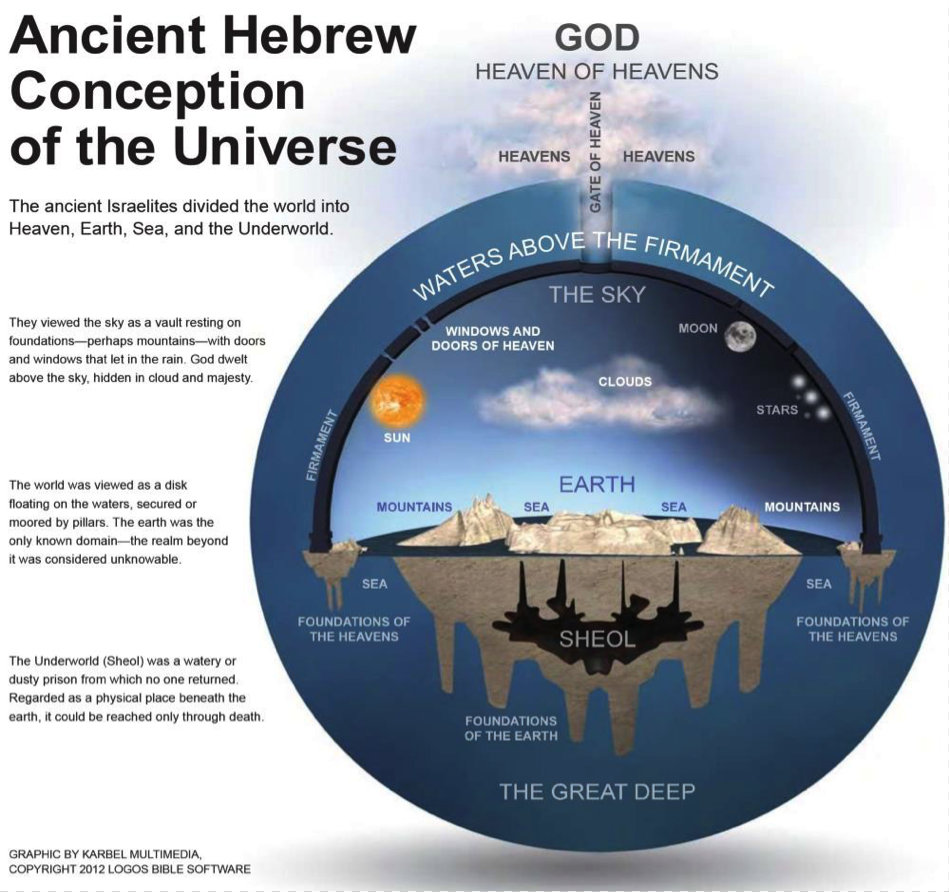
Some claim that Genesis 1 describes the creation of the universe and yet an examination of the text reveals that the author doesn't have any concept of planets other than the earth. Beyond that, the author doesn't even understand that the earth is a planet. This is an example of Ancient Hebrew concept of cosmology:


Image

Why do some claim that Genesis 1 describes the universe when the author shows no knowledge of our solar system much less the universe?


Tcg
To be clear: Atheism is not a disbelief in gods or a denial of gods; it is a lack of belief in gods.

- American Atheists


Not believing isn't the same as believing not.

- wiploc


I must assume that knowing is better than not knowing, venturing than not venturing; and that magic and illusion, however rich, however alluring, ultimately weaken the human spirit.

- Irvin D. Yalom

User avatar
theophile
Guru
Posts: 1666
Joined: Fri Jun 03, 2016 7:09 pm
Has thanked: 80 times
Been thanked: 136 times

Re: Does Genesis 1 describe the Universe?

Post #41

Post by theophile »

TRANSPONDER wrote: Thu Nov 11, 2021 7:42 pm
theophile wrote: Thu Nov 11, 2021 4:15 pm
1213 wrote: Thu Nov 11, 2021 12:43 pm I think that shows nicely how the whole image is basically a straw man argument against the Bible... For example the circumferential sea claim ...
I hear your point, but I actually don't mind the circumferential sea (the quality of the references aside). I prefer the original diagram though that labelled it "the deep," which is an explicit Gen 1 reference. It's like the area outside a known map labelled "here be dragons." (Quite literally even if we equate the deep to other creation myths like the Enuma Elish with its dragon sea goddess Tiamat.)

Also, I think there's an interesting parallel in Gen 2. The deep surrounding the heavens and earth in Gen 1 is like the wilderness surrounding the garden of Eden in Gen 2. That said, I do think it is implied in both cases that the central area is meant to expand, and over time encompass / fill the surrounding abyss.

Anyways, food for thought.

I would agree that Eden itself is a limited area and the humans will eventually expand into it, though the land area itself (geography given in Gen 2. 10-14) will not expand. I also agree that the 'circle of the earth' was seen as being ringed by mountains holding back the outer waters (a view that was shown in the portolan maps on the medieval period until circumnavigating the globe showed this view to be false.
This however only goes to show that the Babylonians snow -dome cosmos illustrated in the posted diagrams and which makes sense of the cosmos described in Genesis and in fact the rest of the Bible, is not the actuality.
I'm agreeable if you want to characterize what Gen 1 describes as a snow-dome. But to be clear, I think that inside the snow-dome is God's creation, i.e., the heavens and the earth that God explicitly creates in Gen 1:1. The dome itself would represent the (moveable) boundary between creation and non-creation, or known and unknown space (to bring back the cartography analogy). Outside the snow-dome is what I keep calling "the deep" per Gen 1, i.e., a sea-like abyss that surrounds creation, and that God is clearly positioned against in Gen 1:2.

I believe your view implies that God has full knowledge of it all (i.e., not just creation but every inch of the deep as well) and that therefore this represents the full - and patently false - biblical view of the cosmos. I don't think that's justified anywhere in the text (or please point out the verse that says God has full knowledge of it all).

My view is that while God may know the heavens and the earth that God creates in Gen 1 (but even this isn't made explicit), the deep / abyss surrounding it is full of mystery (to God included). Again, God is positioned against it in Gen 1:2. As such, i.e., as an unknown space, it can contain all the galaxies, stars, black holes, planets, multiverses, and whatever else we want to pack in there. It is truly a "here be dragons" kind of space. To God included.

Hence why we shouldn't criticize Gen 1 for not giving us a complete and accurate view of the cosmos.

But again, the goal is for the dome to expand, and for God to eventually know all and become all in all at the end (see 1 Corinthians 15:28). But that is at the end, not the beginning. When Gen 1 wraps, creation is still in its initial stages, and God's knowledge (and power) is limited.
Last edited by theophile on Fri Nov 12, 2021 10:58 am, edited 1 time in total.

User avatar
theophile
Guru
Posts: 1666
Joined: Fri Jun 03, 2016 7:09 pm
Has thanked: 80 times
Been thanked: 136 times

Re: Does Genesis 1 describe the Universe?

Post #42

Post by theophile »

Miles wrote: Thu Nov 11, 2021 5:53 pm
theophile wrote: Thu Nov 11, 2021 4:19 pm What about all the components of the diagram without a Gen 1 reference? Only three components have coverage.
Only three? Boy I count quite a few
You're adding things to the diagram. If you want to make updates to it, like drawing in grass and little fruit trees, go ahead. But I'm referencing the diagram as given. I was also referencing the diagram that had actual references on it, which is different from the one you posted.

Last, you're not mentioning at all the items that have no reference. So we can squabble over the details, but there are some major components here that have no basis in Gen 1. Like, the "Heaven of Heavens," "Gate to Heaven" and "Sheol."

Where are all those in Gen 1?
Miles wrote: Thu Nov 11, 2021 5:53 pm
To your last point, I've said multiple times that I don't think Gen 1 describes the universe.
Then exactly what do you think it's describing? It's got stars, the most distant known objects at the time! So if this isn't a depiction of the universe then just what does it depict?
Per earlier posts, I think the goal is more to show us what kind of god God is. It's not to relate the biblical view of the universe but to distinguish God from contemporaries (like the gods in the Enuma Elish, which Gen 1 has strong references to). Related to this, it describes our role on the earth (being made in the image of God and called in the text to keep doing what God shows us).

So to Noose's recent point, it's more about describing the role of humankind, which then sets up the rest of the bible where we fail in that role and need to restore ourselves, the earth, and ultimately the universe to the original plan.
Miles wrote: Thu Nov 11, 2021 5:53 pm
It is not a science text. So why would I try to show what I don't think is true?
Well it isn't a history text either, but many people treat it as such. Taking as historical truth the accounts of a guy who long ago raised people from the dead, cured people of major illnesses, turned water into wine, and could walk on water.
I'm not sure what your point is here. Did I say it was a history text? It has some elements of history - like a very loosely based version of. (Just as you could argue it very loosely touches on science.)

Per earlier posts (perhaps on other threads), I think it would be more suitably treated as philosophy as a broad catch-all. Crossing ethics, politics, economics, etc.
Miles wrote: Thu Nov 11, 2021 5:53 pm
Instead I've tried to open your eyes to the idea that maybe, just maybe, there are other truths being conveyed by Gen 1.
And what would these truths be?
It conveys how we should comport ourselves to make the earth a place where life can prosper. (Hence ethics, politics, and economics.)

It's core truth, I would argue, is in the linkage between the action God demonstrates (and calls us to model) with the rest and prosperity (i.e., goodness) that comes from it.

Although this over simplifies, it is basically the argument that IF we keep doing what God shows us, THEN the world will be a happy, wonderful place where we all live happily ever after. So if we want to critique Gen 1 we should do so on that front (IMO).

User avatar
William
Savant
Posts: 16436
Joined: Tue Jul 31, 2012 8:11 pm
Location: Te Waipounamu
Has thanked: 1036 times
Been thanked: 1948 times
Contact:

Re: Does Genesis 1 describe the Universe?

Post #43

Post by William »

[Replying to TRANSPONDER in post #39]
Am I getting the suggestion that the writers of Genesis knew it wasn't true but they gave a false (Babylonian -style) creation and cosmos because they though nobody would believe it otherwise? Or am I misunderstanding you?
My understanding is that The Creator cannot be imaged because as soon as one does so, the image will be false.

If the author of Genesis shows no knowledge of the cosmos then it has to be because the author had no knowledge of the cosmos.

Ancient fireside stories which have been frozen in time through print and claims of being the word of god, and are no longer living documents because of that, will always eventual suffer the fate of not keeping up with the living...

TRANSPONDER
Banned
Banned
Posts: 9237
Joined: Thu Apr 29, 2021 8:05 am
Has thanked: 1080 times
Been thanked: 3983 times

Re: Does Genesis 1 describe the Universe?

Post #44

Post by TRANSPONDER »

theophile wrote: Fri Nov 12, 2021 9:46 am
TRANSPONDER wrote: Thu Nov 11, 2021 7:42 pm
theophile wrote: Thu Nov 11, 2021 4:15 pm
1213 wrote: Thu Nov 11, 2021 12:43 pm I think that shows nicely how the whole image is basically a straw man argument against the Bible... For example the circumferential sea claim ...
I hear your point, but I actually don't mind the circumferential sea (the quality of the references aside). I prefer the original diagram though that labelled it "the deep," which is an explicit Gen 1 reference. It's like the area outside a known map labelled "here be dragons." (Quite literally even if we equate the deep to other creation myths like the Enuma Elish with its dragon sea goddess Tiamat.)

Also, I think there's an interesting parallel in Gen 2. The deep surrounding the heavens and earth in Gen 1 is like the wilderness surrounding the garden of Eden in Gen 2. That said, I do think it is implied in both cases that the central area is meant to expand, and over time encompass / fill the surrounding abyss.

Anyways, food for thought.

I would agree that Eden itself is a limited area and the humans will eventually expand into it, though the land area itself (geography given in Gen 2. 10-14) will not expand. I also agree that the 'circle of the earth' was seen as being ringed by mountains holding back the outer waters (a view that was shown in the portolan maps on the medieval period until circumnavigating the globe showed this view to be false.
This however only goes to show that the Babylonians snow -dome cosmos illustrated in the posted diagrams and which makes sense of the cosmos described in Genesis and in fact the rest of the Bible, is not the actuality.
I'm agreeable if you want to characterize what Gen 1 describes as a snow-dome. But to be clear, I think that inside the snow-dome is God's creation, i.e., the heavens and the earth that God explicitly creates in Gen 1:1. The dome itself would represent the (moveable) boundary between creation and non-creation, or known and unknown space (to bring back the cartography analogy). Outside the snow-dome is what I keep calling "the deep" per Gen 1, i.e., a sea-like abyss that surrounds creation, and that God is clearly positioned against in Gen 1:2.

I believe your view implies that God has full knowledge of it all (i.e., not just creation but every inch of the deep as well) and that therefore this represents the full - and patently false - biblical view of the cosmos. I don't think that's justified anywhere in the text (or please point out the verse that says God has full knowledge of it all).

My view is that while God may know the heavens and the earth that God creates in Gen 1 (but even this isn't made explicit), the deep / abyss surrounding it is full of mystery (to God included). Again, God is positioned against it in Gen 1:2. As such, i.e., as an unknown space, it can contain all the galaxies, stars, black holes, planets, multiverses, and whatever else we want to pack in there. It is truly a "here be dragons" kind of space. To God included.

Hence why we shouldn't criticize Gen 1 for not giving us a complete and accurate view of the cosmos.

But again, the goal is for the dome to expand, and for God to eventually know all and become all in all at the end (see 1 Corinthians 15:28). But that is at the end, not the beginning. When Gen 1 wraps, creation is still in its initial stages, and God's knowledge (and power) is limited.

What? Another one who doesn't think that God knows everything? Not even the working of the cosmos He created? I suppose it's a viewpoint that might explain a few things, but in fat I think it has no merit - rather like the 'natural explanations' of the Flood, the star, darkness at Noon and miracle healings, which while validating the Bible would invalidate Jesusgod. Because the Better hypothesis is that it is an invented creation -scenario based on Mesopotamian originals (which read very similarly and are evidently wrong) and the sun created (it says) after there was daylight (morning and evening). There have been so many excuses for this passage. 'Light' is mrtaphorical can be dismissed out of hand. 'Metaphorically true' means: 'Not true at all'. The 'cloud cover' excuse doesn't work because that is only how it would look to someone on earth and nobody was. It has to be a vision or information put into Moses' (or whoever) head by God and God Should know that the sun was made to produce the daylight and daylight couldn't be there before the sun.

Ok we can 'make stuff up' God switched sourceless light on and off before making the sun. Which makes no sense - why not tell the truth rather than a swindle to make a lie work? Not tell the truth because nobody would be believe it? Why not? Even I could write a Genesis that would mach the science without causing Bronze age Canaanites to toss it in the bin. And just think how the believers would crow when science validated what no man could have known when it was written? (1) Instead we are stuck with what nobody knew was rubbish when it was written.

But now we do and frankly none of the excuses to try to make Genesis 'True' are good enough. The choice is simple, either become Christian evolutionists (apparently there are some of these in America, probably hiding in Safe Houses praying that nobody come shouting death -threats through he letter -box) or be a science denialist Genesis -literalist and not know that you are deluded because everyone around you is deluded, too.

(1) this is the rebuttal to the slavery excuse - 'God couldn't command the Hebrews not to have slaves - even though they'd already seen how bad it was'. Just think if 'Though shalt not own another person as property' was in there? And if the Jews actually did own people as property (foreign slaves? They aren't really 'persons' are they?) how well that would segue (word of the year :D ) into Jesus denouncing the teachers of the Law for not keeping it.. Yet again (to quote Theramin trees in 'Losing Faith' ... mustwatch video) 'I could do better than this'.

User avatar
William
Savant
Posts: 16436
Joined: Tue Jul 31, 2012 8:11 pm
Location: Te Waipounamu
Has thanked: 1036 times
Been thanked: 1948 times
Contact:

Re: Does Genesis 1 describe the Universe?

Post #45

Post by William »

Given that fireside stories could only be told on the basis of whatever was experienced by ancient humans, there appears no need to bemoan the lack of detail in the details.

What does it prove that the ancients did not have the knowledge we all have about the cosmos? Does it somehow prove we are not existing within a creation?

User avatar
theophile
Guru
Posts: 1666
Joined: Fri Jun 03, 2016 7:09 pm
Has thanked: 80 times
Been thanked: 136 times

Re: Does Genesis 1 describe the Universe?

Post #46

Post by theophile »

TRANSPONDER wrote: Fri Nov 12, 2021 12:34 pm What? Another one who doesn't think that God knows everything? Not even the working of the cosmos He created? I suppose it's a viewpoint that might explain a few things, but in fat I think it has no merit - rather like the 'natural explanations' of the Flood, the star, darkness at Noon and miracle healings, which while validating the Bible would invalidate Jesusgod. Because the Better hypothesis is that it is an invented creation -scenario based on Mesopotamian originals ...

Again, where in Gen 1 does it say God knows everything? The answer is nowhere. You can't just add things to the text that aren't there, and then proclaim yourself to be right.

If you want a broader argument on God's omniscience, just look to all the times God changes in the bible. Would an all-knowing God change course, or regret an action, or knowingly set the whole thing up to fail? It's ridiculous. It's not the biblical view but rather Greek influence (as I believe we've discussed before, but perhaps was someone else).

User avatar
historia
Prodigy
Posts: 3009
Joined: Wed May 04, 2011 6:41 pm
Has thanked: 297 times
Been thanked: 467 times

Re: Does Genesis 1 describe the Universe?

Post #47

Post by historia »

Tcg wrote: Mon Nov 08, 2021 2:42 pm
Why do some claim that Genesis 1 describes the universe when the author shows no knowledge of our solar system much less the universe?
Because Christian fundamentalism is a thoroughly modernist form of religion. It developed in an age that highly valued science, and so it assumes that for biblical accounts to be "true" they must necessarily be historically and scientifically accurate.

User avatar
Miles
Savant
Posts: 5179
Joined: Fri Aug 28, 2009 4:19 pm
Has thanked: 434 times
Been thanked: 1618 times

Re: Does Genesis 1 describe the Universe?

Post #48

Post by Miles »

theophile wrote: Fri Nov 12, 2021 10:34 am
Miles wrote: Thu Nov 11, 2021 5:53 pm
theophile wrote: Thu Nov 11, 2021 4:19 pm What about all the components of the diagram without a Gen 1 reference? Only three components have coverage.
Only three? Boy I count quite a few
You're adding things to the diagram. If you want to make updates to it, like drawing in grass and little fruit trees, go ahead. But I'm referencing the diagram as given. I was also referencing the diagram that had actual references on it, which is different from the one you posted.
Other than adding the green to denote the vegetation mentioned in Genesis 1:11-12, exactly what is it I added to the diagram?


.

User avatar
brunumb
Savant
Posts: 6048
Joined: Thu Nov 02, 2017 4:20 am
Location: Melbourne
Has thanked: 6925 times
Been thanked: 3244 times

Re: Does Genesis 1 describe the Universe?

Post #49

Post by brunumb »

theophile wrote: Fri Nov 12, 2021 10:34 am It conveys how we should comport ourselves to make the earth a place where life can prosper. (Hence ethics, politics, and economics.)

It's core truth, I would argue, is in the linkage between the action God demonstrates (and calls us to model) with the rest and prosperity (i.e., goodness) that comes from it.

Although this over simplifies, it is basically the argument that IF we keep doing what God shows us, THEN the world will be a happy, wonderful place where we all live happily ever after. So if we want to critique Gen 1 we should do so on that front (IMO).
How on earth do you get all of that from Genesis 1? Perhaps you could quote specific passages to illustrate what you are claiming.
George Orwell:: “The further a society drifts from the truth, the more it will hate those who speak it.”
Voltaire: "Those who can make you believe absurdities can make you commit atrocities."
Gender ideology is anti-science, anti truth.

User avatar
Tcg
Savant
Posts: 8728
Joined: Tue Nov 21, 2017 5:01 am
Location: Third Stone
Has thanked: 2279 times
Been thanked: 2408 times

Re: Does Genesis 1 describe the Universe?

Post #50

Post by Tcg »

historia wrote: Fri Nov 12, 2021 1:35 pm
Tcg wrote: Mon Nov 08, 2021 2:42 pm
Why do some claim that Genesis 1 describes the universe when the author shows no knowledge of our solar system much less the universe?
Because Christian fundamentalism is a thoroughly modernist form of religion. It developed in an age that highly valued science, and so it assumes that for biblical accounts to be "true" they must necessarily be historically and scientifically accurate.
This is an interesting point. It's difficult to determine whether or not fundamentalists are the only ones who take this approach, but certainly it is a hallmark of Christian fundamentalism. Would you say then that Genesis 1 was not intended to be historically and scientifically accurate and therefore it does not describe the universe at least not in any literal sense? I'm not trying to put words in your mouth, but rather attempting to understand your position.


Tcg
To be clear: Atheism is not a disbelief in gods or a denial of gods; it is a lack of belief in gods.

- American Atheists


Not believing isn't the same as believing not.

- wiploc


I must assume that knowing is better than not knowing, venturing than not venturing; and that magic and illusion, however rich, however alluring, ultimately weaken the human spirit.

- Irvin D. Yalom

Post Reply