
Could we have made different choices than the ones we actually made?
Moderator: Moderators
-
Compassionist
- Guru
- Posts: 1524
- Joined: Tue Feb 19, 2008 5:56 pm
- Has thanked: 1070 times
- Been thanked: 252 times
Could we have made different choices than the ones we actually made?
Post #1Could we have made different choices than the ones we actually made? By "we" I mean all living things. For example, I have a potted plant that has tilted westward by twenty degrees. Could the plant have refrained from tilting or tilted at a different direction by a different degree or was it inevitable that it tilted westward by twenty degrees? I ate porridge for breakfast today. Could I have eaten something else or was eating porridge for breakfast inevitable? Nelson Mandela died on 14 June 1999. Was his death on that date inevitable or could he have died at a younger or older age? Albert Einstein was a physicist. Could he have been a professional football player instead of a physicist or was his choice of career inevitable? In your response, please explain how you know what you know.
-
Compassionist
- Guru
- Posts: 1524
- Joined: Tue Feb 19, 2008 5:56 pm
- Has thanked: 1070 times
- Been thanked: 252 times
-
William

- Savant
- Posts: 16490
- Joined: Tue Jul 31, 2012 8:11 pm
- Location: Te Waipounamu
- Has thanked: 1037 times
- Been thanked: 1950 times
- Contact:
Re: Could we have made different choices than the ones we actually made?
Post #92[Replying to The Tanager in post #90]
Hi Tanager
I thought I might repost this again now that you and Compassionist have reached an impasse with your respective arguments. Perhaps you now might have time to look into this.
Cheers
W
Hi Tanager
I thought I might repost this again now that you and Compassionist have reached an impasse with your respective arguments. Perhaps you now might have time to look into this.
Cheers
W
William wrote: ↑Fri Jan 30, 2026 1:03 pm [Replying to The Tanager in post #79]
Coherent Causality
and the Rehabilitation of Free Will
Core Insight
Libertarian free will fails only if agency must be either causeless magic or random indeterminacy. The Coherent Causality Argument (CCA) dissolves this false dilemma by reframing agency as a natural, law-like capacity grounded in a causally coherent source reality.

The question has never been whether God is speaking. The question has always been whether there is anyone listening - anyone who has stopped hiding long enough to hear.
-
The Tanager

- Savant
- Posts: 6239
- Joined: Wed May 06, 2015 11:08 am
- Has thanked: 90 times
- Been thanked: 275 times
Re: Could we have made different choices than the ones we actually made?
Post #93[Replying to William in post #92]
Sure, William. Here are my initial thoughts on your Coherent Causality Argument.
1. I don’t think your terms are defined clearly or accurately.
In P5 ‘natural’ means “being coherent, consistent, and conceptually describableâ€. I put that definition into chatgpt to see what word it thought you were defining and it gave back ‘intelligibility’ not anything close to ‘natural’. In your conclusion ‘natural’ means “operating within some consistent framework of cause and effect, even if outside our observable universeâ€. Chatgpt thought you were defining ‘nomological’ here, not anything close to ‘natural’. A supernatural cause would be ‘natural’ under these definitions, which shows that they aren’t good definitions to use for ‘natural’ since supernatural is defined against ‘natural’.
Your definition of ‘supernatural’ is not standard in philosophical discourse whatsoever. ‘Supernatural’ means beyond scientific understanding and outside physical laws (by definition of science).
‘Natural’ is traditionally used to mean something like “that which exists within the spatiotemporal universe and operates according to its physical lawsâ€. And ‘supernatural’ means “that which exists outside of/independently of/beyond the spatiotemporal universeâ€
2. I also don’t think C1 follows from P1 and P2. You’d need an extra premise that says that the universe is something that begins to exist within nature. Following from (1) above, I don’t think that extra premise would be true because the universe is just a way to talk about all of nature, not something existing within some broader thing called ‘nature’.
Sure, William. Here are my initial thoughts on your Coherent Causality Argument.
1. I don’t think your terms are defined clearly or accurately.
In P5 ‘natural’ means “being coherent, consistent, and conceptually describableâ€. I put that definition into chatgpt to see what word it thought you were defining and it gave back ‘intelligibility’ not anything close to ‘natural’. In your conclusion ‘natural’ means “operating within some consistent framework of cause and effect, even if outside our observable universeâ€. Chatgpt thought you were defining ‘nomological’ here, not anything close to ‘natural’. A supernatural cause would be ‘natural’ under these definitions, which shows that they aren’t good definitions to use for ‘natural’ since supernatural is defined against ‘natural’.
Your definition of ‘supernatural’ is not standard in philosophical discourse whatsoever. ‘Supernatural’ means beyond scientific understanding and outside physical laws (by definition of science).
‘Natural’ is traditionally used to mean something like “that which exists within the spatiotemporal universe and operates according to its physical lawsâ€. And ‘supernatural’ means “that which exists outside of/independently of/beyond the spatiotemporal universeâ€
2. I also don’t think C1 follows from P1 and P2. You’d need an extra premise that says that the universe is something that begins to exist within nature. Following from (1) above, I don’t think that extra premise would be true because the universe is just a way to talk about all of nature, not something existing within some broader thing called ‘nature’.
-
William
- Savant
- Posts: 16490
- Joined: Tue Jul 31, 2012 8:11 pm
- Location: Te Waipounamu
- Has thanked: 1037 times
- Been thanked: 1950 times
- Contact:
Re: Could we have made different choices than the ones we actually made?
Post #94[Replying to The Tanager in post #93]
Thanks for that Tanager
My Reply to you is in the The Coherent Causality Argument thread.
Cheers
W
Thanks for that Tanager
My Reply to you is in the The Coherent Causality Argument thread.
Cheers
W
The question has never been whether God is speaking. The question has always been whether there is anyone listening - anyone who has stopped hiding long enough to hear.
-
Kylie
- Scholar
- Posts: 289
- Joined: Thu Jun 04, 2020 2:19 am
- Has thanked: 23 times
- Been thanked: 72 times
Re: Could we have made different choices than the ones we actually made?
Post #95I don't see what this has to do with my question.Compassionist wrote: ↑Thu Jan 29, 2026 8:45 am [Replying to Kylie in post #77]
Miles didn't reply, so I did. Do you agree or disagree? Please explain the basis of your agreement or disagreement. I created the GENE (genes, environments, nutrients and experiences) model many years ago. It was not created by ChatGPT or any other Large Language Model. Please look at the infographic below:
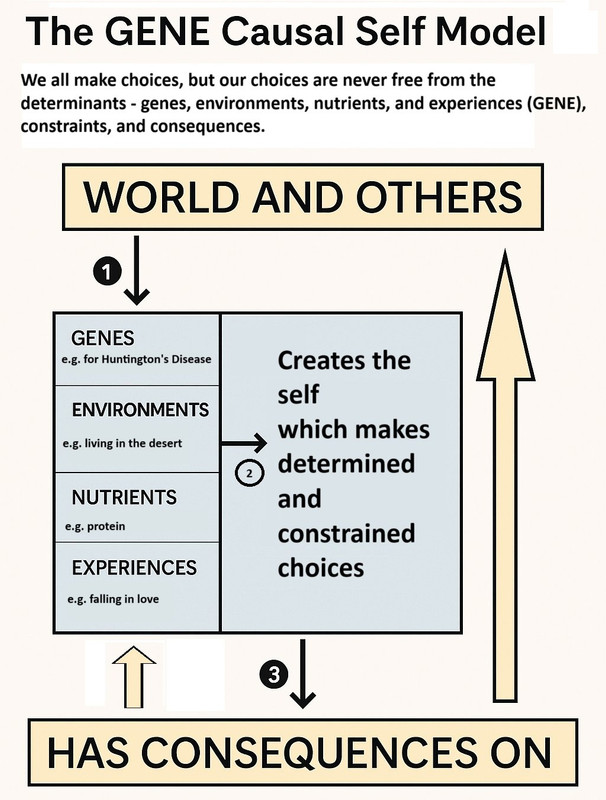
Should people be held responsible for their actions?
If a person punches another person, should the puncher be punished? Miles claimed that no one chooses anything and that all events are predetermined. So the puncher had no way of not throwing the punch.
Your model doesn't address that issue at all.
Honestly, it looks like you are just trying to change the subject because you have something you want to talk about, and you're trying to push it into conversations that are about other things. Please don't.
-
Compassionist
- Guru
- Posts: 1524
- Joined: Tue Feb 19, 2008 5:56 pm
- Has thanked: 1070 times
- Been thanked: 252 times
Re: Could we have made different choices than the ones we actually made?
Post #96[Replying to Kylie in post #95]
The GENE model (Genes, Environments, Nutrients, Experiences) is not a distraction from responsibility. It is an explanation of how actions arise.
Before we can answer whether someone should be held responsible, we must understand what produces behaviour in the first place.
If behaviour emerges from causal factors (biology, upbringing, trauma, brain chemistry, social context, etc.), then responsibility cannot mean “uncaused self-origination.†It must mean something else.
That is precisely the issue under discussion.
1. Retributive punishment (“they deserve suffering because they freely chose evilâ€)
2. Protective and corrective response (“we must prevent further harm by modifying behaviourâ€)
Under the GENE model:
• The punch was caused.
• The person did not self-create their genes.
• They did not self-create their upbringing.
• They did not self-create their neurochemistry.
• They did not self-create the triggering circumstances.
However, none of that implies society should do nothing.
If someone punches another person:
• The victim deserves protection.
• Potential future victims deserve safety.
• The aggressor may require containment.
• The aggressor may require rehabilitation.
• Deterrence may be necessary.
Responsibility becomes pragmatic rather than metaphysical.
We hold people responsible in the sense that they are the causal locus of the behaviour — not in the sense that they are an uncaused cause.
Determinism does not eliminate choice. It explains choice.
A choice is a brain-level decision process shaped by:
• Genetic temperament
• Learned associations
• Emotional state
• Current stimuli
• Prior reinforcement history
The puncher “chose†to punch in the same way a thermostat “chooses†to activate heating — through a causal decision mechanism.
The fact that the mechanism is caused does not mean it does not operate.
The relevant question is not “could they have done otherwise in an absolute metaphysical sense?†The answer to that question is "No, they could not have done otherwise unless the determinants (i.e. genes, environments, nutrients, and experiences) were changed. If the determinants remained the same, they would have made the same choices."
The relevant question is:
What conditions reduce the probability of punching in the future?
That is where moral systems operate.
In fact, it clarifies it. Culpability depends on capacity. The greater the capacity, the greater the culpability.
The model implies a Responsibility Gradient:
• The greater the cognitive capacity
• The greater the impulse control
• The greater the awareness of consequences
• The greater the access to alternative behavioural strategies
— the greater the practical responsibility.
This explains why:
• We treat children differently from adults.
• We treat brain-injured individuals differently.
• We treat people with severe mental illness differently.
• We consider mitigating circumstances in sentencing.
If behaviour were uncaused and purely free, mitigation would make no sense.
But it clearly does.
That reality is exactly what the GENE model formalizes.
The subject is responsibility.
Responsibility depends on what produces action.
If you assume libertarian free will (uncaused choice), then punishment is justified as moral desert.
If you accept causal determination, then punishment must be justified in terms of:
• Harm prevention
• Rehabilitation
• Deterrence
• Social protection
Those are radically different foundations.
The GENE model is relevant because it explains:
Why behaviour varies.
Why some people are more dangerous than others.
Why rehabilitation works in some cases.
Why deterrence works in some cases.
Why pure retribution is incoherent under causal realism.
If someone believes people are self-causing agents, they should defend that claim.
If someone believes behaviour arises from biology and experience, then responsibility must be reframed.
That is not a subject change.
That is going to the root of the issue.
A person with severe intellectual disability cannot deliberate like a neurotypical adult.
A person in psychosis cannot evaluate evidence normally.
A sleep-deprived brain makes worse decisions.
A hypoglycemic brain makes worse decisions.
Freedom is not binary. It varies with capacity.
Genes are foundational for all biological organisms. For example, if you behead a planarian flatworm, he or she will grow his or her head back and will stay alive. If you behead a human, he or she will not grow his or her head back and will die. This is because our desires and capacities are both determined and constrained by our genes, environments, nutrients, and experiences. I desire to go back in time and prevent all suffering, injustice, and death and make all living things forever happy. However, I lack the capacity to do this.
To summarize clearly:
Yes, people should be held responsible - not because they are metaphysically ultimately responsible, but because we need to protect potential future victims from harm.
But responsibility is not metaphysical blame.
It is calibrated social response to prevent harm and improve outcomes.
The puncher did not create themselves. He or she didn't choose their genes, all of their environments, all of their nutrients, and all of their experiences.
But they are still the causal source of the punch.
Society is justified in intervening.
Not because they “deserve suffering.â€
But because protection, deterrence, and rehabilitation matter.
That is exactly what the GENE model explains.
It has everything to do with your question.I don't see what this has to do with my question.
Should people be held responsible for their actions?
The GENE model (Genes, Environments, Nutrients, Experiences) is not a distraction from responsibility. It is an explanation of how actions arise.
Before we can answer whether someone should be held responsible, we must understand what produces behaviour in the first place.
If behaviour emerges from causal factors (biology, upbringing, trauma, brain chemistry, social context, etc.), then responsibility cannot mean “uncaused self-origination.†It must mean something else.
That is precisely the issue under discussion.
We need to distinguish between two very different concepts:If a person punches another person, should the puncher be punished?
1. Retributive punishment (“they deserve suffering because they freely chose evilâ€)
2. Protective and corrective response (“we must prevent further harm by modifying behaviourâ€)
Under the GENE model:
• The punch was caused.
• The person did not self-create their genes.
• They did not self-create their upbringing.
• They did not self-create their neurochemistry.
• They did not self-create the triggering circumstances.
However, none of that implies society should do nothing.
If someone punches another person:
• The victim deserves protection.
• Potential future victims deserve safety.
• The aggressor may require containment.
• The aggressor may require rehabilitation.
• Deterrence may be necessary.
Responsibility becomes pragmatic rather than metaphysical.
We hold people responsible in the sense that they are the causal locus of the behaviour — not in the sense that they are an uncaused cause.
There is a misunderstanding here.Miles claimed that no one chooses anything and that all events are predetermined. So the puncher had no way of not throwing the punch.
Determinism does not eliminate choice. It explains choice.
A choice is a brain-level decision process shaped by:
• Genetic temperament
• Learned associations
• Emotional state
• Current stimuli
• Prior reinforcement history
The puncher “chose†to punch in the same way a thermostat “chooses†to activate heating — through a causal decision mechanism.
The fact that the mechanism is caused does not mean it does not operate.
The relevant question is not “could they have done otherwise in an absolute metaphysical sense?†The answer to that question is "No, they could not have done otherwise unless the determinants (i.e. genes, environments, nutrients, and experiences) were changed. If the determinants remained the same, they would have made the same choices."
The relevant question is:
What conditions reduce the probability of punching in the future?
That is where moral systems operate.
It addresses it directly.Your model doesn't address that issue at all.
In fact, it clarifies it. Culpability depends on capacity. The greater the capacity, the greater the culpability.
The model implies a Responsibility Gradient:
• The greater the cognitive capacity
• The greater the impulse control
• The greater the awareness of consequences
• The greater the access to alternative behavioural strategies
— the greater the practical responsibility.
This explains why:
• We treat children differently from adults.
• We treat brain-injured individuals differently.
• We treat people with severe mental illness differently.
• We consider mitigating circumstances in sentencing.
If behaviour were uncaused and purely free, mitigation would make no sense.
But it clearly does.
That reality is exactly what the GENE model formalizes.
I am not changing the subject.Honestly, it looks like you are just trying to change the subject because you have something you want to talk about, and you're trying to push it into conversations that are about other things. Please don't.
The subject is responsibility.
Responsibility depends on what produces action.
If you assume libertarian free will (uncaused choice), then punishment is justified as moral desert.
If you accept causal determination, then punishment must be justified in terms of:
• Harm prevention
• Rehabilitation
• Deterrence
• Social protection
Those are radically different foundations.
The GENE model is relevant because it explains:
Why behaviour varies.
Why some people are more dangerous than others.
Why rehabilitation works in some cases.
Why deterrence works in some cases.
Why pure retribution is incoherent under causal realism.
If someone believes people are self-causing agents, they should defend that claim.
If someone believes behaviour arises from biology and experience, then responsibility must be reframed.
That is not a subject change.
That is going to the root of the issue.
A person with severe intellectual disability cannot deliberate like a neurotypical adult.
A person in psychosis cannot evaluate evidence normally.
A sleep-deprived brain makes worse decisions.
A hypoglycemic brain makes worse decisions.
Freedom is not binary. It varies with capacity.
Genes are foundational for all biological organisms. For example, if you behead a planarian flatworm, he or she will grow his or her head back and will stay alive. If you behead a human, he or she will not grow his or her head back and will die. This is because our desires and capacities are both determined and constrained by our genes, environments, nutrients, and experiences. I desire to go back in time and prevent all suffering, injustice, and death and make all living things forever happy. However, I lack the capacity to do this.
To summarize clearly:
Yes, people should be held responsible - not because they are metaphysically ultimately responsible, but because we need to protect potential future victims from harm.
But responsibility is not metaphysical blame.
It is calibrated social response to prevent harm and improve outcomes.
The puncher did not create themselves. He or she didn't choose their genes, all of their environments, all of their nutrients, and all of their experiences.
But they are still the causal source of the punch.
Society is justified in intervening.
Not because they “deserve suffering.â€
But because protection, deterrence, and rehabilitation matter.
That is exactly what the GENE model explains.
-
William
- Savant
- Posts: 16490
- Joined: Tue Jul 31, 2012 8:11 pm
- Location: Te Waipounamu
- Has thanked: 1037 times
- Been thanked: 1950 times
- Contact:
Re: Could we have made different choices than the ones we actually made?
Post #97I think your diagramme show a certain type of self - one which remains at the surface level where environment dictates how an individual chooses to self-identify by deciding that the self they identify with is created by the environment they exist within including all those aspects mentioned in your diagramme:
Genes
Geography
Nutrients
Experiences
are all products of environment.
This does adequately explain such surface -level self-identifications but does not explain those who self identify outside of those restraints...for example, I have been watching a number of youtube videos published by Soft White Underbelly, which are focused upon interviewing a broad cross-section of individuals and often move from early childhood trauma into adulthood, how the individuals first reacted to the events in their unfolding life, how they initially reacted as your chart predicts BUT also how they transcended those prediction (environment shape self) and through their own CHOICE - shaped their SELF beyond what your chart predicts.
For example, the story of Nick Yarris - a Wrongfully Convicted Death Row Inmate
Placing the video transcript through AI LLS for summary, this:
Summary of Nick Yarris's Story
Part One: The Descent
Early Life and Trauma
Born in Southwest Philadelphia in 1961, raised in a working-class family
At age 7 (1968), was sexually assaulted by a violent older man in the woods near his home
Sustained severe head trauma from being hit with a rock, causing optic nerve damage and undiagnosed aphasia
Developed night terrors, self-harming behaviors, and began creating fantasy stories to cope
Started drinking at 10, became an alcoholic by 14, progressed to pills and methamphetamine
Criminal Justice Spiral
At 18, diagnosed with aphasia after being committed to a mental institution in Florida
Returned to Philadelphia, relapsed on meth, stole cars
December 4, 1981: Beaten by highway patrol after a car chase, received 86 stitches
December 19, 1981: Stopped by Officer Benjamin Wright in Chester, PA while high and in another stolen car
In a chaotic confrontation, Wright's gun discharged; Wright then falsely claimed Nick tried to kill him
The False Murder Charge
While awaiting trial, Nick saw a newspaper about a missing woman (Linda May Craig)
Desperate to escape a life sentence, he fabricated a story claiming knowledge of the murder
Police instead became convinced Nick was the killer, pressured him in interrogation, and set him up to be targeted in prison as an informant
A cellmate, Charles Catalino, falsely claimed Nick confessed to the murder
Nick was acquitted of attempting to murder Officer Wright (the jury saw through Wright's lies), but prosecutor Barry Gross then took over the murder case and sought the death penalty
Trial and Death Sentence
Given a rushed 3-day trial before a holiday weekend
Convicted based on the jailhouse confession and blood type evidence (B positive, which Nick shared with the actual killer)
Sentenced to death at age 21; the judge couldn't look him in the eye
Sent to Huntington State Prison, condemned by the UN for torture practices
Endured brutal conditions: Thorazine injections, sensory deprivation, regular beatings
Began self-educating using books from a deceased prisoner's cell
Discovered he had dyslexia and aphasia, developed coping mechanisms
Escape and Recapture
February 1985: Escaped from custody while being transported to court (where he was finally gaining legal ground)
Spent 25 days on the FBI's Most Wanted list
Disguised himself with help from strangers in New York, flew to Florida
Planned to commit suicide but chose to return and fight instead
The DNA Revolution
On death row, read about Sir Alec Jeffreys' invention of DNA fingerprinting
Became the first prisoner in America to seek DNA testing from Death Row (1988)
Spent 15 years fighting for access to evidence, which prosecutors repeatedly claimed was "destroyed" or tampered with
Part Two: The Fight and Freedom
The Long Battle for DNA Testing
Discovered that Dr. Muhammad Tahir still had preserved slides with visible spermatozoa
Prosecutors sent detectives to seize this evidence without a court order; it sat in a desk for three years
When finally tested, the slides had been deliberately degraded (attempted destruction of evidence)
Endured years of rejection from innocence projects and journalists
His mother's testimony helped locate the victim's clothes, which were then damaged in shipping
Lost his beloved Jackie after 9 years together—she couldn't continue the fight
Rock Bottom
Developed Hepatitis C from a prison dentist who infected multiple prisoners
Watched fellow inmates die horribly, mocked by medical staff
Interferon treatment for Hepatitis C was mishandled, causing kidney failure and temporary blindness
December 2002: Filed to waive appeals and requested execution
Vindication
The federal court ordered Dr. Edward Blake to perform remaining tests
February 2003: The killer's gloves—never tested, hidden from defense—yielded DNA from "Unknown Male #1"
July 2003: DNA from the gloves matched spermatozoa found on the victim's underwear
After 23 years on death row (1981-2004), Nick was proven innocent
His brother had died of a drug overdose the year before; his mother couldn't fully celebrate due to family crises
Release and Aftermath
January 16, 2004: Released at age 42
Prison administrators kept him in maximum security for 8 months after the DNA results, fearing he would seek revenge
Struggled with the transition: was "allergic" to human touch, didn't recognize his own face on television
Found that 19 years of freedom have been harder than death row—facing cruelty without the protection of prison walls
Now an author and advocate, focused on giving meaning to his experience
Hopes to leave a legacy of goodness for his daughter (16 at the time of this talk)
Core Message
"You define who you are in the aftermath" of suffering
"Never let anyone steal your kindness—it is what makes you uniquely who you are"
Though he was "tested," he was "not broken"
His journey: from a traumatized child, to a drug addict, to a condemned man, to a free man choosing goodness despite everything
The story is a testament to both the depths of systemic injustice and the resilience of the human spirit.
__________
My question is, how does your chart take into consideration such stories of rising above that surface level self your chart describes and why should we accept your belief that environmental factors alone predetermines choice re the argument that we could NOT have made choices other than the ones than the ones we actually made because "the environment" predetermines those choices?
Your chart describes a closed-loop system. Nick Yarris's life demonstrates an open system - one where the individual can, through conscious choice and sustained effort, reach back into the loop of cause and effect and begin to steer it.
His core message - "You define who you are in the aftermath" - is the direct antithesis of "the environment defines who you are." The aftermath is the environment. The act of defining is the self. The chart can map the aftermath, but it is blind to the definer.
Nick Yarris is not just a product of his environment; he is a producer of himself, a living argument that while we may start where we are placed, we do not have to end there. The choice to transcend is the most human thing of all.
The question has never been whether God is speaking. The question has always been whether there is anyone listening - anyone who has stopped hiding long enough to hear.
-
Compassionist
- Guru
- Posts: 1524
- Joined: Tue Feb 19, 2008 5:56 pm
- Has thanked: 1070 times
- Been thanked: 252 times
Re: Could we have made different choices than the ones we actually made?
Post #98[Replying to William in post #97]
Genes are not products of your personal environment. You do not choose your genome. Your parents do not choose it either. It is inherited biology shaped by evolutionary history. Genes are foundational for all biological organisms. For example, if you behead a planarian flatworm, he or she will grow his or her head back and will stay alive. If you behead a human, he or she will not grow his or her head back and will die. This is because our desires and capacities are both determined and constrained by our genes, environments, nutrients, and experiences. I desire to go back in time and prevent all suffering, injustice, and death and make all living things forever happy. However, I lack the capacity to do this.
Geography is environmental. Living on the moon is very different from living on Earth. Living in the desert is very different from living in New York.
Nutrients are your building blocks. If the zygote each human begins as does not receive any nutrients, it dies. Malnourished bodies and minds function worse than properly nourished bodies and minds. No biological organism can survive long-term without nutrients.
Experiences are what we experience through our sensors i.e. eyes, ears, nose, skin and tongue. Also, proprioception and interoception are counted among experiences.
The GENE model is not “environment only.†It is an interaction model with four types of variables: genes, environments, nutrients and experiences. Every type of variable plays a significant role in determining and constraining the choices of sentient biological organisms.
It is not surface-level sociology. It is a causal architecture. Our choices are never free from the causal architecture.
When someone transcends trauma, addiction, or early conditioning, that transcendence is itself caused.
Neuroplasticity is caused.
Insight is caused.
Motivation is caused.
Moral aspiration is caused.
Resilience is caused.
None of those float outside the system.
They are higher-order emergent processes within the system.
Nick Yarris is an extraordinary case of resilience and luck. He could have been killed a long time ago, but was not.
But resilience does not refute causation.
It demonstrates complexity.
Let’s look at his story through the GENE model:
• Severe trauma → neurological injury (head trauma, aphasia)
• Substance abuse → altered neurochemistry
• Brutal prison conditions → extreme stress adaptation
• Access to books → cognitive restructuring
• Discovery of dyslexia/aphasia → reframing identity
• Exposure to DNA science → strategic goal formation
• Support from certain individuals → reinforcement
• Becoming a father → motivational reorientation
Every pivot point in his transformation corresponds to causal inputs.
His “choice†to fight for DNA testing did not arise from nowhere.
It arose from:
– literacy gained through reading
– cognitive reorganization
– awareness of scientific possibility
– emotional investment in survival
– hatred of injustice
– future-oriented meaning-making
Those are causes.
The GENE model is not a closed static loop.
It is a dynamic feedback system.
When a person reflects, they generate new neural states.
Those neural states alter future decisions.
Those decisions alter future environments.
Those environments alter future neural states.
That is steering — but steering is causal.
A thermostat steers temperature.
A pilot steers a plane.
A driver steers a car.
A brain steers choices.
Steering does not require metaphysical freedom.
It requires feedback processing.
Nick Yarris did not step outside causation.
He was caused, and he used causation. This is exactly what the GENE model diagram shows.
The aftermath is environmental input.
“Defining who you are†is a cognitive reframing process.
Cognitive reframing is a neural computation.
Neural computation is shaped by prior structure and current input.
Meaning-making is causal.
The capacity to reinterpret trauma depends on:
• Cognitive capacity
• Emotional regulation
• Linguistic development
• Exposure to narratives
• Social reinforcement
• Brain health
Not everyone exposed to trauma becomes resilient.
Why?
Because genes differ.
Brain injuries differ.
Support systems differ.
Access to books differs.
Temperament differs.
If transcendence were uncaused, it would be random.
It is not random.
It clusters around identifiable predictors.
The brain is a biological system performing recursive self-modelling.
Self-definition is a meta-level computation:
The brain representing its own narrative identity.
That capacity itself varies by:
• Intelligence
• Executive function
• Trauma severity
• Education
• Neurodevelopment
• Neurochemical state
The “definer†is not outside the system.
It is the highest-order layer of the system.
It is not “environment alone.â€
It is:
Genes + Environments + Nutrients + Experiences → Brain State → Decision.
No one chooses their genes, all of their environments, all of their nutrients and all of their experiences.
No one chooses the laws of physics governing neural firing.
No one chooses the structure of dopamine reinforcement.
Given identical total conditions, the same outcome follows.
That is determinism.
But determinism does not mean immobility.
It means deterministic unfolding.
Nick Yarris’s transformation was deterministically produced by his genes, environments, nutrients and experiences.
That does not diminish it.
It makes it intelligible.
Now let’s address the deeper philosophical claim:
• Neurons
• Memory
• Language
• Emotion
• Motivation
• Reinforcement learning
He is self-modifying.
But self-modification is causally structured.
A system that can update itself is still a system.
The capacity to transcend is not supernatural freedom.
It is recursive neural plasticity.
The strongest evidence for determinism is not failure cases.
It is gradient cases.
We already adjust responsibility based on:
• Brain injury
• Childhood trauma
• Addiction
• Lead exposure
• Mental illness
• Intelligence
• Age
If the will were uncaused, mitigation would be irrelevant.
But mitigation matters.
That means we already implicitly accept causal influence.
GENE simply formalizes what criminal justice practice already assumes.
Nick Yarris’s story is inspiring.
But inspiration does not require metaphysical indeterminism.
It requires:
• Capacity for learning
• Capacity for reflection
• Capacity for delayed gratification
• Capacity for moral imagination
Those capacities are unevenly distributed.
That is exactly what the GENE model predicts.
Final clarification:
Determinism does not say:
“You cannot change.â€
It says:
“Change has causes.â€
Nick Yarris changed because causes accumulated in a way that made transformation possible.
His resilience is evidence of a complex, plastic, feedback-driven causal system.
Not evidence of causeless freedom.
The choice to transcend is not outside nature.
It is one of nature’s highest achievements.
This is incorrect.Genes
Geography
Nutrients
Experiences
are all products of environment.
Genes are not products of your personal environment. You do not choose your genome. Your parents do not choose it either. It is inherited biology shaped by evolutionary history. Genes are foundational for all biological organisms. For example, if you behead a planarian flatworm, he or she will grow his or her head back and will stay alive. If you behead a human, he or she will not grow his or her head back and will die. This is because our desires and capacities are both determined and constrained by our genes, environments, nutrients, and experiences. I desire to go back in time and prevent all suffering, injustice, and death and make all living things forever happy. However, I lack the capacity to do this.
Geography is environmental. Living on the moon is very different from living on Earth. Living in the desert is very different from living in New York.
Nutrients are your building blocks. If the zygote each human begins as does not receive any nutrients, it dies. Malnourished bodies and minds function worse than properly nourished bodies and minds. No biological organism can survive long-term without nutrients.
Experiences are what we experience through our sensors i.e. eyes, ears, nose, skin and tongue. Also, proprioception and interoception are counted among experiences.
The GENE model is not “environment only.†It is an interaction model with four types of variables: genes, environments, nutrients and experiences. Every type of variable plays a significant role in determining and constraining the choices of sentient biological organisms.
It is not surface-level sociology. It is a causal architecture. Our choices are never free from the causal architecture.
There is no such thing as identifying “outside†restraints.This does adequately explain such surface-level self-identifications but does not explain those who self identify outside of those restraints...
When someone transcends trauma, addiction, or early conditioning, that transcendence is itself caused.
Neuroplasticity is caused.
Insight is caused.
Motivation is caused.
Moral aspiration is caused.
Resilience is caused.
None of those float outside the system.
They are higher-order emergent processes within the system.
Nick Yarris is an extraordinary case of resilience and luck. He could have been killed a long time ago, but was not.
But resilience does not refute causation.
It demonstrates complexity.
Let’s look at his story through the GENE model:
• Severe trauma → neurological injury (head trauma, aphasia)
• Substance abuse → altered neurochemistry
• Brutal prison conditions → extreme stress adaptation
• Access to books → cognitive restructuring
• Discovery of dyslexia/aphasia → reframing identity
• Exposure to DNA science → strategic goal formation
• Support from certain individuals → reinforcement
• Becoming a father → motivational reorientation
Every pivot point in his transformation corresponds to causal inputs.
His “choice†to fight for DNA testing did not arise from nowhere.
It arose from:
– literacy gained through reading
– cognitive reorganization
– awareness of scientific possibility
– emotional investment in survival
– hatred of injustice
– future-oriented meaning-making
Those are causes.
This misunderstands feedback systems.Your chart describes a closed-loop system. Nick Yarris's life demonstrates an open system - one where the individual can, through conscious choice and sustained effort, reach back into the loop of cause and effect and begin to steer it.
The GENE model is not a closed static loop.
It is a dynamic feedback system.
When a person reflects, they generate new neural states.
Those neural states alter future decisions.
Those decisions alter future environments.
Those environments alter future neural states.
That is steering — but steering is causal.
A thermostat steers temperature.
A pilot steers a plane.
A driver steers a car.
A brain steers choices.
Steering does not require metaphysical freedom.
It requires feedback processing.
Nick Yarris did not step outside causation.
He was caused, and he used causation. This is exactly what the GENE model diagram shows.
It is not an antithesis."You define who you are in the aftermath" is the direct antithesis of "the environment defines who you are."
The aftermath is environmental input.
“Defining who you are†is a cognitive reframing process.
Cognitive reframing is a neural computation.
Neural computation is shaped by prior structure and current input.
Meaning-making is causal.
The capacity to reinterpret trauma depends on:
• Cognitive capacity
• Emotional regulation
• Linguistic development
• Exposure to narratives
• Social reinforcement
• Brain health
Not everyone exposed to trauma becomes resilient.
Why?
Because genes differ.
Brain injuries differ.
Support systems differ.
Access to books differs.
Temperament differs.
If transcendence were uncaused, it would be random.
It is not random.
It clusters around identifiable predictors.
The “definer†is the brain.The chart can map the aftermath, but it is blind to the definer.
The brain is a biological system performing recursive self-modelling.
Self-definition is a meta-level computation:
The brain representing its own narrative identity.
That capacity itself varies by:
• Intelligence
• Executive function
• Trauma severity
• Education
• Neurodevelopment
• Neurochemical state
The “definer†is not outside the system.
It is the highest-order layer of the system.
Again, this misrepresents the model.why should we accept your belief that environmental factors alone predetermine choice
It is not “environment alone.â€
It is:
Genes + Environments + Nutrients + Experiences → Brain State → Decision.
No one chooses their genes, all of their environments, all of their nutrients and all of their experiences.
No one chooses the laws of physics governing neural firing.
No one chooses the structure of dopamine reinforcement.
Given identical total conditions, the same outcome follows.
That is determinism.
But determinism does not mean immobility.
It means deterministic unfolding.
Nick Yarris’s transformation was deterministically produced by his genes, environments, nutrients and experiences.
That does not diminish it.
It makes it intelligible.
Now let’s address the deeper philosophical claim:
Every “self-producing†act is mediated by:Nick Yarris is not just a product of his environment; he is a producer of himself.
• Neurons
• Memory
• Language
• Emotion
• Motivation
• Reinforcement learning
He is self-modifying.
But self-modification is causally structured.
A system that can update itself is still a system.
The capacity to transcend is not supernatural freedom.
It is recursive neural plasticity.
The strongest evidence for determinism is not failure cases.
It is gradient cases.
We already adjust responsibility based on:
• Brain injury
• Childhood trauma
• Addiction
• Lead exposure
• Mental illness
• Intelligence
• Age
If the will were uncaused, mitigation would be irrelevant.
But mitigation matters.
That means we already implicitly accept causal influence.
GENE simply formalizes what criminal justice practice already assumes.
Nick Yarris’s story is inspiring.
But inspiration does not require metaphysical indeterminism.
It requires:
• Capacity for learning
• Capacity for reflection
• Capacity for delayed gratification
• Capacity for moral imagination
Those capacities are unevenly distributed.
That is exactly what the GENE model predicts.
Final clarification:
Determinism does not say:
“You cannot change.â€
It says:
“Change has causes.â€
Nick Yarris changed because causes accumulated in a way that made transformation possible.
His resilience is evidence of a complex, plastic, feedback-driven causal system.
Not evidence of causeless freedom.
The choice to transcend is not outside nature.
It is one of nature’s highest achievements.
-
Kylie
- Scholar
- Posts: 289
- Joined: Thu Jun 04, 2020 2:19 am
- Has thanked: 23 times
- Been thanked: 72 times
Re: Could we have made different choices than the ones we actually made?
Post #99This is a good start.Compassionist wrote: ↑Sat Feb 21, 2026 8:10 am Yes, people should be held responsible - not because they are metaphysically ultimately responsible, but because we need to protect potential future victims from harm.
I mean, honestly, I just needed a yes or a no.
-
William
- Savant
- Posts: 16490
- Joined: Tue Jul 31, 2012 8:11 pm
- Location: Te Waipounamu
- Has thanked: 1037 times
- Been thanked: 1950 times
- Contact:
Re: Could we have made different choices than the ones we actually made?
Post #100[Replying to Compassionist in post #98]
Just one quick correction before I respond to the substance: you wrote that I said genes are products of "personal environment." I didn't. I said genes, geography, nutrients, and experiences are all products of environment—full stop. No "personal" qualifier. Genes are environment too; they're just ancient environment encoded.
That clarification matters because it means we're not arguing about whether some things fall outside your model. I accept that on your terms, everything does. The GENE model is environmental all the way down.
Now to the heart of it.
You've offered a consistent causal framework where Nick Yarris's transformation—his resilience, his choice to forgive, his 15-year fight for DNA testing—is all caused. Every pivot corresponds to an input. I don't dispute that influences exist. Nick himself would credit the books, his mother, the DNA article.
But here's where we diverge.
Your model says: given identical conditions, he could not have done otherwise. His choices were inevitable.
Nick's own testimony says: "You define who you are in the aftermath." That sentence only makes sense if the aftermath—the causes, the inputs, the environment—is the arena, not the script. He believed he could have become a monster and chose not to.
You call that "recursive neural plasticity." He calls it "deciding who to be."
We're not debating facts. We're debating what kind of story this is. Your language describes the causal architecture. His language describes what it felt like to live inside it.
So no, it isn't an argument between supposed causeless and causal.
What this suggests is that some think they are solely the product of mechanics - environmental mechanisms, while others do indeed transcend that thinking and think of themselves in that manner. Whether it is simply natural/nature which provides that is not the issue. The issue seems to be that some will and some will not Transcend from understanding themselves purely at the mercy of mechanism. Arguing that some cannot does not mean that some WILL not.
Just one quick correction before I respond to the substance: you wrote that I said genes are products of "personal environment." I didn't. I said genes, geography, nutrients, and experiences are all products of environment—full stop. No "personal" qualifier. Genes are environment too; they're just ancient environment encoded.
That clarification matters because it means we're not arguing about whether some things fall outside your model. I accept that on your terms, everything does. The GENE model is environmental all the way down.
Now to the heart of it.
You've offered a consistent causal framework where Nick Yarris's transformation—his resilience, his choice to forgive, his 15-year fight for DNA testing—is all caused. Every pivot corresponds to an input. I don't dispute that influences exist. Nick himself would credit the books, his mother, the DNA article.
But here's where we diverge.
Your model says: given identical conditions, he could not have done otherwise. His choices were inevitable.
Nick's own testimony says: "You define who you are in the aftermath." That sentence only makes sense if the aftermath—the causes, the inputs, the environment—is the arena, not the script. He believed he could have become a monster and chose not to.
You call that "recursive neural plasticity." He calls it "deciding who to be."
We're not debating facts. We're debating what kind of story this is. Your language describes the causal architecture. His language describes what it felt like to live inside it.
So no, it isn't an argument between supposed causeless and causal.
What this suggests is that some think they are solely the product of mechanics - environmental mechanisms, while others do indeed transcend that thinking and think of themselves in that manner. Whether it is simply natural/nature which provides that is not the issue. The issue seems to be that some will and some will not Transcend from understanding themselves purely at the mercy of mechanism. Arguing that some cannot does not mean that some WILL not.
The question has never been whether God is speaking. The question has always been whether there is anyone listening - anyone who has stopped hiding long enough to hear.

